search expand

The new blog by the American Anthropological Association

The American Anthropological Association (AAA) has launched a new blog at http://blog.aaanet.org/ It combines their previous Anthropology News, Public Affairs and Human Rights blogs. All archived content and comments were migrated to the new location. The blog looks much better now and it is easier to stay updated.

The AAA writes:

We have created this blog as a service to our members and the general public. It is a forum to discuss topics of debate in anthropology and a space for public commentary on association policies, publications and advocacy issues. We will post select items that we think are of interest to our members and that readers have voiced an interest in. We invite all anthropologists to use this domain to stimulate intellectual discussion, and would be delighted to host guest bloggers who are active in any of anthropology’s four fields.

>> visit the AAA blog

The American Anthropological Association (AAA) has launched a new blog at http://blog.aaanet.org/ It combines their previous Anthropology News, Public Affairs and Human Rights blogs. All archived content and comments were migrated to the new location. The blog looks much better…

Read more

Imponderabilia – new international anthropology student journal

screenshot

Wow! A new anthropology journal! Made by students worldwide. Imponderabilia is it called, and it is “the product of our love of, and frustration with, anthropology”:

The journal tries to overcome, erode, undermine and blur the boundaries between institutions and disciplines, between theory and practice and between undergraduates and postgraduates. We envision a space where students can share their research and exchange their views, criticisms and reflections on anthropology through articles, interviews, photography and other creative methods.

Imponderabilia draws on the thoughts and insights of students from universities across the world; it represents a genuine dialogue between authors, editors and peer reviewers many of whom have been in contact during the process of planning, writing, and rewriting. Authorship therefore transcends university degrees and field sites and we hope the journal can develop into a platform for the sharing of our common, yet unique experiences of studying and ‘doing’ anthropology.

The first issue (spring 2009) consists of several dozens articles – there are interviews about visual and activist anthropology, text about activists and police at a Climate Camp, the significance of gossip, learning and teaching anthropology, and much more including poetry.

And the journal, based in Cambridge University (UK), exists both in a pdf version (even print?) and an “extended online version” – open access for all of us.

Imponderabilia, by the way means “a series of phenomena of great importance which cannot possibly be recorded by questioning or computing documents, but have to be observed in their full actuality” ( Malinowski 1922)

>> visit Imponderabilia (updated Link with copy from Internet Archive, journal closed down)

On their website I found two other student journals I haven’t mentioned before (local ones though): Abantu (University of Cape Town, South Africa) and Problematics (Stanford University, USA)

screenshot

Wow! A new anthropology journal! Made by students worldwide. Imponderabilia is it called, and it is "the product of our love of, and frustration with, anthropology":
The journal tries to overcome, erode, undermine and blur the boundaries between institutions and disciplines,…

Read more

Back from Lahore: Terror and Open Access

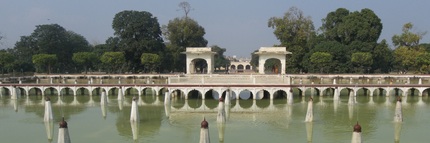
shalamar gardenShalamar Gardens, Lahore

I have been back from Lahore, Pakistan’s cultural center and “City of Poets”, for a while now. It was one of the most inspiring journeys I’ve been to.

Just a few weeks ago we’ve been at the same place where – a few days ago – six policemen were killed and several cricket players from Sri Lanka wounded in a terrorist attack. We were also constantly under police protection. Our hosts were very concerned for our safety.

I went to Lahore to document the conference “Covering Each Other In An Era Of Imagined Clashes Of Civilizations” (see summary in Norwegian), part of the Global Inter-Media Dialogue). Journalists and media researchers from Norway, Pakistan, Indonesia and Bangladesh participated.

Terrorism was one of the main topics during the whole stay – both during and outside the conference. Among other things, the impact of the so-called “war on terror” on global journalism was discussed. Being an journalist in conflict areas has become much more dangerous if you are not willing to let you embedd – and censor – by the military: Not only in Gaza, but also in Iraq and in Pakistan, journalists are hindered in doing their job.

Every Pakistani we met was worried about the “talibanisation” of Pakistan, but also about the drone attacks by the USA in the semi-autonomous “tribal areas” along the Afghan border. The drones are supposed to target Al-Qaida and Taliban terrorists, but mainly kill innocent children, men and women.

Before my departure I wrote about a Pakistani anthropologist who fights for young girls’ right to education in Taliban-controlled Swat in the North. In the same region, a few days ago, Taliban killed journalist Musa Khankhel, a colleague of one of the speakers at the conference, Hamid Mir. ‘He saved me, but I could not save him‘, Mir commented on rediff.com. One day before the recent attack in Lahore, Mir wrote the piece “Don’t create another Swat in Punjab“.

All these issues are debated in the newspapers, several of them are written in English as f.ex The News, Dawn, The Nation or Daily Times. They are of high quality, especially the opinion section where many academics contribute regularily with comments and analysis. Some of the interesting texts are Such is life… in Swat written by a history teacher who had to flee from Taliban, or Forget Gaza, care about Swat and Missing the essence of Talibanism

People in Lahore are troubled about the recent development – something that Imran Khan, Al Jazeera’s correspondent in Lahore, captures very well in the article Lahoris lament ‘shameful’ attack – an aspect that is often missing from mainstream “Western” coverage. When talking with Lahoris, we were often confronted with the negative images that “Western media” spread about Pakistan.

So due to the security situation and Pakistan’s negative image, I suppose, we hardly saw any tourists. Everywhere we went, we became an attraction. People approached us, said hi and shook hands and started a conversation. Some even wanted to be photographed together with us. Needless to say, we only met friendly people.

I was very impressed by the two universities we’ve been at. I have never seen such a huge campus before as at the University of the Punjab in Lahore. At the University of Gujrat they are building seven spectacular “ships of knowledge”. 70% of the students are women. Something I found strange is the role of religion: The conference started with Qur’an recitations and some speakers started their lectures with a short prayer. “That would have been impossible in Indonesia”, the delegates from Jakarta commented.

Interesting for us who engage for open access to scholarship is the icon “Journals” on the front page of the website of the University of the Punjab. A click on it leads us to a list of departments that edit and publish their own journals. And most of them are available online as pdf’s (the current and the previous issue). Journals in Pakistan do not seem to be commercialised as it is the case in Europe and America.

Among the journals with online content we find Journal of Political Studies (including an issue about the “war on terror”), the philosophy journal Al-Hikmat, the Journal of Pakistan Vision, the Oriental College Magazine and the Oriental College Research Journal
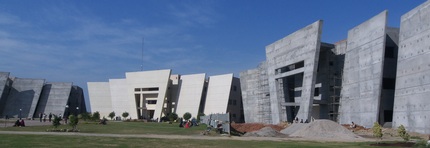
Ships of KnowledgeShips of Knowledge, University of Gujrat
shalamar garden

Shalamar Gardens, Lahore

I have been back from Lahore, Pakistan's cultural center and "City of Poets", for a while now. It was one of the most inspiring journeys I've been to.

Just a few weeks ago we've been at the…

Read more

Open Access Anthropology in Africa – an introduction

logo

Heard of the Sudan Open Archive? Already taken a look at the recent anthropology papers of the University of Pretoria? Many universities in Africa have set up digital libraries, repositories for papers and theses that are freely accessible for everybody.

Here is a short overview over some repositories that also feature anthropology or anthropology related papers in English.

Sudan Open Archive

The Ethnography and Linguistics section of the Sudan Open Archive (SOA) includes papers like Report of The Field Research in Lafon, Eastern Equatoria State: Assessment of the General Conditions and Livelihoods of The Pari People by Eisei Kurimoto or “Presentation on Customary Mediation in the Sudan: Past, Present and Future” by Adam Al Zain Mohammed.

There are comprehensive sections on Conflict and Peace. There are lots of scanned older publications like the 1987-study The Dhein Massacre: Slavery in the Sudan by Ushari Ahmed Mahmud and Ushari Ahmed Ali Baldo.

University of Zimbabwe

screenshot

There is no anthropology department at the University of Zimbabwe, but a department of sociology. Among the six papers we find Anatomy of Alterity: Instrumental Identies Among the San in Zimbabwe by Gillian Chomutare and Elias Madzudo and Revival of Indigenous Food Security Strategies at the Village Level: The Human Factor Implications by Claude. G Mararike.

The Institute of Development Studies has published several papers, among them Plight of children in conflict and post – conflict societies: the case of Africa and Africa and Globalisation Revisited by Donald Chimanikire.

SOUTH AFRICA

We’ll find much more anthropology papers and theses at South African universities.

Rhodes University

screenshot

The anthropology section in the Rhodes eResearch Repository consists of five items. The most recent ones are the master’s theses The resurgence of tuberculosis in South Africa: an investigation into socio-economic aspects of the disease in a context of structural violence in Grahamstown, Eastern Cape by Ida Erstad and The rural-urban interface : the ambiguous nature of informal settlements, with special reference to the Daggafontein settlement in Gauteng by Sibongiseni Kumalo.

University of Johannesburg

There are 14 items in the Anthropology & Development Studies section, among them An analysis of the livelihoods of the Muyexe community located along the Kruger National Park in Limpopo Province by Mkhacani Makamu and Livelihood activities in female-headed households: Letlhakane village by Mamedupe Maggie Kgatshe.

University of Pretoria

7 anthropology papers, for example End of culture? Some directions for anthropology at the University of Pretoria by John Sharp and How equal is equal? A legal-anthropological note on the status of African women in South Africa by J.C. Bekker and C.C.Boonzaaier

University of Western Cape

6 papers by the Department of Anthropology and Sociology, among others Positive Muslims: a critical analysis of Muslim AIDS activism in relation to women living with HIV/AIDS in Cape Town by Abdul Kayum Ahmed and A critical analysis of the effects of tourism on cultural representation: a case study from Leboeng by Masete Mamadi.

University of Witwatersrand

Searching for anthropology gives five hits as for example The silence of colonial melancholy : The Fourie collection of Khoisan ethnologica by Ann Wanless

There are of course more depositories. My selection is based on the overview at http://www.opendoar.org – a website Peter Suber at Open Access News mentioned recently.

In October, Suber pointed to an article on Open Access in Africa that was discussed at Sciencebase.

SEE ALSO:

The resurgence of African anthropology

“Focalizar o que é comum aos seres humanos” / Open Access Anthropology in Brasil

Book and papers online: Working towards a global community of anthropologists

How can we create a more plural anthropological community?

Why open access?

logo

Heard of the Sudan Open Archive? Already taken a look at the recent anthropology papers of the University of Pretoria? Many universities in Africa have set up digital libraries, repositories for papers and theses that are freely accessible for everybody.…

Read more

Open access: Journal of Identity and Migration Studies

logo

Xenophobia in South Africa, labour mobility and economic development, minorities’ integration, representation of refugees and forced migrants in the British Economy are some of the topics in the most recent issue of Journal of Identity and Migration Studies.

The journal was founded a bit more than a year ago by The Research Centre for Identity and Migration Issues (RCIMI) at the University of Oradea in Romania. It was recently added to the Directory of Open Acces Journals.

It is an interdisciplinary journal on one of the most popular topics for anthropologists. So far, no anthropologists have contributed to it, though.

>> visit the journal’s website

logo

Xenophobia in South Africa, labour mobility and economic development, minorities’ integration, representation of refugees and forced migrants in the British Economy are some of the topics in the most recent issue of Journal of Identity and Migration Studies.

The journal was…

Read more