
search expand

MANAO – new Open Access repository for anthropology to be launched

As the open access to Annual Review of Anthropology only was a temporary pleasure, it is good to know that the Department of Anthropology at the University of Hawai’i is going to launch MANAO – an Open Access repository for anthropology:

The Mana’o project combines anthropology’s commitment with the ideal of ‘open access’ with open source software’s focus on free technology. The goal is to provide tools that allow scholars to better communicate with each other and with the world.

Mana’o will ‘soft-launch’ in late-November 2007 during the annual meeting of the American Anthropological Association in Washington D.C. We are currently inviting early adopters to submit work that will be featured in this launch.

(…)

Anthropologists have long been concerned with making their world available to the public, including the communities with whom they have lived and conducted fieldwork. Mana’o represents an important step forward in creating concrete open access solutions for anthropology. I hope that you will be part of our initial program, and I look forward to receiving your submission!

>> read the whole announcement over at Savage Minds

SEE ALSO:

antropologi.info survey: Six anthropologists on Anthropology and Internet

Open Source Anthropology : Are anthropologists serious about sharing knowledge?

The unacknowledged convergence of open source, open access, and open science

Open Access to Indigenous Research in Norway

2006 – The Year of Open Access Anthropology?

American Anthropological Association opposes Open Access to Journal Articles

As the open access to Annual Review of Anthropology only was a temporary pleasure, it is good to know that the Department of Anthropology at the University of Hawai’i is going to launch MANAO - an Open Access repository for…
Read more

(No longer) Open access to Annual Review of Anthropology 2007

(via anthropology.net) The Annual Review of Anthropology 2007 is out and all articles are freely available online, for example: (UPDATE: No longer open access. You'll have to get the paper version in your library! Ridiculous pricing: 20 USD per…

Read more

People, Place and Policy – New Open Access Journal

(via Intute Social Science Blog) Homeless women, gated commnities, active citizenship and the post-industrial labour market: That’s what the papers in the first issue of the new open access journal People, Place and Policy are about:

People, Place and Policy provides a forum for debate about the situations and experiences of people and places struggling to negotiate a satisfactory accommodation with the various opportunities, constraints and risks within contemporary society.

(…)

PPP is founded on the belief that academic research has a critical role to play in the creation and assessment of policies. This is not to criticise social scientists who shy away from involvement in the messy business of policy, but to celebrate the contribution of critical and questioning applied social research to both academic knowledge and thought, and the interpretation, understanding and responsiveness of policy to contemporary social challenges.

(…)

The editorial home of the journal is the Centre for Regional Economic and Social Research at Sheffield Hallam University.

>> Homepage of the journal

SEE ALSO:

Free access to Anthropologica 2002 – 2005

For Open Access: “The pay-for-content model has never been successful”

Omertaa – Open access journal for Applied Anthropology

2006 – The Year of Open Access Anthropology?

(via Intute Social Science Blog) Homeless women, gated commnities, active citizenship and the post-industrial labour market: That's what the papers in the first issue of the new open access journal People, Place and Policy are about:

People, Place and Policy…

Read more

"Voices": Anthropologist publishes e-book about Palestinian women

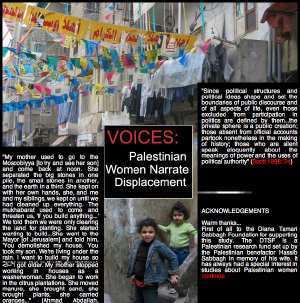
voices-cover

Voices: Palestinian Women Narrate Displacement is a collection of oral histories recorded by Beirut-based anthropologist and oral historian Rosemary Sayigh. It was published as e-book, devoted to men and women living in Gaza, the West Bank, Jerusalem and Israel. It allows readers to not only read the texts and see the pictures but also to hear the stories in the speakers’ own voices, The Daily Star Lebanon reports.

“Because “Voices” seizes on the advantages of technology, the book transcends precisely those borders so troublesome to the Palestinian condition”, Louisa Ajami writes in her review:

Sayigh became one of the few women to enter the Palestinian camps in Lebanon and she devoted her anthropological expertise to writing about the Palestinian diaspora. Much of her field work has centered on women and children, and she writes of the lives of rural peasant women and their more educated urban sisters with equal attention and flair.

Sayigh writes in the unobtrusive, objective style of an anthropologist, but she also interjects her personal impressions. She gives readers a sense of location, ambience and familiarity. (…) With her detached yet intense approach to recording their stories, Rosemary Sayigh renders her Palestinian subjects’ struggles less abstract and more human.

But there is one drawback for those who don’t speak Arabic:

Each narration is preceded by a short introduction in English. The opening lines of each interview are also transcribed in English, but the full interviews have been left in the original Arabic, as has the audio footage. For non-Arabic speakers, this leaves the bulk of the stories out of reach.

The review in The Daily Star Lebanon is no longer online.

>> read the e-book “Voices: Palestinian Women Narrate Displacement” (Link updated 24.7.2024)

More about / by Rosemary Sayigh

Interview with Rosemary Sayigh (The Jerusalem Times / palestine-family.net)

Rosemary Sayigh: No Work, No Space, No Future: Palestinian Refugees in Lebanon (Middle East International, 10 August 2001)

Rosemary Sayigh: Dis/Solving the “Refugee Problem” (Middle East Report 207 – Summer 1998)

SEE ALSO:

Anthropologists on the Israel-Lebanon conflict

The Future of Anthropology: “We ought to build our own mass media”

Open Source Anthropology : Are anthropologists serious about sharing knowledge?

2006 – The Year of Open Access Anthropology? 2005 was the year anthropology finally became visible on the internet. 2006 was the year of a more public, political and open access anthropology?

voices-cover

Voices: Palestinian Women Narrate Displacement is a collection of oral histories recorded by Beirut-based anthropologist and oral historian Rosemary Sayigh. It was published as e-book, devoted to men and women living in Gaza, the West Bank, Jerusalem and Israel. It…

Read more

“Audio podcasting won’t take over the world”

Podcasting – publishing mp3-interviews on websites – has become more popular in the social sciences, including anthropology. But as Paul Ayres writes in an article for ALISS Quarterly, the journal of the Association of Librarians and Information professionals in the Social Sciences, content producers have already started to move on to video.

Audio podcasting won’t take over the world, he explains:

Audio as a format has a number of limitations. It can be inefficient, as it takes 10 minutes to listen to a 10 minute audio file, plus time to download it as well. Much of this information could be summed up in a short piece of text that is easier to scan and retain. Plus, some content does not lend itself to being read out loud, such as complex URLs or detailed instructions.

In the Higher Education context, providing only the audio of a lecture leaves out PowerPoint slides, data, charts or diagrams that may illustrate a point and it also limits the presenter to a chalk and talk approach, which excludes problem based learning techniques and active learning strategies, which require interaction in the lecture theatre or classroom.

Information Professionals may find audio only user education assets very limiting. With an increasing number of online services available, screencasts that offer commentary on a video walkthrough of a service, website or database, will give a visual cue and a more meaningful learning experience to students.

So users and content producers have already started to move on to video and it’s clear that audio podcasting won’t take over the world. Awareness of podcasts has only increased marginally in the last 18 months, and some say that it suffers from the “try me” virus effect, where something may be cool or interesting to sample, but not be engaging enough to return to.

>> read the whole article “Podcasting and Audio in the Social Sciences”

SEE ALSO:

Anthropology podcasts receive much attention

The Future of Anthropology: “We ought to build our own mass media”

Video by anthropologist Michael Wesch: How collaborative technologies change scholarship

Savage Minds: Visual anthropologist Jean Rouch on YouTube

Anthropological Films online

Podcasting - publishing mp3-interviews on websites - has become more popular in the social sciences, including anthropology. But as Paul Ayres writes in an article for ALISS Quarterly, the journal of the Association of Librarians and Information professionals in the…

Read more