
search expand

Success in publishing defined by quality? Anthropology Matters on “The Politics of Publishing”

The new issue of Anthropology Matters – one of the few anthropology online journals is out. The topic is “The Politics of publishing” – a topic that has been widely debated on anthropology blogs: Mostly, the internet was discussed as an alternative (or additional sphere) to publishing in journals because it’s easier and (generally) cheaper to share knowledge online.

The three papers on the culture, cosmology and social organisation of the publishing industry are fascinating reading. One of the main points are summed up in the introduction by Ian Harper and Rebecca Marsland. We often take for granted that only the best articles are published in academic journals. This is wrong, they argue. Success in publishing is not so much defined by academic quality, as your ability to network:

Access to publishing is highly dependent on personalized networks – a situation that can leave postgraduate anthropologists out in the cold. The chances of your paper being published are dictated by two or more peer reviewers, in a peer review process entangled in personal connections and agendas, and shrouded in personal opinion and perhaps some mysticism.

Therefore, Ronnie Frankenberg, tells in an interview, stressing the social aspects of publishing:

Publishing a paper requires the same kind of research as when you apply for a job actually. Then you would find out about the department, and the other people there, and what their interests are, and what they’ve done. You stand a much better chance of getting a paper published if you’ve read at least one issue of the journal, if you’ve looked at what the editor’s interests are, if you’ve looked on the internet at what the aims are.

And it’s of course important which journals you’re going to choose. There are hierarchies, dominated by the US publications. An anthropologist colleague who wanted to publish in a journal produced in Nepal was told by his supervisor not to waste his time, and to start thinking about publishing in serious journals, Harper and Marsland write ( >> read more on the experiences of running a journal in Nepal)

About the US, Daniel Miller writes:

The US system is heavily biased towards giving tenure to academics who have published in a few key journals rather than publishing per se. (…) With books the situation can be even worse. The same tenure system prioritizes certain publishers rather than others.

Additionally, the US system is “incredibly insular” according to Ronnie Frankenberg in an interview with Christine Barry:

I mean they are quite likely to publish articles from Eastern Europe and Latin America as a matter of principle, but unless a paper is by someone very famous from England or France it’s not going to be given very top priority.

So you mean even if it gets favourable reviews they still might not publish it.

Ronnie: Absolutely

Miller points in his paper Can’t publish and be damned to the issue of commercialisation of knowledge. He criticizes that “academic reputation has been outsourced to commercial interests”. The market is dominated by few publishers. The number of independent UK presses that twenty years ago published anthropology either no longer exist or have been bought out. He continues:

The problem is that there are far more manuscripts that can properly claim to be worth publishing on academic grounds than can be sold as commercial successes. Berg, as most presses today, including university presses, is essentially a commercial organization that survives only to the degree to which it remains profitable.

(…)

Some absolutely brilliant scholarly and wonderful books simply have not sold. There are plenty that are successful, but the evidence is that the sales often do not correlate with scholarly quality or originality. A textbook without much of either may outsell an exemplary monograph. So the bottom line is that there are many manuscripts that on academic grounds ought to be published but are not commercially viable, and that may include your intended masterpiece.

The response on the call for papers for this special edition on the politics of publishing was low, the editors write and wonder:

We pride ourselves on our disciplinary self-reflexivity, yet it is odd that these issues have not been unpacked more.

This reminds me of an earlier article by Kerim Friedman on Open Access Anthropology:

Concerns over the ethical dilemmas involved in producing knowledge about the “other” have, in the past few decades, radically changed how anthropologists conduct research and write ethnographies. Unfortunately, they have not changed how we publish. Do we want our intellectual contributions to be hidden in dusty archives, or available to anyone who can Google?

>> continue to Anthropology Matters 2/2005: The Politics of Publishing

SEE ALSO:

Open Access Anthropology – Debate about the Publishing Industry on Savage Mind

Open Source Anthropology : Are anthropologists serious about sharing knowledge?

Marshall Sahlins wants to make the Internet the new medium for pamphleteering

How can we create a more plural anthropological community?

More and more anthropologists, but they’re absent from public debates – “Engaging Anthropology” (1)

The new issue of Anthropology Matters - one of the few anthropology online journals is out. The topic is "The Politics of publishing" - a topic that has been widely debated on anthropology blogs: Mostly, the internet was discussed as…
Read more

On fieldwork: “Blogging sharpens the attention”

Cicilie Fagerlid provides a nice explanation on why she has started blogging while she’s on fieldwork. Her working title for her research is Communities in the making: Identity and belonging in postcolonial Paris and London.

After I started I have noticed that blogging sharpens the attention, just like taking a lot of photos (and probably painting) does; One starts to see motifs everywhere, and then one has to reflect on how to make the motif into a story so other people can understand what you want to tell them.

>> read her whole post “My blog, my project and I, part 1”

SEE ALSO:

More and more academics use blogs

Ethnographic study on bloggers in California & New York

antropologi.info survey: Six anthropologists on Anthropology and Internet

More and more blogging anthropologists – but the digital divide persists

Anthropology Newspaper – Overview over blogging anthropologists (and some others)

Cicilie Fagerlid provides a nice explanation on why she has started blogging while she's on fieldwork. Her working title for her research is Communities in the making: Identity and belonging in postcolonial Paris and London.

After I started I have…

Read more

The Secret of Good Ethnographies – Engaging Anthropology Part III

If anthropologists want to have a larger impact on society, they have to write better. This is the main argument of Thomas Hylland Eriksen’s book Engaging Anthropology. A central question raised in the book: How can anthropology become more relevant for the “outside world”? See part I and part II of my review. Here’s the third and last part.

The fact may be that when anthropologists fail to reach the general intellectual public, it is because they have been taught to be more worried about the reactions from the people they eat lunch with than what people outside the university might think. As a result, they sometimes seem to write badly on purpose.

(…)

To my mind, the single most important characteristic of anthropological writings is that it tends to be chiefly analytical. This means that it is more difficult to get into and less easy to remember than narratives. Stories are the stuff of life; analysis is for specialists

(…)

With modest but determined effort, some of this work could have made a difference outside the subject and indeed outside the academy. Provided, of course, this is considered worthwhile.

(my emphasis as I guess this is a crucial point: many anthropologists I know, don’t want to have much publicity around their work)

How can this be done? How to write better? What are the secrets of good ethnographies?

Essential: As a writer, he argues, you have to care for your readers. Readers want stories. And if you tell your stories well, readers accept dwelving into complex issues (see popular books on sociobiology). Don’t hesitate and let you inspire and pick up a technique or two from journalists: short sentences, not too much jargon, the conclusion in the beginning instead in the end. Less analysis, more narrative. Or rather: Weave the analysis into the narrative!

Many of the best writers address their readers as accomplices, as friends or fellow-travellers, or as adversaries to be won over. That was Montaigne‘s method in Essais, and its potential has not been exhausted yet. Arguably, the open-ended storytelling mode would have been appropriate for a discipline like anthropology in its current incarnation, where few final answers are offered and theoretical conclusions tend to be provisional.

Eriksen is convinced, that it’s possible to turn the research findings into compelling narratives without losing their analytical complexity.

That many anthropologists are perfectly capable of writing well, is regularly demonstrated in the pages of a magazine such as Anthropology Today. In fact, many of the publications are so good, so well written and interesting for a general readership, that one can only lament the fact that this magazine (…) is only being distributed to anthropologists.

In chapter 5 and 6 which are the most interesting ones in my opinion, he reviews som ethnographies.

Douglas Holmes (2000): Integral Europe is an analysis of right-wing populists in England and France. He does almost everything right, Eriksen writes. Holmes has actually spun a narrative, a story relating his own process of discovery but:

“If it were to become really successful in terms of influence, however, it would need to be even sharper in its central formulations on the connections between fast-capitalism, multiculturalism and neofascism, it would have to integrate the analytical framework more seamlessly, and most importantly, it would have to tell the story in a more straightforward and engaging way.”

Aihwa Ong (1999): Flexible Citizenship is a multi-sited ethnography on transnationalism and citizenship among Chinese, the spread of Chinese economic interests worldwide – topics that according to Eriksen many people are interested in, but Ong is “bound to lose at least half of the potential readership on the first ten pages” because of the jargon she uses (“the tranational practices and imaginings of the nomadic subject” or “embeddedness in differently configured regimes of power”)

The book Eriksen likes best is Wade Davis (1995): The Serpent and the Rainbow – “one kind of anthropology at its very best”, “a rare example of an anthropology book from recent decades which has enjoyed popular success as well as respectful nods from fellow academics”, he writes:

Through his book, Davis comes across first and foremost as an adventurer and a storyteller, and almost incidentally as an academic. It could make the rest of us think that maybe we have this in ourselves too, but – alas – we never cared to look.

The book is a singe-person narrative where the reader follows the anthropologist on his path of discovery. Because of his literary language and his ability to tell stories, Eriksen writes, the reader is prepared to accept as much contextual complexity as it takes to get at the bottom of voudun (zombies in Haiti, the book’s topic).

A larger quote:

Now, The Serpent and the Rainbow arguably veers towards exoticism, but at the same time, it treats Haitians respectfully and makes it possible for Western readers without much exposure to “other cultures” to understand how and why it can be that Haitians are both different from and similar to ourselves. In this shared, shrinking world of ours, anthropologists have a duty to do what they do best, namely to make credible translations between different life-worlds and world-views, and to show how such translations make embarrassing reading for global elites who see themselves asthe guardians of universal humanism. Rather than regurgitating the relativist views of early twentieth-century anthropology, a contemporary public anthropology can represent a universal humanism which recognizes the significance of difference. By virtue of its experience-near material, anthropologists are in a better position than most to do this crucial job.

(…)

Anthropology can teach humility and empathy, and also the ability to listen, arguably one of the scarcest resources in the rich parts of the world these days. It can even be fun

No doubt, Engaging Anthropology is an important book, a book that had to be written and will trigger neccessary debates. Most of my recent reviews (in Norwegian) contained some remarks on the unreadable style of writing, “postmodern tribal language” etc. But unfortunately it’s not one of Eriksen’s best written books. It’s not well structured, quite repetitive. And I wonder why he hasn’t treated the possible role of the internet for a more relevant public anthropology.

Thomas Hylland Eriksen is going to write more about these issues. He will be guestblogger on Savage Minds, as it just has been announced

UPDATE: Eriksen’s first posts: A drop of complexity and A predicament of sport and What is good anthropological writing?

SEE ALSO:

More and more anthropologists, but they’re absent from public debates – “Engaging Anthropology” (1)

Why anthropology fails to arouse interest among the public – Engaging Anthropology (2)

Chapter 1 of Engaging anthropology: The Case for a Public Presence

If anthropologists want to have a larger impact on society, they have to write better. This is the main argument of Thomas Hylland Eriksen's book Engaging Anthropology. A central question raised in the book: How can anthropology become more relevant…

Read more

Why anthropology fails to arouse interest among the public – Engaging Anthropology (2)

As anthropology has grown, its perceived wider relevance has diminished. Why is this so? In his second chapter in the book Engaging Anthropology, Norwegian anthropologist Thomas Hylland Eriksen gives us several possible explanations. On the one hand, there are external factors f.ex. recent university reforms, inspired by neoliberalist marked theories:

Universities are being turned into factories. Academics have, as a consequence, lost much of the time they could formerly devote to engagement in greater society. (…) The ongoing formalisation of the recognition of skills through never-ending evaluations of research, auditing and other forms of “professionalisation” threatens to take the creativity out of academic life, and also contributes to isolating it further from society. (…) Students are no longer encouraged to be intellectuals, but to specialize and become professionals.

But the main reasons for the diminishing role of anthropology lie within the discipline. Hylland Eriksen lists several “recipes for cocooning”:

Recipe Nr 1: Elitism:

Anthropology, unlike some other academic disciplines, has yet to escape fully from the mouldy lounges and pompous hallways of pre-war university life. In spite of the demographic explosion it has gone through since the Second World War, and in spite of the democratization of higher education, anthropology somehow remains an elite subject in the English-speaking world.

(…)

The early predominance of minorities and women at the very center of the discipline was significant. Evans-Pritchard’s generation did not even want anthropology to be taught as an undergraduate subject. In Britain, the subject remains dominated by the department of the elite universities.

(…)

In spite of its considerable growth, anthropology still cultivates its self-identity as a counter-culture, its members belonging to a kind of secret society whose initiates possess exclusive keys for understanding, indispensable for making sense of the world, but alas, largely inaccessible for outsiders.

Recipe 2: Myopic specialisation resulting from “my ethnography”

The malinowskian glorification of the detailed, synchronic single-society study encourages specialization and gives the highest marks to the colleague who remains loyal to her fieldnotes thoughout her career

Recipe 3: Insisting on irreducible complexity

Anthropologists are skilled at exposing oversimplifications. This is one of our disciplines strengths, but complex answers are non marketable commodities with respect to the mass media and the general reader, as we all know. Few monographs or even articles have a simple point to make, most anthropologists are reluctant to simplify their insights. But there are exceptions, f.ex. Levi Strauss – one “of the normally least readable anthropologists”):

Levi-Strauss’ Myth and Meaning (1978) and his interview book with Didier Eribon, De Pres et de Loin (1988), convey the main elements in his structuralism and his intellectual vision without losing, presumably, a single potential reader on the way. Many of us have something to learn from Levi-Strauss in this regard.

Recipe 4: The post-colonial critiques and the loss of the native:

After the post-colonial critique of Western representations, the collaps of classic cultural relativism and the damaging postmodernist autocritique of the 1980s, anthropology has become modest in its claims, introverted in its intellectual perspective and even more reluctant than before to raise the big issues in generally intelligible ways

Recipe 5: Anthropology as a subversive kind of activity

There might be totally different explanations for the failure of anthropology to sustain a visible public presence:

One should not rule out the possibiliy that anthropologists are often understood, but disagreed with – its perspectives threaten to subvert values and ideas held dear by its potential non-academic audience. The very idea of anthropology as a cultural (auto)critique (…) presupposes that there is a great demand for cultural self-criticism out there. This, plainly, may not be the case.

Recipe 6: Priviledging analysis over narrative

Anthropologists are bad writers! This is Hylland Eriksens most important argument:

To my mind, the single most important characteristic of anthropological writings is that it tends to be chiefly analytical. This means that it is more difficult to get into and less easy to remember than narratives. Stories are the stuff of life; analysis is for specialists. (…) There is a tendency to combine a penchant for complexity with a lack of engaging, sustained narrative. (…) As a result, it appears that anthropological texts are readable only by other anthropologists, who have learnt – the hard way – to read them.

But there are exceptions. He mentiones Katy Gardner’s “Songs from Rivers Edge. Stories from a Bengladeshi River (1997)” and Tristes Tropiques by Claude Livi-Strauss (1978).

The problem:

There are many brilliant narratives in anthropological literature, but they’re usually hidden in analysis. (…) History is almost alone among academic subjects to fuse original research and popular writing in the very same texts

MORE ABOUT ENGAGING ANTHROPOLOGY:

The Secret of Good Ethnographies – Engaging Anthropology Part III

More and more anthropologists, but they’re absent from public debates – “Engaging Anthropology” (Part I)

SEE ALSO

Archive: Knowledge Sharing and Open Access Anthropology

As anthropology has grown, its perceived wider relevance has diminished. Why is this so? In his second chapter in the book Engaging Anthropology, Norwegian anthropologist Thomas Hylland Eriksen gives us several possible explanations. On the one hand, there are external…

Read more

More and more anthropologists, but they’re absent from public debates – “Engaging Anthropology” (1)

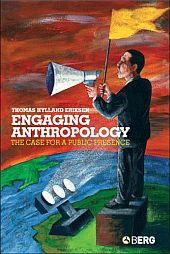
book “Anthropology is exceptionally relevant as a tool for understanding the contemporary world, yet it is absent from nearly every important public debate in the Anglophone world. In fact, it has almost gone underground in the English-speaking world. Paradoxically, as the discipline has grown, its perceived wider relevance has diminished. There are more of us anthropologists than ever before, yet fewer reach out to communicate with a wider world”, Thomas Hylland Eriksen writes in his new book “Engaging Anthropology”.

I’ve just started reading the book and am going to blog more about it the following days. Some of the questions raised in the book are: How can anthropology become more relevant for the “outside world”? What has anthropology to offer? Why do anthropologists fail to engage a wider public?

Thomas Hylland Eriksen takes up issues that have been widely discussed in the anthropological blogosphere before, f.ex. the unwillingness to share knowledge:

Anthropologists have an enormous amount of knowledge about human lives and most of them know something profound about what it is that makes people different and what makes us all similar. Yet there seems to be a professional reluctance to share this knowledge with a wider readership. Translating from other cultures is what we are paid to do; translating for the benefit of readers outside the in-group seems much less urgent.

Anthropologists, he criticizes, present their research findings in a way “that turns almost the entire potential readership off”:

The problem is that all these fine analytic texts, often brimming with insights and novel angles, rarely build bridges connecting them with the concerns of nonspecialists. Also, they are far too rarely supplemented by writings aimed at engaging a wider readership. (…) When did you last read a proper page-turner written by an anthropologist?

It was not always like this, he goes on. In the mid-twentieth century, in the days of Mead, Montagu and Evans-Pritchard, anthropologists were engaged in general intellectual debate and occasionally wrote popular, yet intellectually challenging texts. But as the discipline has grown, its perceived wider relevance has diminished. Since the Second World War, Hylland Eriksen writes, anthropology has shrunk away from the public eye in almost every country where it has an academic presence (Norway is an exception):

Scholarly works of great and enduring importance were published from the 1960s to the 1980s by Claude Lévi-Strauss, Mary Douglas, Victor Turner etc. Yet, the response from the nonacademic world was negligible, and this generation seemed to have no Margaret Mead to take current ideas and run with them. The discipline had become almost self-contained.

There are many possible ways of engaging a readership, he writes and gives some examples. He encourages anthropologists to write more personally engaged ethnographies. There is no contrast between professionalism and engagement:

I suspect that not a few anthropologists have lost their original motivation for studying the subject – understanding Humanity, or changing the world – on the way, replacing it with the intrinsic values of professionalism. And yet, just as the anthropological travelogue may be complementary to the monograph, the engaged pamphlet can often be a necessary complement to the analytical treatise. However, that pamphlet is written too rarely. It gives no points in the academic credit system, it may cause embarrassment among colleagues and controversy to be sorted out by oneself. The easy way out, and the solution most beneficial to one’s career, consists in limiting oneself to scholarly work.

Another suggestion: Anthropologists should write more essays:

Assuming that Leach was right in claiming that most anthropologists were failed novelists, here is a chance to become a truly creative writer without having to invent persons and events. The essay, unlike the article, is inconclusive. It plays with ideas, juxtaposing them, trying them out, discarding some ideas on the way, following others to their logical conclusion. In the essay, the writer sees the reader as an ally and fellow-traveller, not as an antagonist to be defeated or persuaded. The essay appeals to the reader’s common sense, it may occasionally address him directly, and the essayist tries to ensure that the reader follows her out on whichever limb she is heading for.

Strangely enough for us behind the screens: Hylland Eriksen doesn’t mention blogging. Blogs are as experimental as the essay form (or rather more). Additionally, blogs invite the reader to discuss with the anthropologist.

You can read the whole first chapter on Thomas Hylland Eriksens homepage.

UPDATE – MORE ON THIS BOOK:

Why anthropology fails to arouse interest among the public – Engaging Anthropology (2)

The Secret of Good Ethnographies – Engaging Anthropology (3)

UPDATE: Alun Salt writes:

Engaging Anthropology looks like it will be a fascinating book to read. There’s a post about it on antropologi.info. One of my favourite books is Popularizing Anthropology by McClancy and McDonaugh which makes a strong argument that if anthropology (and science) is publically funded then there is an obligation to make your results accessible to the public. They also make the argument that popular does not automatically mean unscholarly.

SEE ALSO:

Marshall Sahlins wants to make the Internet the new medium for traditional pamphleteering

Open Source Anthropology : Are anthropologists serious about sharing knowledge?

“Minimal willingness to post one’s own work online”, survey by the American Anthropological Association reveals

The Future of Anthropology: “We ought to build our own mass media”

book

"Anthropology is exceptionally relevant as a tool for understanding the contemporary world, yet it is absent from nearly every important public debate in the Anglophone world. In fact, it has almost gone underground in the English-speaking world. Paradoxically, as the…

Read more