

search expand

Pecha Kucha – the future of presenting papers?

(UPDATE: See Beware: No Pecha Kucha allowed without consent from Tokyo) Why reading your paper when there are lot more exciting ways of presenting your research? I have asked Aleksandra Bartoszko and Marcy Hessling to tell us about their experience with a recent experiment at the annual meeting of the American Anthropological Association last december.

They attended a panel where papers were not read but presented via 20 images that were displayed for 20 seconds each. After 6 minutes and 40 seconds the show is over and the discussion can begin.

This way of presenting is getting more and more popular around the world and is called Pecha Kucha.

Pecha Kucha presentations might take more preparation time, but presentations are more focused, there is more discussion as when people want to hear more after 6 min 40 sec, “they will just open their mouth and ask”. According to Aleksandra Bartoszko Pecha Kucha style presentations might also be a great way to present anthropology to the non-anthropological public.

“It was the first time ever I was totally focused on all the presentations during the whole session”, Aleksandra Bartoszko writes enthusiastically:

It was the first time ever I was totally focused on all the presentations during the whole session:

1) because of the REAL time limit,
2) because of the power point presentations NOT being a text,
3) because of the lack of WRITTEN style of the presentation, the oral style is almost required in this format and in a way natural,
4) because of the lack of word overflow – presentations really to the point,
5) because of the time left for the discussion (real or potential, but still, there is time for that).

I did enjoy this format because:

1) because of the lack of fluency in English I’m not too good in oral presentations, and because of the 20 seconds per slide (in my understanding of the idea, 20 sec per point) it was easier to present something in more “digestible” way to the audience. And because of the pictures, there was a lot of things/descriptions I could just skip.

2) because of the time limit, I really had to think what was the main point I wanted to address to the audience – NOT everything that I had discovered and would like to share with (this is just not working). This time limit is also a good lesson of modesty and self-criticism. I think that this is also a good way to MAKE PEOPLE DISCUSS – I think that usually when “unfortunately we have time for just one short question or comment” most of the people do not want to be the one who talk or “steal” this question, they pull out, especially young scholars. While during an 1 hour discussion more and more people get involved.

Anyway, when I’m done in 6,40 mins and people want to hear more, they will just open their mouth and ask. I think that academia does lack the culture of speaking, talking and discussing. Yes, I do think so :) So, I am for more active meetings.. people are getting so lazy sometimes, both the presenters and the audience.

3) Also, and paradoxically, because of the language issue I prefer the discussion part to the paper. I am just not able to speak so naturally having a paper, and I don’t like the way I usually present (in spite of the fact that this is a tradition etc. It’s just not fun at all, and I guess that most of the participants of the conferences agree, they are just too lazy not to read the excerpts of their books etc). So, that is why I do appreciate every single minute left for a discussion. I believe that any other session I attended could work in this way and the discussion would be great and more fruitful than usually.

4) after fieldwork we have so many photos that never will be used. And I think it is so valuable to see other “fields”, other people in work, their “photographical” perspectives, we can learn so much. And I do feel sorry for all those picures stored in our offices, apartments, old albums which will never be used, maybe one of them for a cover to some book, or a nostalgic wallpaper on our laptops.. I don’t know, I just think that the places and people deserve to be seen once they are “captured”.

5) this is a great way to present anthropology to the non-anthropological public, to present our results in an understandable but still scientifical manner. Most of the anthropologists (like many other disciplines) just do not know how to speak about anthropology and our work, so it is a good way to start. As one of the participants said “this is the way I can explain my parents what I am doing”.

Marcy Hessling organized the Pecha Kucha session. I asked her a few questions:

How was the session? Did you like it? What did the others say?

– I think that the Pecha Kucha format was quite a success at the meeting.  I enjoyed presenting, and I am fairly certain the other participants did too.  It does take a lot of preparation in advance, which is surprising to some because of the shorter presentation time.  But when you just have 6 minutes and 40 seconds to utilize, it is important to be succinct and focus fairly narrowly on a specific issue or topic.  And it is also quite a challenge to choose the 20 more relevant, and yet at the same time visually compelling, images.

Why did you decide to organize a Pecha Kucha session?

– I first heard about the Pecha Kucha format a few years ago (probably in 2007, I think or in early 2008) when I saw a Call For Papers for a student conference that was going to be held somewhere overseas.  Possibly in Japan.  It sounded like a great way for students to present their work.  First, because students are generally quite technologically savvy, and second, because students are typically working through aspects of being in the field or creating a project.  This format is very audience-interactive (at the end) so it is a way to get some feedback too.

Pecha Kucha means 20 slides a 20 sec. How important is it to follow the rules? Is it ok to use 10 slides a 30 seconds?

– The way I understood the format is that it is important to stay within the 6 min 40 second time limit, and that generally most people do 20 slides for 20 seconds per slide.  However, I have heard of some people doing a 6 min 40 second movie too.  So I think it depends on the organizers.  

Was it easy to motivate people to take part in this Pecha Kucha session?

– There were quite a few people who were initially interested in this format, but it does take a commitment to do the preparation in advance. We had a visual anthropologist act as our discussant, and I really wanted to get the presentations to her in advance of the meeting so that she could speak to them in her comments.  She was very impressed with the format, and with the quality of work that the participants brought in.

Will there be another Pecha Kucha session at the next AAA meeting?

– I am not sure if there will be another Pecha Kucha presentation at the 2010 AAA meeting, it depends on the current program chair, and the individual section program editors.  I hope that it does continue.

How do these presentations look like? Here are two presentations you can download:

Fredy R. Rodriguez Mejia, Non-Governmental Organizations and the Politization of Environmental Practices in Copan, Honduras (Powerpoint, 8.9MB)

Aleksandra Bartoszko – Do They Have Any Choice? Distribution of Life Chances, Risk management and poverty in a Nicaraguan village (Powerpoint, 16.4MB)

Here are the abstracts and infos about the session (pdf, 78kb).

Aleksandra Bartoszko has written more about her research in her field blog Antropyton (which I found was one of the best field blogs I’ve read). She edited the open access e-book The Patient that includes her article “I’m not sick, I just have pain”: Silence and (Under) Communication of Illness in a Nicaraguan Village. Norwegian readers can download her thesis Vi er ikke dumme, vi er fattige!
Om vitenskap, eksperter, utdanning og barrierer for folkelig deltakelse i en nicaraguansk landsby

Fredy R. Rodriguez Mejia is also a poet.

And here is a Pecha Kucha presentation about Pecha Kucha

Pecha Kucha Training Bite

There is a large collection of videos over at www.pecha-kucha.org

AQWorks has made a Guide To Better Pecha Kucha Presentations

Last summer, neuroanthropology had an interesting post about speed presentations.

Thanks Fredy R. Rodriguez Mejia, Marcy Hessling and Aleksandra Bartoszko for your contributions!

UPDATE: It seems there will be similar experiments at the next AAA meeting as well! The AAA blog mentions this post about Pecha Kucha and asks for contributions:

Are you interested in creating a session or special event in an innovative format for the 2010 AAA meeting? Do you want to organize a service activity, walking tour, or an unconference to complement the meeting? Email your ideas to aaaprogramchair [at] gmail.com or aaameetings [at] aaanet.org.

UPDATE 2: Yes, there will be another Pecha Kucha session. See AAA 2010 New Orleans – Call for Abstracts – Graduate Pecha Kucha Session

SEE ALSO:

How To Present A Paper – or Can Anthropologists Talk?

Academic presentations: “The cure is a strong chairman and a system of lights”

Norwegian anthropology conferences are different

(UPDATE: See Beware: No Pecha Kucha allowed without consent from Tokyo) Why reading your paper when there are lot more exciting ways of presenting your research? I have asked Aleksandra Bartoszko and Marcy Hessling to tell us about their…

Read more

Looking back at 10 years Public Anthropology online

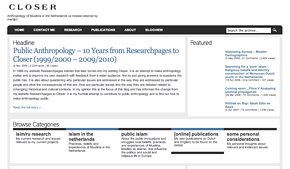
What is public anthropology? Already in 1999, when he had started his Ph.D project, Martijn de Koning has made his first anthropology website. In a very interesting blog post with many links, he is looking back at 10 years public anthropology online:

In 1999, when I just had started my Ph.D project in Gouda, I had a fantastic idea. An idea so fantastic that in the next 10 years I would dedicate a huge amount of time to sustaining and developing it. Too much time perhaps because sometimes it destroyed my time to sleep. The idea was that I would launch a website about and for my research and that also dealt with all kinds of issues related to it.

He sees his current blog Closer as one of his contributions to a public anthropology. He discusses several examples of good public anthropology. Public anthropology is not only about reaching a broader public. It is not just about giving answers to questions the public has. Public anthropology means also questioning why particular issues are addressed in the way they are (f.ex debate about islam) and what the consequences of that are. What are the historical and cultural contexts? What is taken-for-granted and what does it mean?

Public anthropology is not the same as anthropology in public (interesting debate!). It is rather about making the work accessible to the wider public, including people anthropologists write about. “This means that anthropoligists should write better: clear and accessibly”, he writes:

Many people in my current research project have read my PhD thesis, there have been discussions about it in chatrooms in which I present for my current research and several people emailed me, contacted me in the chatrooms and on MSN wanting to discuss my book and the publicity about it. Opening up your research in fact already begins at the initial stage when you have to explain to your informants what you are doing and why you are there where they are.

In my experience, the conversations that follow from this are not only a good a way of improving your ‘translation’ skills but also provide relevant input for your research. The same can be said about the questions people asked after reading my book and articles. As good public science indeed can produce better social science because the public is allowed to question and test the hypothesis of the researcher and even the significance of the whole research.

Public anthropology should be multilingual. Martijn de Koning is therefore blogging in both Dutch and English:

The current development in social sciences that only writing in Anglo-Saxon journals is valued above anything else (or better, the rest doesn’t matter) could lead I’m afraid to a situation in which social sciences are not relevant anymore for native, non-English publics and render the cause for a public anthropology futile or even ridiculous.

Together with his colleague Henk Driessen he is going to organize an international workshop on anthropology and publicity in 2010.

>> read the whole post: Public Anthropology – 10 Years from Researchpages to Closer (1999/2000 – 2009/2010)

His anniversary might be an opportunity to remind of recent posts about Public Anthropology at Neuroanthropology.net, for example Top Ten Ways for Anthropologists to Make A Difference and Expanding the Top Ten Ways for Anthropologists to Make a Difference or Varieties of Public Anthropology.

Furthermore. Maximilian Forte has started a series of posts about “Zero Anthropology“, about “knowledge after anthropology” – posts that will bring his blog unfortunately to a close.

SEE ALSO:

Nancy Scheper-Hughes: Public anthropology through collaboration with journalists

Why anthropologists should become journalists

Marianne Gullestad and How to be a public intellectual

“Anthropology needs to engage in an activist way”

“Discuss politics!” – How anthropologists in Indonesia engage with the public

Why anthropology fails to arouse interest among the public – Engaging Anthropology (2)

2006 – The Year of Open Access Anthropology?

What is public anthropology? Already in 1999, when he had started his Ph.D project, Martijn de Koning has made his first anthropology website. In a very interesting blog post with many links, he is looking back at 10…

Read more

Anthropologists ignore Open Access Week – a report from Wellington

What’s the point of science if it’s not publicly accessible? Two weeks ago, the first global Open Access Week was organized. Masters’ student in anthropology Karstein Noremark has written a report for antropologi.info about the Open Access Week at Victoria University of Wellington.

In his opinion, especially anthropologists should be interested in making research available online. But he did not see any anthropologists at the Open Access Week seminars. There was a general lack of interest among academics. Many of the attendants were library staff. He hopes more students will get involved in the Open Access movement – as future researchers, as end-users, and as a group that is in a unique position to advocate for the ‘rights to research’ of students in poorer countries.

Here is his report:

A small report from Open Access Week at Victoria University of Wellington

(including a critical note on anthropological engagement)

By Karstein Noremark – karsteinn (AT) gmail.com –

Victoria was the only university in New Zealand to (officially) celebrate Open Access Week, and the five days at Victoria covered an impressive broad range of subjects: workshops on Creative Commons licences and Open Access publishing, a web conference on Open Education with Wayne Mackintosh from WikiEducator, an institutional repositories roundtable, and, on top of this, a seminar on “Net Neutrality.” (More information on the various seminars can be found here).

The person behind most of the organising was Sigi Jöttkandt from Open Humanities Press. During the week, she also introduced the attendants to an open source publishing tool that can be used to create Open Access journals. An informative seminar on copyright and licences provided an introduction to various legal tools for Open Access, and in the spirit of the week, this seminar is also available as a webcast (get ogg player).

Still a room for professional publishers?

One of the more exciting topics during the week was the workshop on Open Access publishing. Interestingly enough, a representative from the ‘business’ – Fergus Barrowman from Victoria University Press – had agreed to sit in the panel. Barrowman gave a face to Open Access publishing that is often overlooked: the implication for publishers who are interested in Open Access, but who are not sure how to get involved. He gave an account of the realities that publishers face, the cost of publishing, the problems with ‘unprofitable’ Open Access models for publishing, and all the work that actually goes in to the publication of a text. As he told us, “we also like to get paid for our labour.”

Although Barrowman saw Open Access was “the right way forward,” he also told us that publishers would not embrace Open Access until a profitable business model was in place. Barrowman’s speech spurred a discussion around the themes of publishing and self-publishing, especially on the ‘craft’ side of publishing and how this knowledge could become lost in a transition to online publishing and Open Access. Most of the attendants agreed that there should still be room for professional publishers, but that more individual freedom was needed, especially for academics, whose access to specific articles might be crucial for their work.

All in all, the seminar was interesting, and had an edge to it, given that there were different stakeholders present (all honour to Barrowman for attending such a conference, and showing that he had given consideration to Open Access). I for one, who had come to the seminar with ideas about ‘evil publishers’ left with a more nuanced view on the publishing business – still thinking that a change was needed, but also with a feeling that ‘change’ does not just mean replacing ‘the old’ altogether. Of course, a webcast is also available for this seminar.

Anthropological absence

There did not seem to be any anthropologists at the seminars (although, there could have been some – I am not a student here myself). In fact, there seemed to be a general lack of academic interest altogether; many of the attendants were library staff, worked in digital repositories, or (like me) had an interest in Open Access as a ‘phenomenon’.

An example might reflect the awareness of some anthropologists of Open Access.

Roughly one week before the OA Week, I attended an anthropology student seminar held at Victoria. In the seminar, one of the lecturers from the university talked about her experiences from an international anthropology conference, complaining about the ‘elitism’ that she saw in much of the discipline.

I felt like I should make a comment to her presentation, and asked if Open Access could not be a way for anthropology to overcome ‘elitist tendencies’, by making texts and research more publicly accessible. She did not seem to understand what I was talking about (I am not sure if she didn’t know about OA, or just didn’t have an opinion on the topic), and wandered off on a metaphorical detour before resuming her complaints of the seemingly unbridgable ‘gap’ between ideal and practice in anthropology.

I started to think: which discipline should have vested interests in promoting and understanding Open Access if not anthropology, whose practitioners are constantly drawing on other fields of study, complains about not getting their message through, and maintain linkages to a number of academics in poorer countries where access to high quality articles is, to put it mildly, limited. And yet, many anthropologists seem more content to focus on a critique of existing ‘knowledge systems’ rather than looking for promising alternatives to this situation.

A student movement?

Open Access has become associated with a student movement (at least in the USA), but where were the students here in New Zealand?

I am currently writing an article on Open Access for a Norwegian anthropology student magazine called Kula Kula, and comparing my experiences from New Zealand to those of Norway. It might seem as though a lack of student involvement is related to the degree of institutionalisation that Open Access has been subjected to in both countries.

In Norway, the Research Council has agreed to sign the Berlin Declaration, and the University of Bergen has followed up by trying to persuade their researchers to make articles available in online repositories and Open Access journals. Still, ‘recommendations’ might be a far cry from actual implementation (article in Norwegian / English translation by Google).

A ‘technical’ approach to Open Access seems to have taken over an initiative that might otherwise have come from students – as future researchers, as end-users, and as a group that is in a unique position to advocate for the ‘rights to research’ of students in poorer countries.

In fear of violating a “wait and see – and then possibly write about it” attitude that is often taken to Open Access, I would urge more students to get involved. And more of them should come from anthropology.

The Open Access Week website has a lot of information, including videos and webcasts, among others an interview with Mr. Open Access, Peter Suber from Open Access News:

[video:vimeo:7375512]

SEE ALSO:

SSOAR – The first Social Science Open Access Repository is online

2006 – The Year of Open Access Anthropology?

For Open Access: “The pay-for-content model has never been successful”

antropologi.info survey: Six anthropologists on Anthropology and Internet

Kerim Friedman: Are anthropologists serious about sharing knowledge?

What's the point of science if it's not publicly accessible? Two weeks ago, the first global Open Access Week was organized. Masters' student in anthropology Karstein Noremark has written a report for antropologi.info about the Open Access Week at Victoria…

Read more

Two months free access to AAA journals!

From now on until the end of December, the American Anthropological Association (AAA) is offering free access to a large number of its journals.

Why not free all the time? asks Kerim Friedman. Good question. The AAA has often been criticized for its restrictive publishing policies.

But maybe things are changing. Here is a selection of journals with free access in november and december 2009. I’ve picked a sample article from the most recent issue as well. Very interesting stuff and many catchy titles! For the full list of journals, visit the AAA Blog

SEE ALSO:

Free access to the 25 most popular Anthrosource articles!

From now on until the end of December, the American Anthropological Association (AAA) is offering free access to a large number of its journals.

Why not free all the time? asks Kerim Friedman. Good question. The AAA has often been…

Read more

SSOAR – The first Social Science Open Access Repository is online

(via media/anthropology and Open Access Anthropology blog) Where can I publish my papers online? A few weeks ago, I wrote about ResearchGATE and other initiatives. Now, SSOAR – the Social Science Open Access Repository is online. It is according to Kerim Friedman from the Open Access Anthropology blog, “the first general Social Science Open Access repository we’ve found”.

The repository is multilingual with texts in English, Spanish, German, Polish and many other languages. There are already around 5000 papers available, around 84 of them are listed under Eth­nol­o­gy, Cul­tur­al An­thro­pol­o­gy, Eth­noso­ci­ol­o­gy (84), whille searching for anthropology gives 96 hits.

SSOAR’s goal is to provide free electronic access to journal article preprints and postprints. Master’s theses are not included here, it seems. You can deposit the following types of documents:

Copyright permitting, you can deposit in SSOAR all quality-assured scholarly contributions which have already been published or have been accepted for publication in journals, collective volumes or journal-like series.
Journal contributions include scholarly articles, reviews, interviews and conference proceedings. By collective volumes we mean all text compilations such as handbooks, conference readers or proceedings. Contributions such as research reports, discussion papers and working papers from, for example, institutes’ series or research networks can also be deposited in SSOAR, and are, indeed, becoming increasingly significant. Such contributions can be monographic in nature or comprise several documents. Actual monographs (books, dissertations) may also be deposited, ideally in full.

SSOAR is a German initiative, “operated jointly by the Center for Digital Systems, the Institute of Qualitative Research (both are part of the Freie Universitaet Berlin), and by GESIS – Leibniz Institute for the Social Sciences. The project is funded by the German Research Foundation (DFG).

Open Access Anthropology gives an overview over other repositories.

A few weeks ago, the Open Anthropology Cooperative (OAC) has launched the OAC Press

SEE ALSO:

Selv-archiving repositories: Is ResearchGate the solution?

essays.se: Open access to Swedish university papers

Open Access Anthropology in Africa – an introduction

Open access to all doctoral dissertations at Temple University

How can we create a more plural anthropological community?

(via media/anthropology and Open Access Anthropology blog) Where can I publish my papers online? A few weeks ago, I wrote about ResearchGATE and other initiatives. Now, SSOAR - the Social Science Open Access Repository is online. It…

Read more
