
search expand

David Graeber dies aged 59: "One of the most original anthropologists"

A few hours ago I was shocked to read that David Graeber has died. He was only 59 years old. Graeber was one the most known and most original anthropologists in the world. He was one of the leading figures of the Occupy movement and got famous among the general public with his books on Debt and Bullshit Jobs.

There is still no official information about what happened besides from that he died in a hospital, according to his wife who tweeted:

David Graeber has always been one of my favorite anthropologists. I liked the way he combined anthropology with activism and search for alternatives to capitalism and other oppressive ideologies and systems. One of the first pieces I read by him was Fragments of an Anarchist Anthropology. Everytime there was something in the news about him, I was eager to write about it (while I was still active blogging).
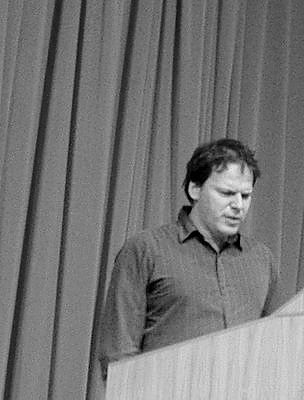
David Graeber in 2006.
Photo: Lorenz Khazaleh

My first encounter with him was here on antropologi.info. He commented om some reviews about his Fragments of an Anarchist Anthropology that I linked to and criticized some of his points. Two years later, we met at a conference about anthropology and cosmopolitanism in Britain and chatted a bit about anthropology and the internet and probably also about conference culture. I stíll remember very well that his presentation was one of the highlights, not only because of its content (“Democracy is no Western invention“), but also because of his presentation style. In contrast to most other paper givers, he was actually able to communicate with the audience and use normal language to express complex ideas.

Three years after the conference, in 2009, we ended up in a little fight here on this blog. He had just just signed a petition calling for boycotting Israel and I had blogged about it, using his name in the headline. He did not like this exposure. On the one hand his reaction was surprising, on the other hand it was somehow understandable: His activism had caused him lots of trouble already. A few years before this blog post he was fired from Yale, most likely because of his activism.

The most recent publication by him that I enjoyed is the audio book of his bestseller Bullshit Jobs: A Theory. I listened to it on long walks last summer. “Such a wise book”, I often thought while listening. “You learn so much more than just about the book’s topic. I definitely should blog about it.”

Many more substantial texts have been written about David Graeber’s death already, see among others David Graeber: 1961-2020 by Greg Downey at Neuroanthropology who links to a long post with many videos on the website heavy.com: David Graeber Dead: Anthropologist & Anti-Capitalist Thinker Behind ‘We Are the 99%’ Slogan Dies at 59. Interestingly, all major news sites write about him, see Deutsche Welle: Anthropologist and Occupy activist David Graeber dies or New York Times: David Graeber, Caustic Critic of Inequality, Is Dead at 59 and last time I checked David Graeber, anthropologist and author of Bullshit Jobs, dies aged 59 has been the most read news story on The Guardian.

UPDATES:

Tribute by his friend and anthropologist Vito Laterza on facebook:

Two books stand out from his impressive intellectual production:
– “Debt: the first 5000 years” – a masterly history of debt and how it has been leveraged against people and communities in historical and contemporary perspective.
– “Bullshit jobs: a theory” – a wide-ranging critique of the current system of worth and valuation of jobs that would make you think very differently about the “virtues” of the uncontrolled growth of managerialism and digitalisation in today’s companies and organisations. This work is particularly important to understand the current moment. As David noted in a recent Politico op-ed, the pandemic has clearly shown that those who perform the most important jobs are paid the least.

Anarchist dissident and historian Andrej Grubacic: In loving memory of our friend, comrade, and mentor…David Graeber Including the introduction from the forthcoming Mutual Aid: An Illuminated Factor of Evolution by David Graeber and Andrej Grubačić:

When he died, David had just completed his most recent book, one on which he worked for several years. He teamed up with British archeologist David Wengrow to challenge some of the more stubborn assumptions of mainstream social science. This was one of the most ambitious projects David embarked upon, and it should be published in 2021.

In Memoriam David Graeber by focaalblog with comments by several anthropologists, among others Don Kalb, University of Bergen:

David was the most important anthropologist of his generation and by far its most brilliant and effective public intellectual. He reached wider audiences than anyone of us, possibly even larger than Margaret Mead in anthropology’s heydays. His message was as revolutionary as hers, if not more so. It announced nothing less than an anthropology that would research, critique, and go beyond capitalism.

Or by Alpa Shah, London School of Economics:

I often thought of David Graeber as a genius. But of the many things that David taught me, it was that there is in fact a genius in each of us. We can’t see this because we don’t have the collective structures to realise the brilliance within us, because we live in a world that violently excludes the many, that reserves the acquisition of individual heroism for the few, a world today driven by finance capital.
For David, anthropology was important for it was a means to resurrect other possible more beautiful worlds, imagine societies other than our own exclusive one, figure out the larger implications, and then offer those ideas back to the world for an anti-capitalist politics.

David Graeber’s Strength – beautiful tribute by Olivier Coulaux at the footnotes blog:

In your intellectual life, you can sometimes get lucky, and be pulled into writings that give you the wonderful feeling of being released from your intellectual routines and shackles. Numerous people have seen this rupture as the necessary condition to engage in reflexive work. I remember experiencing this feeling more than a few times during my initiation into anthropology, and Graeber’s oeuvre never failed to make me feel that way.
(…)
What is about Graeber’s work that makes you look at your everyday routine, and that makes you feel like re-discovering it for the first time? And what is it that makes that perspective so important?

A few hours ago I was shocked to read that David Graeber has died. He was only 59 years old. Graeber was one the most known and most original anthropologists in the world. He was one of the leading figures…


Read more

The new Anthropology Journal Ticker (beta): Get updated with recent open access journal articles!

How do you stay up to date with the most recent journal articles in anthropology? How do you navigate the growing amount of texts? How do you find something interesting? While most academics might have their own personal routine, there is as far as I know no public overview online.

The overview over Anthropology Open Access Journals is one of the most visited pages on antropologi.info. I recently updated the list and and then used it to create The Anthropology Journal Ticker. This new site displays the most recent articles from more than 80 anthropology open access journals.

screenshot.

Currently it features articles from Mana, Cultural Anthropology, the Journal of Extreme Anthropology, the New Florida Journal of Anthropology, and Anuac on the front page.

Unfortunately I was not able to include all journals. The reason is that the only automated way to create such an overview works via RSS feeds. In the same way I created a few years ago The Anthropology Newspaper that displays the most recent blog posts. While all blogs publish RSS-feeds by default, this is not the case with journals. I found out that around one in three journals lack RSS feeds. But there are ways to create feeds for websites without feeds and I am exploring the options. With the Feed Creator by Fivefilters I was able to add the journals Cultural Anthropology andf Asian Ethnology to the list. RSS Bridge is another tool.

Categorizing the journals is no easy task. So far I only categorized them by language. Many journals are multilingual, though, they post articles in both English and Spanish for example. Selecting the category English will therefore also display posts in Spanish. I will have to find a better solution. As additionaly only very few journals tag their entries, I was looking for other ways to browse the content of this site. A good solution seems to be the Random Posts page. Each time you visit or refresh this page three random articles are displayed. Have a try!

Visit The Anthropology Journal Ticker at https://journals.antropologi.info

This site is work in progress. Let me know if there are journals to add and how to make the site more useful. Thanks!

Thanks to the Corona slowdown, I had time to do some work with antropologi.info – some updates behind the scenes, correcting dead links, working with the layout etc, I hope it stays like that!

SEE ALSO:

Do we (still) need journals?

screenshot

How do you stay up to date with the most recent journal articles in anthropology? How do you navigate the growing amount of texts? How do you find something interesting? While most academics might have their own personal routine,…

Read more

Racism, Circumcision, Suicide Bombing: The most viewed posts in 2017

Unfortunately no new content was published here last year. Nevertheless, this blog received lots of visitors. Looking at last year’s statistics about the most viewed posts and pages, I find three clear winners.

The three most viewed posts are:

1. The Five Major Challenges for Anthropology (4806 visits)

This post from 2006 is about the book Plausible Prejudice by Marianne Gullestad.To understand the problems of the world today, we need to “decolonize anthropological knowledge”, she writes.

2. Yes to female circumcision? (4254 visits)

This is also the most commented post on antropologi.info. It is about Sierra Leonean-American anthropologist Fuambai Ahmadu who attacks Western feminists, media and anti-Female Genital Mutilation campaigns and accuses them for presenting a one-sided, ethnocentric picture of female circumcision.

3. Free Open Access Anthropology Journals (3880 visits)

This is a regularily updated overview over Open Access journals in anthropology in several languages

The following posts and pages have significantly lower page views

4. Anthropologists condemn the use of terms of “stone age” and “primitive” (1508 visits)

A post about a statement by the ASA (Association of Social Anthropologists of the UK and Commonwealth) in 2007

5. The Anthropology Newspaper (1128 visits)

This pages provides an overview over the recent blog posts by anthropologists in English, German, and Scandinavian languages around the world.

6. Selected quotes from “On Suicide Bombing” (942 visits)

A post about a book by Talal Asad where he asks questions as: What actually is terrorism? What kind violence is labelled as “legitimate” and why? Is there really a big difference between soldiers at war and suicide bombers?

7. Lookism: Why we don’t want to be perceived as “ugly” or “different” (933 visits)

A review by Tereza Kuldova of “The Power of Looks. Social Stratification of Physical Appearance” by Bonnie Berry

8. Why anthropologists should become journalists (912 visits)

A post about an article by Brian McKenna in Counterpunch where he writes: “We need courses and programs in “Anthropology & Journalism” to help create the critical public intellectuals of the 21st century.”

9. Why we need more disaster anthropology (833 visits)

A post about Uy Ngoc Bui’s master’s thesis about the role of NGOs, the state and the people themselves’ in the period after typhoon Durian hit Bến Tre province in Southern Vietnam.

10. On African Island: Only women are allowed to propose marriage 759 (visits)

A post about an article in USA Today about negative consequences of Christian missionaries on an island who try to convince the islanders that it is men, not women, who should make the first move and propose.

11. The Anthropology of Suicide (722 visits)

A post after the death of a close friend. Suicide is best approached by getting out of the confines of biomedical sciences and into the domains of anthropology and sociology. A suicide is not primarily a sign of “that there was something wrong with a person”, but also that something might be wrong with society as a whole.

12. How racist is American Anthropology? (704 visits)

A post about the book Reversed Gaze by Kenyan anthropologist Mwenda Ntarangwi who conducted an anthropological study of American anthropology. Whereas Western anthropologists often study non-Western cultures, he studies “the Western culture of anthropology”.

13. The “illegal” anthropologist: Shahram Khosravi’s Auto-Ethnography of Borders (644 visits)

A post about Shahram Khosravi’s journey from Iran to Europe as “illegal” refugee whose life was saved by a human smuggler.

14.Thesis: Hijab empowers women (541 visits)

A post about Siham Ouazzif’s thesis “Veiled Muslim Women in Australian Public Space.

15. Lila Abu-Lughod: It’s time to give up the Western obsession with veiled Muslim women (515 visits)

A post about an article by Lila Abu-Lughod who critizes the images of Muslim women that are constructed in the “West” especially after 9/11.

Unfortunately no new content was published here last year. Nevertheless, this blog received lots of visitors. Looking at last year's statistics about the most viewed posts and pages, I find three clear winners.

The three most viewed posts are: …

Read more

A New Layout For The New Year

After 12 years it was time to update the layout of antropologi.info. I tried to keep some of the old elements while adjusting the look to our new times. The design still needs some tweaking, I will work on it during the holidays. If you encounter any errors, let me know!

Maybe one or two new posts might show up as well, one never knows. Since my last post in April this year, I was finally able to leave Egypt with my wife and move to Germany where I found a job as German teacher. This is a quite demanding job, so I will have to reserve a few hours during the weekends for blogging!

Anyway, this was just a short post to say hi, this blog is still alive! Enjoy the holidays if you have some, and all the best for the next year. See you soon!

After 12 years it was time to update the layout of antropologi.info. I tried to keep some of the old elements while adjusting the look to our new times. The design still needs some tweaking, I will work on it…

Read more

antropologi.info finally mobile friendly (and secure)

Today I have finally upgraded the antropologi.info’s blogging software (b2evolution, not WordPress!) and made its templates mobile friendly.

So, now, finally, antropologi.info no longer looks so weird when you visit it with your mobile phone. In my tests it looks ok now, let me know if it works for you.

The upgrade isn’t finished yet, there are still some things that have to be put in place, like search and new cover images. And here and there, things might not work as expected. On some pages, the sidebar does not show up for some strage reason. I’ll fix these things tomorrow, I hope. Feel free to report any issues you might face. Thanks!

Another thing: You may now access antropologi.info with https, partly at least. When the page includes elements from non-secure sites then most browsers will display a warning. This is the case with most pages on antropologi.info as images are referred to with their http://antropologi.info/media URL instead of the secure https://antropologi.info/media I will try to fix that as well. And maybe, soon there will be some new content as well… UPDATE: FIXED!

Today I have finally upgraded the antropologi.info's blogging software (b2evolution, not Wordpress!) and made its templates mobile friendly.

So, now, finally, antropologi.info no longer looks so weird when you visit it with your mobile phone. In my tests it looks ok…

Read more