

search expand

Open Access Anthropology in Africa – an introduction

logo

Heard of the Sudan Open Archive? Already taken a look at the recent anthropology papers of the University of Pretoria? Many universities in Africa have set up digital libraries, repositories for papers and theses that are freely accessible for everybody.

Here is a short overview over some repositories that also feature anthropology or anthropology related papers in English.

Sudan Open Archive

The Ethnography and Linguistics section of the Sudan Open Archive (SOA) includes papers like Report of The Field Research in Lafon, Eastern Equatoria State: Assessment of the General Conditions and Livelihoods of The Pari People by Eisei Kurimoto or “Presentation on Customary Mediation in the Sudan: Past, Present and Future” by Adam Al Zain Mohammed.

There are comprehensive sections on Conflict and Peace. There are lots of scanned older publications like the 1987-study The Dhein Massacre: Slavery in the Sudan by Ushari Ahmed Mahmud and Ushari Ahmed Ali Baldo.

University of Zimbabwe

screenshot

There is no anthropology department at the University of Zimbabwe, but a department of sociology. Among the six papers we find Anatomy of Alterity: Instrumental Identies Among the San in Zimbabwe by Gillian Chomutare and Elias Madzudo and Revival of Indigenous Food Security Strategies at the Village Level: The Human Factor Implications by Claude. G Mararike.

The Institute of Development Studies has published several papers, among them Plight of children in conflict and post – conflict societies: the case of Africa and Africa and Globalisation Revisited by Donald Chimanikire.

SOUTH AFRICA

We’ll find much more anthropology papers and theses at South African universities.

Rhodes University

screenshot

The anthropology section in the Rhodes eResearch Repository consists of five items. The most recent ones are the master’s theses The resurgence of tuberculosis in South Africa: an investigation into socio-economic aspects of the disease in a context of structural violence in Grahamstown, Eastern Cape by Ida Erstad and The rural-urban interface : the ambiguous nature of informal settlements, with special reference to the Daggafontein settlement in Gauteng by Sibongiseni Kumalo.

University of Johannesburg

There are 14 items in the Anthropology & Development Studies section, among them An analysis of the livelihoods of the Muyexe community located along the Kruger National Park in Limpopo Province by Mkhacani Makamu and Livelihood activities in female-headed households: Letlhakane village by Mamedupe Maggie Kgatshe.

University of Pretoria

7 anthropology papers, for example End of culture? Some directions for anthropology at the University of Pretoria by John Sharp and How equal is equal? A legal-anthropological note on the status of African women in South Africa by J.C. Bekker and C.C.Boonzaaier

University of Western Cape

6 papers by the Department of Anthropology and Sociology, among others Positive Muslims: a critical analysis of Muslim AIDS activism in relation to women living with HIV/AIDS in Cape Town by Abdul Kayum Ahmed and A critical analysis of the effects of tourism on cultural representation: a case study from Leboeng by Masete Mamadi.

University of Witwatersrand

Searching for anthropology gives five hits as for example The silence of colonial melancholy : The Fourie collection of Khoisan ethnologica by Ann Wanless

There are of course more depositories. My selection is based on the overview at http://www.opendoar.org – a website Peter Suber at Open Access News mentioned recently.

In October, Suber pointed to an article on Open Access in Africa that was discussed at Sciencebase.

SEE ALSO:

The resurgence of African anthropology

“Focalizar o que é comum aos seres humanos” / Open Access Anthropology in Brasil

Book and papers online: Working towards a global community of anthropologists

How can we create a more plural anthropological community?

Why open access?

logo

Heard of the Sudan Open Archive? Already taken a look at the recent anthropology papers of the University of Pretoria? Many universities in Africa have set up digital libraries, repositories for papers and theses that are freely accessible for everybody.…

Read more

Dissertation: Sexualisation of childhood?

cover

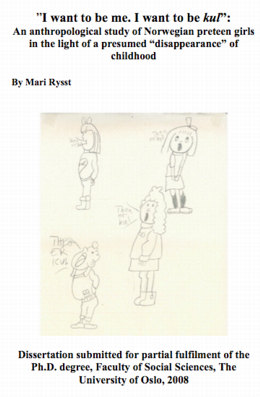
Tight jeans and short tops for seven year-old girls? When anthropologist Mari Rysst was out shopping clothes for her then seven year-old daughter she – to her dismay – mostly found clothes which imitated the teenage look. Seven years later she published her doctoral thesis “I want to be me. I want to be kul” An anthropological study of Norwegian preteen girls in the light of a presumed ‘disappearance’ of childhood.

In the introduction Rysst explains:

This study aims to explore gender constructions, sexuality and peer relationships among preteen Norwegian girls in the light of a presumed “disappearance” of childhood. The focus is on whether girls’ everyday lives are affected by what is currently expressed as the “sexualisation of childhood”. The sexualization of childhood forms part of the wider preoccupation that “childhood” is disappearing, as inferred by the above quotation.

But these fears seem to be exaggerated, she concludes:

By doing participant observation over a two year period in two school settings in Oslo, I concluded that the sexualisation of childhood exists in their social contexts and wider milieu, but does not dominate their overall everyday practices and mixed- gender relationships. These are still filled with sports activities and different forms of both traditional and particular play.

Most importantly, the ultimate indication of any (senior) sexualisation, how they “do love”, still qualifies as variants of “play”, not as older heterosexual practices. This is so because the love relationships are performed according to strict norms or rules. In the first place, they are directed and followed up by the peer community. In the second place, they are a collective rather than a private affair, and lastly, they include a minimum of physical intimacy. (…) The study shows how the subject positions of the kul and of girlfriend/boyfriend did not relate to images of the sexy before the peer group had reached puberty (being aware of individual exceptions).

The notion of the “pure childhood” is,she writes, rather Western – and paradoxical:

Understanding children and childhood in developmental terms has so far meant that children have to be protected from the “evils” of adult society (sex, drugs and violence) in order to become healthy adults. In particular, the positive potential of children can only be realized if they are not “spoiled” (too early) by the “impure” adult world.

In this lies a moral paradox: The ideal, pure childhood is not to involve a preparation for what children will inevitably be confronted with as youths and adults. The paradox is historically and culturally specific, having its roots in the Enlightenment and Rousseau’s perception of children as “pure” or “innocent” (Ariés 1962, James, Jenks and Prout 1998).

>> download the thesis

Mari Rysst has been several times in Norwegian media, see among others my post in Norwegian Doktorgrad: Barn mer opptatt av tauhopping enn G-streng

SEE ALSO:

Transforming the Anthropology of Childhood – Anthropology News April

New book critizises ethnographic methods in market research on children

“We want children to be their own ethnographers”

Anthropologist calls for a greater appreciation of child labor

Technologies of the Childhood Imagination- new text by anthropologist Mizuko Ito

Ethnographic Study: Social Websites Important For Childhood Development

cover

Tight jeans and short tops for seven year-old girls? When anthropologist Mari Rysst was out shopping clothes for her then seven year-old daughter she - to her dismay - mostly found clothes which imitated the teenage look. Seven years later…

Read more

What anthropologists and artists have in common

In the new issue of American Ethnography, we’ll find these words by anthropologist Martin Hoyem:

Artists, like ethnographers, train their eyes to see things other people don’t see. They try to present what they see so that we, the audience, can glimpse something where we have looked a thousand times and failed to find anything noteworthy.

He continues:

“Nothing exists until or unless it is observed,” wrote William Burroughs, in his 1992 Painting & Guns. (…) “An artist is making something exist by observing it. And his hope for other people is that they will also make it exist by observing it. I call it ‘creative observation’. Creative viewing.”

Anthropologists as creative viewers? Sounds good! The January issue includes two articles on the similarities and differences between artists and social scientists. In his article on Robert Frank’s famous photo book “The Americans”, Hoyem quotes anthropology professor Jay Ruby who wrote:

“Frank’s The Americans is a fundamental text. While he did behave like a field worker he knew nothing about ethnography. His contribution to photography was the virtual invention of a photographic narrative. Few have been able to equal it and in many ways it should be a model for ethnographic photographers to follow.”

>> read the whole article “This, upon reading The Americans”

>> Howard Becker: “Photography and Sociology” (republished from Studies in the Anthropology of Visual Communication, 1974).

SEE ALSO:

New e-zine: American Ethnography

The anthropology of nudity: New issue of American Ethnography Quasimonthly

Manga instead of scientific paper: How art enriches anthropology

Connecting Art and Anthropology

Photography as research tool: More engaged Kurdish anthropology

Anthropology, photography and racism

In the new issue of American Ethnography, we'll find these words by anthropologist Martin Hoyem:

Artists, like ethnographers, train their eyes to see things other people don't see. They try to present what they see so that we, the audience,…

Read more

Open access: Journal of Identity and Migration Studies

logo

Xenophobia in South Africa, labour mobility and economic development, minorities’ integration, representation of refugees and forced migrants in the British Economy are some of the topics in the most recent issue of Journal of Identity and Migration Studies.

The journal was founded a bit more than a year ago by The Research Centre for Identity and Migration Issues (RCIMI) at the University of Oradea in Romania. It was recently added to the Directory of Open Acces Journals.

It is an interdisciplinary journal on one of the most popular topics for anthropologists. So far, no anthropologists have contributed to it, though.

>> visit the journal’s website

logo

Xenophobia in South Africa, labour mobility and economic development, minorities’ integration, representation of refugees and forced migrants in the British Economy are some of the topics in the most recent issue of Journal of Identity and Migration Studies.

The journal was…

Read more

Humain Terrain anthropologist attacked in Afghanistan has died

(via ‘Ilm al-insaan) An anthropologist embedded with the U.S. Army in Afghanistan to help soldiers understand local customs has died more than two months after she was doused with fuel and set on fire, according to ap.

Anthropologist Paula Loyd, 36, had been chatting with an Afghan man about fuel prices when he suddenly attacked her. She worked for contractor BAE Systems in a Human Terrain Team, in which social scientists and anthropologists are embedded with combat brigades, according to court records.

She earned a cultural anthropology degree from Wellesley College and spent much of her career abroad.
According to BAE Systems Loyd served in Bosnia as a U.S. Army reservist, working on civil military affairs projects. She had spent significant time in Afghanistan, working as a civilian military officer for a United Nations Assistance Mission in Afghanistan, and also as a field program officer for the U.S. Agency for International Development in one of Afghanistan’s poorest provinces.

>> read the whole ap-story (link updated)

Oh I see there is also a story about her death in Wire Third ‘Human Terrain’ Researcher Dead and on Open Anthropology The Unreported Death of Staff Sgt. Paula Loyd of the Human Terrain System: Third Researcher to Die with lots of additonal resources (Open Anthropology seems to be the first to have reported on her death)

SEE ALSO:

More and more anthropologists are recruited to service military operations

“Anthropology = Smarter Counterinsurgency”

Cooperation between the Pentagon and anthropologists a fiasco?

The dangerous militarisation of anthropology

(via 'Ilm al-insaan) An anthropologist embedded with the U.S. Army in Afghanistan to help soldiers understand local customs has died more than two months after she was doused with fuel and set on fire, according to ap.

Anthropologist Paula Loyd,…

Read more