search expand

Launches new anthropology student e-journal

The Association of Student Anthropologists (NASA) would like to have submissions from anthropology students worldwide for their new e-journal. The NASA will launch its first online publication under the banner of the 2008 American Anthropological Association conference theme: “Inclusion, Collaboration, and Engagement”, as Marc Hebert (University of South Florida) informs me in an email.

They seek scholarly submissions from undergraduate and graduate students worldwide about the application of anthropological theories and methods outside of academia or across disciplines for the purpose of exploring, problematizing, or addressing social problems.

The NASA also welcomes “innovative commentary submissions” that “express the next generation of anthropologists’ ideas, goals and beliefs of the direction our discipline should head, be it locally, nationally or globally.”

>> read the whole Call for Papers in the antropologi.info forum

The Association of Student Anthropologists (NASA) would like to have submissions from anthropology students worldwide for their new e-journal. The NASA will launch its first online publication under the banner of the 2008 American Anthropological Association conference theme: "Inclusion, Collaboration,…

Read more

Ethnographic research: Why care about plagiarism?

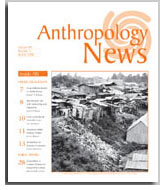
AN-cover

Educators complain about plagiarism. But it is not principally because material is too readily available that students copy and paste material from the internet to their papers. It’s because new forms of authorships are emerging online, anthropologist Susan D. Blum writes in Anthropology News March 2008.

Blum has done ethnographic research on plagiarism and college culture for three years at “Saint Pastoral’s” University.

Social websites like Wikipedia challenge the romantic notion of the author as the individual genius:

While the romantic notion of the author emphasized creation in a vacuum, without influence, touched only by inspiration from the individual’s genius, the new collectivized idea of the author celebrates the kind of creativity that comes from selecting, from accumulating a pastiche, a patchwork, a sample of others’ work. The line between creation and what “copyright fundamentalists” regard as theft is now completely— and consciously—fluid.

(…)

Collectively, one after another, contributors add to or edit Wikipedia articles, without directly requesting credit or payment. The living product is quite essentially collaborative, an accretion of many people’s words belonging to everyone and Common Sense and anthropological Sense no one simultaneously.

(…)

Sharing music, video, text and images is routine and simple on the “digital commons” with YouTube, Flickr and other file-sharing interfaces. Items often follow a circuitous path before they end up on some- one’s iPod or hard drive.

Maybe educators should care lass about plagiarism? Blum concludes:

Faculty can attempt to enforce traditional academic citation norms, but we are well advised to recognize that a large portion of the students we encounter do not share traditional academic values of originality, singularity and individualism in intellectual creation. In the area of authorship, educators’ common sense is not necessarily students’ common sense.

In some ways our students have become folk anthropologists, speaking out about the impossibility of singularity, the shared quality of discourse, the reality of fragments of texts incorporated into every utterance (or written document) and the collective nature of cultural creation. Now that’s a story!

>> read the whole article “The Internet, the Self, Authorship and Plagiarism” (pdf)

This is one of five articles on “Online Engagement” in Anthropology News March 2008.

SEE ALSO:

Interview with Michael Wesch: How collaborative technologies change scholarship

New media and anthropology – AAA meeting part III

Plans to study anthropological online communities and Open Access movement

AN-cover

Educators complain about plagiarism. But it is not principally because material is too readily available that students copy and paste material from the internet to their papers. It's because new forms of authorships are emerging online, anthropologist Susan D. Blum…

Read more

“Focalizar o que é comum aos seres humanos” / Open Access Anthropology in Brasil

cover

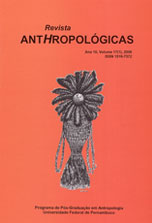
What do all humans have in common? My interview with anthropologist Christoph Antweiler in German about his book on cultural universalisms has been translated into Portuguese and will be published in the journal Revista ANTHROPOLÓGICAS. You can download the Portuguese translation here.

The text was translated by Peter Schröder, one of the editors of Revista ANTHROPOLÓGICAS. The journal is open access.

Open Access, he tells me, is supported by the Brazilian government. The best scientific journals are freely available on the Portal Scielo http://www.scielo.br Via the subject list, I found three more anthropology journals: Horizontes Antropológicos, Mana and Revista de Antropologia. Most of the articles are in Portuguese, only a few of them in English.

SEE ALSO:

Museum Anthropology Review goes open access

Already lots of publications in the open access anthropology repository Mana’o

Book and papers online: Working towards a global community of anthropologists

cover

What do all humans have in common? My interview with anthropologist Christoph Antweiler in German about his book on cultural universalisms has been translated into Portuguese and will be published in the journal Revista ANTHROPOLÓGICAS. You can download the Portuguese…

Read more

Museum Anthropology Review goes open access

screenshot

This morning, the journal Museum Anthropology Review was launched as an open access journal. The content that was published during 2007 (the journal’s first year) is now available in both HTML and PDF format – free for all readers all over the world.

Editor Jason Baird Jackson said that making scholarly work more easily and affordably accessible is especially important in fields like folklore and anthropology that are rooted in the study of local cultures worldwide:

“If, for instance, a scholar spends months documenting the work of an elderly woodcarver living in a small American town and then writes about what she learned in a peer-reviewed research article, I have an obligation as her editor to make it as easy as possible for the schoolchildren of that town — or the artist’s grandchildren — to gain access to her writing. Open access repositories and journals, in their varied forms, help make this possible.”

>> read the press release

>> more information on the Museum Anthropology Blog

>> website of the Museum Anthropology Review

UPDATE: Inside Higher Ed reports:

There are hundreds of scholarly journals published online, plenty of them free. But what makes Museum Anthropology Review’s launch notable is that it is being led by the same editor as the traditional journal, Museum Anthropology, using the exact same peer review system.

For years, the criticism of the free, online model has been that it would be impossible for it to replicate the quality control offered by traditional publishing. When online journal publishers have boasted of their quality control, print loyalists have said, in effect, “well maybe it’s good, but it can’t be as good as what we’re doing.”

To this subjective criticism, open access advocates can now point to someone who knows exactly what the standards are at both journals, as he’s leading them both.

>> read the whole article in Inside Higher Education

SEE ALSO:

Danah Boyd on Open Access: “Boycott locked-down journals”

Anthropology News February about Open Access Anthropology

2006 – The Year of Open Access Anthropology?

Why should anthropologists care about open access?

Open Access News

screenshot

This morning, the journal Museum Anthropology Review was launched as an open access journal. The content that was published during 2007 (the journal's first year) is now available in both HTML and PDF format - free for all readers all…

Read more

What anthropologists can do about the decline in world food supply

The UN Food and Agriculture Organisation (FAO) warns ominously of an ‘unforeseen and unprecedented’ decline in world food supply. Anthropologists should contribute their expertise and knowledge to this emerging problem, Solomon H. Katz writes in the current issue of Anthropology Today (accessible for subscribers only).

First, anthropologists are often on the ground in remote places in societies which should, but often do not, figure in the mainstream of news stories about food problems. By the nature of our work, anthropologists are often close to the centre of the most desperate problems. We need to report these problems, especially through blogs, wikis and other instant communications within our means.

Second, anthropologists need to communicate beyond our own field about these food problems – with other scientific disciplines, the media, public policy advocates and elected officials who can help implement corrective change. The economic community has begun to focus on the micro level, which is consonant with the anthropologist’s study of problems at the local level.

In the case of food problems, for example, we can share our knowledge of how households, villages and communities are being affected and are coping with the rapidly increasing price of food throughout the world, and we can do so without delay.

Third, anthropologists need to be fully involved in building increased lines of communication that represent their collective perspectives more effectively, and can provide new insights for the media and policy-makers and help change the way societies think and act on problems of global concern.
(…)
Finally, we need to help develop a systematic way for government policy affecting the human food chain to be tested before it is adopted, in order to avoid unintended consequences.

The anthropologist is mentioning an online wiki web page and database of reports from the field as part of a new ‘world food problems’ wiki that he launched in December 2007 at http://wfmo.pbwiki.com Unfortunately, it seems he has taken it down already as it is password protected.

Katz has organized a panel entitled ‘Food to Fuel’ that I organized for the annual meeting of the American Anthropological Association in Washington in December 2007.

He writes that the food crisis is the result of the sharp rise in competition between food and fuel, together with the higher costs of energy to produce and transport foods, the increased use of maize as animal feed in China and elsewhere, and the rapid changes in climate and rainfall patterns:

Last winter, within a month of Felipe Calderón taking office as the new president of Mexico, there were so many protests over the rise in corn prices induced by the US corn-to-ethanol policy that Calderón had to reverse his free trade philosophy and immediately fix corn prices or risk further street violence during the opening days of his presidency.

Similarly, the wheat price crisis has sparked street protests in Italy and Russia. In Africa there have been major protests, and the real spectre of food shortages this year resulting from prohibitively high prices looms in at least 37 countries.

UPDATE: The Guardian (26.2.08) reports Feed the world? We are fighting a losing battle, UN admits

SEE ALSO:

Malaysia: Penan people threatened by demand for “green” bio-fuels

Dissertation: Survival in the Rainforest

Global Migrants For Climate Action – Migrants organize to fight climate change

Thesis: How does EU influence the life of farmers in Finland?

Anthropology of Food – one more Open Access Journal!

The UN Food and Agriculture Organisation (FAO) warns ominously of an ‘unforeseen and unprecedented’ decline in world food supply. Anthropologists should contribute their expertise and knowledge to this emerging problem, Solomon H. Katz writes in the current issue of Anthropology…

Read more