search expand

Anna Tsing and Michael Fischer awarded book prize from the American Ethnological Association

Anna Tsing, professor of anthropology, has received the 2005 Senior Book Prize from the American Ethnological Association (AEA) for her book, Friction: An Ethnography of Global Connection (Princeton University Press, 2004). Tsing shares the prize with Michael Fischer, professor of anthropology and science and technology studies at MIT, who was honored for his book Emergent Forms of Life and the Anthropological Voice, University of Santa Cruz reports:

In Friction, Tsing challenges the widespread view that globalization invariably signifies a “clash” of cultures, and she develops the concept of friction in its place as a metaphor for the diverse and conflicting social interactions that make up our contemporary world. She focuses on the Indonesian rainforest, where local and national environmentalists, international science, North American investors, advocates for Brazilian rubber tappers, UN funding agencies, mountaineers, village elders, and urban students, among others, all combine in unpredictable, messy misunderstandings, but misunderstandings that sometimes work out.

>> read the whole story

Amazon writes on Fischers book:

A vigorous advocate of the anthropological voice and method, Fischer emphasizes the ethical dimension of cultural anthropology. Ethnography, he suggests, is uniquely situated to gather and convey observations fundamental to the creation of new social institutions for an evolving civil society. In Emergent Forms of Life and the Anthropological Voice Fischer considers a dazzling array of subjects—among them Iranian and Polish cinema, cyberspace, autobiographical and fictional narrative, and genomic biotechnologies—and, in the process, demonstrates a cultural anthropology for a highly networked world.

Anthropology, Fischer explains, now operates in a series of third spaces well beyond the nineteenth- and twentieth-century dualisms of us/them, primitive/civilized, East/West, or North/South. He contends that more useful paradigms—such as informatics, multidimensional scaling, autoimmunity, and visual literacy beyond the frame—derive from the contemporary sciences and media technologies.

Anna Tsing, professor of anthropology, has received the 2005 Senior Book Prize from the American Ethnological Association (AEA) for her book, Friction: An Ethnography of Global Connection (Princeton University Press, 2004). Tsing shares the prize with Michael Fischer, professor of…

Read more

Why anthropology fails to arouse interest among the public – Engaging Anthropology (2)

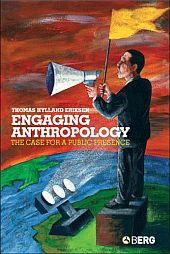
As anthropology has grown, its perceived wider relevance has diminished. Why is this so? In his second chapter in the book Engaging Anthropology, Norwegian anthropologist Thomas Hylland Eriksen gives us several possible explanations. On the one hand, there are external factors f.ex. recent university reforms, inspired by neoliberalist marked theories:

Universities are being turned into factories. Academics have, as a consequence, lost much of the time they could formerly devote to engagement in greater society. (…) The ongoing formalisation of the recognition of skills through never-ending evaluations of research, auditing and other forms of “professionalisation” threatens to take the creativity out of academic life, and also contributes to isolating it further from society. (…) Students are no longer encouraged to be intellectuals, but to specialize and become professionals.

But the main reasons for the diminishing role of anthropology lie within the discipline. Hylland Eriksen lists several “recipes for cocooning”:

Recipe Nr 1: Elitism:

Anthropology, unlike some other academic disciplines, has yet to escape fully from the mouldy lounges and pompous hallways of pre-war university life. In spite of the demographic explosion it has gone through since the Second World War, and in spite of the democratization of higher education, anthropology somehow remains an elite subject in the English-speaking world.

(…)

The early predominance of minorities and women at the very center of the discipline was significant. Evans-Pritchard’s generation did not even want anthropology to be taught as an undergraduate subject. In Britain, the subject remains dominated by the department of the elite universities.

(…)

In spite of its considerable growth, anthropology still cultivates its self-identity as a counter-culture, its members belonging to a kind of secret society whose initiates possess exclusive keys for understanding, indispensable for making sense of the world, but alas, largely inaccessible for outsiders.

Recipe 2: Myopic specialisation resulting from “my ethnography”

The malinowskian glorification of the detailed, synchronic single-society study encourages specialization and gives the highest marks to the colleague who remains loyal to her fieldnotes thoughout her career

Recipe 3: Insisting on irreducible complexity

Anthropologists are skilled at exposing oversimplifications. This is one of our disciplines strengths, but complex answers are non marketable commodities with respect to the mass media and the general reader, as we all know. Few monographs or even articles have a simple point to make, most anthropologists are reluctant to simplify their insights. But there are exceptions, f.ex. Levi Strauss – one “of the normally least readable anthropologists”):

Levi-Strauss’ Myth and Meaning (1978) and his interview book with Didier Eribon, De Pres et de Loin (1988), convey the main elements in his structuralism and his intellectual vision without losing, presumably, a single potential reader on the way. Many of us have something to learn from Levi-Strauss in this regard.

Recipe 4: The post-colonial critiques and the loss of the native:

After the post-colonial critique of Western representations, the collaps of classic cultural relativism and the damaging postmodernist autocritique of the 1980s, anthropology has become modest in its claims, introverted in its intellectual perspective and even more reluctant than before to raise the big issues in generally intelligible ways

Recipe 5: Anthropology as a subversive kind of activity

There might be totally different explanations for the failure of anthropology to sustain a visible public presence:

One should not rule out the possibiliy that anthropologists are often understood, but disagreed with – its perspectives threaten to subvert values and ideas held dear by its potential non-academic audience. The very idea of anthropology as a cultural (auto)critique (…) presupposes that there is a great demand for cultural self-criticism out there. This, plainly, may not be the case.

Recipe 6: Priviledging analysis over narrative

Anthropologists are bad writers! This is Hylland Eriksens most important argument:

To my mind, the single most important characteristic of anthropological writings is that it tends to be chiefly analytical. This means that it is more difficult to get into and less easy to remember than narratives. Stories are the stuff of life; analysis is for specialists. (…) There is a tendency to combine a penchant for complexity with a lack of engaging, sustained narrative. (…) As a result, it appears that anthropological texts are readable only by other anthropologists, who have learnt – the hard way – to read them.

But there are exceptions. He mentiones Katy Gardner’s “Songs from Rivers Edge. Stories from a Bengladeshi River (1997)” and Tristes Tropiques by Claude Livi-Strauss (1978).

The problem:

There are many brilliant narratives in anthropological literature, but they’re usually hidden in analysis. (…) History is almost alone among academic subjects to fuse original research and popular writing in the very same texts

MORE ABOUT ENGAGING ANTHROPOLOGY:

The Secret of Good Ethnographies – Engaging Anthropology Part III

More and more anthropologists, but they’re absent from public debates – “Engaging Anthropology” (Part I)

SEE ALSO

Archive: Knowledge Sharing and Open Access Anthropology

As anthropology has grown, its perceived wider relevance has diminished. Why is this so? In his second chapter in the book Engaging Anthropology, Norwegian anthropologist Thomas Hylland Eriksen gives us several possible explanations. On the one hand, there are external…

Read more

More and more anthropologists, but they’re absent from public debates – “Engaging Anthropology” (1)

book “Anthropology is exceptionally relevant as a tool for understanding the contemporary world, yet it is absent from nearly every important public debate in the Anglophone world. In fact, it has almost gone underground in the English-speaking world. Paradoxically, as the discipline has grown, its perceived wider relevance has diminished. There are more of us anthropologists than ever before, yet fewer reach out to communicate with a wider world”, Thomas Hylland Eriksen writes in his new book “Engaging Anthropology”.

I’ve just started reading the book and am going to blog more about it the following days. Some of the questions raised in the book are: How can anthropology become more relevant for the “outside world”? What has anthropology to offer? Why do anthropologists fail to engage a wider public?

Thomas Hylland Eriksen takes up issues that have been widely discussed in the anthropological blogosphere before, f.ex. the unwillingness to share knowledge:

Anthropologists have an enormous amount of knowledge about human lives and most of them know something profound about what it is that makes people different and what makes us all similar. Yet there seems to be a professional reluctance to share this knowledge with a wider readership. Translating from other cultures is what we are paid to do; translating for the benefit of readers outside the in-group seems much less urgent.

Anthropologists, he criticizes, present their research findings in a way “that turns almost the entire potential readership off”:

The problem is that all these fine analytic texts, often brimming with insights and novel angles, rarely build bridges connecting them with the concerns of nonspecialists. Also, they are far too rarely supplemented by writings aimed at engaging a wider readership. (…) When did you last read a proper page-turner written by an anthropologist?

It was not always like this, he goes on. In the mid-twentieth century, in the days of Mead, Montagu and Evans-Pritchard, anthropologists were engaged in general intellectual debate and occasionally wrote popular, yet intellectually challenging texts. But as the discipline has grown, its perceived wider relevance has diminished. Since the Second World War, Hylland Eriksen writes, anthropology has shrunk away from the public eye in almost every country where it has an academic presence (Norway is an exception):

Scholarly works of great and enduring importance were published from the 1960s to the 1980s by Claude Lévi-Strauss, Mary Douglas, Victor Turner etc. Yet, the response from the nonacademic world was negligible, and this generation seemed to have no Margaret Mead to take current ideas and run with them. The discipline had become almost self-contained.

There are many possible ways of engaging a readership, he writes and gives some examples. He encourages anthropologists to write more personally engaged ethnographies. There is no contrast between professionalism and engagement:

I suspect that not a few anthropologists have lost their original motivation for studying the subject – understanding Humanity, or changing the world – on the way, replacing it with the intrinsic values of professionalism. And yet, just as the anthropological travelogue may be complementary to the monograph, the engaged pamphlet can often be a necessary complement to the analytical treatise. However, that pamphlet is written too rarely. It gives no points in the academic credit system, it may cause embarrassment among colleagues and controversy to be sorted out by oneself. The easy way out, and the solution most beneficial to one’s career, consists in limiting oneself to scholarly work.

Another suggestion: Anthropologists should write more essays:

Assuming that Leach was right in claiming that most anthropologists were failed novelists, here is a chance to become a truly creative writer without having to invent persons and events. The essay, unlike the article, is inconclusive. It plays with ideas, juxtaposing them, trying them out, discarding some ideas on the way, following others to their logical conclusion. In the essay, the writer sees the reader as an ally and fellow-traveller, not as an antagonist to be defeated or persuaded. The essay appeals to the reader’s common sense, it may occasionally address him directly, and the essayist tries to ensure that the reader follows her out on whichever limb she is heading for.

Strangely enough for us behind the screens: Hylland Eriksen doesn’t mention blogging. Blogs are as experimental as the essay form (or rather more). Additionally, blogs invite the reader to discuss with the anthropologist.

You can read the whole first chapter on Thomas Hylland Eriksens homepage.

UPDATE – MORE ON THIS BOOK:

Why anthropology fails to arouse interest among the public – Engaging Anthropology (2)

The Secret of Good Ethnographies – Engaging Anthropology (3)

UPDATE: Alun Salt writes:

Engaging Anthropology looks like it will be a fascinating book to read. There’s a post about it on antropologi.info. One of my favourite books is Popularizing Anthropology by McClancy and McDonaugh which makes a strong argument that if anthropology (and science) is publically funded then there is an obligation to make your results accessible to the public. They also make the argument that popular does not automatically mean unscholarly.

SEE ALSO:

Marshall Sahlins wants to make the Internet the new medium for traditional pamphleteering

Open Source Anthropology : Are anthropologists serious about sharing knowledge?

“Minimal willingness to post one’s own work online”, survey by the American Anthropological Association reveals

The Future of Anthropology: “We ought to build our own mass media”

book

"Anthropology is exceptionally relevant as a tool for understanding the contemporary world, yet it is absent from nearly every important public debate in the Anglophone world. In fact, it has almost gone underground in the English-speaking world. Paradoxically, as the…

Read more

Ethnography for Marketers: “A pretty tragic book”

Ethnography is a buzz-word in the marketing industry. But do anthropologists and markerters have the same understanding of what it means to be a good ethnographer? Maybe not according a new book that anthropologist Simon Roberts from Ideas Bazaar reviewed: Ethnography for Marketers by Hy Mariampolski. A quite tragic book, he writes, as it focuses too much on the practical, on how an ethnography project is set up:

To focus so strongly on the fieldwork seems to me to reveal the dynamics of the market research industry itself: namely ‘fetishise’ the method, commodify it and then sell it by the unit. Ethnography offers the opportunity to sell thinking not research, but this book offers little in the way of insight into how to think ethnographically.

(…)

This focus on the practical and logistical is understandable but it betrays a common confusion as to what ethnography is, its roots and how this informs what we do as researchers and what we give our clients. Mariampolski seems to be writing about one aspect of ethnography, the act of doing fieldwork, focusing almost exclusively on being in the field. Ethnography, however, is as much about interpretation, the post-fieldwork-fieldwork, as it is conducting participant observation.

>> read the whole review

Ethnography is a buzz-word in the marketing industry. But do anthropologists and markerters have the same understanding of what it means to be a good ethnographer? Maybe not according a new book that anthropologist Simon Roberts from Ideas Bazaar…

Read more

Why cellular life in Japan is so different – Interview with anthropologist Mizuko Ito

Technology Review interviews anthropologist Mizuko Ito. Ito has studied the use of mobile phones for six years and is editor of a new book “Personal, Portable, Pedestrian: Mobile Phones in Japanese Life”. Cell phones are used differently depending partly on the way the technology is rolled out, and partly on the culture of each country. She became interested in studying mobile culture partly because mobile technology use in Japan was being driven by young girls:

It’s fairly unusual that teenage girls are seen as technology innovators, so it was a really attractive case for me for a lot of reasons.

In the interview she argues for a kind of culture relativism regarding technological development. You can’t really say the United States should feel that they are “behind” Japan when it comes to cell phone technology, because their technology trajectory has been completely different.

>> read the whole interview

SEE ALSO:

Mizuku Ito’s website

Studying Keitai (or ‘Mobile Phones’ in Japanese) (SavageMinds on Ito’s book)

How Mobile Phones Conquered Japan (Wired News)

More Reviews of Mizuko Ito’s book “Personal, Portable, Pedestrian”

Technologies of the Childhood Imagination- new text by anthropologist Mizuko Ito

Technology Review interviews anthropologist Mizuko Ito. Ito has studied the use of mobile phones for six years and is editor of a new book "Personal, Portable, Pedestrian: Mobile Phones in Japanese Life". Cell phones are used differently depending partly on…

Read more