
search expand

“Focalizar o que é comum aos seres humanos” / Open Access Anthropology in Brasil

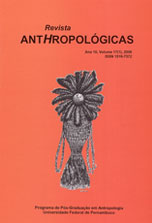
cover

What do all humans have in common? My interview with anthropologist Christoph Antweiler in German about his book on cultural universalisms has been translated into Portuguese and will be published in the journal Revista ANTHROPOLÓGICAS. You can download the Portuguese translation here.

The text was translated by Peter Schröder, one of the editors of Revista ANTHROPOLÓGICAS. The journal is open access.

Open Access, he tells me, is supported by the Brazilian government. The best scientific journals are freely available on the Portal Scielo http://www.scielo.br Via the subject list, I found three more anthropology journals: Horizontes Antropológicos, Mana and Revista de Antropologia. Most of the articles are in Portuguese, only a few of them in English.

SEE ALSO:

Museum Anthropology Review goes open access

Already lots of publications in the open access anthropology repository Mana’o

Book and papers online: Working towards a global community of anthropologists

cover

What do all humans have in common? My interview with anthropologist Christoph Antweiler in German about his book on cultural universalisms has been translated into Portuguese and will be published in the journal Revista ANTHROPOLÓGICAS. You can download the Portuguese…

Read more

Professor lets students blog their field experiences: More than 20 new blogs online!

Anthropology professor Joe Rubenstein has started an interesting project: Students in his course “Field Methods” are expected to blog their field experiences (it seems). Their research topic is teens and adolescence.

“The purpose of writing on our blogs is to keep each other and ourselves informed and up to date on what is going on for *Adolescent* field work project”, Danielle explains.

The students are about to meet their first informants. Take a look at the long list of student field blogs on Rubensteins blog (at the bottom of the left sidebar).

Lots of interesting posts in the professor’s blog as well, for example On Doing Fieldwork where he helps us organizing one’s thoughts for the Weblog methods reflections and lists some useful fieldwork websites.

SEE ALSO:

Open Source Fieldwork! Show how you work!

On fieldwork: “Blogging sharpens the attention”

Paper by Erkan Saka: Blogging as a Research Tool for Ethnographic Fieldwork

“Knowledge of the bigger context is crucial for successful fieldwork”

antropologi.info survey: Six anthropologists on Anthropology and Internet

Anthropology professor Joe Rubenstein has started an interesting project: Students in his course "Field Methods" are expected to blog their field experiences (it seems). Their research topic is teens and adolescence.

"The purpose of writing on our blogs is to…

Read more

Museum Anthropology Review goes open access

screenshot

This morning, the journal Museum Anthropology Review was launched as an open access journal. The content that was published during 2007 (the journal’s first year) is now available in both HTML and PDF format – free for all readers all over the world.

Editor Jason Baird Jackson said that making scholarly work more easily and affordably accessible is especially important in fields like folklore and anthropology that are rooted in the study of local cultures worldwide:

“If, for instance, a scholar spends months documenting the work of an elderly woodcarver living in a small American town and then writes about what she learned in a peer-reviewed research article, I have an obligation as her editor to make it as easy as possible for the schoolchildren of that town — or the artist’s grandchildren — to gain access to her writing. Open access repositories and journals, in their varied forms, help make this possible.”

>> read the press release

>> more information on the Museum Anthropology Blog

>> website of the Museum Anthropology Review

UPDATE: Inside Higher Ed reports:

There are hundreds of scholarly journals published online, plenty of them free. But what makes Museum Anthropology Review’s launch notable is that it is being led by the same editor as the traditional journal, Museum Anthropology, using the exact same peer review system.

For years, the criticism of the free, online model has been that it would be impossible for it to replicate the quality control offered by traditional publishing. When online journal publishers have boasted of their quality control, print loyalists have said, in effect, “well maybe it’s good, but it can’t be as good as what we’re doing.”

To this subjective criticism, open access advocates can now point to someone who knows exactly what the standards are at both journals, as he’s leading them both.

>> read the whole article in Inside Higher Education

SEE ALSO:

Danah Boyd on Open Access: “Boycott locked-down journals”

Anthropology News February about Open Access Anthropology

2006 – The Year of Open Access Anthropology?

Why should anthropologists care about open access?

Open Access News

screenshot

This morning, the journal Museum Anthropology Review was launched as an open access journal. The content that was published during 2007 (the journal's first year) is now available in both HTML and PDF format - free for all readers all…

Read more

Open Access: South Asia Multidisciplinary Academic Journal

Migration and Constructions of the Other is the topic of the first (and most recent) issue of the Open Access journal South Asia Multidisciplinary Academic Journal.

According to their self-description, the journal “seeks to ‘democratize’ research-based studies on South Asia by giving them a greater visibility through a free and worldwide access. It is the “first academic and peer-reviewed on-line journal devoted to social sciences studies on South Asia.” It covers studies in history, geography, anthropology, sociology, political science and economy.

The next issue (due in Spring 2008) will deal with the mobilization of ‘offended communities’ in South Asia.

>> visit the journal’s website

Migration and Constructions of the Other is the topic of the first (and most recent) issue of the Open Access journal South Asia Multidisciplinary Academic Journal.

According to their self-description, the journal "seeks to ‘democratize’ research-based studies on South Asia…

Read more

ScientificCommons.org – The Open Access Search Engine

UPDATE: ScientificCommons was closed down in 2014

How can I find research papers and theses that are freely available? ScienceCommons is a search engine and portal that is still in beta but now lists 893 repositories (according to Peter Suber at Open Access News). A search for anthropology gives more that 44 000 hits but a quick check reveals that not all papers or theses are open access.

ScientificCommons.org is a project of the University of St.Gallen (Switzerland) and hosted and developed at the Institute for Media and Communications Management:

The major aim of the project is to develop the world’s largest communication medium for scientific knowledge products which is freely accessible to the public. A key challenge of the project is to support the rapidly growing number of movements and archives who admit the free distribution and access to scientific knowledge

>> visit ScientificCommons

There is another search engine as well: OAIster. There a search for anthropology gives 54679 records – but also included some papers with restricted access (f.ex. from journals like Current Anthropology)

See also 2007 Highlights over at Savage Minds: “2007 was a great year for the open access movement”.

SEE ALSO:

Already lots of publications in the open access anthropology repository Mana’o

2006 – The Year of Open Access Anthropology?

For Open Access: “The pay-for-content model has never been successful”

UPDATE: ScientificCommons was closed down in 2014

How can I find research papers and theses that are freely available? ScienceCommons is a search engine and portal that is still in beta but now lists 893 repositories (according to Peter Suber at…

Read more