
search expand

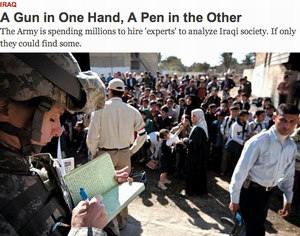
Cooperation between the Pentagon and anthropologists a fiasco?

newsweek

The collaboration between the U.S. military and anthropologists has been criticized for both political and ethical reasons. According to a recent article in Newsweek, the whole project could end as a fiasco: The implementation of the $40 million project has fallen short, according to more than a dozen people involved in the program that were interviewed by Newsweek.

Recruitment appears to have been mishandled from the start, with administrators offering positions to even marginally qualified applicants:

Several team members say they were accepted after brief phone interviews and that their language skills were never tested. As a result, instead of top regional experts, the anthropologists sent to Iraq include a Latin America specialist and an authority on Native Americans. One is writing his Ph.D. dissertation on America’s goth, punk and rave subcultures.
(…)
Of 19 Human Terrain members operating in five teams in Iraq, fewer than a handful can be described loosely as Middle East experts, and only three speak Arabic. The rest are social scientists or former GIs who (…) are transposing research skills from their unrelated fields at home.
(…)
Most team members admit they are hampered by an inability to conduct real fieldwork in a war zone. Some complain that the four-month training they underwent in the States was often a waste of time.

Matt Tompkins, who returned home in January after five months in Iraq, said he thought his team provided helpful input to its brigade, but the contribution was more superficial than planners of the program had conceived. “Without the ability to truly immerse yourself in the population, existing knowledge of the culture … is critical,” he said in an e-mail. “Lacking that, we were basically an open-source research cell.”

Actually, language skills and the fact that you have been to Iran to attend academic conferences can make you suspicious – as it was the case with Zenia Helbig, a 31-year-old doctoral student at the University of Virginia with a concentration in Islamic studies and proficiency in both Farsi and Arabic. She had according to Newsweek one of the more impressive résumés of all the recruits.

She says:

“The running joke was that I was clearly a spy and the only question was which country I worked for.”

The articles continues:

The banter turned ugly when, over beers one night, team members began speculating whether the U.S. military would eventually be called on to invade Iran. In the jocular spirit of the moment, Helbig made what she now describes as a careless remark: “I said, ‘OK, if we invade Iran, that’s where I draw the line, hop the border and switch sides’.” In an academic setting, the comment might not have been particularly shocking. Her supervisors settled for a rebuke. But an officer in the program complained to security officials at Fort Leavenworth whose investigation led to her dismissal.

>> read the whole story in Newsweek

According to Wire, “Human Terrain Teams are hopping mad about the Newsweek article” and anthropologist Montgomery McFate, one of the main architects of the human terrain teams, wrote a lengthy response >> read the letter

UPDATE: The American Anthropological Association (AAA) has also responded to the Newsweek article. >> read the letter to the editor on AAAs website

Furthermore, Maximilian Forte has written several related posts recently, see Reviewing the AAA’s Report on Anthropology and the Military and American Anthropologists against Counterinsurgency: Part Two.

SEE ALSO:

The dangerous militarisation of anthropology

Anthropology and CIA: “We need more awareness of the political nature and uses of our work”

Protests against British research council: “Recruits anthropologists for spying on muslims”

Oppose participation in counter-insurgency! Network of Concerned Anthropologists launched

Savage Minds: The Fate of McFate – Anthropology’s Relationship with the Military Revisited

“Tribal Iraq Society” – Anthropologists engaged for US war in Iraq

Military spies invade anthropology conferences?

“Arabs and Muslims should be wary of anthropologists”

San Jose: American Anthropologists Stand Up Against Torture and the Occupation of Iraq and AAA Press Release: Anthropologists weigh in on Iraq, torture at annual meeting

“War on terror”: CIA sponsers anthropologists to gather sensitive information / see also debate on this on Savage Minds

Two Books Explore the Sins of Anthropologists Past and Present

newsweek

The collaboration between the U.S. military and anthropologists has been criticized for both political and ethical reasons. According to a recent article in Newsweek, the whole project could end as a fiasco: The implementation of the $40 million project has…

Read more

Ethnographic research: Why care about plagiarism?

AN-cover

Educators complain about plagiarism. But it is not principally because material is too readily available that students copy and paste material from the internet to their papers. It’s because new forms of authorships are emerging online, anthropologist Susan D. Blum writes in Anthropology News March 2008.

Blum has done ethnographic research on plagiarism and college culture for three years at “Saint Pastoral’s” University.

Social websites like Wikipedia challenge the romantic notion of the author as the individual genius:

While the romantic notion of the author emphasized creation in a vacuum, without influence, touched only by inspiration from the individual’s genius, the new collectivized idea of the author celebrates the kind of creativity that comes from selecting, from accumulating a pastiche, a patchwork, a sample of others’ work. The line between creation and what “copyright fundamentalists” regard as theft is now completely— and consciously—fluid.

(…)

Collectively, one after another, contributors add to or edit Wikipedia articles, without directly requesting credit or payment. The living product is quite essentially collaborative, an accretion of many people’s words belonging to everyone and Common Sense and anthropological Sense no one simultaneously.

(…)

Sharing music, video, text and images is routine and simple on the “digital commons” with YouTube, Flickr and other file-sharing interfaces. Items often follow a circuitous path before they end up on some- one’s iPod or hard drive.

Maybe educators should care lass about plagiarism? Blum concludes:

Faculty can attempt to enforce traditional academic citation norms, but we are well advised to recognize that a large portion of the students we encounter do not share traditional academic values of originality, singularity and individualism in intellectual creation. In the area of authorship, educators’ common sense is not necessarily students’ common sense.

In some ways our students have become folk anthropologists, speaking out about the impossibility of singularity, the shared quality of discourse, the reality of fragments of texts incorporated into every utterance (or written document) and the collective nature of cultural creation. Now that’s a story!

>> read the whole article “The Internet, the Self, Authorship and Plagiarism” (pdf)

This is one of five articles on “Online Engagement” in Anthropology News March 2008.

SEE ALSO:

Interview with Michael Wesch: How collaborative technologies change scholarship

New media and anthropology – AAA meeting part III

Plans to study anthropological online communities and Open Access movement

AN-cover

Educators complain about plagiarism. But it is not principally because material is too readily available that students copy and paste material from the internet to their papers. It's because new forms of authorships are emerging online, anthropologist Susan D. Blum…

Read more

Plans to study anthropological online communities and Open Access movement

Anthropology of anthropology: How do anthropologists form online communities? How are open access publishing and other developments that have sprung up online changing community boundaries? Soon, an anthropologist will do fieldwork among us online anthropologists. http://nodivide.wordpress.com/ is the address of the blog by anthropologist Owen Wiltshire, grad student at Concordia University, Montreal, where he writes:

I am interested in collaborative research methods, and the growth of anthropology online. (…) I’m particularly interested in open-access journals, and feel that opening up academic publishing is an enormously important step for anthropology.

(…)

Delving into the interesting colonial history of anthropology, and into discussions of globalization and neoliberal economic injustice, it’s pretty easy to see how it makes sense to make anthropological work freely available to the world that it studies.

In this way I’ll be exploring ways to study online communities – in this case communities of anthropologists. Its an exciting time for anthropology online. I’ve been following anthropology blogs for a year now, and its amazing how fast its growing. Its quite inspiring, and I think reflects a very vibrant community thats just itching to work (and fight) with each other!

So while my research proposal is extremely vague, and I’ve been made aware of this, I’m absolutely confident that the internet, blogs, and the desire to liberate anthropological knowledge from the world economy are fueling a change in anthropology, and that within this excitement I’ll find an interesting “field” of study.

In an email to me he tells that he’ll be handing in a proposal in April and hopefully be doing fieldwork over the summer. He has already been investigating the ways faculty at Concordia University use the internet in classroom, and is working on getting access to an anthropological journal to investigate the publishing world “face to face”.

Owen Wiltshire worked as a web developer for a number of years prior to studying anthropology: “I’ve always followed developments in open source – so I’m excited to see how similar developments work their way into academic culture”, he writes.

>> visit Owen Wiltshire’s blog “Just another anthro blog”

SEE ALSO:

Interview with Michael Wesch: How collaborative technologies change scholarship

antropologi.info survey: Six anthropologists on Anthropology and Internet

Anthropology of anthropology: How do anthropologists form online communities? How are open access publishing and other developments that have sprung up online changing community boundaries? Soon, an anthropologist will do fieldwork among us online anthropologists. http://nodivide.wordpress.com/ is the address of…

Read more

Museum Anthropology Review goes open access

screenshot

This morning, the journal Museum Anthropology Review was launched as an open access journal. The content that was published during 2007 (the journal’s first year) is now available in both HTML and PDF format – free for all readers all over the world.

Editor Jason Baird Jackson said that making scholarly work more easily and affordably accessible is especially important in fields like folklore and anthropology that are rooted in the study of local cultures worldwide:

“If, for instance, a scholar spends months documenting the work of an elderly woodcarver living in a small American town and then writes about what she learned in a peer-reviewed research article, I have an obligation as her editor to make it as easy as possible for the schoolchildren of that town — or the artist’s grandchildren — to gain access to her writing. Open access repositories and journals, in their varied forms, help make this possible.”

>> read the press release

>> more information on the Museum Anthropology Blog

>> website of the Museum Anthropology Review

UPDATE: Inside Higher Ed reports:

There are hundreds of scholarly journals published online, plenty of them free. But what makes Museum Anthropology Review’s launch notable is that it is being led by the same editor as the traditional journal, Museum Anthropology, using the exact same peer review system.

For years, the criticism of the free, online model has been that it would be impossible for it to replicate the quality control offered by traditional publishing. When online journal publishers have boasted of their quality control, print loyalists have said, in effect, “well maybe it’s good, but it can’t be as good as what we’re doing.”

To this subjective criticism, open access advocates can now point to someone who knows exactly what the standards are at both journals, as he’s leading them both.

>> read the whole article in Inside Higher Education

SEE ALSO:

Danah Boyd on Open Access: “Boycott locked-down journals”

Anthropology News February about Open Access Anthropology

2006 – The Year of Open Access Anthropology?

Why should anthropologists care about open access?

Open Access News

screenshot

This morning, the journal Museum Anthropology Review was launched as an open access journal. The content that was published during 2007 (the journal's first year) is now available in both HTML and PDF format - free for all readers all…

Read more

(updated) Danah Boyd on Open Access: “Boycott locked-down journals”

“This is the last article that I will publish to which the public cannot get access. I am boycotting locked-down journals and I’d like to ask other academics to do the same”, writes Danah Boyd on her blog:

On one hand, I’m excited to announce that my article “Facebook’s Privacy Trainwreck: Exposure, Invasion, and Social Convergence” has been published in Convergence 14(1) (special issue edited by Henry Jenkins and Mark Deuze).

On the other hand, I’m deeply depressed because I know that most of you will never read it. It is not because you aren’t interested (although many of you might not be), but because Sage is one of those archaic academic publishers who had decided to lock down its authors and their content behind heavy iron walls.

What’s the point of writing papers if no one can read them? The journals are “god-awful expensive and no one outside of a niche market knows what’s in them”, she writes:

Digital copies of the articles have intense DRM protection, often with expiration dates and restrictions on saving/copying/printing. Authors must sign contracts vowing not to put the articles or even drafts online. (Sage -allows- you to posts articles one year following publication.) Academic publishers try to restrict you from making copies for colleagues, let alone for classroom use.
(…)
The result? Academics are publishing to increasingly narrow audiences who will never read their material purely so that they can get the right credentials to keep their job. This is downright asinine. If scholars are publishing for audiences of zero, no wonder no one respects them.

This has to change, she writes. Scholars have a responsibility to make their work available as a public good.

She proposes:

  • Tenured Faculty and Industry Scholars: Publish only in open-access journals
  • Disciplinary associations: Help open-access journals gain traction
  • Tenure committees: Recognize alternate venues and help the universities follow
  • Young punk scholars: Publish only in open-access journals in protest, especially if you’re in a new field
  • All scholars: Start reviewing for open-access journals. Help make them respected
  • Universities: Support your faculty in creating open-access journals on your domains

>> read the whole post on her blog

UPDATE:

Anne Galloway does not think boycott is the way to go: “I fully support open-access scholarship, but find danah boyd’s recent post on boycotting “locked-down” journals naive at best, and offensive at worst”, she writes in her blog. Furthermore she think Danah Boyd “overstates the “lock-down”.”:

I’ve published articles with Sage and Taylor&Francis, and was able to publish almost identical draft versions here. All I did was hand-write that provision onto my contract before I signed it, and no one ever objected.

>> read the whole post by Anne Galloway

There are now more than twenty comments on Danah’s post, including by publishers, a very interesting discussion!

SEE ALSO:

A quick guide to selv-archiving for anthropologists (mainly USA/GB-related, it seems) by Kerim Friedman

Anthropology News February about Open Access Anthropology

2006 – The Year of Open Access Anthropology?

Why Open Access?

Open Access News

"This is the last article that I will publish to which the public cannot get access. I am boycotting locked-down journals and I'd like to ask other academics to do the same", writes Danah Boyd on her blog:

On one hand,…

Read more