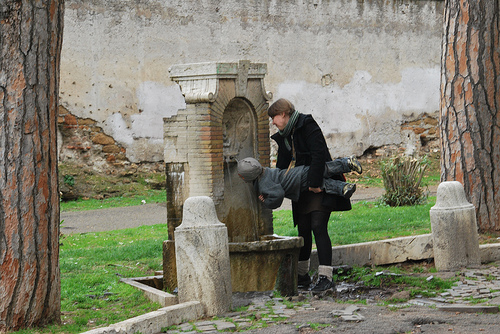
Exploring the drinking fountains at Forum Romanum at 23 January 2012, at the day my thesis was finished printed and handed in to the department of social anthropology, and one day before I turned 40
The project and the PhD are now completed. In order to also wrap up this research blog, I’ll see if I can find the time to conclude a couple of unfinished posts as well as finishing it all with a description of the defence, or viva, itself. As this blog has followed me all the way from Ménilmontant, 8 October 2005, it feels right to do it this way. At the same time, I feel a bit in a hurry to conclude all this now, as I’m so eager to get on with other things, many of them of course related to this large project.
[teaserbreak]
I started writing this particular post a couple of days before I received the title of the trial lecture. It sums up the areas of weakness in the thesis as described in the committee’s conclusion as well as my replies. After I had held the trial lecture, and just before the defence was to begin, I found the time to quickly revise these 14 points, an exercise I found useful for the defence as many of the questions – if not posed exactly the same way – concerned the same themes and issues. It also gave me confidence that I understood quite well my opponents’ lines of thought.
– The comments I’ve added today, a couple of days after the actual defence, are written in italics. As I revise it, I realise that the post treats thematic issues of the slam phenomenon as well as how I actually prepared for the defence. –
According to their written assessment, the committee evaluated the dissertation in relation to
the originality of the subject matter; the description and theorization of the research problem; the central methodologies; the clarity of argumentation; and to the degree to which the data support the major conclusion about performance poetry in contemporary Paris.
I should say right away that the assessment was overall positive, despite the fact that the paragraph of “major contributions” counted half a page while the weaknesses spread over nearly three. As these proportions fits well with how my selective ear usually hears criticism of my own work, I’ll do as I usually do and investigate into the weaknesses rather than dwell on the contributions.
The committee’s first critical comment (except their dismissal of the ability of Deleuze and Guattari’s hydraulic models of reality (see e.g. here) to say something significant of the postcolonial condition in Europe today – on which I strongly disagree with them) concerned that I should further discuss “a number of issues related to performativity” since the poems in Parisian slam poetry are performed. As I understand it, the longest and most central and complicated chapter in the thesis concerns performativity. Perhaps we understand the notion of performativity differently, I wonder?
– The title of my trial lecture also asked me to discuss performativity, a subject I was very happy to talk about as I felt I knew it quite well. I’ll write about that experience another day.
Secondly, since I assert that the slam scene is fluid (in many senses) and that transformations – in both person and relationships between persons – take place, they ask me “what is this stage? Is it a local stage or a global stage? The thesis implies both…” I love that question, because it goes right to the core of my argument! A central dimension of the fluidity of the slam session, is the dissolution of identity categories fixing persons as French, or not French, foreigners from far away, ethic this or ethnic that. Instead, persons appear as singularities, simultaneously from just around the corner as well as harbouring histories from elsewhere. This stage thus blurs the boundaries of the local and the global. It blurs the (discursive) boundary of France, and expands our understanding of what the local means as well as what a European country like France is. This is well in line with Eric Wolf’s understanding of nation-states in Europe and the People without history, as well as – as I just discovered – Paul Gilroy’s visions in After Empire: Melancholia or convivial culture?” Perhaps I’ll have time to come back to this important issue in another post.
– This was one of the first questions my second opponent posed. I was happy to receive it, but I think I forgot to see it sufficiently in connection to Eric Wolf, which annoys me. I wanted to draw an explicit link between Wolf and Gilroy, but perhaps that will make more sense in an article than in front of that particular audience.
Thirdly, the committee draws attention to the fact that there exists an important branch of Parisian slam which is competitive and want me to expand on that. I based my research around non-competitive slam circles, and I argue that what I have found to be the central dynamics in these sessions is different from what happens in competitions, albeit of a very congenial kind. This question has an empirical rather than an analytical answer, and I will not spend much time on it: Why did someone strongly promote slam as competition in the already quite proliferate non-competitive performance poetry scene? The generosity of the French state subsidies into the cultural sector is important here, and some in the scene suggests that to create slam competitions was a profitable way to promote one’s own slam company.
– This subsidies question is least interesting part of the issue, and the first opponent posed a similar question on the defence, but added that she appreciated my comparison with US slam and asked me to elaborate on the differences, as I argue that competition versus non-competition has important consequences. However, the comparison with the US also imply a comparison between what I call two different philosophies of integration (one multiculturally inspired and one republican). I mentioned this on the viva, but were not asked to go into it in detail.
The fourth point of the committee can be explored both empirically as well as analytically: A significant proportion of the slammers are women. Since slam is performed, “what does this say about the changing gender ideologies and roles?” I’m not really sure if I understand what they aim at here, but I think I would answer the question empirically through local accounts of how they perceive gender roles in slam, as well as my own Northern Scandinavian, which was from a few exception, slightly different from the continental. The analysis will build on these varying perceptions: To what extent are the gender categories in slam as fluid – thus free and changing – as I argue that the “ethnic” ones are?
– I also had this question at the viva and answered it empirically, from the perspective of people I talked to as well as from my own perception of it. There are several different views here, which reflects the heterogeneity of the scene. Gender roles in French performance poetry is, I suppose, also a suitable subject for an article, if I only could find the time to write it…
The fifth question concerning the commercial success of Grand Corps Malade and the way that has affected the content and performance of the poetry, I think I have answered from various angles and on several occasions in the thesis. The increased competition and media attention have affected the “moral and aesthetic stance of the slam poets”, just as the committee asks. This question gives me an opportunity to expand on the particular dynamics – both on an individual as well as a communal level – of exposing yourself in front of a convivial, non-judging, audience. Many people touch upon this in the thesis. Many are grateful of the opening up of opportunities (and thus artistic exposure as well as a highly welcome income) that the popularity of slam has given them. Others think slam has changed forever and can never be as forceful as it once was – but that is, as they also say, just the normal life cycle of such “underground” cultural phenomena. Creative people will always come up with something new. On the other hand, all seems to be positive about the fact that now more people than ever are able to hear the gospel of slam (my phrasing!) and experience its wonderful effects, whether in a diluted form or not.
– Also this question the opponents posed, and they were well satisfied with the example of Grand Corps Malade who maintains his integrity through continuing to participate in the original scene. Also here, I appreciated to point out the heterogeneity of attitudes and experiences of the Parisian slammers. The diversity, more than anything else, almost, is the lifeblood of the phenomenon.
Sixth, to what extent did more political parties (than the “Sego slam” attempt of Ségolène Royal in the 2007 campaign, which was for the most part met with a cold shoulder and strong warnings) try to make use of slam, thus co-opting it, politically? In 2007 it was very little. I’m very curious to know how it was in the 2012 election campaign. (In order to size this project down into a format possible to handle, I’ve closed myself off from all extra information from the end of my fieldwork in July 2007).
– Another question they asked me at the viva, and I answered it differently, and better, there because I explained that political utilisation would kill the art of it. And the art is indispensable in order to communicate aesthetically, poietically, with the audience and create a true relation. Slam is not politics, it is art. That is the reason why it works.
The seventh question I find quite interesting, particularly the analytical aspect of it: What is the relationship between the French state and its bureaucracy and slam? “The French state,” the committee writes, “has had a longstanding interest in and history of involvement in the definition and promotion of both high and popular forms of culture.”
– Another question that returned in several similar shapes at the defence. I find it really intriguing, but I don’t think I’ve got the full answer to it. At the defence, I pointed out that the French in general, as well as the slammers, have a double relationship with the French state. They have huge expectations that it should be fair and provide vital welfare and cultural services for the whole people. That slammers don’t criticise the state school but quite on the contrary had good memories from their years in school, both the opponent and I find interesting. On the other hand, it is the state that is accused of double standards in terms of discrimination and not keeping up the promises of equal treatment. Another interesting point here is how the French state promotes slam in cultural centres and the like all over the Francophonie. On the one hand, they’re officially proud of their contemporary metissage, on the other they still can’t tackle the problems of discrimination and “the colonial gap”… This is really at the crux of the Republican paradox.
The eight concerns similarities and differences between slammers and rioters, as I argue that slam and rioting (and also other expressions at the other end of the political spectrum, but that’s another part of it) originate in “silencing, muting, disregard and disrespect”, as the committee formulates it. How do “slammers differentiate themselves from rioters as agents of change?” The question is simple in its empirical form, first of all because rioters are far younger than slammers who’re for the most part at least in their mid twenties, usually considerably older. I have thus not heard anyone explicitly compare themselves to rioters, or delinquents. However, several profiled slammers describe the harsh environment of their youth. The closest I come to an explicit answer, is a slammer with a very considerate and reflective perspective on the work he does among youth in “difficult” suburbs. He sees much of life in the suburbs, as well as the life of several generations of “immigrants”, as the life of “sheep” being directed to various “sheep folds”: For the first generation, to the battlefields and factories, for the second to prison. The “sheep” are treated as second-rate citizens in poor suburbs, with poorer transport and poorer schools. They’re also conned by drug-dealers flashing their fancy cars and promising them a future like Tony Montana in Scar Face, or by Islamists and religious sects. An important part of his work in writing workshops, he says, is to confront youth who stands in front of “the tunnel” (leading to a sheep fold) he himself has been through and choose another outlet for their rage. “The pen and the paper are massive weapons of description; with them, you can rage war!” he exclaims.
– Here, my revision before the viva ended. There’s so much to say about this question, which I received in a similar for at the defence, however, as I think about it now, I’m not really sure I remembered to answer it fully. [Note to myself: I should have written more extensive notes, as there were several things I didn’t remember to comment upon…]. I remember though that the opponents liked Dgiz’ dictum about “massive weapons of description”. The second opponent, I think, also mentioned my treatment of Direct Action by David Graeber in relation to this issue. It annoys me that I didn’t remember to answer it properly. The third opponent said to me, after having finished, that this is exactly what will happen: now, I’ll start thinking about things I said, and didn’t say. He’s absolutely right, but at the same time, I got the chance to cover a whole deal, and overall I’m amazingly satisfied with it all. But this is definitely also something to expand on in an article. It just itches in my fingers to get on with it…
– The rest, I’ll go through quickly, all from a post-defence perspective:
Point nine concerns the French colonial history and I’m happy they didn’t ask me that at the defence. It’s an immense subject, which is the main reason why I didn’t even attempt to approach it in a thesis that was already long enough. From my perspective, the colonial era is most interesting as it appears in the present, as treated in for instance La Fracture Coloniale and subsequent books. Except from the issue of the contemporary repercussions of the “colonial gap”, it’s not an issue I would like to go too much into, as it needs a specialisation in itself.
The final five points are related and concern the transformative potentials of slam, inwardly as therapy for the person as well as – and simultaneously – for societal relations. We talked about some of this at the defence as well, but I see there’s a lot more to go into. Anyway, this is certainly enough for now and I’ve got other pressing issues to attend to, like finishing a job application (where they ask for people with a PhD!).