search expand

Antweiler: Fuer mehr Tourismusethnologie! – Neue Ausgabe journal-ethnologie

Ethnologie muss das Thema Tourismus viel ernster nehmen muss, als das bislang der Fall ist. Ethnologische Forschung zu Tourismus nützt sowohl der Tourismuswirtschaft als auch der Ethnologie selbst. Das schreibt Christoph Antweiler in der neuesten Ausgabe von journal-ethnologie, eine Zeitschrift des Frankfurter Museums fuer Weltkulturen:

Als soziales Phänomen ist Tourismus zu verbreitet, um es als Thema „nur angewandter“ Ethnologie abzutun. Tourismus ist so interessant und empirisch vielfältig, dass das Thema zu schade ist, um es bei postmodernen Reflexionen zu belassen.

(…)

Tourismus kann sowohl die empirische Ethnologie als auch die Theoriebildung bereichern. (…) Tourismus ist eines der weltweiten Phänomene, in denen sich interkultureller Umgang konkret manifestiert, und er bietet ein methodisch ergiebiges „Fenster“ auf die Dynamik von Interkulturalität.

Christoph Antweiler liefert auch konkrete Themenvorschaege fuer kuenftige Untersuchungen.

– Ethnologinnen und Ethnologen sollten verstärkt Individualreisende und Reisegruppen empirisch untersuchen. Es gibt bislang immer noch sehr wenige wirklich detaillierte, dichte und umfassende Untersuchungen von Touristen.

– Idealerweise sollten Touristen vor, während und auch nach der Reise untersucht werden

– Ethnologen sollten die sehr vielfältigen Motive bei Reisenden, bei Vermittlern und „Bereisten“ genauer untersuchen.

– Wir brauchen mehr Studien zu den Übergängen zwischen Tourismus und anderen Mobilitätsformen, statt nur Tourismus zu untersuchen. Wie hängen Grenzüberschreitung; Migration, traveling culture (statt nur „Fremdenverkehr“) zusammen?

>> zur neuen Ausgabe von Journal Ethnologie zum Thema Tourismus

SIEHE AUCH:
Texte des Arbeitskreises Tourismus und Ethnologie (GATE)

Ethnologie muss das Thema Tourismus viel ernster nehmen muss, als das bislang der Fall ist. Ethnologische Forschung zu Tourismus nützt sowohl der Tourismuswirtschaft als auch der Ethnologie selbst. Das schreibt Christoph Antweiler in der neuesten Ausgabe von journal-ethnologie, eine Zeitschrift…

Read more

Eine Schweizer Migrantin in Deutschland ueber Integration und Identitaet

Es tut immer gut, seine eigene Gesellschaft oder das vermeintlich bekannte zu exotisieren. Migranten, das sind nicht nur Tuerken oder Pakistaner, sondern auch die Leute aus dem Nachbarland. Einige Aussagen der von Swissinfo portraitierten Schweizer Migrantin, die nach Deutschland gezogen ist, koennten auch aus einem Interview mit einer Tuerkin stammen:

Dass sie einen Deutschen heiratete und wegging, war für ihr Umfeld nicht einfach. “Für meine Mutter war es am Anfang schwer.” Das habe sich dann zum Glück bald geändert, denn sie “liebte ihren Schwiegersohn”, sagt Ruth Ziegler mit einem Zwinkern zu ihrem Ehemann.

(…)

Schattenseiten gebe es überall, sagt Ziegler. “Als Fremde muss ich mich anpassen, nicht mein Gastland.” Und: “Meine Heimat ist die Schweiz, doch zu Hause bin ich hier.”

Wir erfahren auch, dass es Freiburg – nur 60km von der Schweiz entfernt, einen Schweizer Verein gibt.

>> weiter bei Swissinfo: “”Ich bin Gast, aber keine Ausländerin”” (Link aktualisiert)

SIEHE AUCH:

Tessin: Deutsche und Deutschschweizer wollen sich nicht integrieren

Deutsche in Zürich: Sie sind überall!

Es tut immer gut, seine eigene Gesellschaft oder das vermeintlich bekannte zu exotisieren. Migranten, das sind nicht nur Tuerken oder Pakistaner, sondern auch die Leute aus dem Nachbarland. Einige Aussagen der von Swissinfo portraitierten Schweizer Migrantin, die nach Deutschland gezogen…

Read more

On fieldwork: “Blogging sharpens the attention”

Cicilie Fagerlid provides a nice explanation on why she has started blogging while she’s on fieldwork. Her working title for her research is Communities in the making: Identity and belonging in postcolonial Paris and London.

After I started I have noticed that blogging sharpens the attention, just like taking a lot of photos (and probably painting) does; One starts to see motifs everywhere, and then one has to reflect on how to make the motif into a story so other people can understand what you want to tell them.

>> read her whole post “My blog, my project and I, part 1”

SEE ALSO:

More and more academics use blogs

Ethnographic study on bloggers in California & New York

antropologi.info survey: Six anthropologists on Anthropology and Internet

More and more blogging anthropologists – but the digital divide persists

Anthropology Newspaper – Overview over blogging anthropologists (and some others)

Cicilie Fagerlid provides a nice explanation on why she has started blogging while she's on fieldwork. Her working title for her research is Communities in the making: Identity and belonging in postcolonial Paris and London.

After I started I have…

Read more

My blog, my project and I, part 1

The name of my blog is a sort of homage to the field diary that inspired me to start blogging: Jon Henrik among the Ifugaos. Lorenz, my Webmaster and the editor of www.antropologi.info, asked me ages ago to write a few words on why I decided to write a blog from my fieldwork. In fact, the answer isn’t as well-considered as Lorenz, a dedicated net publicist, might have thought. I just thought that what Jon Henrik had done was such a cool thing to do: It was nice to see what he was doing among the Ifuagos. However, after I started I have noticed that blogging sharpens the attention, just like taking a lot of photos (and probably painting) does; One starts to see motifs everywhere, and then one has to reflect on how to make the motif into a story so other people can understand what you want to tell them.
[teaserbreak]
This brings me to a question some people have asked me; is your blog your fieldnotes? No, my notes don’t look like my blog at all. My fieldnotes are very sketchy and cover a vast array of themes, and they’re not at all as coherent and focused as I try to make the posts in the blog. The texts here can perhaps be described as somewhere between fieldnotes and academic texts in terms of stringency, but not in terms of analysis. My posts are meant to be descriptive rather than analytic. (I’m not in that phase on the project yet.) The idea is to describe the process of discovery that I’m going through during my stay here. This includes ethnographic discovery, as well as day-do-day theoretical and methodological reflections. It made me happy to hear a friend of mine say that she found my reflections on the fieldwork situation and research process helpful. Nothing is better than students or others being inspired or learning something from what I write.

After I started blogging, I’ve become aware that there is a whole world of bloggers out there (for instance, one in ten Frenchpersons have their own blog!) Certainly, this must have a chaotic and anarchic democratising effect on public communication. And I can imagine that there must be yet undiscovered effects on individual reflection and social integration as well, (just like the diary had in its time, and text-messages and e-mails have now). For an anthropologist, this has theoretical implications as well as interesting methodological possibilities. – I hope some native Parisians sooner or later would talk back to me on my blog, but I guess they’re so busy blogging themselves, that they haven’t got the time to read other people’s blogs…

That was my blog, now on to my project. But since this post is long enough, the middle part of the presentation will have wait for later. The only thing I want to reveal for now is that its working title is Communities in the making: Identity and belonging in postcolonial Paris and London.

The name of my blog is a sort of homage to the field diary that inspired me to start blogging: Jon Henrik among the Ifugaos. Lorenz, my Webmaster and the editor of www.antropologi.info, asked me ages ago to write a…

Read more

Security à la français: précarité and insécurité

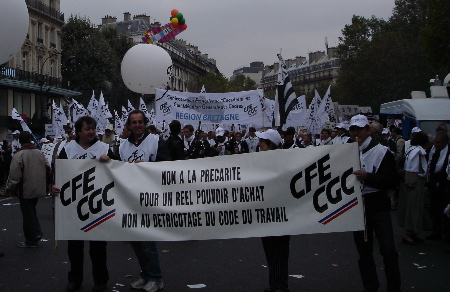
From a large demonstration 04/10/05: “against uncertainty, for a real increase in buying power and against dismantling of the labour regulations”.

Last week I was back home for a few days, and I went to a seminar on the wide-ranging notion of safety/security (“trygghet”). As it happens, two aspects of “security” play important roles in French politics and society; however, these aspects do not seem to be very high on a security agenda in a Norwegian context. I think this difference in emphasis points to interesting economical and social differences between the two societies.
[teaserbreak]
It was in fact at language school at l’Alliance française, amongst middle class students from all over the world, that I realised the insecurity the middle classes is experiencing at the moment, perhaps almost globally, but particularly in continental Europe. The buying power of the majority of the population is in many countries going down. (Excuse me for appearing naïve, but the accelerating consumerism in the Norwegian society must have blinded me to the situation elsewhere). Large parts of the population can no longer take for granted the growth and upward social mobility from one generation to the next, which has been such important forces in the capitalist societies since the second world war.

In France, unemployment among the under-25-year-olds is 21% (and of course doubled in the so-called “problem areas” (zones sensibles)). Thus précarité (insecurity, uncertainty, particularly concerning social issues, like job security) is a key aspect of French political discourse, especially among the left.

The news coverage before Christmas frequently returned to the issue of the dropping buying power, and at Christmas time the TV news showed report after report about the homeless (les SDF; sans domicile fixe). A typical story of a SDF shown on the news is about a normally well-dressed and well-kept male perhaps around the age of 40 who had “everything a few years ago, but then he lost his job…” According to a friend of mine, such stories are not common at German television. Despite high rates of unemployment, homelessness is apparently not such a big problem there. The atmosphere of la précarité in France is obviously reinforced by the enormous lack of suitable housing, a problem Germany does not suffer from.

The other aspect of security in French politics and society is l’insécurité. If the notion of précarité appeals to the left, insécurité is a winner on the right. For some reason, insécurité has particularly come to mean urban violence (but it can also be used in relation to road safety and food safety). (Since the French can’t talk about “race” and ethnicity, they have come up with a whole range of terms that can connote “race” and ethnicity… I think insécurité sometimes have such connotations, but probably not always. I will certainly return to this particular French way of talking about social and ethnic issues, which is very different from the Anglo-Saxon way).

“Insecurity” has not been very important in French politics the last 4 years (thanks to some clever political stunts by Interior Minister Sarkozy), but after an absurd incident of violence and harassment on a train in Southern France New Year’s Eve, it’s up on the agenda again – 15 months before the next presidential election, as the journalist commented. It was probably the overwhelming focus on “insecurity” in the media and in the political discourse that made the socialist candidate loose to the extreme right candidate in the 2002 elections (see “It’s better to vote than to burn cars”). Thus, if French politics are returning to the issue of insecurity now, it means that it’s taking a turn in a particular direction.

In the news today, Prime Minister Dominique de Villepin announced a new employment policy for the young unemployed, a move which of course can be latched on to the précarité debate. Interior Minister Sarkozy, on the other hand, announced 700 new positions in a kind of railroad police, and a few days ago he suggested the creation of a school police as well, thus clearly an issue of l’inséurité.

Neither précarité nor insécurité have such prominent positions in the Norwegian society. As I mentioned, the difference in focus – and reality – epitomises differences between the two societies: Norway has an oil economy apparently in safe distance from the vagaries of the world (when oil prices are rising with consequences for populations all over the world, Norway is making a bigger profit than ever). The French society is noticeably part of to the rest of world – culturally, economically, politically and physically – in a different way than Norway.

From a large demonstration 04/10/05: “against uncertainty, for a real increase in buying power and against dismantling of the labour regulations”.

Last week I was back home for a few days, and I went to a seminar on the wide-ranging notion…

Read more