search expand

Arctic refuge saved from oil drillers – Inuit divided

Good news (for environmentalists) before the Christmas New Year-break: There will be no oil drilling in the Alaska’s Arctic national wildlife reserve. Republicans have battled to allow drilling in the reserve for 25 years. Although they pledged to try again next year, the defeat was expected to remove the issue from the agenda for a decade, according to The Age.

The region is home to hundreds of polar bears, and tens of thousands of caribou and other animals. Interesting how the concept of beauty differs. Alaska’s 82-year-old senator Ted Stevens is quoted. The wildlife refuge was a “barren, frozen wasteland”, with “constant tundra, no trees, no beauty at all”.

>> read the whole story

Concerning oil drilling, the Inuit are divided as ethnic US Americans: Oil of course means money, therefore Nunatsiaq wrote some years ago: Alaskan Inuit support oil drilling in the ANWR.

In an Guardian article we meet Bruce Inglangasak, an Inupiat Inuit. He describes one of the consequences of the oil drilling in another Alaskan region – it’s smog:

“When the wind blows from the west, a yellow-brown smog goes right across the horizon. In the summer, when I go fishing, it burns my eyes. It’s not just the air. Every time it rains our fish get it and our whales get it. You can feel the difference when you hold the fish now. The flesh is not as firm as it once was.”

The article goes on, telling that the oilfields have not turned out to be the ecological showpieces the Inupiat were promised:

More oil was found than expected and the drilling rigs, roads and pipelines now dominate the landscape. There is an average of more than one toxic spill a day; 43,000 tonnes of nitrogen oxides are released into the air each year, more than in Washington DC.

Nevertheless, he is not against the drilling:

For all his unease about the contamination of his ancestral lands, Mr Inglangasak needs a job. He has an eight-year-old daughter, and hunting and fishing are not enough to keep her clothed, housed and educated.

Seems to be more a problem of capitalism!

>> read the whole Guardian-story: Oil clouds gather over Alaskan eden

SEE ALSO:

Native Perspectives on Drilling in Alaska National Wildlife Refuge (Field Notes)

The Arctic is changing. An environment at risk. By Mark Nuttall (TheArctic.is)

Zebedee Nungak: Arctic Christmas – The then and now (very nostalgic column in the Windspeaker about the commercialisation of Christmas)

Good news (for environmentalists) before the Christmas New Year-break: There will be no oil drilling in the Alaska's Arctic national wildlife reserve. Republicans have battled to allow drilling in the reserve for 25 years. Although they pledged to try again…
Read more

Sosialantropologi fjernes ikke fra læreplanen i den videregående skole

Det nytter å kommentere blogg-innlegg. Her en gladnyhet fra Norsk antropologisk forening. Halvard Vike skriver:

På bakgrunn av et leserinnlegg av Jardar Seim i aftenposten.no den 4. desember 2005, har nettstedet antropologi.info følgende overskrift på en nyhetssak: ”Videregående skole: Sosialantropologi fjernes fra læreplanen.” Denne saken førte til noen kommentarer med kritikk av foreningen for ikke å følge opp høringsutkastet. Norsk Antropologisk Forening beklager at saken ikke har blitt grepet fatt i tidligere. Men vi har nå vært i kontakt med Arne Otto Refsdal ved Prosjekt Læreplan i Utdanningsdirektoratet, og kan meddele at sosialantropologi fortsatt vil være med i læreplanen.

>> les hele saken

Det nytter å kommentere blogg-innlegg. Her en gladnyhet fra Norsk antropologisk forening. Halvard Vike skriver:

På bakgrunn av et leserinnlegg av Jardar Seim i aftenposten.no den 4. desember 2005, har nettstedet antropologi.info følgende overskrift på en nyhetssak: ”Videregående skole: Sosialantropologi…

Read more

Neues Buch: Wie der Tsunami das Leben in „meinem“ indischen Dorf veränderte

Ethnologin Hilde K. Link lebt seit acht Jahren zwischen ihren Arbeitsplätzen in München und Chinna-mudaliyarchavadi – „ihrem“ Dorf in Tamilnadu, Südostindien. Auch am Tag der großen Flutkatastrophe war sie dort. In ihrem neuen Buch “Nach der großen Flut. Wie der Tsunami das Leben in „meinem“ indischen Dorf veränderte” beschreibt sie, das Katastrofenhilfe nicht so einfach, wie viele es gerne hätten. Darauf macht uns Wolfgang Wohlwendt auf ethno::log aufmerksam:

Bei allem guten Willen, welchen die Leute hinter diesen Aktionen haben, vergessen sie häufig , dass die Betroffenen zwar Opfer sind aber alles andere als unselbständig und unwissend um die beste Strategie wie ihre Probleme zu lösen sind.

Link zeigt auch auf, schreibt Wohlwendt, wie der Ausnahmezustand die betroffenen Menschen zum Umdenken bringt und Wertvorstellungen verändert.

>> weiter bei ethno::log

Webseite des Hilfsprojektes

SIEHE AUCH

Hilfe für ein indisches Fischerdorf – ein Projekt von deutschen Ethnologen

Nach dem Tsunami: Noch eine Hilfsaktion von einem Ethnologen

When applied anthropology becomes aid – A disaster anthropologist’s thoughts

Ethnologin Hilde K. Link lebt seit acht Jahren zwischen ihren Arbeitsplätzen in München und Chinna-mudaliyarchavadi – „ihrem“ Dorf in Tamilnadu, Südostindien. Auch am Tag der großen Flutkatastrophe war sie dort. In ihrem neuen Buch "Nach der großen Flut. Wie der…

Read more

Eksotisk norsk kultur: St. Lucia-feiring i USA

Sosialantropologistudent Mona Rekve visste lite om Kitsap County utenfor Seattle i USA. Hun skulle gå på feltarbeid der for å studere hvordan lokalavisa formidler nyheter. Lite ante hun at hun var i ferd med å entre en komprimert utgave av Skandinavia, skriver hun i Hallingdølen:

Riktignok var det kjent for meg at mange norske og svenske emigranter valgte å bosette seg nordvest i USA på 1900-tallet, men at den norske «kulturen» skulle være så sterkt tilstede som jeg opplever den, er overraskende og ikke minst fascinerende. Som antropologistudent er dette vel så spennende som fjerne, rurale områder de færreste har hørt om.

Hun skriver at det er norske flagg langs hovedveien, gater er oppkalt etter medlemmer av det norske kongehuset. Men som hun sier: “Det er ingen overraskelse at i diaspora blir identitet og tradisjoner ofte forsterket”.

Hun skildrer så Lucia-feiringen som framsto som “et resultat av en miks av ulike Skandinaviske tradisjoner ispedd et snev av USA”.

>> les hele saken (link oppdatert)

Merkelappen Norge blir faktisk brukt for å markedsføre denne regionen.

Nettsiden av en eiendomsmegler (link oppdatert) roser området slik:

Nowhere in the Pacific Northwest can visitors enjoy breathtaking scenery and a variety of attractions than in. “Little Norway on the Fjord.” Nestled in a valley between the majestic Olympic and Cascade Mountain ranges, this authentic Norwegian community invites you to experience nature’s beauty, Scandinavian hospitality and old world charm, Combined, it makes it an enriching and captivating place to visit. Poulsbo proudly displays its Scandinavian heritage in street names such as Moe, lverson, Lindvig and Fjord; its annual ethnic events such as Viking Fest, Scandia Midsummerfest and Yule Fest and unique rosemaled storefronts.

Poulsbo blir beskrevet som “Little Norway” som er kjent for den populære Viking Fest

SE OGSÅ:

Studerte norske ghettoer i Dubai

Norsk innvandring til Spania skaper et jordskjelv i lokalsamfunnet

Det løfterike landet – Norsk utvandring til Amerika og norsk-amerikansk historie 1825-2000

Sosialantropologistudent Mona Rekve visste lite om Kitsap County utenfor Seattle i USA. Hun skulle gå på feltarbeid der for å studere hvordan lokalavisa formidler nyheter. Lite ante hun at hun var i ferd med å entre en komprimert utgave av…

Read more

Bienvenu à mon blog de Charonne

It’s been more than two weeks now, since I’ve moved house. This move has made me realise that I in fact lived in a village before, and now I seem to have moved downtown. In downtown Charonne, I’m not recognised by the baker the second time I enter his shop, and the same faces don’t surround me on the street every day. In our little neighbourhood in Ménilmontant I saw familiar faces all the time, and even a shy person like me got to know the local merchants in not much time. As I think about how quickly I got a sense of the village-like place I moved from, I realise that I’m not able to give a good description of my new quarter yet, despite having lived here for a while.
[teaserbreak]
Part of the impersonal atmosphere of Charonne – a quartier populair a little northeast of Place de la Bastille – comes down to it being wintertime. There are no longer chairs and tables outside the cafés and bistros, and people don’t hang around outside but hurry home and inside on their way from the metro or bus. And crossing a local square, I only come across some youths asking for cigarette papers or the odd loner, doing nothing on a bench. The parents and children, staying for hours after school time in the warm days of autumn are long gone. December is a hard month discovering an area…

My impression so far is that the middleclass bohemian bourgeoisie (‘bobo’) creeping down, or up, the hill in Ménilmontant, have not reached here yet. There is a small gallery of modern, figurative paintings and a little shop of ceramics in my street – in addition to an appealing little shop for making your own hanging garden – but I suppose a gallery or two doesn’t qualify a Parisian area as gentrified. The working classes seem for the most part still left by themselves. (There is however a couple of all right restaurants around including a sushi place, but still I’d claim that it doesn’t count as gentrification). My impression is strengthened when considering the food on offer in the local supermarkets; my amateur guess is that the number of ecological products at sale might be an indicator of the social class of the area. The only ecological groceries you can get here, are staple foods and other long lasting products (usually quite dusty). There are no ecologically grown bananas or other fruits or vegetables… I haven’t checked for organic meat, I’ll have a look next time. (When talking about supermarkets; one thing I like about French supermarkets is the loooong time many people spend in front of the cheese counter). Similarly, only one supermarket around here sells expensive and small (thus easily stealable?) beauty products like facial creams and razor stuff. In that particular store they are also more persistent in asking their customers to leave their bags in custody when entering the shop. Is there a connection? I’m only guessing.

I learnt by coincidence – on a screening of a film from a local elementary school on the 100 years anniversary for the law on laïcité (the separation of church and state) – that the local schools are in fact classified as educational priority. Being a ZEPzone éducation prioritaire – means there exist a number of socio-economical disadvantages here. (I’ll for sure return to the question of ZEP, as it has played an important role in the debates both before and after the November riots/revolts. ZEP is the French version of affirmative action; habitants of particular areas, instead of particular (ethnic) categories, are considered as disadvantaged and thus entitled to special attention).

When thinking about it, I think perhaps my description has been a bit one-sided. If I’ve given the impression that the area is in any way shabby, I should correct myself. I find the area ordinary and a bit impersonal, but far from shabby. The streets are incessantly being washed by small, green cars here, as in the rest of the city. The squares, the flowerbeds and the trees lining the boulevard are being well kept. And the buildings, greyish by pollution, are well maintained.

Apart from a couscous take-away, a yet uncounted number of tiny bars where (mostly) men seem to hang around the counter at every hour of the day, a surprisingly tidy food-market twice a week, an abundance of pharmacies (at least as many as there are newsagents but fewer than there are bakeries and patisseries), my local area also comprises an anarchist bookshop (Quilombo). Perhaps my very favourite thing of Paris life is walking down a street, an anonymous just normally picturesque Parisian street, and then you stumble upon an amazing graffiti, or a café so charming that you just have to enter – or an anarchist bookshop, just around the corner on your way to the supermarket.

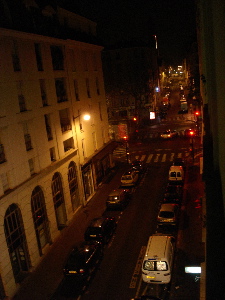
When I finished writing this post, I realised that I had not taken any photos of the area (perhaps another sign of how impersonal I find it), so I had to take one right now, out of my bedroom window. Thus, Charonne by night…

It’s been more than two weeks now, since I’ve moved house. This move has made me realise that I in fact lived in a village before, and now I seem to have moved downtown. In downtown Charonne, I’m not recognised…

Read more