search expand

Book Review: How Indissoluble is Hindu Marriage?

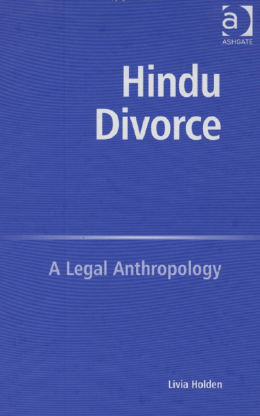
Divorce does not belong to Hindu tradition, anthropologist Livia Holden was told when she started her research in India 14 years ago. But is this true? Tereza Kuldova reviews for antropologi.info Holden’s new book Hindu Divorce. A Legal Anthropology.

Anthropologist Livia Holden has been on 16 months of fieldwork over the course of 12 years in a village in Madhya Pradesh, India. With the help of the case studies of several women she challenges popular belief and earlier anthropological studies.

Here is the review:

cover

Review: Holden, Livia. 2008. Hindu Divorce: A Legal Anthropology. Ashgate.

Tereza Kuldova

Livia Holden’s book Hindu Divorce presents an invaluable and to a certain degree also provocative re-examination of the praxis and legal status of Hindu divorce and remarriage, both in its past and present manifestations. Being an anthropologist, Livia Holden has the necessary first-hand experience with the actual practices of Hindu divorce and remarriage, at the same time as she connects these with the greater framework of the official law at the national level and even traces the implications of her findings transnationally.

Her examination of the divorce practices and remarriage is based on 16 months of fieldwork over the course of 12 years in a village in Madhya Pradesh, India. Over these years she had the opportunity to follow her informants, their stories and to develop deep relationships.

With the help of the case studies of several women (p. 69-124), which she has gathered over this period, she proves that contrary to the popular discourse in which Hindu marriage is considered indissoluble, and even contrary to the most legal and even anthropological studies, it is possible to find textual, historical and even contemporary evidence of customary provisions for divorce and remarriage.

The mainstream view of the Brahmans and other upper-caste Hindus, as it is codified in the Laws of Manu and other classical texts, which claims that marriage – solemnized according to the sacred rites prescribed by the ancient religious texts – is indissoluble, is contested on the basis of the customary law and practice.

It is also this view which served the British when developing the Anglo-Hindu personal law, as they gave priority to the religious texts and naturally also to the upper-caste views on law (p. 14). This codification led to even greater general consolidation of this idea, which is again what is reflected in most of the anthropological and law treatises.

In 1955 the Hindu Marriage Act was passed. This act guaranteed divorce for all Hindus and has saved customary practices of divorce. The emphasis on customary law and practices is important here, because, as Livia Holden points out, it would be a misconception to believe that most Hindu divorces take place through the juridical process in the civil courts, it is rather the customary law which prevails.

In addition “the inclusion of custom in the realm of the legal has the unique advantage of overcoming the fictional opposition between normative and non-normative behaviors, or between official and alternative normative orders that fix society within the limits of a privileged and totalizing cultural system” (p. 11). And it thus corresponds more to what her empirical data clearly show, i.e. that these customary provisions for divorce and remarriage function even among Brahmans and other high-caste Hindus, even though they are commonly perceived as practices of the lower castes.

She claims firmly that “dissolution of marriage did not only exist from ancient times; it was available to women and it was also widespread among the Hindu upper caste” (p. 5).

Being inspired by the feminist anthropology she also provides throughout her book an account of “how the mainstream Hindu discourse of gender imbalance shapes the legal discourse of law and how, in turn, the official legal discourse shapes Hindu society” (p. 19). Relating her empirical observations to the law discourse and theories on gender, she shows that customary law may actually provide more scope than the statutory personal law for the woman to negotiate successfully the conditions of her existence. She provides an analysis of the problem whether and if so how does the Hindu divorce and remarriage constitute a certain way out for women in the situations of matrimonial crisis.

In this context she presents several of her cases in which she also discusses such topics as arranged and child marriage, dowry, bigamy, domestic violence and interestingly also manipulations of custom and of official law. She further discusses the treatment of the Hindu divorce in the framework of national official law and its various relationships to the customary law and discusses the effects of the official law for the women.

She concludes that:

“in specific circumstances Hindu women can successfully negotiate the end of an unsuitable matrimonial tie and remarry to secure better lives for themselves and their children; but for an understanding of peculiar techniques, which are part of the women’s legal awareness, it is necessary to see beyond positive law, to where the non-state law can inform or even substitute for state-law a perspective of legal pluralism that is something more than plurality of law” (p.218).

This book is no doubt a great contribution both for anthropology and for the study of law in India. Connecting the different levels of analysis it provides a coherent picture of the state of affairs. The possible direction of future research in this area might lie in the focus on the Hindu divorce and remarriage in the urban areas, especially among middle classes.

As my own fieldwork experience suggests, divorce and remarriage among Hindus in villages, even among higher-caste Hindus was generally possible, precisely on the basis of the customary law as pointed out above. But in the urban areas on the other hand the higher-castes acted more conservatively and generally restricted women who left their husbands to remarry, and even women themselves felt that it would be inappropriate. Investigating these processes which go hand in hand with modernity and which to a certain degree can be considered as the products of modernity, might thus be a fruitful scenario fur further research.

But except for the undoubtedly remarkable contribution of rethinking of the Hindu divorce and remarriage in various areas, the book is also striking in its degree of self-reflexivity. The chapter 2 (p. 27-68) is devoted to the discussion of the theoretical and methodological insights and reflection over these. It is very instructive in its open discussion of the changing role of the anthropologist and her positioning in the field.

Livia Holden goes on to discuss such topics as what challenges doing research together with a husband brings and what possibilities it on the other hand also opens, or how she was perceived in the first period when she was childless and how the relationships changed and evolved when she came next time with a baby and how this changed situation opened up different arenas for her research. She reflects also on doing research in a village which was already previously studied by her professor J. L. Chambard and the negotiation of the relationships with the villagers on this subject. She reflects on her status as a woman who is concerned generally with mens matters, as she becomes a kind of honorary male, which allows her cross-gender behavior. She also discusses her ideas on authorship and the collaborative nature of her research.

Methodologically this book is also interesting as it combines different resources, even integrating the method of filming. The resulting ethnographic film from 2001 is called Runaway Wives and it was done in co-production with her husband Marius Holden who also wrote a chapter in this book (p. 60-8) that discusses and reflects the process of filming and the theoretical problems of visual anthropology.

This extensive self-reflection incorporated throughout the whole book makes it instructive and an interesting reading for every anthropology student and anthropologist. In addition the multidisciplinary approach to the research which draws from feminist and legal studies and social sciences will be of interest to any student or scholar of law, sociology and anthropology.

>> Information on the book by the publisher (Ashgate)

>> information on Tereza Kuldova (both anthropologist and artist)

SEE ALSO:

Thesis: How Indian women fight the stigma of divorce

Unmarried Women in Arab Countries: Status No Longer Dependent upon the Husband

China: Where women rule the world and don’t marry

On African Island: Only women are allowed to propose marriage
cover

Divorce does not belong to Hindu tradition, anthropologist Livia Holden was told when she started her research in India 14 years ago. But is this true? Tereza Kuldova reviews for antropologi.info Holden’s new book Hindu Divorce. A Legal Anthropology.

Anthropologist…
Read more

Why we need more disaster anthropology

cover

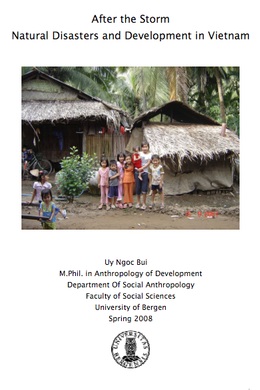
On the 5th of December 2006, typhoon Durian hit Bến Tre province in Southern Vietnam. Close to 100 people died, more than 800 moored fishing boats sank, thousands of buildings collapsed including schools and hospitals. In her master’s thesis, Uy Ngoc Bui looks at how this event changed peoples’ lives and explains why we need more disaster anthropology.

In this extremly well written thesis at the University of Bergen (Norway), Uy Ngoc Bui looks at the role of NGOs, the state and the people themselves’ in the period after the disaster. Although the government and the NGOs did a significant job in handling typhoon Durian the real heroes were the people themselves, who helped one another in a time of great need, she writes:

They showed great courage, endurance and solidarity by overcoming this challenge. As such, it is perhaps no surprise that my study concurs with the many previous studies which state that disaster management is very dependent on the participation of the community, and their strengths and efforts can determine the outcome of the disaster.

Therefore it is important to study peoples’ knowledge and coping mechanisms:

In disasters as floods and tsunamis, traditional knowledge acts as warning signs which can be read ahead of time, saving many lives. This type of information should be spread wherever it is useful, as Red Cross has done in Vietnam.
(…)
I believe that thorough research into traditional knowledge and local coping mechanisms should be emphasised as they are a type of accumulative knowledge which has been passed on throughout generations, adapted to their specific environment. This type of knowledge is valuable because it is not written down, and if is lost, it will be lost forever. Here anthropology has an important job to do.

There are lots of topics to study for anthropologists, for example the local-global linkages and the reconstruction work:

My experience is that more research should be done on the bridging of relief aid with long term reconstruction and development. Relief aid has become more efficient and standardised, which is positive, but this is only short term help for people who are in a vulnerable situation. Decreasing their vulnerability and strengthening their capacity to overcome disasters in the future should be the key foci of anthropologists and NGOs.

(…)

Anthropology provides a unique look at how the local situation relates to the global through the holistic approach. It is therefore important that anthropology uses this approach to better understand the complex local-global linkages in future research. Solid fieldwork on the ground level can show how the lives of the people involved are changed as a result of the disaster and the following intervention by foreign actors. The real effects of natural disasters, the ones that are felt intimately and which linger on long after the dust has settled, are best researched with anthropological methods which can take into account all the historical, economical, political and social factors that are involved in the making of a natural disaster.

One of the global forces are related to global warming:

Many blame the Western industrial ways for corrupting the planet’s eco-system, creating more and more havoc for each year. Research in disaster management therefore also includes research into finding more eco-friendly ways to live.

Uy Ngoc Bui has studied anthropology at the University in Bergen, Norway. As she’s “of Vietnamese origin” she felt that she “had an advantage in being half-immersed in the ‘culture’ already, which would make the transition somewhat smoother”. Furthermore, people were as interested in hearing about Norway and Norwegian culture as she was interested in them, she writes.

>> download the thesis “After the Storm: Natural Disasters and Development in Vietnam”

Today was by the way the second day of an interdisciplinary climate conference in Copenhagen. Among the researchers we find many anthropologists. Kirsten Hastrup is team leader of the research project Waterworlds at the anthropology department at the University of Copenhagen:

The ambition of the project is to study local, social responses to environmental disasters related to water, as spurred by the melting of ice in the Arctic and in other glacier areas, the rising of seas that flood islands and coastal communities, and the drying of lands accelerating desertification in large parts of Africa and elsewhere. The aim is to contribute to a renewed theory of social resilience that builds on the actualities of social life in distinct localities, and pays heed to human agency as the basis for people’s quest for certainty in exposed environments.

SEE ALSO:

When applied anthropology becomes aid – A disaster anthropologist’s thoughts

The Anthropology of Disaster – Anthropologists on Katrina

“Disasters do not just happen” – The Anthropology of Disaster (2)

Anthropology News October: How Anthropologists Can Respond to Disasters

Comparative studies of flood management in neoliberal, social-democratic states needed

New website: Understanding Katrina: Perspectives from the Social Sciences

BBC: Tsunami “folklore” saved islanders

How to survive in a desert? On Aboriginals’ knowledge of the groundwater system

Thailand: Local wisdom protects hometown from the onslaught of globalisation

cover

On the 5th of December 2006, typhoon Durian hit Bến Tre province in Southern Vietnam. Close to 100 people died, more than 800 moored fishing boats sank, thousands of buildings collapsed including schools and hospitals. In her master's thesis,…

Read more

Back from Lahore: Terror and Open Access

shalamar gardenShalamar Gardens, Lahore

I have been back from Lahore, Pakistan’s cultural center and “City of Poets”, for a while now. It was one of the most inspiring journeys I’ve been to.

Just a few weeks ago we’ve been at the same place where – a few days ago – six policemen were killed and several cricket players from Sri Lanka wounded in a terrorist attack. We were also constantly under police protection. Our hosts were very concerned for our safety.

I went to Lahore to document the conference “Covering Each Other In An Era Of Imagined Clashes Of Civilizations” (see summary in Norwegian), part of the Global Inter-Media Dialogue). Journalists and media researchers from Norway, Pakistan, Indonesia and Bangladesh participated.

Terrorism was one of the main topics during the whole stay – both during and outside the conference. Among other things, the impact of the so-called “war on terror” on global journalism was discussed. Being an journalist in conflict areas has become much more dangerous if you are not willing to let you embedd – and censor – by the military: Not only in Gaza, but also in Iraq and in Pakistan, journalists are hindered in doing their job.

Every Pakistani we met was worried about the “talibanisation” of Pakistan, but also about the drone attacks by the USA in the semi-autonomous “tribal areas” along the Afghan border. The drones are supposed to target Al-Qaida and Taliban terrorists, but mainly kill innocent children, men and women.

Before my departure I wrote about a Pakistani anthropologist who fights for young girls’ right to education in Taliban-controlled Swat in the North. In the same region, a few days ago, Taliban killed journalist Musa Khankhel, a colleague of one of the speakers at the conference, Hamid Mir. ‘He saved me, but I could not save him‘, Mir commented on rediff.com. One day before the recent attack in Lahore, Mir wrote the piece “Don’t create another Swat in Punjab“.

All these issues are debated in the newspapers, several of them are written in English as f.ex The News, Dawn, The Nation or Daily Times. They are of high quality, especially the opinion section where many academics contribute regularily with comments and analysis. Some of the interesting texts are Such is life… in Swat written by a history teacher who had to flee from Taliban, or Forget Gaza, care about Swat and Missing the essence of Talibanism

People in Lahore are troubled about the recent development – something that Imran Khan, Al Jazeera’s correspondent in Lahore, captures very well in the article Lahoris lament ‘shameful’ attack – an aspect that is often missing from mainstream “Western” coverage. When talking with Lahoris, we were often confronted with the negative images that “Western media” spread about Pakistan.

So due to the security situation and Pakistan’s negative image, I suppose, we hardly saw any tourists. Everywhere we went, we became an attraction. People approached us, said hi and shook hands and started a conversation. Some even wanted to be photographed together with us. Needless to say, we only met friendly people.

I was very impressed by the two universities we’ve been at. I have never seen such a huge campus before as at the University of the Punjab in Lahore. At the University of Gujrat they are building seven spectacular “ships of knowledge”. 70% of the students are women. Something I found strange is the role of religion: The conference started with Qur’an recitations and some speakers started their lectures with a short prayer. “That would have been impossible in Indonesia”, the delegates from Jakarta commented.

Interesting for us who engage for open access to scholarship is the icon “Journals” on the front page of the website of the University of the Punjab. A click on it leads us to a list of departments that edit and publish their own journals. And most of them are available online as pdf’s (the current and the previous issue). Journals in Pakistan do not seem to be commercialised as it is the case in Europe and America.

Among the journals with online content we find Journal of Political Studies (including an issue about the “war on terror”), the philosophy journal Al-Hikmat, the Journal of Pakistan Vision, the Oriental College Magazine and the Oriental College Research Journal

Ships of KnowledgeShips of Knowledge, University of Gujrat

shalamar garden

Shalamar Gardens, Lahore

I have been back from Lahore, Pakistan's cultural center and "City of Poets", for a while now. It was one of the most inspiring journeys I've been to.

Just a few weeks ago we've been at the…

Read more

Anthropological activism in Pakistan with lullabies

screenshot

A few days ago, Pakistani anthropologist Samar Minallah lauched a “video song”, a tribute to little girls in all the regions of Afghanistan and Pakistan where schools are being destroyed, depriving girls of their right to education, The News reports.

The song ‘Allaho: A Lullaby for You, My Daughter’ (both in Dari and Pashto) is one of the first lullabies that have been dedicated to girls according to the news report. Traditionally lullabies are made for sons alone. The new song is “a welcome break from the traditional practice”:

The production and launch of the song has acquired an added significance in that hundreds of schools have been burnt down in recent months both in Pakistan and Afghanistan by those who are not ready to allow girl education despite the fact that women constitute almost half of the population of both the neighbouring countries.
(…)
One of the verses in Pashto is: ‘Ookhiyaara sha taleem oka; Da tol jahan tazeem oka; Da khalqo khidmatgaara sha; Har kaar pa lowar tasleem oka’ If translated into English, it means: ‘Become clever and educated; Respect and serve mankind; Ready for the challenges of life; Learning makes the journey of life easy.’

Samar Minallah is a Pukhtun (Pashtun / Pashto) from the North-West Frontier Province who has done her MPhil in Anthropology and Development at the University of Cambridge. She heads Ethnomedia, an organisation in Islamabad that works in the field of media and communications for a social change. She is the winner of Perdita Huston Human Rights Activist Award 2007 for effectively using electronic media to highlight the lives of women in Pakistan.

UPDATE (via pukhtunwomen.org) The video is now availabe on youtube:

Allaho--A lullaby for you my daughter

Samar Minallah has produced lots of documentaries, among others ‘Swara — A Bridge Over Troubled Waters’. ‘Swara’ is the name of a practice where minor girls are given away as compensation to end disputes between different families. Even swara killings occur. Although officially outlawed in Pakistan, the custom prevails.

In the documentary a “tribal leader” says about one of the swara girls:

“She is the prize of my son’s death and will be treated accordingly, I’ll taunt and humiliate her for she’s the price paid for my son’s death. She’s not part of the family and cannot partake in any rituals or festivities.”

The anthropologist comments:

“Swara is a part of the Pukhtun culture, we are always told it is a noble sacrifice or that the girl is an ambassador of peace. Sadly though, throughout my research, it is clear that the girl that is given away in the name of Swara has very little chances of leading a good life. A custom that so heartlessly forces a girl to suffer for the rest of her life is completely against basic human rights”

The film can be watched online in full length. At first I only found a six minutes introduction and I was not sure if I liked it as it seemed to be a bit essentializing. But in an interesting interview with Damon Lynch, she is more nuanced:

Samar points out that culture is never static. What is seen as a fixed cultural tradition today may have developed over time from an honorable tradition into a profoundly negative one. For instance, a current “traditional” method of dispute resolution involves the payment of a girl to a family that has been wronged. (…)

Historically, Samar believes this tradition involved a girl from one family or village going to another family or village, and returning with gifts, signifying the respect of one family or village for the women of the other. However this practice decayed until it reached its present form. Samar is challenging this practice of dispute resolution in the Supreme Court, hoping to have it declared illegal. (…)

Samar believes that aspects of Pukhtunwali–the ancient code of Pukhtun honor and custom–are good, even as there are other areas in need of reform.

As part of her work, Minallah even produced a talk show for a Pashto television channel, which she hosted. And she persuaded truck and rickshaw owners to paint slogans against Swara, such as “Giving away little girls as compensation is not only inhuman but also un-Islamic” on their vehicles.

She has been present in Pakistani media many times also related to other issues like Da Bajaur Guloona — Homeless at Home. Highlighting the plight of the displaced and Minallah brings out hidden colours of NWFP (North-West Frontier Province)

SEE ALSO:

“Anthropology needs to engage in an activist way”

Criticizes the “apathy of anthropologists toward the human rights situation in the Balochistan Provice in Pakista”)

Thesis: The limits of youth activism in Afghanistan

John Postill on media anthropology and internet activism in Malaysia

Do anthropologists have anything relevant to say about human rights?

Chronicles Women’s Social Movements in India

Thesis: How Indian women fight the stigma of divorce

5.11.2022: Some links updated, links to her site ethnomedia.pk removed as the site has been hacked

screenshot

A few days ago, Pakistani anthropologist Samar Minallah lauched a "video song", a tribute to little girls in all the regions of Afghanistan and Pakistan where schools are being destroyed, depriving girls of their right to education, The News reports.…

Read more

Humain Terrain anthropologist attacked in Afghanistan has died

(via ‘Ilm al-insaan) An anthropologist embedded with the U.S. Army in Afghanistan to help soldiers understand local customs has died more than two months after she was doused with fuel and set on fire, according to ap.

Anthropologist Paula Loyd, 36, had been chatting with an Afghan man about fuel prices when he suddenly attacked her. She worked for contractor BAE Systems in a Human Terrain Team, in which social scientists and anthropologists are embedded with combat brigades, according to court records.

She earned a cultural anthropology degree from Wellesley College and spent much of her career abroad.
According to BAE Systems Loyd served in Bosnia as a U.S. Army reservist, working on civil military affairs projects. She had spent significant time in Afghanistan, working as a civilian military officer for a United Nations Assistance Mission in Afghanistan, and also as a field program officer for the U.S. Agency for International Development in one of Afghanistan’s poorest provinces.

>> read the whole ap-story (link updated)

Oh I see there is also a story about her death in Wire Third ‘Human Terrain’ Researcher Dead and on Open Anthropology The Unreported Death of Staff Sgt. Paula Loyd of the Human Terrain System: Third Researcher to Die with lots of additonal resources (Open Anthropology seems to be the first to have reported on her death)

SEE ALSO:

More and more anthropologists are recruited to service military operations

“Anthropology = Smarter Counterinsurgency”

Cooperation between the Pentagon and anthropologists a fiasco?

The dangerous militarisation of anthropology

(via 'Ilm al-insaan) An anthropologist embedded with the U.S. Army in Afghanistan to help soldiers understand local customs has died more than two months after she was doused with fuel and set on fire, according to ap.

Anthropologist Paula Loyd,…

Read more