search expand

24 minutes visual anthropology about (trans)nationalism on the Danish-German border

Anthropologist and blogger Johannes Wilm has published a fascinating video about the annual meeting of the Danish minority in a small village in Northern Germany called Ascheffel. Is it possible to be both German and Danish? Why are there so many Germans who send their kids to the Danish school? As he shows, there is both nationalism and much transnational history among the participants of the annual meeting.

>> watch the video

SEE ALSO:

On Sylt, Germany’s northernmost island, the Danish minority cultivates its language and culture

Anthropologist and blogger Johannes Wilm has published a fascinating video about the annual meeting of the Danish minority in a small village in Northern Germany called Ascheffel. Is it possible to be both German and Danish? Why are there so…

Read more

Brewing Cultures: Craft Beer and Cultural Identity

beer

By studying beer cultures, you may learn lot about identity. In the United States, German-American identity is rarely marked. But given the association between Germany and beer, craft beer allows for the active negotiation of German-American identity, anthropologist Alexandre Enkerli writes in a draft of his paper Brewing Cultures: Craft Beer and Cultural Identity in North America, that he ‘s published on his blog.

“Craft beer” refers to barley malt beer brewed locally by a small commercial brewery. The “craft beer movement”, Enkerli explains, is oriented against the beer globalization. Slogans like “Think Global, Drink Local” are popular in the craft beer world.

Enkerli also discusses gender aspects:

Not only is the overwhelming majority of craft beer people male but masculinity and even virility are significant aspects of craft beer culture.

The negotiation of gender identity is an especially significant dimension of homebrewing, Enkerli writes. It often relates to the gender differentiation of food in general:

Historically, alewives and other brewsters have been responsible for domestic beer production. Contemporary (male) brewers often acknowledge the importance of women in the history of brewing. Yet the passage from a woman-centric domestic brewing practice to a male-dominated brewing industry and then to an overwhelmingly male craft beer culture rarely seems to represent a continuous process. It is as if male brewers, and especially homebrewers, were saying that despite their presence in the kitchen, they were still men.

Enkerli is both anthropologist and a craft beer enthusiast and has been homebrewer for several years.

>> read the whole paper

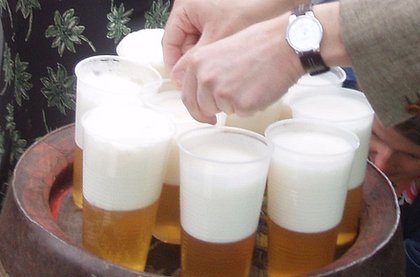
PS: The picture was taken at a Norwegian-German wedding. For the wedding, two barrels of Bavarian beer were transported by the couple from Bavaria to Norway by car. Enkerli’s point about negotion of German identity in the US might also be true for Norway.

beer

By studying beer cultures, you may learn lot about identity. In the United States, German-American identity is rarely marked. But given the association between Germany and beer, craft beer allows for the active negotiation of German-American identity, anthropologist Alexandre Enkerli…

Read more

"Germans stick to the ethnic definition more than any other European nation"

Germany’s real problem isn’t “honor” killers or skinheads. Instead, what keeps this increasingly diverse nation from gaining a strong sense of social cohesion is its self-made confusion over what it means to be German in the first place, Gregory Rodriguez writes in a great article in the Los Angeles Times.

He quotes Barbara John, professor of European anthropology at Humboldt University in Berlin, who says: “We stick to the ethnic definition probably more than any other European nation.” He writes:

Indeed, long before Germany’s terrible experiment with ethnic supremacy during the Nazi years, Germans had a narrow view of themselves as a people. Unlike, say, the French, who acknowledge that their culture and language derive from the Romans and that they are akin to other Latin peoples, the Germans see themselves as unique.

What he (and many others as well) wonder about: Have the Germans learned from the nazi-period and World war II?:

Even after World War II, when West Germans did everything in their power to rid their culture of chauvinism and racism, they left intact a citizenship law that was based on blood kinship rather than on place of birth. That meant that the children of Turkish guest workers, born in Germany, were not automatic citizens, yet an ethnic German from Romania whose family had never resided in contemporary Germany was.

(…)

It wasn’t until 2000 that a more open citizenship law took effect. In arguing for a territory-based notion of citizenship, then-Interior Minister Otto Schily proclaimed that Germany needed to rise above “the destructive principle of ethnocracy.”

Six years on, Germans are only beginning to differentiate between their ethnic and civic identities. Ethnic Germans still tend to look on non-ethnic Germans as auslander, or foreigners. Even the media, when they acknowledge minorities as German citizens, use tortured phrases, describing someone as a “Turk who carries a German passport,” for example. Not surprisingly, such marginalization has negative consequences.

Rodriguez believes that the shaping of Germany’s future identity lies in popular culture. He mentions a popular sitcom “Turkish for Beginners,” and Turkish-German novelist Feridun Zaimoglu who says:

“The truth is you can’t talk anymore of a foreign population and a native population, as if they were enemies. As I understand myself, I am a German,” Zaimoglu says. “I love my country, but I don’t make a Wagner opera out of it. I don’t try to define what it means to be German. I just live it.”

>> read the whole article in the Los Angeles Times (link updated 14.10.2019)

SEE ALSO:

For Turks, Germany is home

French versus Germanic national identity

What’s all this fuss about national identity?

What’s a German? The Search for Identity Continues

Germany Survival Bible – a cultural guide for visitors by Spiegel Online

Germany's real problem isn't "honor" killers or skinheads. Instead, what keeps this increasingly diverse nation from gaining a strong sense of social cohesion is its self-made confusion over what it means to be German in the first place, Gregory Rodriguez…

Read more

Three interviews about multiculturalism, arranged marriages, honor and dignity

Three interviews that I’ve conducted earlier this year have been translated from Norwegian to English:

Take on the multiculturalism debate – Interview with Alexa Døving
Does culture exist? What is integration? What defines Norwegianness? Is nationalism excluding? How useful are cultural explanations? Should special rights be awarded on cultural and religious grounds? What groups make up a society? Alexa Døving has chosen to write about the big issues. >> read the interview

Unni Wikan with plans for a new book about immigrant men, honour and dignity
Previously Unni Wikan has been interested in immigrant women and children. She now wants us to be more concerned with the men. Better insights into the mens’ situations could prevent conflicts, says the anthropologist, who is working on the analysis of two court cases to do with honour killing and forced marriage. >> read the interview

To engage the reader with a complex message – Interview with Anja Bredal
Do not underestimate free will and do not trivialize coercion! This is the conclusion in Anja Bredal’s doctoral thesis on arranged marriage. After ten years of research, one doctorate and several journal and newspaper articles this sociologist is still interested in the topic. She wonders about one thing in particular: How is it possible to maintain a nuanced moderate position and yet still be interesting? >> read the interview

Three interviews that I've conducted earlier this year have been translated from Norwegian to English:

Take on the multiculturalism debate - Interview with Alexa Døving
Does culture exist? What is integration? What defines Norwegianness? Is nationalism excluding? How useful are cultural explanations?…

Read more

“A postcolonial urban apartheid”: Two anthropologists on the riots in France

In their Anthropology News May article Urban Violence and Civil Rights in Postcolonial France, Paul A Silverstein
and Chantal Tetreault analyse the riots in France in november 2005.

French Prime Minister Dominique de Villepin announced a “state of emergency” across over a quarter of the nation:

Deploying this law, an instrument of colonial governance, both challenged the basic civil rights of France’s suburban citizens and revealed an enduring logic of colonial rule. Like colonial settler cities, contemporary French urban centers cast their impoverished peripheries as culturally, if not racially, distinct.

The anthropologists are not surprised over the riots:

Nearly every euro France has saved by “tightening the belt” on the public sector has been redeployed into the forces of security. Every attempt at “integrating” (or “civilizing”) underclass residents of the cités has been undermined by policing practices that continue to demarcate these populations as racially and spatially “other.”

The result is a form of postcolonial urban apartheid, in which the French state is equated with repression by many cité inhabitants. The October-November violence reflected this unity of social marginalization and anti-police sentiment. In the end, the French state’s treatment of its own citizenry as racially suspect and intrinsically violent—as potential enemies within—may prove to be a self-fulfilling prophecy.

>> read the whole article in Anthropology News (Link updated, was removed)

SEE ALSO:

Riots in France and silent anthropologists

Who Are the Rioters in France? Anthropology News January

In their Anthropology News May article Urban Violence and Civil Rights in Postcolonial France, Paul A Silverstein
and Chantal Tetreault analyse the riots in France in november 2005.

French Prime Minister Dominique de Villepin announced a “state of emergency” across over…

Read more