search expand

Anthronow – new magazine will make anthropology accessible to lay readers

logo (via somatosphere) “Other disciplines have a magazine for the general public. Why can’t we?” Now, we have it. The first issue of Anthronow is out. The editors Katherine McCaffrey, Emily Martin, Ida Susser, and Susan Harding (they’re all from American universities) write:

Other disciplines have a magazine for the general public. Why can’t we? Why can’t we have a “popular anthropology” magazine that would fill the gap between conventional news coverage of current events and topics and the more specialized analysis of similar events and topics in professional journals? If our scholarship were written in clear and accessible language and embellished with photographs and other visual materials, wouldn’t there be public interest in the ways that anthropological theory and research can inform and affect contemporary public discourse and public policy debates?

Anthropology Now’s mission is to make anthropological knowledge accessible to lay readers, and to enrich knowledge and debate in the public sphere. The magazine aims to reclaim a voice for anthropology in public debate, not by simplifying complex problems, but by conveying anthropological knowledge in clear and compelling prose. Anthropology Now will build on a growing commitment among anthropolo- gists to make our research findings open and accessible to the world outside of the confines of the academy.

It seems that there is both a paper and a webversion of Anthronow. All articles of the first issue are online. I hope they will continue to provide open access to future issues as well.

I havent’ had time to look at the articles yet. Have they succeeded in making anthropology accessible for the world outside of the universities?

>> visit Anthronow

PS: There is another “popular anthropology” magazine, not in the U.S, but in Germany. It’s called Journal Ethnologie. Are there more? Oh yes, maybe American Ethnography?

UPDATE: Debate about Anthronow and its future over at Savage Minds

logo

(via somatosphere) "Other disciplines have a magazine for the general public. Why can’t we?" Now, we have it. The first issue of Anthronow is out. The editors Katherine McCaffrey, Emily Martin, Ida Susser, and Susan Harding (they're all…

Read more

Accused of being CIA-spy: Anthropologist on fieldwork among Cambodian muslims

Are muslim communities getting more sceptical towards anthropologists? In an interview with Phnom Pen Post, anthropologist Bjørn Blengsli tells about his research among muslims in Cambodia – “one of the fastest-changing Muslim societies in the world”.

After September 11, he got arrested and expelled from the village and the district. He was accused of being one of “60 identified CIA spies”. (After a letter from the Ministry of Religion and meetings with undersecretaries of state, he could continue his research.)

Furthermore, Blengsli is concerned about reports of certain researchers who have pretended to convert to Islam in order to gain the confidence of Muslim informants. Muslims consider such people hypocrites, or munafiq – one who is more dangerous to Muslims than the enemies of Islam, he says. “I am afraid that this kind of devious behavior will negatively impact legitimate researchers in the future.”

Blengsli is especially interested in religious change and the impact of foreign donors on religious schooling. He found out that the schools’ religious content is closely linked to the type of religion practiced in the donor countries – often conservative Arab countries. Islamic schooling has led to a “growing sympathy for fundamentalist understandings of the faith and terrorism”.

In his opinion, secular education should be implemented in all Muslim schools:

The secular education among Muslims is still low when compared to that of the Khmer, with Muslim girls most disadvantaged in their pursuit of secular education. Increased knowledge not only about the Khmer society, but also the different sects within Islam is also imperative. As many as 99 percent of Muslim religious students believe there is only one correct interpretation of their religion and this is extremely dangerous.

>> read the whole interview

Earlier, he told Arab News:

In Cambodia … religious activists from the Arab world are arriving with a new view on religion and they preach an austere version of Islam. These organizations want to purify Cham Islamic practice by getting rid of the many influences from Buddhism.

He was also interviewed by the New York Times. He said:

‘This country is ripe for Muslim missionaries. They had to start all over again. They had no religious leaders, nothing. They lost almost everything — their script, their rituals, almost all their written material. They were left with a couple of myths. That’s why today a purification movement is so easy. They are very vulnerable, and a lot of people are coming into Cambodia and telling them how to change.

But he added that ”being fundamentalist does not mean being a terrorist.” And ”If you have radical, militant Muslims living in Cambodia, I have not seen any proof.”

SEE ALSO:

Protests against British research council: “Recruits anthropologists for spying on muslims”

“Arabs and Muslims should be wary of anthropologists”

Anthropology and CIA: “We need more awareness of the political nature and uses of our work”

Religious divide grows amid Thai unrest

Doctoral Thesis: Is Islam Compatible with Secularism?

Islam in Morocco: TV and Internet more important than mosques

Are muslim communities getting more sceptical towards anthropologists? In an interview with Phnom Pen Post, anthropologist Bjørn Blengsli tells about his research among muslims in Cambodia - "one of the fastest-changing Muslim societies in the world".

After September 11, he got…

Read more

George Marcus: "Journals? Who cares?"

(LINKS UPDATED 20.5.2022) When George Marcus, one of the most influential anthropologists, was in Oslo recently, I asked him what he thinks about Open access. His answer surprised me. “Journals? Who cares?”, he replied. There is in his opinion little original thinking in journals, there are no longer exciting debates. “Maybe it’s because I’m getting older”, he said. “I don’t care.” He explained that “journals are meant to establish people”, to advance careers.

George Marcus offered similar pessimistic views in an interview in the journal Cultural Anthropology (subscription needed) in spring. Among other things, he said, that there are “no new ideas in anthropology”.

Maximilian Forte at Open Anthropology does not agree with Marcus and summarizes parts of the interview in his post George Marcus: “No New Ideas” (2.0) & the After-Life of Anthropology (1.1)

I mentioned Forte’s critique. Marcus replied “Of course Forte does not agree. Younger anthropologists are interested in progress and new ideas.”

Additionally, Marcus explained me his vision of the anthropologist as collaborator. Anthropologists should not study other people, but work together with them, and treat them as co-researcher. Nowadays, our informants may be interested in the same questions as the anthropologst, and they might even have studied anthropology as well. Marcus wrote an experimental book about the nobility in Portugal called Ocasião: The Marquis and the Anthropologist, A Collaboration.

George Marcus talkes about these issues in another interview in the Open Access journal After Culture, see Elise McCarthy, Valerie A. Olson: After Writing Culture: an interview with George Marcus.

See also the website of the Center of Ethnography that he has established and the website of the Anthropology of the Contemporary Research Collaboratory where there are lots of papers, among others Marcus’ Notes on the Contemporary Imperative to Collaborate, the Traditional Aesthetics of Fieldwork That Will Not Be Denied, and the Need for Pedagogical Experiment in the Transformation of Anthropology’s Signature Method – check also the 2020 update

George Marcus is best known for the books Writing Culture (edited together with James Clifford) and “Anthropology as a cultural critique” (written together with Michael Fischer)

For those of you who can read Norwegian, there’s an article by me on George Marcus here.

UPDATE: Peter Suber (Open access news) comments:

Did this transcript miss something or did George Marcus miss something? Even if we concede for the sake of argument that there are no new ideas in the field of anthropology, and that journals are more about advancing careers than advancing research, Marcus’ answer was not responsive. Apparently he thinks OA is all about journals, which it isn’t. It’s all about access, which may be through journals or repositories or many other vehicles (like wikis, ebooks, multimedia webcasts, P2P networks, RSS feeds…). It’s as if someone had asked, “What do you think about freedom of speech?” and he answered, “Public speaking? Who cares? It’s all grandstanding and vanity.”

Good point! I have to admit that Marcus was very busy and did not have much time for this interview – and I had lots of questions! We talked just a few minutes on Open Access while we we took the subway from the city up to the university campus at Blindern. He said he admires Chris Kelty’s work on open source and open access, but he does not seem to be up to date in regard to blogging, web2.0 etc (few anthropologists actually are, and most anthropologists have never heard of the Open Access movement)

ANOTHER UPDATE Dorothea Salo does not agree with Peter Suber. Yes, its about journals, she writes.

What is it we’re asking faculty to self-archive? Theses and dissertations, yes; (…) If we weren’t talking about the journal literature, why would repository-rats get so much flak (…) when we take in other things?

So follow Dr. Marcus’s train of thought here: if the journal literature isn’t all it’s cracked up to be, why would he waste time fighting for open access to it? There’s a lot to fight for in the world!

Interesting comment by Chris Kelty on journals:

I think George is right that journals are not where the action is—- and this is related to why I and others are so passionate about open access. Journals are increasingly getting slower, more clogged with submissions, finding it difficult to get reviewers, cash strapped and so on. And at the same time, getting published in a “good” journal (i.e. one with “prestige”) is getting more and more important for people who want permanent jobs in the academy.

the result is that the interesting debates and discussions have moved elsewhere… in some fields (though not anthropology, I fear) they have moved online and into the blogosphere. In others (anthropology I fear) they have retreated into departments and enclaves of other sorts, or have produced and increased sense of alienation from things.

(LINKS UPDATED 20.5.2022) When George Marcus, one of the most influential anthropologists, was in Oslo recently, I asked him what he thinks about Open access. His answer surprised me. "Journals? Who cares?", he replied. There is in his opinion…

Read more

NEW: antropologi.info call for papers and job announcements (beta)

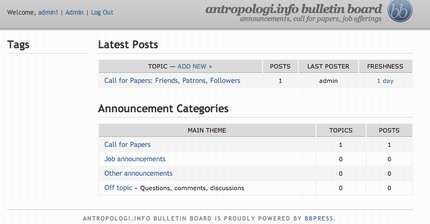
I have installed a new bulletin board for job announcements and call for papers. Announcements are now easier accessible.

Until now, I’ve posted announcements in one of the forums. Apart from the German forum, the forums haven’t been a huge success, so I am considering closing them and concentrate on announcements instead (I often receive emails where I am asked to put announcements on the antropologi.info website).

There are two ways of publishing announcements:

1) send them to me

2) register (takes 10 seconds) and do it yourself.

So take a look at the new announcement site and tell me if it looks okay. I’ll integrate the bulletin board into the site afterwards.

screenshot
screenshot

I have installed a new bulletin board for job announcements and call for papers. Announcements are now easier accessible.

Until now, I've posted announcements in one of the forums. Apart from the German forum, the forums haven't been a huge…

Read more

Nigel Barley: "Fiction gives better answers than anthropology"

(LINKS UPDATED 18.2.2021) “Fiction’s more fun. It lets you look inside people’s heads in a way you wouldn’t dare to do if you stuck to anthropology”, anthropologist Nigel Barley says in an interview with the Telegraph:

“As an anthropologist you’re always asking questions such as: How different can different peoples be? Are we all reducible to a common humanity? And if so: what is it? Nobody can answer these questions. But I like to use fiction to try to answer anthropological questions. And fiction, I find, gives better answers.”

His book The Duke of Puddledock records Nigel’s travels, literal and figurative. It is part biography, part autobiography, part natural history, part anthropology, and part travelogue.

>> read the whole story in the Telegraph

Nigel Barley, most known for his funny book The Innocent Anthropologist: Notes from a Mud Hut is not the only anthropologist who explores the possibilities of fiction.

A few weeks ago, I read about Tahmima Anam, the first Bangladeshi writer to win the Overall First Book Award at The Commonwealth Writers Prize 2008. She has a PhD in Social Anthropology from Harvard University, and an MA in Creative Writing from Royal Holloway College.

“I wrote A Golden Age because I wanted the story of the Bangladesh war to reach an international audience”, she says. She travelled throughout Bangladesh, interviewing ex-freedom fighters, military officers, students, and survivors of the 1971 war. The novel is a fictionalised account of these war stories, combined with her own family history.

In an interview with the Boston Globe she explains why she wrote a novel, rather than a nonfiction book:

I felt that this was a human story that needed character and plot. I wanted it to touch people’s hearts, as the stories I had heard had touched my heart. I wanted people to have a visceral sense of what it was like to be there at that time, and I didn’t think that nonfiction, for all its beauties and virtues, could do that.

And in an interview with the Guardian she says:

After graduating from university I started a PhD in social anthropology, but really I was dreaming of writing a novel. I would sit in my lectures and scribble in the margins of my notebooks. But for a long time, I didn’t tell anyone I wanted to be a writer; it was my undercover identity. It was when I started doing the research that it became more real. I travelled back to Bangladesh and met survivors of the Bangladesh war. After hearing their stories, I felt that I really ought to take the project more seriously, and that’s when I began writing the novel in earnest.

See also her articles in the Guardian and in New Statesman

SEE ALSO:

Manga instead of scientific paper: How art enriches anthropology

The most compelling ethnographies and ethnographic fiction

The Secret of Good Ethnographies – Engaging Anthropology Part III

Why is anthropological writing so boring? New issue of Anthropology Matters

(LINKS UPDATED 18.2.2021) "Fiction's more fun. It lets you look inside people's heads in a way you wouldn't dare to do if you stuck to anthropology", anthropologist Nigel Barley says in an interview with the Telegraph:

"As an anthropologist you're always…

Read more