
search expand

How anthropologists should react to the financial crisis

cover

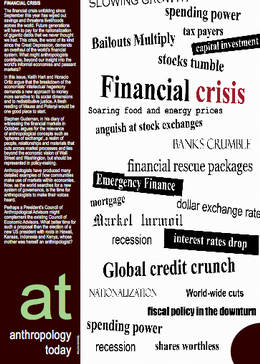
Anthropologists have largely left the global effects of economic globalisation to economists. Now in this worldwide financial crisis it is the time for anthropologists to renew an engagement with political economy, Keith Hart and Horacio Ortiz write in their guest editorial in the new issue of Anthropology Today:

Anthropology’s relevance to the world would be enhanced if some of us adopted a more self-conscious strategy of seeking to understand the present crisis and its consequences for society at all levels.
(…)
We should try to bring the distributive consequences of finance down to a concrete level. Readers might then be able to engage with money not as a superhuman force with devastating effects, but as the outcome of ideas and institutions that can and should be changed by human action.
(…)
The breakdown of the economists’ intellectual hegemony represents a chance for us to link our engagement with people’s lives to anthropology’s original mission to understand humanity as a whole.

There are many ways to do this:

One method of doing so would be to analyse the everyday practices of professionals in financial corporations, states and regulatory bodies (Ortiz 2008), but also those of the people who entrust their monetary resources to them or are barred from access to the process.
(…)
Kula objects have magical power for those who exchange them, but anthropologists have shown their social logic and instrumentality. We have always invented concepts to describe and explain social processes quite different from those familiar at home. The current crisis presents us with a compelling reason to do so again, this time in a global context.

Anthropologists can do no better than to renew their engagement with the writings of Marcel Mauss and Karl Polanyi. Their perspectives on political economy can help us to make sense of the current situation and to recommend alternative paths forward according to Hart and Ortiz.

In his famous work “The Gift”, Mauss observed,

…that in contemporary capitalism the wealthy classes acted increasingly as if they did not belong to a social order that made redistributive obligation a condition of their hierarchical privilege. Their amnesia when it came to the ‘gift’ was not just a function of power, but of an accumulation of power that considered itself to be socially unbounded. As a result, heightened strife put the social order itself at risk.

Polanyi showed in his famous work The great transformation (1944) how markets became disembedded from the rest of society. Like Mauss, Polanyi was concerned with the ideas that defined money, the rules of its use and the social distinctions that made its circulation possible and legitimate:

He too contended that the classes who benefited from markets, particularly high finance in the decades before the First World War, neglected the interests of the rest of the population, with devastating consequences for society. (…) He identified the historical dialectic or ‘double movement’ whereby the drive of capitalists to escape from social constraints met the countervailing power of classes and institutions (such as those adhering to the welfare state) acting in society’s self-defence. (…) The distribution of resources, according to him, should not be left to the search for profit in market relations, but needed also to acknowledge solidarity between all members of society.
(…)
Anthropologists following him would thus explore how the social struggles over money are understood by the participants, and with what consequences for distribu- tion itself. This would offer a critique of the pretence that economics is not social or political; beyond that, it would constitute a research programme.

Polanyi and Mauss made sure that their more abstract understandings of political economy were grounded in the everyday lives of concrete people:

An unblinking focus on distribution at every level from the global to the local reveals how the social consequences of political economy and the way it is understood by those who make it are one and the same social process. The current crisis renders this insight particularly visible, since it challenges contemporary financial ideas, while its tangible distributive effects are felt and feared throughout the world.

It is no coincidence that economic anthropology was last a powerful force in the 1970s, when the world economy was plunged into depression by the energy crisis, Hart and Ortiz write:

Now, if ever, is the time for anthropologists to renew an engagement with political economy that went into abeyance then. The prize at stake for our discipline as a whole is much larger than the revival of one of its parts.

Anthropology’s highest mission is to start from where people are and go with them wherever they take you. That means engaging with their visions of the world, perhaps to catch a glimpse of the world humanity is making together. What better time to follow this imperative than when the model the world has been compelled to live by for three decades is in such disarray?

The editorial is not accessible for readers outside the university world, but Keith Hart has published a different version of the editorial on his website (and many related papers as well)

SEE ALSO:

Used anthropology to predict the financial crisis

Anthropologist: Investors need to understand the tribal nature of banking culture

What anthropologists can do about the decline in world food supply

The last days of cheap oil and what anthropologists can do about it

After the Tsunami: Maybe we’re not all just walking replicas of Homo Economicus

Why were they doing this work just to give it away for free? Thesis on Ubuntu Linux hackers

cover

Anthropologists have largely left the global effects of economic globalisation to economists. Now in this worldwide financial crisis it is the time for anthropologists to renew an engagement with political economy, Keith Hart and Horacio Ortiz write in their…

Read more

How media covered Claude Lévi-Strauss’ 100th birthday

100 years ago he was born – Claude Lévi-Strauss – one of the most famous and influential anthropologists in the world. A quick Google News search revealed that there are some articles in a some newspapers around the world (not so many in English than in German, though – let alone French I suppose…).

Here is a selection of articles:

100th-Birthday Tributes Pour in for Lévi-Strauss (New York Times 29.11.08)

Patrick Wilcken: The century of Claude Lévi-Strauss (How the great anthropologist, now approaching his 100th birthday, has earned a place in the prestigious Pléiade library – The Times Literary Supplement 29.11.08)

Dan Sperber: Claude Lévi-Strauss at 100: echo of the future (Lévi-Strauss was the pioneer of a true “cognitive anthropology” – OpenDemocracy, 28.11.08)

Lévi-Strauss, a French icon, turns 100 ( France celebrated with films, lectures and free admission to the museum he inspired, the Musée du Quai Branly – International Herald Tribune, 28.11.08)

100 Candles for Claude Levi-Strauss (The Chronicle of Higher Education, 25.11.08)

Anthropologist Claude Levi-Strauss Turns 100 (NPR, 23.11.08)

Benjamin Ivry: Claude of the Jungle. The other Lévi-Strauss turns 100 (The Forward, 6.11.08)

Grand chieftain of anthropology lives to see his centenary: Claude Lévi-Strauss did not see the West as superior (The Independent, 29.11.08)

There many blog posts about Levi-Strauss’ birthday.

The Savage Minds bloggers have collected a large number of Levi-Strauss quotes.

Daniel Miller from Material World has written A tribute to Professor Claude Levi-Strauss. Another Material World-blogger, Laurence Douny, has made a special birthday card for him.

Steve at What Do I Know wrote two posts – no three.

Jason Baird Jackson blogged The Anthropologist as Hero: Claude Lévi-Strauss on his 100th Birthday, and also Maximilian Forte at Open Anthropology says Happy Belated Birthday, Claude Lévi-Strauss

Anthropologist Stephen Chrisomalis has never been much of a fan of Levi-Strauss’ work, but sees the real value of Levi-Strauss’ work “is an attempt (however imperfect) to build anthropological theory through the comparative use of anthropological data”, he writes in his post Structuralism and comparativism

Robert K. Blechman explains Claude Lévi-Strauss’s contribution to Media Ecology

100 years ago he was born - Claude Lévi-Strauss - one of the most famous and influential anthropologists in the world. A quick Google News search revealed that there are some articles in a some newspapers around the world (not…

Read more

What happened at the AAA meeting in San Francisco?

The American Anthropological Association’s annual meeting is over – here a quick round-up of the conference coverage on the web.

Anthropology and the military was a hot topic this year as well as Inside Higher Ed informs in three articles:

According to the article Anthropological Engagement, for Good and for Bad?, the debates were “generally civil but at times pointed”. During a “consistently unorthodox question and answer session cut the moderator, Rob Borofsky of Hawaii Pacific University follow-up questions and at one point barked at an audience member “That’s, it! Down!” as if addressing a dog. Many questioners grew unsettled with the panelists’ answers.

The Network of Concerned Anthropologists submitted a letter to AAA’s president, Setha Low, accompanied by 1,056 signatures of anthropologists who signed a “Pledge of Non-participation in Counterinsurgency.”Ethics and Militarization Dominate Anthropology Meeting, see Ethics and Militarization Dominate Anthropology Meeting (Inside Higher Ed 21.11.08)

Montgomery McFate cancelled her presentation. She was invited to give a keynote lecture at a conference of the Southwestern Anthropological Association, see Raised Eyebrows over Keynote Choice (Inside Higher Ed, 20.11.08)

Other topics:

On an inter-generational panel on mothering, anthropology and fieldwork the question “How do we mix our passion for anthropology, which is rooted in fieldwork, and our passion for parenting, which is often rooted in schedules and routines and a sense of normalcy?” was discussed, see Fieldwork with Three Children (Inside Higher Ed, 25.11.08)

“Religion in Evolutionary Perspective” was the topic of the session by Barbara King. See Dispatch From the AAA Annual Meeting (Science and Religion Today, 24.11.08)

“The Encultured Brain session went very well yesterday”, we read on the blog Neuroanthropology. They have previously presented their topic in several posts, among others Daniel Lende, Ethnography and Addiction (which includes links to several papers) – update Greg Downey put his paper ‘Balancing Between Cultures: A Comparative Neuroanthropology of Equilibrium in Sports and Dance.’ online

Dave Gottwald writes about a multi-disciplinary panel about architecture and anthropology. The panel’s purpose was to expand on the dialogue between architecture and anthropology, and included case studies on place branding, contemporary lifestyle and retail stores, shopping malls and theme parks, and casinos around the world.

The Damito has written an interesting round up of six different panels and even another one

Iceland Review reports about an Icelandic student at the Lawrence University in Wisconsin, Sveinn Sigurdsson. Together with his research partner Ashlan Falletta-Cowden,he received an award for their project on Icelandic food habits from the AAA.

The AAA Public Affairs Blog has collected links to press coverage.

Finally, there is a brief wrap up at Savage Minds and readers are asked to leave comments on the highlights/low points of the AAA-meeting

The American Anthropological Association’s annual meeting is over - here a quick round-up of the conference coverage on the web.

Anthropology and the military was a hot topic this year as well as Inside Higher Ed informs in three articles:

According…

Read more

antropologi.info voted nr 2 in Savage Minds awards

What are the best anthropology websites? Last night, at the annual meeting of the American Anthropology Association in San Francisco, the Savage Minds Awards were handed out. In the category “Most excellent blog”, antropologi.info was voted second best, behind my favorite, Culture Matters.

Thanks a lot for voting for antropologi.info :) ! Unfortunaltely, I could not be there.

Here are the results:

Most Excellent Blog
Runner up: Antropologi.info
Most Win: Culture Matters

Most Excellent Open Access Journal
Runner Up: Cultural Analysis
Most Win: Anthopology Matters

Most Excellent Blog or Journal that does not end in “Matters” (The Category formerly known as Most Excellent Unclassifiable Digital Thingamajob)
Runner Up: Digital Anthropology
Most Win: Neuroanthropology

Congratulations! As the above list and the list of the nominated sites show, there are a lot of great anthropology websites! There has been a huge development during the recent years. This is great news!

See also the announcement of the Savage Minds Awards and coverage by Culture Matters and Neuroanthropology

What are the best anthropology websites? Last night, at the annual meeting of the American Anthropology Association in San Francisco, the Savage Minds Awards were handed out. In the category "Most excellent blog", antropologi.info was voted second best, behind my…

Read more

Vote for the best anthropology blog and journal!

The voting has begun – the winners will be announced at the annual meeting of the American Anthropological Association. antropologi.info is one of seven blogs that were nominated for the Most Excellent Anthropology Blog category (currently number two behind Culture Matters).

There are two more categories: “Most Excellent Open Access Journal in Anthropology” and “Most Excellent Uncategorizable Digital Thing-a-ma-job for Anthropology”

Read more about the Teh Savage Minds Awards Ceremony over at Savage Minds: http://savageminds.org/2008/11/14/teh-savage-minds-awards-ceremony/

The voting has begun - the winners will be announced at the annual meeting of the American Anthropological Association. antropologi.info is one of seven blogs that were nominated for the Most Excellent Anthropology Blog category (currently number two behind Culture…

Read more