
search expand

(updated) Danah Boyd on Open Access: “Boycott locked-down journals”

“This is the last article that I will publish to which the public cannot get access. I am boycotting locked-down journals and I’d like to ask other academics to do the same”, writes Danah Boyd on her blog:

On one hand, I’m excited to announce that my article “Facebook’s Privacy Trainwreck: Exposure, Invasion, and Social Convergence” has been published in Convergence 14(1) (special issue edited by Henry Jenkins and Mark Deuze).

On the other hand, I’m deeply depressed because I know that most of you will never read it. It is not because you aren’t interested (although many of you might not be), but because Sage is one of those archaic academic publishers who had decided to lock down its authors and their content behind heavy iron walls.

What’s the point of writing papers if no one can read them? The journals are “god-awful expensive and no one outside of a niche market knows what’s in them”, she writes:

Digital copies of the articles have intense DRM protection, often with expiration dates and restrictions on saving/copying/printing. Authors must sign contracts vowing not to put the articles or even drafts online. (Sage -allows- you to posts articles one year following publication.) Academic publishers try to restrict you from making copies for colleagues, let alone for classroom use.
(…)
The result? Academics are publishing to increasingly narrow audiences who will never read their material purely so that they can get the right credentials to keep their job. This is downright asinine. If scholars are publishing for audiences of zero, no wonder no one respects them.

This has to change, she writes. Scholars have a responsibility to make their work available as a public good.

She proposes:

  • Tenured Faculty and Industry Scholars: Publish only in open-access journals
  • Disciplinary associations: Help open-access journals gain traction
  • Tenure committees: Recognize alternate venues and help the universities follow
  • Young punk scholars: Publish only in open-access journals in protest, especially if you’re in a new field
  • All scholars: Start reviewing for open-access journals. Help make them respected
  • Universities: Support your faculty in creating open-access journals on your domains

>> read the whole post on her blog

UPDATE:

Anne Galloway does not think boycott is the way to go: “I fully support open-access scholarship, but find danah boyd’s recent post on boycotting “locked-down” journals naive at best, and offensive at worst”, she writes in her blog. Furthermore she think Danah Boyd “overstates the “lock-down”.”:

I’ve published articles with Sage and Taylor&Francis, and was able to publish almost identical draft versions here. All I did was hand-write that provision onto my contract before I signed it, and no one ever objected.

>> read the whole post by Anne Galloway

There are now more than twenty comments on Danah’s post, including by publishers, a very interesting discussion!

SEE ALSO:

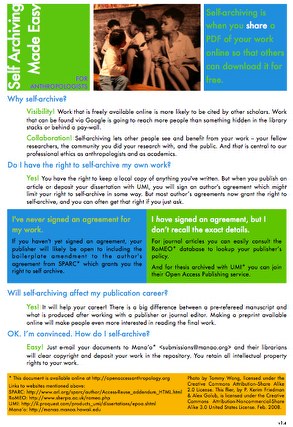
A quick guide to selv-archiving for anthropologists (mainly USA/GB-related, it seems) by Kerim Friedman

Anthropology News February about Open Access Anthropology

2006 – The Year of Open Access Anthropology?

Why Open Access?

Open Access News

"This is the last article that I will publish to which the public cannot get access. I am boycotting locked-down journals and I'd like to ask other academics to do the same", writes Danah Boyd on her blog:

On one hand,…
Read more

Military spies invade anthropology conferences?

The U.S. military is not only interested in employing anthropologists. Now, they have started attending anthropology conferences. Anthropologist Caroline Osella from the University in London and one of the editors of Social Mobility In Kerala, is worried.

In a post in the ASA Globalog (run by the Association of Social Anthropologists of the UK and Commonwealth) she tells us about her recent experience from a conference at the Exeter Gulf Studies Centre where she met people from the U.S. military both in the bar and in the conference:

Bad enough to have to check oneself and what one says in conferences…but to have to be on your guard in the bar afterwards in case you say something of interest about the Gulf-connected Muslim Indians you work among is surely one step too James Bond for an anthropologist?

A week before, she had attended a conference on south Asian studies in Leiden and “also found some of these security types there, listening in on the panels on south Asian Muslims – and even presenting papers themselves!”

Do we have to tolerate this?, she wonders:

I still maintain that this is a worrying trend and that effectively, academic freedom and decent research is jeopardised if all our conferences are gatecrashed.

Conferences are places where we try out ideas and present first drafts of our work; we may later decide to alter some things before going to publication in order to protect the people we work with.

By letting security personnel or academics form the military into conferences then effectively our work is going into the public realm before we are ready for it to do so.

Washington and whoever else is welcome to read the published versions of my and Filippo’s work, like any other members of the interested public. But they can download it and read it in their offices.

They can please keep away from academic conferences, where I want the freedom to try out my ideas, decide which details I might want to keep confidential for ethics’ sake, and feel free to engage in discussions which are not monitored or where the information I may pass on is not feeding into any policy agenda. And I want to be able to go and drink and talk shop in the bar in the evening without wondering who is listening.

(…)

We teach our undergrads about our shameful past with regard to colonialism. Are we going to find the next generation of anthropologists teaching about us and our pathetic accommodations to state power and our polite refusals to speak out?

>> read the whole blog post on the ASA Globalog

>> more posts on counterinsurgency on the ASA Globalog (quite a lot actually!)

On the website of the Network of concerned anthropologists (NCA), Hugh Gusterson tells a related story. During a panel at the American Anthropological Association annual meeting featuring three NCA members, witnesses saw two U.S. Army personnel writing down the names and institutional affiliations of anthropologists who had signed copies of the NCA pledge of Non-participation in Counter-insurgency circulating during the panel.

SEE ALSO:

Protests against British research council: “Recruits anthropologists for spying on muslims”

Final report launched: AAA no longer opposes collaboration with CIA and the military

The dangerous militarisation of anthropology

“Arabs and Muslims should be wary of anthropologists”

Anthropology and CIA: “We need more awareness of the political nature and uses of our work”

The U.S. military is not only interested in employing anthropologists. Now, they have started attending anthropology conferences. Anthropologist Caroline Osella from the University in London and one of the editors of Social Mobility In Kerala, is worried.

In a post…

Read more

(updated) Anthropology News February about Open Access Anthropology

The American Anthropological Association (AAA) is starting to remind me of the recording industry and their rearguard actions against file-sharing and online dissemination in general”, Eric Kansa commented one year ago.

I was reminded on this comment when I read about the the Februrary issue of Anthropology News that focuses on Open Access Anthropology. Five articles are available online – but only for one month. Then, the articles about Open Access Anthropology will be hidden behind login-boxes.

UPDATE: Dinah Winnick, Associate Managing Editor Anthropology News writes to me and clarifies that the articles will continue to be accessible after the 1st of March:

To clarify, these articles will appear on the Featured page for one month, after which they will be moved over to our Archives page and also be available through AnthroSource. They are moved from the Featured page monthly so that we can feature new content from our latest issue. I appreciate your bringing this misunderstanding to my attention and I have added a phrase to our website for clarification.

Four of the five articles provide lots of good arguments for Open Access Anthropology. It’s only Jason Cross, member of the AAA Long-Range Planning Committee who is reluctant. He is mainly concerned for the financial consequences and proposes “careful research on business models to assess whether and how to make an OA transition”.

So download now:

Lee D Baker: Mission Improbable and the Possible Mission

Don Brenneis: Process, Access and Value

Melissa Cefkin: Organizing for Access

Jason Cross: Open Access and the AAA

Christopher Kelty: The State of Open Access Anthropology (see also an earlier version of the text on Savage Minds)

The AAA has also set up an Open Access blog “where members and non-members alike can offer both their reactions to the In Focus series and their general thoughts on the Open Access issue”.

PS: The AAA has redesigned their website, see discussion over at Savage Minds

RELATED:

selv-archiving

A quick guide to selv-archiving for anthropologists (mainly USA/GB-related, it seems) by Kerim Friedman

SEE ALSO:

Open Access: “The American Anthropological Association reminds me of the recording industry”

American Anthropological Association opposes Open Access to Journal Articles

Kerim Friedman: Open Source Anthropology

The Anthropologists – Last primitive tribe on earth? (Take a look at indigineuos people’s use of online communication as a mean of resistance and raising awareness.)

2006 – The Year of Open Access Anthropology?

Already lots of publications in the open access anthropology repository Mana’o

Why Open Access?

Open Access News

selv-archiving

"The American Anthropological Association (AAA) is starting to remind me of the recording industry and their rearguard actions against file-sharing and online dissemination in general", Eric Kansa commented one year ago.

I was reminded on this comment when I read…

Read more

ScientificCommons.org – The Open Access Search Engine

UPDATE: ScientificCommons was closed down in 2014

How can I find research papers and theses that are freely available? ScienceCommons is a search engine and portal that is still in beta but now lists 893 repositories (according to Peter Suber at Open Access News). A search for anthropology gives more that 44 000 hits but a quick check reveals that not all papers or theses are open access.

ScientificCommons.org is a project of the University of St.Gallen (Switzerland) and hosted and developed at the Institute for Media and Communications Management:

The major aim of the project is to develop the world’s largest communication medium for scientific knowledge products which is freely accessible to the public. A key challenge of the project is to support the rapidly growing number of movements and archives who admit the free distribution and access to scientific knowledge

>> visit ScientificCommons

There is another search engine as well: OAIster. There a search for anthropology gives 54679 records – but also included some papers with restricted access (f.ex. from journals like Current Anthropology)

See also 2007 Highlights over at Savage Minds: “2007 was a great year for the open access movement”.

SEE ALSO:

Already lots of publications in the open access anthropology repository Mana’o

2006 – The Year of Open Access Anthropology?

For Open Access: “The pay-for-content model has never been successful”

UPDATE: ScientificCommons was closed down in 2014

How can I find research papers and theses that are freely available? ScienceCommons is a search engine and portal that is still in beta but now lists 893 repositories (according to Peter Suber at…

Read more

More Podcasts by the Society for Applied Anthropology

Last year’s podcasts from the annual meeting of the Society for Applied Anthropology (SfAA) have received much attention. This year they are continuing the project, Jen Cardew writes on the SfAA-Podcast Blog. She is also looking for six team members who can participate in the podcasting project at the 2008 SfAA Annual Meeting, March 24 – 29, 2008, in Memphis, TN. The deadline for applications is January 28, 2008. >> more inforation on the SfAA-Podcast Blog

Last year's podcasts from the annual meeting of the Society for Applied Anthropology (SfAA) have received much attention. This year they are continuing the project, Jen Cardew writes on the SfAA-Podcast Blog. She is also looking for six team members…

Read more