
search expand

“Help the Hadza!” – Why focus on culture and not on human rights?

Help out the Hadza, urges anthropology.net. A United Arab Emirates royal family is trying to use the land of the Hadza as a “personal safari playground”. After a helicopter tour, they have worked out an arrangement with the Tanzanian government to lease the land without consulting the Hadza.

Philip Marmo, a Tanzanian official, said that a nearby hunting area the royal family shared with relatives had become “too crowded” and that a member of the Abu Dhabi royal family “indicated that it was inconvenient” and requested his own parcel.

Marmo called the Hadzabe “backwards” and said they would benefit from the school, roads and other projects the UAE company has offered as compensation, according to the Washington Post. “We want them to go to school,” said Marmo. “We want them to wear clothes. We want them to be decent.”

Marmo is by the way Tanzania’s minister for good governance!

A similar agreement with another company resulted in dozens of Hadzabe men being arrested for hunting on their own land. Three of the men died of illness in the prison, three others died soon after being released.

>> read the whole story in the Washington Post

>> Comment by anthropologist Christopher O’Brien

Reading these stories and comments I am wondering why the focus is on “saving culture” and not on human rights or class?

The Washington Post starts the article with well known evolutionism:

One of the last remaining tribes of hunter-gatherers on the planet is on the verge of vanishing into the modern world.

And the journalist continues describing them as “backward” people. They “still make fire with sticks”, they “still hunt and gather as a way of life” and “avoid confrontation by fleeing into the bush”.

And of course they call them a “tribe”.

Maybe even worse: We find the same ethnocentric evolutionism among anthropologists. In the first post on this issue at anthropology.net Tim writes:

I wrote previously about mankind’s attempts to resurrect some faunal components of the Pleistocene, but here’s a story about mankind’s attempts to obliterate one of the last remaining hunter-gatherer societies that has survived (just about) to the present day.
(…)
We might expect the government of Tanzania to have some interest in preserving their cultural past. (….) There are various projects which seek to protect wildlife in Africa – for example there is a big, if not completely effective, anti-poaching drive to protect elephants from ivory hunters and traders – so why can we not protect human hunters and gatherers?

UPDATE (13.6.07): The Guardian (Tanzania) reports about earlier “violations of human rights against the Hadzabe ethnic group committed by social researchers, tour firms, filmmakers and some non-governmental organizations”:

There are claims that some of these groups have been inspecting the Hadzabe people`s private organs to determine their size for unknown reasons. They reportedly use a variety of strategies to convince the Hadzabe to undress for the purpose of having sexual intercourse, in attempt to photograph them while naked. (…) There are claims that tour operators are ferrying visitors to see the Bushmen`s primitive way of life and their environment, hence generate money while the Hadzabe themselves get nothing.

And according afrol.com international protests against the land-grab is growing. The case has now been presented to the UN Special Rapporteur on Human Rights and Fundamental Freedoms of Indigenous Peoples, Rodolfo Stavenhagen.

SEE ALSO:

Anthropologists condemn the use of terms of “stone age” and “primitive”

Our obsession with the notion of the primitive society

Primitive Racism: Reuters about “the world’s most primitive tribes”

“Stone Age Tribes”, tsunami and racist evolutionism

“Good story about cannibals. Pity it’s not even close to the truth”

Ancient People: We are All Modern Now – Debate on Savage Minds

Do anthropologists have anything relevant to say about human rights?

Help out the Hadza, urges anthropology.net. A United Arab Emirates royal family is trying to use the land of the Hadza as a “personal safari playground”. After a helicopter tour, they have worked out an arrangement with the Tanzanian…
Read more

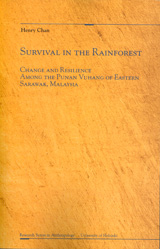
Dissertation: Survival in the Rainforest

chan cover Are hunter-gatherer communities able to rely completely on the rainforest environment for their food, without any dependence on food traded from farming societies? How has their life changed as a result of settling down? How has the community responded to the drastic changes that have come with logging?

Anthropologist Henry Chan (University of Helsinki) answers these questions in his dissertation “Survival in the Rainforest. Change and Resilience among the Punan Vuhang of Eastern Sarawak, Malaysia” that has been published a few days ago.

For nearly all of their known history, the Punan Vuhang have lived as hunter-gatherers, writes the anthropologist. In 1968, however, they adopted cultivation. His research among the Punan Vuhang began in 1993 and continued through 1995, with a more brief follow-up period in November 2002. Chan is the first Sarawakian awarded the Asian Public Intellectual (API) Fellowship of the Nippon Foundation.

Based on memories of informants, and, where relevant, from participation-observation of present-day hunting-gathering activities, Chan has reconstructed their past economy, history and social organization.

He supports the argument that hunters-gatherers could survive without relying on farming societies for food. For several decades anthropologists and human ecologists have been divided in “The Hunter-Gatherer Dependency Debate”:

Ethnographic studies from the early 1960s of hunter-gatherers emphasized the economic and social advantages of hunting and gathering. This was a complete reversal of an earlier notion that hunter-gatherers are marginalized people on the perpetual verge of starvation, constantly pursuing food, and failing to develop forms of social organization associated with supposedly more advantageous means of production. (…) Lee and Marshall (1961) were the main proponents of a model that maintained that the environment sufficiently provides for the needs of hunter-gatherers.

(…)

Subsequent studies later challenged this model, leading to a series of debates that persisted into the 1990s. These debates pitted against each other two schools of thought commonly known as the “traditionalists” or “isolationists,” and the “revisionists” or “integrationists.” In contrast to traditionalists’ view of the ease in obtaining food, the revisionists documented the difficulty of some hunter-gatherer societies in obtaining carbohydrates. Further, the revisionists maintained that the perception of hunter-gatherers as isolated is erroneous and is an external view imposed on them by anthropologists. (…)

Most revisionists accept the world systems political model, first formulated by Immanuel Wallerstein (1974, 1979), as applicable to the analysis of past and present hunter-gatherers. They argue that the devotion of ethnographic attention to hunting and gathering is itself spurious, and that researchers should instead study how people relate to the forces of capitalism and colonialism.

His data, Chan writes, show that the rainforest is capable of sustaining a hunter-gatherer population:

The case of the Punan Vuhang lends some support to Sahlins’ “original affluence” theory that suggests hunting and gathering people are able to easily satisfy their needs and wants because they have few needs. In fact, of the things they need the most, food, the Punan Vuhang show little concern if no one succeeds in obtaining food for any particular day. They know that someone will get something the next day and share it with everyone else. So long as every hunter explores a field further away and is diligent, there are lots of little things to be found.

In addition to mastering the means by which a wide range of food could be obtained, coping with food scarcity also involved gaining an in-depth knowledge of the environment and its resources according to Chan:

Hunter-gatherers systematically combed the forest and kept in their memory the locations of sago groves, fruit trees and places that attract animals such as salt-licks and wallowing ponds. Armed with this knowledge, hunters brought their specially-bred dogs to hunt wild boars or used blowpipes to shoot tree-dwelling animals and birds. (…) Should an individual hunter fail to obtain game, he did not have to worry about going hungry, for the Punan Vuhang organized themselves so that successful hunters and gatherers shared their food with others.

But this prior situation of food sufficiency, from the past through 2001, was shattered as the Punan Vuhang entered the 21st Century:

In 2001, logging intruded into the remote rainforest and since then has drastically impacted the Punan Vuhang, both physically and socially, as it has left an altered, empty landscape littered with fallen branches and muddy soil. The Punan Vuhang feel frustrated and angered with this wanton destruction of their forest. They spend much time hunting in distant forests, but often return empty handed. Instead of sharing, successful hunters sell meat to loggers whose demand is insatiable.

Many Punan Vuhang men frantically search for scarce aloewood to sell before it is destroyed by logging. Consequently, they neglect their farms and they have to buy rice and sago starch from the logging camp’s grocery shop. Hence, with deforestation, it seems that they have now become truly dependent on outsiders for food. (…) Unable to bear such helplessness, many Punan Vuhang have resorted to alcohol and frequently become drunk.

>> download the thesis

UPDATE: See the comment by Eric Davis related to the Khmer: Hunting and Gathering Discussions

SEE ALSO:

“But We Are Still Native People” – Tad McIlwraith’s dissertation is online

Challenges popular notions on indigenous peoples: Alex Golubs dissertation on mining and indigenous people

How to survive in a desert? On Aboriginals’ knowledge of the groundwater system

chan cover

Are hunter-gatherer communities able to rely completely on the rainforest environment for their food, without any dependence on food traded from farming societies? How has their life changed as a result of settling down? How has the community responded…

Read more

Criticizes the “apathy of anthropologists toward the human rights situation in Balochistan”

“Anthropologists should shed light on the violence in Balochistan Province in Pakistan, anthropologist Hafeez Jamali writes in Anthropology News May 2007. Balochistan is presently the scene of a bitter and violent struggle. Multinationals are exploiting the region’s mineral resources. Hundreds of ordinary Baloch died, some 84,000 civilians predominantly have been displaced and hundreds of political activists have been arrested and tortured.

Jamali criticizes the “apathy of the discipline and of anthropologists toward the appalling human rights situation” there: There is hardly any effort by anthropologists who have worked amongst Baloch people to raise this issue in their ethnographic work, he writes. Most of the current work on Baloch people does not address current political issues:

Indeed (…) much of the past and recent anthropological work on the Baloch people has tended to focus on pastoral-nomadic aspects of Baloch social organization by employing concepts of ecological adaptation and kinship networks. These ethnographic works (…) give the impression that the Baloch are pre-modern beings living in bounded cultural groups which are relatively unconcerned with larger geo-strategic and political developments in the region and the world.

This approach is misleading because Baloch tribes’ resistance movements against colonial rule of the British Raj as well as against inequities of postcolonial states such as Iran and Pakistan were intrinsically linked to regional anti-colonial struggles. The present day struggle in Balochistan also draws inspiration from contemporary movements for self-governance in other parts of the world and in that sense is comparable to the struggles being waged by Palestinians, Kurds and other marginalized ethnic groups.

In view of this situation, it is important that anthropologists who work in and study Balochistan take the influence of regional geo-strategic politics as well as the intrusion of neoliberal globalization in the Baloch people’s lives and the response of the Baloch to such intrusion more seriously in their work.

>> read the whole article in Anthropology News

MORE INFO:

Hundreds missing in conflict-torn Balochistan (IRIN, 10.5.07)

Pakistan’s battle over Balochistan (BBC, 26.8.06)

By the way, in Anthropology News April 2007, there are several articles on the Oaxacan Rebellion (Mexico)

SEE ALSO:

Do anthropologists have anything relevant to say about human rights?

Engaged anthropologists beaten by the Mexican police

‘War on Terror’ Has Indigenous People in Its Sights

Riots in France and silent anthropologists

Anthropologists on the Israel-Lebanon conflict

"Anthropologists should shed light on the violence in Balochistan Province in Pakistan, anthropologist Hafeez Jamali writes in Anthropology News May 2007. Balochistan is presently the scene of a bitter and violent struggle. Multinationals are exploiting the region’s mineral resources. Hundreds…

Read more

Global Migrants For Climate Action – Migrants organize to fight climate change


We’ve read a lot about the consequences of climate change for the Inuit. But it’s people in poor countries who will suffer most and they already do. Lots of people from these countries live as migrants in countries like Norway or the U.S. Because of personal knowledge and experience, immigrants from poorer countries have a special motivation to circulate information both ways. Therefore, immigrants in Norway have started a new organisation Global Migrants For Climate Action:

The organization will seek cooperation with other immigrant organizations in Norway and internationally, in order support all demands for stronger reduction of emissions. We are also focusing on how important the issue of social justice is regarding the consequences of climate change.

Poor countries in Africa and Asia that are emitting a small part of greenhouse gas emissions are likely to bear the brunt of rising temperatures.

On their website they provide lesser known information about global activism against climate change, among other things about a film festival by Exiled Tibetans in Dharamsala about global warming.

Around 200 people attended the opening conference, most of them were immigrants.

>> visit the website of Global Migrants for Climate Action

SEE ALSO:

Time to reframe the climate issue? “It’s time to ask questions about equal rights, fairness, vulnerability, and the balance of power,” researcher Karen O’Brien argues (CICERO – Center for International Climate and Environmental Research Oslo)

Bangladesh: A nation in fear of drowning (The Independent, 18.4.07)

Intergovernmental Panel on Climate Change (IPCC): Billions face climate change risk (BBC, 7.4.07)

A new word For June – or: When is the Arctic no longer the Arctic?

We've read a lot about the consequences of climate change for the Inuit. But it's people in poor countries who will suffer most and they already do. Lots of people from these countries live as migrants in countries like Norway…

Read more

“But We Are Still Native People” – Tad McIlwraith’s dissertation is online

Our fellow anthro-blogger Tad McIlwraith has successfully defended his dissertation “But We Are Still Native People’: Talking about Hunting and History in a Northern Athapaskan Village” that now can be downloaded from his website (The graduates in his year are the first who are able to request open access publication)

His dissertation is a study of hunting in the northern Athapaskan village of Iskut, British Columbia, Canada. Iskut hunting is a source of pride for Iskut people. Yet, hunting is sometimes stigmatized by outsiders with interests in the lands and natural resources of northern British Columbia. For some outside observers, he writes, modernization and acculturation are one-way processes. Traditions are better left in the past. At times, he found out, Iskut talk about hunting conveys those sentiments too. At other times, Iskut people strongly reject the stigma of labels like ‘impoverished’ or ‘nomadic’ that resonate in the words that have been written about Iskut people.

Tad McIlwraith indicates that the ethnographic inquiry into an Iskut culture was a profitable way to identify the importance of hunting to Iskut people and, thus, to offset the racism and stereotypes that are frequently associated with native lives.

He also argues that ethnoecological research and the Ethnography of Speaking both contribute useful methodological alternatives to Traditional Use Studies particularly when the documentation and interpretation of the varied expressions of hunting in Iskut Village is of concern.

>> download the dissertation

>> visit his blog

Our fellow anthro-blogger Tad McIlwraith has successfully defended his dissertation "But We Are Still Native People’: Talking about Hunting and History in a Northern Athapaskan Village" that now can be downloaded from his website (The graduates in his year are…

Read more