
search expand

Ethnographic reports about the uses of ICT in low-income communities

Culture Matters points to “exciting” working papers by the Information Society Research Group about the social and economic benefits of Information and Communication Technology (ICT) in low-income communities in Jamaica, India, South Africa and Ghana: “These working papers strongly re-enforce the benefits of an ethnographic approach for the wider world”.

One of the most convincing papers is according to Culture Matters written by Daniel Miller and Heather: Horst juxtaposes conventional ICT policy making in Jamaica with ethnographic findings and uncovers that the assumptions concerning internet use held by the government as well as international NGOs diverge hugely from the realities.

Culture Matters juxtapose some of the current policies with Miller’s and Horst’s recommendations:

  • Instead of more computers in secondary schools invest in post-educational training for young adults
  • Instead of investing into expensive high-end computers invest in low-price computers without gaming facilities
  • Instead of creating their own content at high costs, a lot of money can be saved by creating portals which identify useful and high-quality web resources
  • Instead of investing in community computers, offer Internet access via individual mobile phones

Also fascinating according to the blog: the reports from Ghana by Don Slater and Janet Kwami:

Again, ethnography unveiled a huge gap between policy assumptions and actual usage. On the one hand there is the widespread belief amongst governments and NGOs that the Internet is a tool of development through information distribution.

Yet all Internet users in the Accra slum studied used the internet only for chat with foreigners (as well as some diasporic family members and friends). “There was exceptionally low awareness of even the existence of websites”. In internet cafes everybody is chatting with unknown foreigners, largely in the North but also in Asia, with a view of accumulating actual and symbolic goods (either on IM (Yahoo or MSN) or in Yahoo chat rooms).

Internet access, although widespread and popular in Accra, is not cheap – one hour costs much more than the average kid’s lunch money – but many teenagers come several times a week, for several hours, solely to chat with foreigners.

>> read the whole post on Culture Matters

>> all working papers by the Information Society Research Group

SEE ALSO:

How internet changes the life among the First Nations in Canada

INTEL-ethnographers challenge our assumptions of the digital divide

How Media and Digital Technology Empower Indigenous Survival

Why cellular life in Japan is so different – Interview with anthropologist Mizuko Ito

Women in Cameroon: Information technology as a way out of the cultural cul-de-sac

Now online: EASA-conference papers on media anthropology

Culture Matters points to "exciting" working papers by the Information Society Research Group about the social and economic benefits of Information and Communication Technology (ICT) in low-income communities in Jamaica, India, South Africa and Ghana: "These working papers strongly re-enforce…
Read more

How to save Tibetan folk songs? Put them online!

More and more Tibetan folk songs are disappearing. Led by anthropology professor Gerald Roche, the Tibetan Endangered Music Project (TEMP) uses digital media to capture tunes that are being lost. The volunteer-run program aims to put all the digital songs they collect online, as a way of archiving the material for future generations, the National Geographic writes.

So far the students at Qinghai Normal University have recorded more than 250 songs, including melodies for herding, harvesting, singing babies to sleep, and coaxing yaks into giving more milk. “The goal is to digitalize the songs we record and return them to our communities,” said 20-year-old student Dawa Drolma. “We want to record as many songs as possible.”

“It is quite remarkable how much they have been able to accomplish from such a remote place, thanks to the Internet and digital recording technology,” said Jonathan C. Kramer, a professor of music at North Carolina State University who has worked with the students. “It is hard to imagine such a project even 20 years ago.”

>> read the whole story in the National Geographic

“One of the biggest challenges that we face at the moment is how to return the music to the communities it comes from,” says Roche, as there are few Tibetan communities with Internet access. “Putting it online is a start, but just a small start.” Tsering Lhamo from Ngawa, Sichuan suggests, “the music we have recorded [could be] taught in primary schools of Tibetan areas in order to preserve them.” according to That’s Beijing.

TEMP is remarkable for many reasons according this blog: its ease of growth, use of existing technology with no budget, a method of preservation by people from the culture itself, and a prospect for real use by both local and global communities.

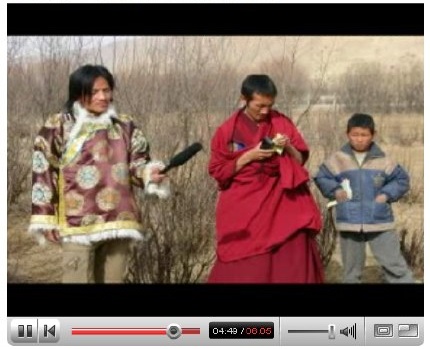
The Tibetan Endagered Music Project has its own website at YouTube with currently five videos.

Related: On the Digital Himalaya website you can listen to music by the Laya (Bhutan and Tibet)

SEE ALSO:

“A new approach to the collection of traditional Aboriginal music”

Multimedia Music Ethnography of Yodelling and Alphorn Blowing

How Media and Digital Technology Empower Indigenous Survival

watch the video on youtube

More and more Tibetan folk songs are disappearing. Led by anthropology professor Gerald Roche, the Tibetan Endangered Music Project (TEMP) uses digital media to capture tunes that are being lost. The volunteer-run program aims to put all the digital songs…

Read more

Cyberanthropology: “Second Life is their only chance to participate in religious rituals”

You can light virtual candles for Shabbat, teleport to a Buddhist temple or consult the oracle for some divine guidance. In Second Life, an online virtual universe with 3.7 million users, religious diversity and participation have skyrocketed. For some people, Second Life is their only chance to participate in religious rituals according to the Washington Post.

Anthropologist Tom Boellstorff is going to publish a book on “cybersociality” in Second Life called “Coming of Age in Second Life: An Anthropologist Explores the Virtually Human.” The avatar of the anthropologist (Tom Bukowski) has an office there, “Ethnographia,” where you can visit him. These emerging virtual worlds pose fundamental challenges to anthropological theory, he writes on his website. “We are witnessing the birth of a significant new modality of human interaction.”

He expected — but hasn’t found any evidence — that Second Life would foster relationships among far-flung members of minority faiths. But the game does seem to be sparking community among followers of more mainstream faiths like among Jews, Muslims and Christians.

Washington Post also writes about Yunus Yakoub Islam who is writing his dissertation on religion in Second Life and runs Second Faith, an educational resource about religion in Second Life. Islam believes he’s the only Muslim in his village in England and uses Second Life to interact with more than 200 members of the game’s Islamic Society.

>> read the whole story in the Washington Post

>> Interview with Tom Boellstorff in the Second Life Herald

>>Anthropologist Grant McCracken: Second Life: the new Disney or vaporville?

>> Anthropologist Alexander Knorr: Second life creation. A guide to in- and offworld online resources

SEE ALSO:

Ethnographic research on Friendster’s online communities

Ethnographic Skype

Ethnographic Flickr

Ethnographic Study on “Digital Kids”

The Internet Gift Culture

The Birth of a Cyberethnographer: The MU5 is to Blame

You can light virtual candles for Shabbat, teleport to a Buddhist temple or consult the oracle for some divine guidance. In Second Life, an online virtual universe with 3.7 million users, religious diversity and participation have skyrocketed. For some…

Read more

Anthropology podcasts receive much attention

Jen Cardew has done a great job in recording and publishing speeches held at the annual meeting of the Society for Applied Anthropology (SfAA). Several new podcasts (mp3-files from the session “Global Health in the Time of Violence”) can be downloaded. She has even written an introduction in podcasting and blogging.

The podcasts received lots of attention as you can see on the page Buzz Around the Web. Even a blog about internet marketing found something interesting there.

As she explains in a comment on Savage Minds, her project was “quite easy and cost effective”.

>> visit the website Podcasts from the SfAA

EARLIER COVERAGE

Conference Podcasting: Anthropologists thrilled to have their speeches recorded

Anthropologists no longer a primitive tribe?

Jen Cardew has done a great job in recording and publishing speeches held at the annual meeting of the Society for Applied Anthropology (SfAA). Several new podcasts (mp3-files from the session "Global Health in the Time of Violence") can be…

Read more

Conference Podcasting: Anthropologists thrilled to have their speeches recorded

Are we on the way to “Open Access Conferences”? As already announced, several sessions at the conference of the Society for Applied Anthropology (SfAA) will be published as podcasts. Jen Cardew who has taken the initiative to this project reports that all presenters (except for one) were very happy to have their speeches to be recorded:

Presenters were; Paul Farmer, Phillipe Bourgois, Merrill Singer, Linda Whiteford, Carolyn Nordstrom, Barbara Rylko-Bauer, Didier Fassin, and Jame Quesada, all of whom were excellent speakers with excellent things to say. The room was packed and I believe there was 300+ people at any given time. These are the rockstars of anthropology. All of the presenters were thrilled to have their speeches recorded for the podcasting project and they even had me announce the project to the group. The fact that all of these presenters were excited about the opportunity to be recorded made the project worth it to me in itself. It actually was quite an honor :)
(…)
It was very reassuring to see that the anthropologists were open to new technology, as we are not known as a “techy” or “progressive with new technology” field :)

There are also some students doing informal interviews and some minimal coverage of the conference, which will be published on the web, she writes. Their goal was to seek out how anthropologists are using technology.

Read more on her blog

>> SfAA Day 2

>> SfAA Day 1

SEE ALSO:

Podcasting: Anthropologists no longer a primitive tribe?

The Future of Anthropology: “We ought to build our own mass media”

AAA Annual Meeting: Are blogs a better news source than corporate media?

Anthropology and the World: What has happened at the EASA conference?

This is conference blogging!

Are we on the way to "Open Access Conferences"? As already announced, several sessions at the conference of the Society for Applied Anthropology (SfAA) will be published as podcasts. Jen Cardew who has taken the initiative to this project…

Read more