search expand

Deadly migration: The ignored health crisis on the US-Mexican border

A multi-dimensional public health crisis is unfolding on the U.S.-Mexico border that few seem ready to acknowledge, anthropologists Rachel Stonecipher & Sarah Willen write on the Access Denied blog.

The complexity of this crisis came to light during a recent study tour to Tucson, Arizona, in which Rachel Stonecipher took part.

Dehydration and heat-related illness claim hundreds of lives annually, and many of these deaths go unrecorded. No uniform system exists to count or repatriate remains. “We can only imagine the impact of these missed opportunities for identification on family members searching for their loved ones”, Stonecipher and Willen write.

For migrants who do reach their destination but face subsequent arrest, “interception” itself can involve serious health risks:

What happens to migrants after they are arrested and detained often remains shrouded from both the public eye and, to a great extent, the eyes of the human rights community. This is a particularly grave concern when arrested individuals already are sick or injured. (…) One especially serious concern involves the deportation of injured individuals who have not yet been medically stabilized. (…)

Detainees are also at risk of abuse – physical and mental – at the hands of police and Border Patrol officers. Despite official denials, No More Deaths, the Border Action Network, and other NGOs have collected and responded to numerous reports of abuse.

Through water stations, humanitarian aid camps, and desert patrols, a handful of NGOs provide assistance to migrants in need. But this cross-border health crisis is “far too vast for activists to address alone”, the anthropologists note:

Both human rights principles and contemporary realities demand that we hold countries with porous borders – including but not only the U.S. – accountable. Not only must such countries recognize migration as an enduring global phenomenon with complex causes and share accountability for both lives and deaths, but they must also engage in transnational public health efforts to develop the kind of multi-layered interventions needed to protect human life in border regions. (…)

Like the humanitarian organizations that work along the border, we all must insist on an expansive understanding of “public health” that recognizes people in transit as members of a common moral community: as people who are connected to us, and whose lives matter. Whether or not we understand or agree with the choice to migrate, activists along the U.S.-Mexico border remind us that border crossers are human beings who – like all other members of our moral community – are deserving of health-related attention, investment, and care.

>> read the whole post at Access Denied

SEE ALSO:

The "illegal" anthropologist: Shahram Khosravi’s Auto-Ethnography of Borders

"Human smugglers fight global apartheid"

No more conferences in Arizona: Anthropologists condemn Immigration Law

Why borders don’t help – An engaged anthropology of the US-Mexican border

Online: On the Margins – An Ethnography from the US-Mexican Border

Migration: Paperless underclass exposes dark side of Europe

"Ethnographic perspectives needed in discussion on public health care system"

A multi-dimensional public health crisis is unfolding on the U.S.-Mexico border that few seem ready to acknowledge, anthropologists Rachel Stonecipher & Sarah Willen write on the Access Denied blog.

The complexity of this crisis came to light during a recent study…
Read more

Where shamans understand colonialism as sickness

“I am here to save the people, to cure the people. In the city they are all sick, they are all domesticated. The shaman has to go together with disease.”

Anthropologist Anders Burman talks to Don Carlos, an Aymara shaman in Bolivia. According to Don Carlos, people are ill from Colonialism and in need of a cure.

“In contemporary Bolivia, the concept Colonialism is used so frequently, and with such distinct connotations by such a diverse set of actors that it demands scrutiny”, the Swedish anthropologist writes in his paper Colonialism in Context An Aymara Reassessment of ‘Colonialism’, ‘Coloniality’ and the ‘Postcolonial World’ (pdf) that was published in the recent issue of KULT on postkolonial.dk.

Colonialism is according to Burman on the one hand considered a sickness and on the other hand the source of sickness. Most notions of illness held by Aymara shamans find their equivalents in notions of Colonialism.

As illness, as lived experience and as collective memory, Colonialism is still present in the Andes. To the indigenous peoples in Latin America it is a question of continuous Colonialism; the colonialists have not left. Although the Spanish colonial administration no longer holds power over their former indigenous subjects, Aymara people of the 21st century are subalternized and impoverished in a global system that still has colonial traits according to Burman.

Evo Morales’ victory at the polls in December 2005 did not change that, the researcher writes. There is an imminent risk of the new regime being “infected”.

>> read the whole paper

Burman has written a dissertation about this topic.

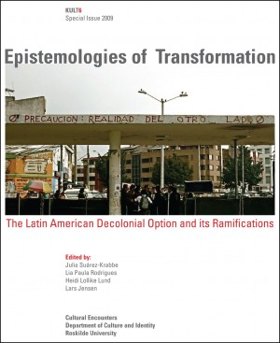
KULT is a postcolonial special issue series. It began in 2004 as the result of a desire to connect a series of discussion fields about postcolonial Denmark. The recent issue on Contemporary Latin American epistemologies has grown out of a network of Latin Americanists in Scandinavia and the Americas.

In one of the other papers in this issue, Madina Tlostanova and Walter Mignolo introduce what they call decolonial thinking, an approach that – they claim – differs from what postcolonial studies have been doing so far:

As a corridor between the academy and the Political Society, decolonial thinking is transdisciplinary (not inter-disciplinary), in the sense of going beyond the existing disciplines, of rejecting the “disciplinary decadence” (Gordon 2006) and aiming at un-disciplining knowledge (Walsh et. al 2002).

Decolonial thinking, in the academy, assumes the same or similar problems articulated in and by the “Political Society.” Knowledge is necessary to act in the political society. But this knowledge is no longer or necessarily produced in the academy. Living experiences generate knowledge to solve problems presented in everyday living. And this knowledge is generated in the process of transformation enacted in the “Political Society.”

Hence, decolonial thinking in the academy has a double role: a) to contribute to de-colonize knowledge and being, which means asking who is producing knowledge, why, when and what for; b) to join processes in the “Political Society” that are confronting and addressing similar issues in distinct spheres of society.

>> read the whole paper: Global Coloniality and the Decolonial Option

SEE ALSO:

Why was anthropologist and indigenous rights activist Miguel Ángel Gutiérrez Ávila beaten to death?

Rethinking Nordic Colonialism – Website Sheds Light Over Forgotten Past

Colonialism, Racism and The Five Major Challenges for Anthropology

New book explores female roots of shamanism

Bolivia: More and more indigenous influence on politics

Why anthropologists should politicize mental illnesses

Open Access to Indigenous Research in Norway

"I am here to save the people, to cure the people. In the city they are all sick, they are all domesticated. The shaman has to go together with disease."

Anthropologist Anders Burman talks to Don Carlos, an Aymara…

Read more

The Anthropology of Wrestling

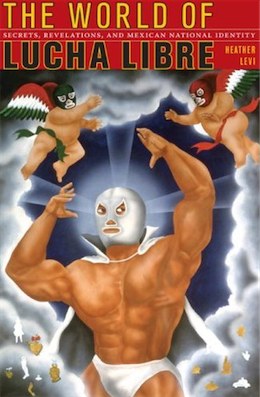
How do you study wrestling as an anthropologist? By becoming a wrestler yourself! Heather Levi’s book The World of Lucha Libre: Secrets, Revelations, and Mexican National Identity is featured in the new issue of American Ethnography on Lucha libre – Mexican wrestling.

A long excerpt from the second chapter can be read there – an example of good anthropological writing and according to Martin Høyem, editor of American Ethnography, the best ethnography of 2008.

I found some reviews of the book. According to the Los Angeles Times the book is actually “entertaining”. And it places wrestling in a political context:

“The success of figures like Superbarrio lay in the capacity of lucha libre to invoke a series of connections between sometimes contradictory domains: rural and urban, tradition and modernity, ritual and parody, machismo and feminism, politics and spectacle,” she writes. And in that tight sentence, Levi nails the appeal lucha libre has had among working-class Mexicans for decades. The various intersections she describes — class, sexuality, gender, xenophobia — are frequently lost on American audiences but make the sport so enjoyable.

“The World of Lucha Libre is one of the most interesting cultural studies of a key pastime in Mexico for many years” according to the Latin American Review of Books, while the Seattle newspaper The Stranger insists that “the first few chapters are pretty dry”. But this is to be expected: “Most anthropological writing simply isn’t for general audiences”.

But the academic nature of the text is something to be overcome:

Levi lays the entire world of lucha libre at the reader’s feet, from the adulation of the crowd to the metallic smell of blood in the ring, and the act of creativity, installing the personal narrative, is the reader’s job. This is excellent reportage on an endlessly fascinating subject, and Levi should be commended for standing back and letting the luchadores take center stage.

As in previous issues, American Ethnography is really interdisciplinary: It includes images from the Bolivian Lucha Libre scene, a review of a book by photographer Lourdes Grobet on the Mexican wrestling scene and a glimpse into American wrestling magazines from the 1970’s on “apartment wrestling”, where women – according to the magazine Sports Review Wrestling in 1978 “clash with the fury of primitive savages fighting for their gods!”

SEE ALSO:

New e-zine: American Ethnography

How do you study wrestling as an anthropologist? By becoming a wrestler yourself! Heather Levi's book The World of Lucha Libre: Secrets, Revelations, and Mexican National Identity is featured in the new issue of American Ethnography on Lucha libre -…

Read more

Why was anthropologist Miguel Ángel Gutiérrez Ávila beaten to death?

One year after anthropologist, author and indigenous rights activist Miguel Ángel Gutiérrez Ávila was beaten to death in Southern Mexico, there has been silence from the Mexican authorities. The Writers in Prison Committee (WiPC) of International PEN askes people to take action.

The killing may according to PEN be related to Gutiérrez’ documentation of attacks by the authorities against an indigenous community radio station.

In a letter to the Mexican Embassy in London the WiPC writes:

A few days before his death, between 23 and 25 July 2008, Gutiérrez had visited the Suljaa’ and Cozoyoapan communities in Costa Chica, Guerrero, in connection with a documentary film he was making on indigenous cultures and traditions. Gutiérrez had been carrying out research into the indigenous people of southern Guerrero for more than 20 years, particularly in Costa Chica, and had been involved in various cultural projects there, including the community radio station Radio Ñomndaa and the establishment of the first Amuzgo community library.

During his last visit to the area, Gutiérrez documented alleged human rights violations on the part of the authorities against the staff of Radio Ñomndaa/ La Palabra del Agua (The Word of the Water), including an interview with one of the station’s founders, which he reportedly intended to include in his documentary.

According to local press reports at the time of Gutiérrez’ death, one lead pointed to the involvement of Aceadeth Rocha Ramírez, mayor of Xochistlahuaca municipality in Costa Chica. Rocha is allegedly one of a number of local political leaders opposed to indigenous movements and Radio Ñomndaa. Another lead reportedly suggested that Gutiérrez may have angered the authorities by filming members of the Federal Investigations Agency (Agencia Federal de Investigación, AFI) while they were conducting a raid on the radio station.

In August last year, the WiPC wrote to the Guerrero state and federal authorities asking them to ensure that a full and impartial investigation into Gutiérrez’ murder was carried out and that those responsible were brought to justice. However, a year after the killing, there has been no response from the authorities; nor have we received any reports on the progress of the investigation from other sources. Our understanding is that the crime remains unsolved.

>> read the whole letter

It seems that his case hasn’t received any attention in the English speaking media.

It was not the first case of this kind in Mexico, see earlier story Engaged anthropologists beaten by the Mexican police

(picture: PEN)

SEE ALSO:

Mexico: Pride in Indigenous Heritage – Literally a Thing of the Past

Engaged research = Terrorism: Germany arrests social scientists

Blogging and Public Anthropology: When free speech costs a career

“Intolerant Universities”: Anthropology professor Chris Knight suspended over G20-activism

One year after anthropologist, author and indigenous rights activist Miguel Ángel Gutiérrez Ávila was beaten to death in Southern Mexico, there has been silence from the Mexican authorities. The Writers in Prison Committee (WiPC) of International PEN askes people…

Read more

Olivia Harris has passed away

Olivia Harris

One of antropologi.info’s readers alerted me to the death of anthropologist Olivia Harris. She died suddenly of cancer aged 60 on the morning of 9th April.

Harris is the co-founder of the Anthropology Department at Goldsmiths College (also University of London) and served as vice-president of the Royal Anthropological Society. In 2005, she became chair of the London School of Economics’ anthropology department. Highland Bolivia was her main research area. She published among other things about Inca civilisation and the impact of the Spanish invasion, changing notions of citizenship and the growth of indigenous movements.

The London School of Economics has set up a page In Memory of Professor Olivia Harris (1948-2009) and a page with tributes to Olivia Harris.

There are obituaries in The Guardian and in Times Higher Education.

One of Olivia Harris’ phd-students (T’anta Wawa) has written two nice blog posts about her.

In Olivia Harris 1948 – 2009 she writes that:

Olivia’s influence in British anthropology and Latin American studies has been immense, but her contribution to thinking about Bolivia is perhaps even more significant.

and adds:

I’ve also been reluctant to put it up here because frankly, that would mean admitting that she is dead, and that has been difficult. It’s illogical that someone so lively, warm and important should be suddenly gone. But she is.

Then, she translated a text by Olivia Harris’ friend and colleague Xavier Albó that was originally published in La Razon:

An excerpt:

Olivia belonged to a well-connected British family, associated with the upper levels of the Anglican church and even linked to the Crown. But she immersed herself fully over many years in a completely different world, in the community of Muruq’u Marka, a day’s travel away from the paved road in the south of the Mining District of Catavi (…).

The comunity members thought highly of her because she shared all their lives with them: worked in the fields, herded llamas, danced in fiestas, ate and slept whatever and wherever. They admired her audacity to go on foot anywhere, to cross rivers in rainy season. She ran around all those stretches of land mostly on foot, sometimes even on a large motorbike which a teacher lent her. Over six months she accompanied the llama caravans to the Mizque valleys. Jaime Bartolli, at that time of Uncia parish, reminds me of a detail which is her all over: at the most unexpected hour and day, she appeared around there with her poncho – and her violin!

>> read the whole post “Xavier Albó writes on Olivia Harris’s life and death”

(Photo: LSE)

Olivia Harris

One of antropologi.info's readers alerted me to the death of anthropologist Olivia Harris. She died suddenly of cancer aged 60 on the morning of 9th April.

Harris is the co-founder of the Anthropology Department at Goldsmiths College (also University…

Read more