search expand

Online: New book on the cultural significance of Free Software

cover

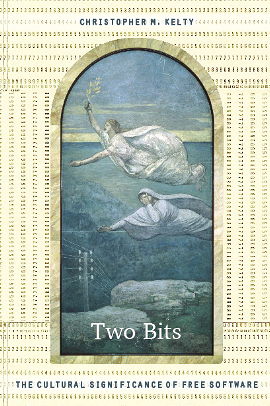
How has Free Software transformed not only software, but also music, film, science, and education? Anthropologist and Savage Minds blogger Christopher M. Kelty explores this question in his new book “Two bits” that now is “available for purchase, for download and for derivation and remixingas he writes.

A really web 2.0 book in other words. It is both available on paper (published by Duke University Press) and online – freely accessible. Both book, blog and wiki!

From the book description:

Drawing on ethnographic research that took him from an Internet healthcare start-up company in Boston to media labs in Berlin to young entrepreneurs in Bangalore, Kelty describes the technologies and the moral vision that binds together hackers, geeks, lawyers, and other Free Software advocates.
(…)
Kelty shows how these specific practices have reoriented the relations of power around the creation, dissemination, and authorization of all kinds of knowledge after the arrival of the Internet.

>> more information about the book

>> website of the book

SEE ALSO:

Why were they doing this work just to give it away for free? Thesis on Ubuntu Linux hackers

2006 – The Year of Open Access Anthropology?

The Internet Gift Culture

Ethnomusicologist uses website as an extension of the book

cover

How has Free Software transformed not only software, but also music, film, science, and education? Anthropologist and Savage Minds blogger Christopher M. Kelty explores this question in his new book "Two bits" that now is "available for purchase, for…

Read more

Anthropology blogs more interesting than journals?

Have anthropology journals ignored students? Is this one of the reasons for the popularity of anthropology blogs? Anthropology journals are not well known among students, Owen Wiltshire writes in his class assignment Why do anthropologists blog? A mini ethnography, a story, and a field report:

A restrictive publishing environment gives little voice to students. Not only that, but anthropology journals have ignored students and perhaps in doing this they have missed out on generating a name for themselves. As more and more material becomes freely available online, it becomes a matter of knowing where to look – and my small survey of students revealed that journals are not well known.
(…)
My small survey revealed that students had a hard time identifying a prestigious journal in their field, and the survey from Savage Minds shows that graduate students make up a large percentage of the readership. In my exploration of blogs I found a number of graduate students writing them. So perhaps the limited distribution of academic publishing contributes to the desirability of the blogsphere.

Owen Wiltshire found much “interesting thought” in the blogosphere and wonders if journal publications would only serve for the purposes of gaining prestige: “Everything is being said in conversations elsewhere, but is ‘proved’ in journals”.

In his text, he discusses several reasons for why anthropologists blog – or do not blog. Among other things he talked to several anthropologists who wish there was more room for new ways of writing anthropology.

Several students don’t want to share their thoughts online because they fear of having ideas “stolen”:

Another anthropology professor discussed the way societies he had studied were hierarchical, depending on secrecy and not necessarily the democratic exchange of knowledge – but as my interviews revealed many students worry that ideas can be stolen, and this is perhaps another reason people might have to not blog. Anthropologists in this sense are a hierarchical organization too, and secrecy is indeed a reason many do not feel comfortable sharing or discussing their ideas.

Here is his prelimarlary summary:

Why do Anthropologists Blog?

  • Public engagement – feedback from beyond the discipline
  • Less formal – much broader range of style, more complex ways of manipulating knowledge
    (video, text, dynamic content)
  • Community, feedback. Enjoy discussing ideas with others.
  • Prestige – great place to get known, at least by other anthro bloggers
  • Younger generation growing up with online publishing – not worried about privacy as much
  • Perhaps an escape from work/professionalism when reflecting on anthropological ideas

Why Don’t Anthropologists Blog?

  • Fear that their work isn’t good enough
  • Do not want to have their name associated with it
  • Generally not part of internet culture – accessibility
  • Lack of time – anthropology is a professional topic – there aren’t many “amateur
    anthropologists” – although this is one thing many bloggers want to change
  • Fear of having ideas stolen – desire to “own” ideas.
  • Prefer traditional publishing mediums – books
  • Desire for more filtered knowledge
  • Desire to maintain privacy outside of work

Wiltshire explored this issue by participation in the blogosphere through his own blog, and reading and writing on numerous other anthropology blogs. He also discussed blogging, sharing information, and public engagement with a focus group of six students, and multiple interviews with students and one professor – all at Concordia University.

>> read the whole text on Wiltshire’s blog

>> Follow-up post: forced vs free writing: “Students ignore journals, just as much as journals ignore students”

Related issues are discussed by Erkan Saka in an e-seminar at the EASA Media Anthropology Network 19 May – 1 June 2008. “Blogging as a research tool for ethnographic fieldwork”.

SEE ALSO:

Plans to study anthropological online communities and Open Access movement

Interview with Michael Wesch: How collaborative technologies change scholarship

antropologi.info survey: Six anthropologists on Anthropology and Internet

Paper by Erkan Saka: Blogging as a Research Tool for Ethnographic Fieldwork

On fieldwork: “Blogging sharpens the attention”

Blogging and Public Anthropology: When free speech costs a career

Danah Boyd on Open Access: “Boycott locked-down journals”

Success in publishing defined by quality? Anthropology Matters on “The Politics of Publishing”

Have anthropology journals ignored students? Is this one of the reasons for the popularity of anthropology blogs? Anthropology journals are not well known among students, Owen Wiltshire writes in his class assignment Why do anthropologists blog? A mini ethnography,…

Read more

New e-zine: American Ethnography

cover

Anthropologist Martin Høyem has launched the e-zine “American Ethnography”, an “internet glossy on the study of cultures”:

We cover ethnography that relates to anything we would call America. We aim to present the tradition and practice of ethnography to people who didn’t know they could be intrigued by ethnography. The goal is to help increase the interest in how we all try to understand unfamiliar cultures. This, we think, could do the world good.

As he writes to me in an email, “it’s pretty new, so there isn’t a lot of material there yet, and most of what is there is old public domain texts (previously not freely available to the general public).” Most of the texts were previously published in the journal American Anthropologist.

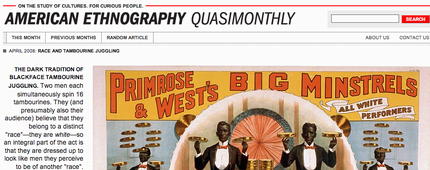
Around twelve articles are online already, including portraits of some famous anthropologists and texts about the peyote-cult – a cactus that was eaten in rituals of native Indians. The most recent issue contains articles about race and tambourine juggling. Looks interesting!

>> visit American Ethnography

Høyem has previously written a thesis about American Lowrider Culture called I want my car to look like a whore. Lowriding and poetics of outlaw aesthetics, see also my post about the thesis: When Norwegians do business in Brazil, Lowrider Culture and 9 more anthropology theses.

Høyem is currently working at Pacific Ethnography – anthropology and design

UPDATE: The discussion about American Ethnography and copyright issues is continuing over at Savage Minds, see American Ethnography, the AAA, and the Public Domain

cover

Anthropologist Martin Høyem has launched the e-zine "American Ethnography", an "internet glossy on the study of cultures":

We cover ethnography that relates to anything we would call America. We aim to present the tradition and practice of ethnography to people…

Read more

First podcast of the 2008 Society of Applied Anthropology Meeting is online

logo

"The Art and Science of Applied Anthropology in the 21st Century" is the topic of the first podcast from the annual meeting of the Society of Applied Anthropology.

More podcasts will be published during the following two months. Last…

Read more

Plans to study anthropological online communities and Open Access movement

Anthropology of anthropology: How do anthropologists form online communities? How are open access publishing and other developments that have sprung up online changing community boundaries? Soon, an anthropologist will do fieldwork among us online anthropologists. http://nodivide.wordpress.com/ is the address of the blog by anthropologist Owen Wiltshire, grad student at Concordia University, Montreal, where he writes:

I am interested in collaborative research methods, and the growth of anthropology online. (…) I’m particularly interested in open-access journals, and feel that opening up academic publishing is an enormously important step for anthropology.

(…)

Delving into the interesting colonial history of anthropology, and into discussions of globalization and neoliberal economic injustice, it’s pretty easy to see how it makes sense to make anthropological work freely available to the world that it studies.

In this way I’ll be exploring ways to study online communities – in this case communities of anthropologists. Its an exciting time for anthropology online. I’ve been following anthropology blogs for a year now, and its amazing how fast its growing. Its quite inspiring, and I think reflects a very vibrant community thats just itching to work (and fight) with each other!

So while my research proposal is extremely vague, and I’ve been made aware of this, I’m absolutely confident that the internet, blogs, and the desire to liberate anthropological knowledge from the world economy are fueling a change in anthropology, and that within this excitement I’ll find an interesting “field” of study.

In an email to me he tells that he’ll be handing in a proposal in April and hopefully be doing fieldwork over the summer. He has already been investigating the ways faculty at Concordia University use the internet in classroom, and is working on getting access to an anthropological journal to investigate the publishing world “face to face”.

Owen Wiltshire worked as a web developer for a number of years prior to studying anthropology: “I’ve always followed developments in open source – so I’m excited to see how similar developments work their way into academic culture”, he writes.

>> visit Owen Wiltshire’s blog “Just another anthro blog”

SEE ALSO:

Interview with Michael Wesch: How collaborative technologies change scholarship

antropologi.info survey: Six anthropologists on Anthropology and Internet

Anthropology of anthropology: How do anthropologists form online communities? How are open access publishing and other developments that have sprung up online changing community boundaries? Soon, an anthropologist will do fieldwork among us online anthropologists. http://nodivide.wordpress.com/ is the address of…

Read more