search expand

Now open access to 39 years of the journal Folklore Forum

cover

Folklore Forum, a journal that is produced by graduate students at the Folklore and Ethnomusicology Department of Indiana University, has gone Open Access. From now on, 39 years of scholarship, debate, and exchange of ideas are freely accessible for everybody in the freshly digitized archives of Folklore Forum.

Their most recent volum focuses on Folklore and the Internet and includes articles on urban legends that circulate in chain letter-form as anonymous emails, and on icons and avatars as cyberart and examples of the development of folkloric art forms online.

Folklore has has always had an ambivalent relationship with mass media, Editor-in-Chief Curtis Ashton writes in the editorial:

Salvage ethnography to recover oral texts would be unnecessary if print were not invading 19th century Europe and America and depriving the Folk of their lore. (…) Though the trend has been shifting in professional meetings and journal publications, folklorists do tend to avoid the world of computers as a field for enquiry, either because of a lack of technical training or just a lack of general interest.

But as this volume demonstrates, the web has much to offer for folklorists:

I encourage our readers to consider how we use the Internet in our work as folklorists, as a object of study in an of itself, with its own discourse of traditional motifs; as a field for ethnographic research into the virtual, networked community; as a means for scholarly communication and publication; as a storage facility for the digitally compressed knowledge of the past; as a presentation space for the mutual benefit of both ethnographer and informant; as a means for reflection, rethinking how we do our work, what draws us to it, and why.

>> visit Folklore Forum

As a sidenote: In the most recent entry here on antropologi.info I wrote about how folkore can enrich anthropology, see “Take care of the different national traditions of anthropology”

SEE ALSO:

Now online: Up to 100 year old anthropology papers

2006 – The Year of Open Access Anthropology?

antropologi.info survey: Six anthropologists on Anthropology and Internet

cover

Folklore Forum, a journal that is produced by graduate students at the Folklore and Ethnomusicology Department of Indiana University, has gone Open Access. From now on, 39 years of scholarship, debate, and exchange of ideas are freely accessible for everybody…

Read more

essays.se: Open access to Swedish university papers

Swedish universities have launched a new website www.essays.se which gives access to several thousands University papers:

Every year tens of thousands of Swedish university students spend many million hours researching and writing their final theses. The end result – all the essays – is a knowledge resource of great weight. However, up until quite recently, it was common that the finished essays where stored away in the darkest corners of the university libraries, where no-one would ever find them.

This problem led way to the Swedish website Uppsatser.se. The website was launched in 2004, with the goal to become a knowledge platform that could bridge the knowledge-gap between university students, schools and companies in Sweden.

Essays.se – the english language version of Uppsatser.se, was launched in november 2007. It is meant for all of people who do not speak Swedish, but still want to take part of the research carried out by Swedish students.

Essays.se and Uppsatser.se co-operate with the LIBRIS-department at the National Library of Sweden.

A search for anthropology gives 23 matches.

Additionally, there is the portal http://www.diva-portal.org/ that lets you find theses, dissertations and other publications in full-text from a number of mainly Swedish universities.

For Norwegian archives, see:DUO (University of Oslo)MUNIN (University of Tromsø)BORA (University of Bergen) and Theses from Norwegian University of Science and Technology (Trondheim)

SEE ALSO:

2006 – The Year of Open Access Anthropology?

Swedish universities have launched a new website www.essays.se which gives access to several thousands University papers:

Every year tens of thousands of Swedish university students spend many million hours researching and writing their final theses. The end result - all the…

Read more

First issue of open access journal “After Culture” is online

The first issue of “After Culture – Emergent Anthropologies” that was planned for release in September 2006 has finally been published, Savage Minds reports.

The journal is edited by anthropologist Matthew Wolf-Meyer . In his editorial he explains that After Culture is intended as international, open access, and run primarily by graduate students. One of the central issues for the journal is: How are we to explain the worlds we interact with and perceive when “culture” as an explanatory concept, as a causal force, had been debunked?

In the first issue we find among others an interview with George Marcus:

In the interview, Marcus reviews the common pitfalls of students’ first projects and offers his thoughts towards new framings of research design that can evolve out of “research imaginaries.” These new framings expose the tensions between the opportunities and pressures of collaboration in the field and older, simpler technologies of individual knowing. They also open the door to searching for critical data, challenging well-worn fieldwork tropes, and preparing for the reception of one’s work.

>> After Culture Volume 1

SEE ALSO:

Anpere – New Open Access Anthropology Journal

New Proposals – New Open Access Journal

New journal: “Radical Anthropology” with David Graeber

Omertaa – Open access journal for Applied Anthropology

2006 – The Year of Open Access Anthropology?

American Anthropological Association opposes Open Access to Journal Articles

The first issue of "After Culture - Emergent Anthropologies" that was planned for release in September 2006 has finally been published, Savage Minds reports.

The journal is edited by anthropologist Matthew Wolf-Meyer . In his editorial he explains that After Culture…

Read more

New journal: “Radical Anthropology” with David Graeber

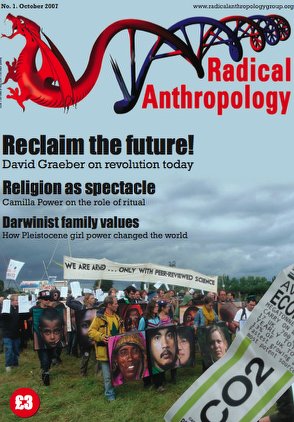
David Graeber is one of the authors in a new journal called Radical Anthropology. The journal is available for free. You can download it as pdf-file. The journal follows Graebers vision of anthropology as an “intellectual forum for all sorts of planetary conversations” that makes “common cause with social activism for the sake of human freedom”.

The first issue consists of two essays

David Graeber: Revolution in reverse
The idea of radical change today seems unrealistic.Why?

Camilla Power: Religion as spectacle
Richard Dawkins may think it’s just a delusion, but religion had amore interesting evolutionary role than that.

The journal is edited by The Radical Anthropology Group that was founded back in 1984. Many members are active in indigenous rights movements and combine academic research with activist involvement in environmentalist, anticapitalist and other campaigns.

>> download the first issue of “Radical Anthropology

>> previous publications by The Radical Anthropology Group (lots of papers!)

David Graeber is one of the authors in a new journal called Radical Anthropology. The journal is available for free. You can download it as pdf-file. The journal follows Graebers vision of anthropology as an “intellectual forum for all…

Read more

Now online: Up to 100 year old anthropology papers

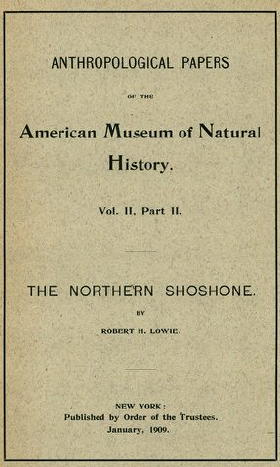
(via Museum Anthropology) More and more open access to anthropology online: The American Museum of Natural History has digitalized their up to 100 year old Anthropological Papers and put them online.

We find both more recent papers like Green revolution : agricultural and social change in a north Indian village and (that’s maybe even more interesting) historic ethnographies from the beginning of the 20th century like Some protective designs of the Dakota by Clark Wissler (published 1907), Tales of Yukaghir, Lamut, and Russanized natives of eastern Siberia by Waldemar Bogoras (published 1918) and The history of Philippine civilization as reflected in religious nomenclature by Alfred L. Kroeber (published 1918).

>> browse the whole collection

SEE ALSO:

2006 – The Year of Open Access Anthropology?

(via Museum Anthropology) More and more open access to anthropology online: The American Museum of Natural History has digitalized their up to 100 year old Anthropological Papers and put them online.

We find both more recent papers like Green…

Read more