The journal publishes reviews of recent works in anthropology and related disciplines, as well as occasional feature articles. The first issue was published a few days ago. Apart from a “feature article” by Maurice Bloch, the issue consists of six book reviews.
Although the journal name seems to signal innovation, it is a rather conventional academic publication. It is written for other social scientists and does not take use of the possibilities that the internet provides. No links, no multimedia, no interactive parts. It has a nice design, including illustrations by Ed Linfoot.
Charles Stafford: Living with the Economists (review of Economic Persuasions edited by Stephen Gudeman and Economy’s Tension: The Dialectics of Community and Market by Stephen Gudeman
Sherry Ortner: On Neoliberalism (review of The Shock Doctrine by Naomi Klein, A Brief History of Neoliberalism by David Harvey, and Inside Job a film by Charles Ferguson)
(via Cognition and Culture Blog) More and more open access anthropology journals are popping up. The newest one is Anthropology Of This Century (AOTC), edited by Charles Stafford from the London School of Economics (LSE).
What’s the point of science when the public lacks access to it and researchers hide in their ivory towers? The internet provides new ways for researchers and the public to exchange knowledge. How do antropologists make use of blogging, Facebook, YouTube and new modes of publishing, for example Open Access journals?
The history of anthropology section was meant to reveal that anthropologists have reasons for increased collaboration with non-anthropologists, reasons to engage with public audiences, reasons to give people outside academia a place to respond to what anthropologists write.
Unfortunately, the way I did this led some people to think I was attacking them and their profession.
– Why did you choose to study your own discipline online instead of studying mobile phone use in Papua New Guinea or immigrants in Toronto?
– I saw open access publishing and new online publishing options as being important new developments that might contribute to “decolonizing” the creation and dissemination of anthropological work.
– So how is internet fueling change in Anthropology? Can you give us 3 examples?
– The desire for changes in anthropology that I discuss had been occurring well before the Internet became popular. But the Internet, of course, is a revolutionary technology that allows anthropologists to target all sorts of different audiences in new ways.
The main points of change I addressed were:
1. Open Access (OA) publishing is helping researchers disseminate work that might normally remain geographically bound due to the costs to access it.
As Max Forte pointed out, most OA journals in anthropology come from what would be the periphery of anthropological publishing. This is interesting when we see that that academic publishing, at least in terms of the American Anthropological Association, continues to be very geographically centered, even ethnocentric to a degree.
Open Access journals are a way for international scholars to make their work accessible to researchers abroad. OA might help scholars in places like Brazil have their work recognized in North America. Of course language divides remain.
2. Blogging and other ways of creating publicly accessible, archived, discussions are an awesome way to develop ideas throughout and after the research process!
It really opens the door for anyone to participate, to react, and to help guide research through feedback (however nasty it might be). It helps make writing research reports a more iterative process, where researchers can bounce ideas off each other and other audiences, prior to publishing.
For anthropologists who have been criticized for misrepresenting communities (as I have with anthropology!) it makes sense to work in as much discussion like this as possible. I tried to show how this could occur by incorporating blog responses into the thesis. Where I may have been wrong about anthropology as a whole (you can make that decision yourself), I think my biases are balanced out to a degree by the included responses.
3. Welcome the uncensored, unreviewed voice of the anthropology students.
I think we can be a pain in the ass, but I can’t imagine going through the program without reading so many other blogs by people going through the same thing in different institutions.
– Anthropologist have been described as “the last primitive tribe on earth”: They hide in their ivory towers and look with suspicion upon new technologies like the internet. Does your research challenge this assumption?
– I made this argument in my thesis, and its true to a degree, but I take it more as a argumentative point. Anthropologists and other academics are making use of the internet and just about every new tool that comes their way.
The point I make in my thesis is that the ivory tower remains even when we use these tools in public.
I used the distinction which had been developed in discussion with a number of anthros, including some people at Savage Minds, and Max Forte, and Erkan Saka, of there being “anthropology in public” and “public anthropology”.
Even if you write about anthropology in public, it doesn’t mean you are addressing interests outside the ivory tower. That is where public anthropology comes in, where anthropologists address issues outside the ivory tower. When they do this however, it is a challenge to identify what makes the work academic. Michael Wesch’s youtube videos are a great example of this that I discussed very briefly in the thesis.
An anthropological introduction to YouTube
47:32 Networked Production: The Collab. MadV's "The Message" and the message of YouTube 49:29 Poem: The Little Glass Dot, The Eyes of the World 51:15 Conclusion by bnessel1973 52:50 Dedication and Credits (Our Numa Numa dance) The Numa Numa quote is from *Douglas* Wolk (not Gary Wolk as I mistakenly said in the talk).">
– Why are some anthropologists interested in sharing and open access, while others are not?
– Some see the discipline of anthropology as being an expert and professional society. They want to share their work with other anthropologists who have the same interests and concerns as themselves. Feedback from random Youtube users, or even people in other disciplines, isn’t very valuable to them. The feedback they can get through peer review in professional anthropology journals is exactly what they want, as is the recognition.
Also, I don’t think every researcher agrees that expensive academic journals fail to disseminate work. They only want to share their work with a select audience, and don’t see the point in making it available free online. In the end they disagree that free access would improve the impact of their work (it comes down to who they are trying to impact).
– What are in your view the main barriers to open access publishing?
– Some professors encourage students to look at select journals, and they don’t consider the Open Access journals that are out there. If researchers only use Jstor and Anthrosource to find material, they are missing out on a lot of what is being discussed – yet this is standard practice and considered to be acceptable.
Is it a researchers responsibility to make themselves aware of everything that’s being published out there? Or is that unreasonable? The increasing number of journals around the world make it quite difficult to do a complete literature review! If we can’t funnel it down to a select number of publications, it is impossible to ask researchers to keep up to date. But if OA journals are ignored, many researchers may never realize how beneficial it is to be able to openly link to, discuss, and talk about publications online.
– But you stress that OA Publishing does not necessarily lead to a more public anthropology?
– Yes, OA publishing is just about making anthropological research more accessible to its desired audience. It doesn’t mean anthropologists are writing with the intention that public audiences interact with it, or that it be relevant to public interests. Also, if you look at OA repositories, theres still no effort being made to host responses, so we can’t say that OA is an attempt to get more feedback.
– Do you think we need a more public anthropology? OA Publishing is not enough?
– I think it’s easy to adapt anthropology and research to public contexts, but at that point it ceases to be anthropology as we know it. I would have loved to come out of my masters degree program with more experience producing video, and documentary-like productions. Maybe I should have studied communications. Speaking of which, my roommate studies Communications, and we shared many of the same readings. Finally, as I develop in the thesis, theres nothing inherently good about public engagement – take a look at the Human Terrain Teams for example.
– You’ve done your fieldwork mainly online. An interesting experience?
– Yes. I think the blog experiment worked out rather well, showing that the blog can be used to solicit feedback throughout the research process and not just as a way of disseminating/publishing ideas.
– The most interesting thing you have learned?
– It is really easy to piss people off when you critique anthropology.
– What are the implications of your research?
– Feedback is important, and sharing ideas openly online is a great way to solicit that feedback!
– Final words to the readers in front of the screen?
What's the point of science when the public lacks access to it and researchers hide in their ivory towers? The internet provides new ways for researchers and the public to exchange knowledge. How do antropologists make use of blogging, Facebook,…
What comes into your mind, when you’re reading the following lines?
“We tend to gather in certain locales (cities, sometimes specific neighbourhoods); we frequent particular businesses – some of the services being unique to our community; we have dedicated media, strong social networks and political tendencies; we even have certain etiquette, social rules and beliefs we would likely agree on (a topic for another day), all the result of shared experiences distinct to our clique.”
Why doesn’t she call them migrants? Well, it’s a question of class and “race”: The people she writes about aren’t from Somalia or Iraq. They’re white people and wealthy. By using a different term, a distance to “the other” is established.
So, it’s not surprising to see that no Somali people are interviewed on the website about Expats in Norway.
In its broadest sense, an expatriate is any person living in a different country from where he or she is a citizen. In common usage, the term is often used in the context of professionals sent abroad by their companies, as opposed to locally hired staff (who can also be foreigners).
The differentiation found in common usage usually comes down to socio-economic factors, so skilled professionals working in another country are described as expatriates, whereas a manual labourer who has moved to another country to earn more money might be labelled an ‘immigrant’. There is no set definition and usage does vary depending on context and individual preferences and prejudices.
I always found the usage of the word expat interesting. Personally, I never use it, and call everybody for migrants regardless their class or “race”. Inspired by Steegar’s text I googled around and found that the usage of the terms expat and migrant is contested.
On Wikipedia’s talk page long there’s a long debate about the meaningfulness of this distinction.
“If you picked up, moved to Paris, and landed a job, what would you call yourself? Chances are, if you’re an American, you’d soon find yourself part of a colorful community of ‘expats.’ If, while there, you hired an Algerian nanny– a woman who had picked up, moved abroad, and landed a job– how would you refer to him or her? Expat probably isn’t the first word that springs to mind. Yet almost no one refers to herself as a ‘migrant worker.'”
Yes, that’s because, as Laura María Agustín says in the interview with Howley, ” ‘migrants’ travel because they are poor and desperate, ‘expatriates’ travel because they are curious, self-actualizing cosmopolites.”
Westerners don’t like referring to themselves as immigrants because the word “immigrant” has such nasty connotations. (…) An immigrant is an unwanted job-stealer, while an expat is a foreigner who could be leaving any day now. An immigrant is on a desperate search for a better life. An expat is on an adventure. (…) Our usage of these words reveals a certain double standard. Whether you’re an expat or an immigrant depends not on your residency plans, but on the relative wealth of your native country.
I might add, the usage of this term suits very well to the rhetoric of the political elite in the West who is building and enforcing Fortress Europe, as part of the larger project of Global Apartheid
UPDATE 1: (via richmondbrige) Great commentary in the Guardian by sociologist Peter Matanle, British migrant in Japan, published today. He feels uncomfortable when British people overseas, or the Guardian, use the term “expat” with reference to Britons abroad, then use words such as “immigrant” when describing people from other countries who are in the UK:
So, my proposal is for the Guardian to amend its style guide to discourage the use of the word “expat” in its pages. The word is too redolent of the days of empire and sipping gin and tonic in the shade while the locals toil beyond the fence. It is too easily used as a cultural marker to distinguish people from one another, making it easy for some Britons to feel both superior to and separated from the local people in their host cultures. I suggest that words such as resident, visitor, settler, immigrant and tourist be used instead in order to equalise the way we describe ourselves with the ways in which we describe others. It is only fair and just to do so.
UPDATE 3: Great post by Julie Sheridan, “native Scot” in Spain: Double acts & double standards. She asks: What makes me an expat but my neighbour an immigrant? She also draws attention to the etymology of “expat” (excluded, absent from one’s “fatherland”) and ends her post with these sentences:
No idea how long I’ll be here, but while I am, I want to feel settled, and ideally integrated. And try to remember that being here is an experience, rather than an identity.
What comes into your mind, when you're reading the following lines?
"We tend to gather in certain locales (cities, sometimes specific neighbourhoods); we frequent particular businesses - some of the services being unique to our community; we have dedicated media, strong…
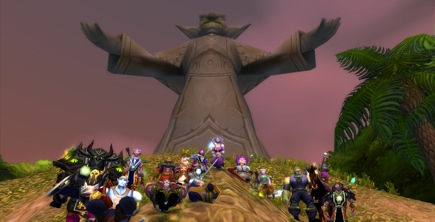
The anthropologist and his virtual research team in World of Warcraft. Photo: Colorado State University
It’s always refreshing when anthropologists challenge wideheld assumptions, for example about video- and onlinegames. Many video game studies focus on the negative and addictive aspects of game play.
In two recent studies, Jeffrey Snodgrass and his team show, that video game playing can be healthy.
The idea is that if you lose yourself, you escape. So it’s deeply relaxing, what some gamers describe as akin to meditation, or at other times positively challenging and stimulating, like a great chess match where you’re actually one of the pieces, and we show that there are strong associations between these various states of consciousness and the game’s health benefits.
But it is important to note that the escape must be controlled and temporary to be positive so that it leads to rejuvenation rather than simple problem avoidance, which in the end only increases the experience of stress.”
He hopes that people will start to understand that addiction is only one side of video game usage.
According the press release, “both articles are currently available online”. That’s true, but they’re behind a pay wall.
The anthropologist and his virtual research team in World of Warcraft. Photo: Colorado State University
It's always refreshing when anthropologists challenge wideheld assumptions, for example about video- and onlinegames. Many video game studies focus on the negative and addictive aspects…
(draft) Have you tried googling “Japan” “earthquake” and “no looting”? Or “Libya” and “tribes”? It’s no big surprise to see stereotypical representations of other people in the news, but the ongoing historical developments in Libya and Japan might provide especially interesting examples.
Libya is for many journalists and experts a “tribal” country.
“Many Americans pride themselves on God and country. In Libya, it’s God, tribe, then country”, explains CNN and quotes anthropologist Philip Carl Salzman who says “Libyans have a strong loyalty to tribe. A tribe provides welfare in times of need,” he said. “They have a collective responsibility.”
In the article In Libya the revolution will be tribalized (The Globe and Mail), Khalil Ali Al-Musmari, a retired professor of anthropology and sociology, said the foreign media have often crudely misrepresented the nature of “tribal power” in the country, by talking about tribal leaders as though they still commanded the same obedience they did in ancient times. Educated Libyans in coastal cities, he says, make their own political decisions and do not feel obligated to follow their tribal elders. Talk of tribal divisions in the country is dangerous.
“The layer of human turmoil – looting and scuffles for food or services – that often comes in the wake of disaster seems noticeably absent in Japan”, claims CNN and several experts give culturalist explanations. Among them Merry White, an anthropology professor at Boston University who studies Japanese culture. “Violence, and taking what belongs to others, are simply not culturally approved or supported”, she says.
The paper writes about “the extraordinary sense of calm on the Japanese archipelago amid conditions which in perhaps any other place would have led to chaos”.
“The Japanese culture encourages a heightened sense of individual responsibility, but also a very powerful sense of solidarity, and that is a very powerful combination”, says sociologist Frank Furedi.
“In Japanese culture, there’s a sort of nobility in suffering with a stiff upper lip, in mustering the spiritual, psychological resources internally,” explains anthropologist John Nelson.
Theories abound as to what makes the Japanese so resilient and willing to cooperate. Some cite the centuries-old need to work together to grow rice on a crowded archipelago prone to natural disasters. Others point to the hierarchical nature of human relations and a keen fear of shaming oneself before others.
“It strikes me as a Buddhist attitude,” Glenda Roberts, an anthropology professor at Tokyo’s Waseda University, said. “Westerners might tend to see it as passivity, but it’s not that. It takes a lot of strength to stay calm in the face of terror.”
There are even stories about the lack of a Japanese word for looting, as the bloggers at Language Log have observed. “As usual, the attempt to diagnose and explain culture cheaply in lexical terms is empirically as well as conceptually weak”, Mark Liberman comments. Further down in the comment field, Chris Kern deconstructs the notion of the non-looting Japanese:
Looking at Japanese news articles on the disasters is the easiest way to disprove this. There’s one article that discusses the American news media’s wonder over the lack of looting with the following headline:
「なぜ略奪ないの?」=被災地の秩序、驚きと称賛-米
“ryakudatsu” is used as the translation of “looting” there.
But there are other articles that talk about looting that actually has been occurring in Japan in the wake of the disasters, and they use “ryakudatsu” and “goudatsu”
But there has been looting, and these stories don’t seem to be translated into English or reported on English language news sites as the BBC explains.
What are the consequences of this kind of reporting?
These news stories that contrast peaceful Japan with violent Haiti have often triggered racist discourses in the comment fields.
Japan is one of the least “diverse” countries in the world. This gives them solidarity and sense of nationhood that “multicultural” societies don’t have, it allows them to pull together for the common good in times of adversity. Contrast that with “multicultural” New Orleans response to a natural disaster. It seems like unity is a strength and “diversity” is a weakness.
Johann Hari challenges these stereotypes in her comment The myth of the panicking disaster victim. The evidence gathered over centuries of disasters, natural and man-made, is overwhelming, she writes:
The vast majority of people, when a disaster hits, behave in the aftermath as altruists. They organise spontaneously to save their fellow human beings, to share what they have, and to show kindness. They reveal themselves to be better people than they ever expected.
But what about the violence in New Orleans after Hurricane Katrina?
Remember the gangs “marauding” through New Orleans, raping and even cannibalising people in the Super-Dome after Hurricane Katrina? It turns out they didn’t exist. Years of journalistic investigations showed them to be racist rumours with no factual basis. Yes, there was some “looting” – which consisted of starving people breaking into closed and abandoned shops for food. Of course human beings can behave atrociously – but the aftermath of a disaster seems to be the time when it is least likely.
As an African-American who lived with a Japanese family as a high school exchange student, majored in Japanese studies in college, and later rode the Tokyo subway every day to work in a Japanese corporation, I have some thoughts. I say it is economic, but it isn’t quite that simple, because other circumstances are at play.
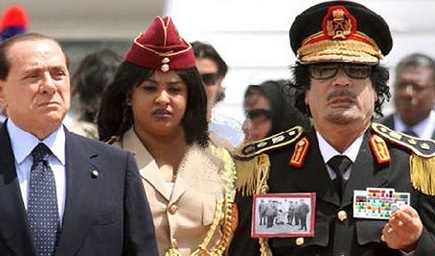
Two friends, same culture: Berlusconi and Gaddafi. Photo: Derek Visser, flickr
(draft) Have you tried googling "Japan" "earthquake" and "no looting"? Or "Libya" and "tribes"? It's no big surprise to see stereotypical representations of other people in the news, but the…