search expand

Secret knowledge exchange at Europe’s largest anthropology conference

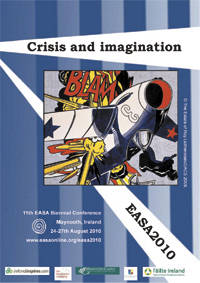
A bit more than two weeks ago, around 1300 anthropologists from all over Europe left the university village Maynooth not far away from Dublin. Europe’s largest anthropology conference, the biennial congress of The European Association of Social Anthropologists (EASA) was over.

As usual, hardly any information about the knowledge that was exchanged at the conference, found its way to the public.

Here is what I found.

Eoin O’Mahony, geographer at Maynooth, sums up the opening keynote lecture by one of the most famous anthropologists around – Talal Asad.

“As far as I can tell”, he writes, “the lecture laid out the ground for a new anthropology of terrorism and human rights”. Talal Asad “mapped out the economy of liberal human rights where the reorientation of the concept of ‘just war’ made certain peoples’ deaths necessary to safeguard the lives of others”.

Asad’s paper, which his speech is based on, is available online (pdf – download it before they remove it!). Or check also an earlier post Selected quotes from “On Suicide Bombing” by Talal Asad.

Philipp Budka 
(University of Vienna) is the only one who has written a report about the conference. It focuses on workshops that deal with media (technology). Several bloggers are among the paper givers, for example John Postill, Alexander Knorr and Gabriella Coleman (who blogged a little bit about her Ireland trip).

Stéphane Voell, blogger at Traditional Law in Georgia, is wondering if it was worth organizing a workshop after not more that seven or eight people showed up. It reminded him on the days when he as a 17 year old was playing in his school band (Text in German only).

Finally, Cicilie Fagerlid explains us why she is calling conferences for festivals:

The more anthropology (or other academic genres) I engage in during a 3-4 days period, the more engaging it gets. Listening to debates and commenting on papers during the day, and discussing, chatting and mingling during the night, with too little sleep in-between high-wire the brain in a very creative and inspiring fashion. The first time I experienced it, weeklong camping on rock festivals was still fresh in my memory, and that experience was what an anthropology conference reminded me of.

Are there some blog posts I haven’t seen? Something about EASA 2010 you want to share?

UPDATE (18.10.10): Digital Anthropology: An EASA Workshop (Heather Horst, Material World 13.10.10)

SEE ALSO:

The Secret Society of Anthropologists

What’s the point of anthropology conferences?

Conference Culture

Conference Podcasting: Anthropologists thrilled to have their speeches recorded

First reports from Europe’s largest anthropology conference (EASA 2008)

Anthropology and the World: What has happened at the EASA conference (2006)?

What happened at the AAA-conference in San Jose 2006 – a round up

A bit more than two weeks ago, around 1300 anthropologists from all over Europe left the university village Maynooth not far away from Dublin. Europe's largest anthropology conference, the biennial congress of The European Association of Social Anthropologists (EASA)…

Read more

Thesis: That’s why they go to war

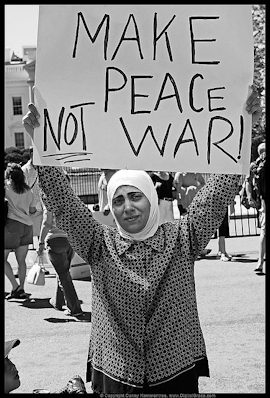
Make Peace. Photo: Danny Hammontree, flickr

What if they gave a war and nobody came?” is a popular slogan from the antiwar-movement. But nowadays, when USA with their allies go to war in Iraq and Afghanistan, people do come. Lots of people enlist in the military, even voluntarily, especially in the U.S. Why?

Anthropologist Sarah Salameh answers this question in her master’s thesis Courtesy Of The Red, White And Blue. A Midwest American Perspective on Troops, War and Nation.

She’s been on a six months’ fieldwork in a small town in the upper Midwest, a rather conservative and patriotic area that struggles with deindustrialization, low wages and unemployment. Salameh – an opponent of the U.S wars in Afghanistan and Iraq – describes the six months “as the most interesting and mind blowing time of my life.”

And it is indeed an interesting and well written thesis about “one of the most understudied groups”: white middle-class Americans.

She introduces us to a diverse group of military people:

The many settings the reader is introduced to includes an Army recruiting office, a public elementary school, Memorial Day celebrations, the motorcycle group the Patriot Guard Riders‟ missions, and the celebration of a National Guard unit returning home from Iraq. One gets to know people ranging from Army recruiters to the girls they helped enlisting at the age of 17, the concerned mother of a soldier, and a bunch of rather unconcerned 5th graders performing their patriotic duty decorating their town‟s cemetery with Star Spangled Banners.

One of her findings is the critical distance many soldiers have towards the government.

While in uniform, the anthropologist writes, soldiers are not allowed to speak negatively about the President. But in reality, as Robert, one of the soldiers, told her “The troops fight for the people, the American people, not the government. Neither the troops nor the people like the government.”

The official reason for waging a war is not always relevant for the soldiers. Looking at peoples‟ motives for joining the military, Salameh writes, “underlines the irrelevance of government and politics”.

Not one person she’s talked to (around 100) claimed to have joined the military because he or she thinks that this or that exact war is especially just or necessary as it is explained by politicians.

Robert is one of them. He did not believe the official explanation of the Iraq war (weapons of mass destructions). At times, Robert claimed the Iraq war is a quest for oil.

But he doesn’t care:

I am going for other reasons than oil. When I was in Iraq, I built schools, and handed out backpacks and paper to school children. I fixed dams so the people could have electricity. I spent two years totally committed to doing stuff like that.
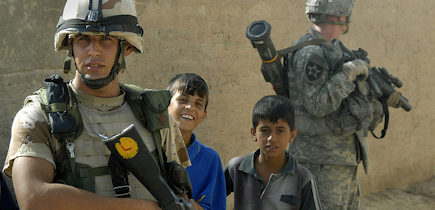

U.S. Army Soldiers in Iraq. Photo: Scott Taylor, U.S.Army, flickr

The research subjects explained and mostly legitimized the US military presence and their own participation, with a reference to themselves as Americans.

Robert places American politicians outside these “American people. He places himself, as a service member, on the side of and fighting for, the American people, not the government.

The anthropologist explains:

People and troops, the government and the people make up two societies that act according to two different value systems; the politicians according to a rather crooked one, initiating wars on unjust premises and ignoring the will of the American people; the American people according to what might perhaps be termed a more American one, expressed in Robert‟s account as focused on a wish to keep his own family and other Americans safe and free, and help Iraqis towards a better life.

Help Iraqis towards a better life? That’s in the eyes of the soldiers their responsibility as Americans. The USA is in their view a positive example for other countries, an example to follow. It seems to me they are on a kind of religious mission.

This religious dimension is interesting. Salameh discusses American nationalism as “civil religion”:

Much of the (…) USA and its military, can be understood within the context of civil religion, wherein the nation is the focus of belief, and its endeavours overseas is the spreading (missionary function) of the values inherent in the „national belief‟.

One of the dogmas of this “civil religion” is the idea that God has a special concern for America, putting Americans in the role of the chosen people, and America in the role of the promised land:

This is connected to the story of the American foundation, taking the form of myth, where today‟s American‟s ancestors came to this promised land and made a covenant with it, still binding today‟s Americans. The covenant has two aspects: to maintain the concept of promised land, basically to keep the USA free, as underlined by for example Robert, as well as to „export by example‟ the American version of freedom.

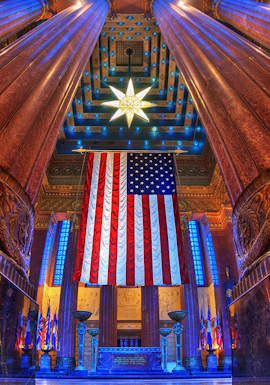
Indianapolis War Memorial Shrine Room.
Photo: Carl Van Rooy, flickr

She also describes the flag as totem, and blood sacrifice as an American group taboo.

At Memorial Day sacrifice was a central theme. “What soldiers in the Army do is to give up their life for others‟ freedom”, an army recruiter explained.

Tony‟s 5th graders stood up, faced the flag on the left side of the blackboard, put their right hand on the left side of their chest and said the Pledge simultaneously with the principal‟s voice. Everybody knew the Pledge by heart and said it out loud: I pledge allegiance to the flag of the United States of America and to the republic for which it stands: one nation under God, indivisible, with liberty and justice for all.

But do people in Iraq and Afghanistan really want their help? What about the widespread opposition towards the US wars?

This question is not very relevant for the research subjects. Even if the the people the USA tries to help reject the help, the USA‟s efforts are legitimate.

“It is as if the people on the receiving side of, what by the Americans is presented as „help‟, are not in a position to judge whether what the US presence offers is good or bad”, Salameh comments.

This remembers of what Edward Said describes as orientalism.

People in the Orient have frequently been portrayed as more passionate, more violent and barbaric, as well as culturally determined. This „savaging‟ of the Orientals has justified European and American imperialism throughout history, often presented as a civilizing project.
(…)
And in the very same act as „the West‟ thus diagnoses other countries as less developed, „the West‟ also categorizes them as passive (they are weak, ill), thus allowing for a paternal role.

For the research subjects, there are “good others” and “bad others” in Iraq and Afghanistan:

There is the „good Other‟ who takes the form of some sort of deprived, but possible, allied and member of the „free world‟; in the accounts above termed „innocents‟, „civilians‟, „the people‟ (of Afghanistan and Iraq), or simply „Afghanis‟ and „Iraqis‟. Opposed to this, exists a „bad Other‟ that cannot possibly be helped, thus only fought. This bad Other carries many different names, among them „terrorists‟, „insurgents‟, „extremists‟, „radicals‟, and to a varying degree also the Iraqi and Afghani „leaders‟ and „government‟ are included.

Although nationalism is important, she stresses that she does not claim it is the only, or the most central factor. There are many individual factors (escaping from smalltown life etc). Economic incentives are often central when people decide to join the military in the first place, and “a thesis could have been written on economy as incentive alone””.

Sarah Salameh is currently turning the thesis into a book where she will include on all those other factors as well.

The whole thesis is available online. (LINK UPDATED 4.4.2020)

SEE ALSO:

Thesis: That’s why there is peace

Secret rituals: Folklorist studied the military as an occupational folk group

Embedded anthropology? Anthropologist studies Canadian soldiers in the field

War in Iraq: Why are anthropologists so silent?

Military anthropologist starts blogging about his experiences

More and more anthropologists are recruited to service military operations
Make Peace. Photo: Danny Hammontree, flickr "What if they gave a war and nobody came?" is a popular slogan from the antiwar-movement. But nowadays, when USA with their allies go to war in Iraq and Afghanistan, people do…

Read more

The Best of Neuroanthropology (etc)

One of the – in my view – most interesting anthropology blogs, Neuroanthropology, has recently celebrated post #1000 and made a list over their Top 100 Posts – based on page views (there is also a list with their personal favorites).

At the same time, the blog has moved to http://blogs.plos.org/neuroanthropology/. They are now part of the new Public Library of Science: PLoS Blogs, “a serious and powerful voice for open-access scholarship and education”. Neuroanthropology bloggers Daniel Lende and Greg Downey hope to “act as a voice for anthropology in a scholarly and public forum built around science and medicine”.

Neuroanthropology is one of the rather few outward looking anthropology blogs – writing both for fellow researchers and the interested public. There are many in-depth magazine style posts – and not only about neuroanthropology – often regarded as one of the most exciting research fields.

One of the most recent posts deals with the question: How does language affect thought and perception? while others discuss The Pitfalls and Pratfalls of Criminals or The dog-human connection in evolution or the Neuroanthropology of Morality.

Public Anthropology is a popular topic, see for example On Reaching a Broader Public or Glory Days – Anthropologists as Journalists or Student Websites and the Classroom: Anthropology Online.

A lot to explore and learn!

One of the - in my view - most interesting anthropology blogs, Neuroanthropology, has recently celebrated post #1000 and made a list over their Top 100 Posts - based on page views (there is also a list with their personal…

Read more

Floods in Pakistan: On silent anthropologists and real heroes


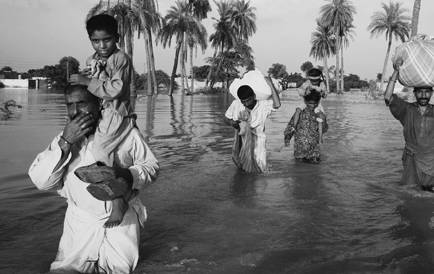
Photo: Giro555 / Samenwerkende Hulporganisaties, flickr

Anthropologists are following in media’s and politicians footsteps: They care less about the floods i Pakistan than for the Tsunami in Southeast Asia, the Katrina floods in the USA and the earthquake in Haiti.

A quick search reveals nearly complete silence. While several anthropologists mention the desaster or call for help, they don’t contribute with any analyses.

The only piece by an anthropologist that deals specifically with the floods consists of rather dubious culturalisations: Cultural wisdom in crisis by Kashmali Khan from Oxford University, published in the Pakistani Tribune.

But while I am writing these lines, suddenly an interview about the flood pops up at the great blog Anthropologyworks. Pakistan expert Maggie Ronkin (who’s recently taught on Justice and Peace in Pakistan and Social Development in South Asia at Georgetown University) interviews Fayyaz Baqir, Director of the Akhter Hameed Khan Resource Center in Islamabad.

Fayyaz Baqir describes the floods as “the worst in the entire world during the past hundred years”. But he is eager to add – and this is the interesting part in my view – that we “are underestimating the resilience, resourcefulness, and capacity of the people to cope with the disaster due to the presence of hundreds of formal and informal institutions and mechanisms that help people on a day-to-day basis.”

This capacity and the will to help is echoed in several stories in Pakistani media.

“In the last 10 days”, Zeresh John writes, in the Pakistani newspaper Dawn, “I’ve seen Pakistan come together in ways never seen before.” “It is an overwhelming feeling”, Zeresh John adds, “when people unite for a cause. When in an instant, strangers no longer remain strangers”:

The Pakistani youth has risen and literally stepped out on the streets to help their countrymen affected by the flood. (…) Each day brings a relentless and constant chain of support. Where the monetary contributors stop, there is a group of people ready to take over by running to crowded bazaars everyday to buy food supplies, clean drinking water and medicines. From there yet another massive portion of the population is stepping in to pack those supplies and load them into trucks to deliver them to the affected areas.
(…)
As Pakistani authorities failed to provide the necessary leadership needed and with no proper coordination in the relief efforts, the civilian population of Pakistan has taken it upon themselves to do what they can in the face of this crisis; in the process, developing a conscientious society that we’re all proud to belong to.

But these stories are not told by the media, a reader comments:

“I live overseas and this post was quite educational for me. How is it that none of our TV channels are highlighting this spirit ? All I’ve seen so far are stories about corruption, fake camps and immoral feudals diverting the flow of flood waters to their benefit. Our free media seems to be failing miserably by promoting only the demoralizing but sensational stories.”

My favorite story is written by Shabnam Riaz in The News: The Real Heroes (see also cached version). She is also writing about “a spirit-lifting experience in this whole nightmare”: Pakistan’s youth, young men and poor laborers who help other people:

Small, scattered groups of young boys and men had formed where the rain was the harshest and was threatening to sweep away cars along with their occupants. (…) They worked in unison, all of them had a single purpose and that was to rescue other human beings. (…) They waved at us, hurriedly preparing to help the next hapless driver who was blindly careening into their path. We waved back with euphoric ‘thank you’ but they had already become busy in helping others.
 
I was touched beyond words. These young men were poor labourers who were most probably hungry as a day full of rain would not have given them a chance to earn their daily wage. I am sure that none of them were owners of a vehicle either. But their dedication to help the other members of society who definitely had more material possessions than they had, without any contempt at all, told me something. It told me that deep inside they were people of substance. Those individuals who had their moral compasses pointing in the right direction.
 
It also told me something else; that in fact, these were our heroes. Also, these people who slog from sun-up till sun-down for a meagre amount that could hardly put a decent meal on anyone’s table, are our actual role models.

 
Here another story about how people help themselves (video by Al Jazeera)

Pakistan flood victims build makeshift transport

Save Pakistan from the catastrophe is the title of an earlier article where anthropologist Fazal Amin Baig calls for action. Fazal Amin Baig wrote it earlier this year in the aftermath of a heavy landslide that took the lives of 19 people and displaced more than 1,500 people. “The year 2010 witnessed a natural disaster, which did not indicate a good omen to the people of Pakistan.” Unfortunately, the anthropologist was right.

Check also Dawn’s excellent special section about the flood and the updates at Global Voices and al-Jazeera and don’t forget to help.

For an excellent example of how to contribute as social scientists, see my earlier post on anthropologists on Katrina.

(update: Pakistan: Netizens In Action Helping Flood Victims. (Global Voices 24.8.2010))

SEE ALSO:

Why we need more disaster anthropology

When applied anthropology becomes aid – A disaster anthropologist’s thoughts

“Disasters do not just happen” – The Anthropology of Disaster (2)

After the Tsunami: Maybe we’re not all just walking replicas of Homo Economicus

Haiti Earthquake: Worldwide solidarity, a common humanity?

Photo: Giro555 / Samenwerkende Hulporganisaties, flickr

Anthropologists are following in media's and politicians footsteps: They care less about the floods i Pakistan than for the Tsunami in Southeast Asia, the Katrina floods in the USA and the earthquake in Haiti.

A…

Read more

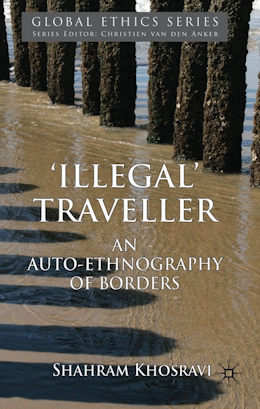
The "illegal" anthropologist: Shahram Khosravi’s Auto-Ethnography of Borders

Globalisation means for most people on this planet higher fences and less movement across borders. The new book by anthropologist Shahram Khosravi is an auto-ethnography of illegalised border crossing.

‘Illegal’ Traveller is based on the anthropologists’s own journey from Iran to Sweden and his informants’ border narratives. “Studies of migrant illegality are often written by people who have never experienced it”, he writes in the introduction. “My aim has been to offer an alternative, partly first-hand, account of unauthorized border crossing that attempts to read the world through ‘illegal’ eyes:

This book is the outgrowth of my own ‘embodied experience of borders’, of ethnographic fieldwork among undocumented migrants between 2004 and 2008, and of teaching courses on irregular migration and the anthropology of borders. It also emerges from my activities outside academia: freelance journalism, helping arrange events such as film festivals about border crossing, and volunteer work for NGOs helping failed asylum seekers and undocumented migrants in Sweden.
(…)

Auto-ethnography lets migrants contextualize their accounts of the experience of migrant illegality. It helps us explore abstract concepts of policy and law and translate them into cultural terms grounded in everyday life.

(…)
In my years as an anthropologist, I have been astonished at how my informants’ experiences overlapped, confirmed, completed, and recalled my own experiences of borders. One interesting aspect of the auto-ethnographic text is that the distinction between ethnographer and ‘others’ is unclear.

I haven’t found any reviews yet, but what I have found is a fascinating paper by him, published in Social Anthropology three years ago. The title: The ‘illegal’ traveller: an auto-ethnography of borders (subscription required now open access!).

In this paper he describes his journey from Iran to Europe as “illegal” refugee and theoreticizes about the ‘world apartheid’ we live in according to him and criticizes the ways we think about borders and migration:

Based on a capitalist-oriented and racial discriminating way of thinking, borders regulate movements of people. However, borders are also the space of defiance and resistance.

It is because of this resistance he is still alive. In September 1986 he tried to leave Iran ‘illegally’ for the first time. “I had then just finished high school and I was called up to do military service during the ongoing terrible war between Iran and Iraq. To come back alive from the front was a chance I did not want to take”, he writes.

It was a long journey via Afghanistan, Pakistan and India. He ended up in Sweden via human smugglers. They saved him his life.

Human smuggling is in his opinion recurrently misrepresented by the media and politicians as an entirely mafia-controlled criminality. One of his helpers was Homayoun, a 25-year-old Afghani man, an undocumented immigrant, who had lived clandestinely in Iran since he was 15:

According to immigration law, Homayoun was a human smuggler, a law breaker and a criminal. But in fact he saved my life in one of the most dangerous places, under the rule of ruthless criminal gangs, corrupt border guards and fanatic Mujaheddin. (…) Homayoun facilitated my escape from undesired martyrdom in a long and bloody war.

Maybe one can say that the smugglers did what the UN Refugee Agency (UNHCR) was supposed to do? Khosravi tells shocking stories about the UNHCR who seems to be responsible for several deaths, including suicides, among refugees. Almost everyone in the refugee community had the same answer: “There is no point in going to the UNHCR”. You won’t get any help. Khosravi’s application was rejected as well. In the view of the UNHCR officer, his “fear of being killed in a horrible war was not ‘well-grounded’ enough.

He tells us the story of Henry’s suicide:

Henry, a young Iranian-Armenian man (…) was an activist within a communist militia, Cherikhaye Fadai, in Iran. But the UNHCR did not believe him. The reason was a wall painting in a corridor in the basement of a prison in Isfahan, where Henry had been detained for several months before his escape to Pakistan. In the interview Henry was asked by the UNHCR official to say what was painted on the wall in the corridor, to test his reliability. Henry had not seen such a painting and consequently his application was rejected. How did the UNHCR officer know about the wall painting? How could she or he be sure that there was any painting at all in that corridor?

Henry was desperate and did not know what to do. Just a few weeks before my departure from Karachi, one morning when the UNHCR officials arrived in their dark-windowed cars, he poured gasoline on himself and struck a match in front of the UNHCR.

With a false passport, Khosravi escaped to India. There he found a smuggler with good reputation, Nour:

During my five months in New Delhi I shared rooms with many persons in transit. All are now residents of Europe or North America – thanks to the smugglers.

He finally ended up in Sweden, a country that he at that time was not able to locate on a world map.

He explains:

The choice of destination was rarely as it was intended and designed. An ‘illegal’ journey is after all arbitrary. Sometimes the migrants end up in a country just coincidentally.
(…)
First of all, the destination was determined by the payment. A few hundred dollars could change the destination from one continent to another. Masoud, a roommate, was Nour’s mosafer (client) at the same time as I was. He had US$500 more than me and today he is a Canadian citizen, lives in Toronto and his children’s mother tongue is English. I am a Swedish citizen, live in Stockholm and my children’s language is Swedish: US$500 destined our lives so differently.

Border crossing is, he continues, is in anthropological sense a ritual:

The border ritual reproduces the meaning and order of the state system. The border ritual is a secular and modern sort of divine sanctity with its own rite of sacrifice. Several hundred clandestine migrants die en route to Europe each year. From January 1993 to July 2007 the deaths of more than 8800 border-crossers were documented in Europe. The Mediterranean Sea is turned into a cemetery for the transgressive travellers.

Border crossing can be experienced in terms of honour and shame:

A legal journey is regarded as an honourable act in the spirit of globalism and cosmopolitanism. The legal traveller passes the border gloriously and enhances his or her social status, whereas the border transgressor is seen as anti-aesthetic and anti-ethical (they are called ‘illegal’ and are criminalised). We live in an era of ‘world apartheid’, according to which the border differentiates between individuals. While for some the border is a ‘surplus of rights’, for others it is a ‘color bar’ (Balibar 2002: 78–84).

Khosravi ends his paper with some “final remarks” from 18 years later (2006), when he arrives at Bristol airport, along with colleagues from Stockholm University. He was convener for a workshop on ‘irregular migration in Europe’ at the biannual conference of the European Association of Social Anthropologists (EASA).

At the immigration control, he is illegalised again in the name of the “war on terror”:

After passing immigration control, I was stopped by a security official who let my blond fellow travellers pass. In the middle of a narrow corridor a mini interrogation began which lasted for half an hour.
(…)

My status as a Swedish citizen disappeared at the border because of my face. I answered questions about myself, my education, work, purpose of visit to Bristol. Then she asked about my parents, where they lived and what they did. I was not willing to disclose to her any kind of information about my elderly parents, who have been subjected to persecution by the Iranian state for decades. When I refused to answer her questions about my parents, she threatened to detain me first for nine hours and then, if necessary, for nine days according to the Anti- Terrorism Act.

I protested that she had targeted me because of my ‘Middle Eastern’ look and her selection of suspicious persons was racist. She did not even deny it and said ‘you [me and who else?] want to kill us. We have to protect ourselves’.

Khosravi has published some articles in Swedish, see my earlier post – Ikke kall dem for illegale

SEE ALSO:

More Global Apartheid?

For free migration: Open the borders!

Why borders don’t help – An engaged anthropology of the US-Mexican border

Research in refugee camps: Too political for anthropology?

Nina Glick Schiller: Who belongs where? A Global Power Perspective on Migration (ASA-blog)

Globalisation means for most people on this planet higher fences and less movement across borders. The new book by anthropologist Shahram Khosravi is an auto-ethnography of illegalised border crossing.

'Illegal' Traveller is based on the anthropologists's…

Read more