
search expand

5 years antropologi.info

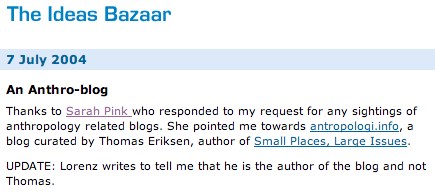
It’s hard to believe that I have been running this blog already for around five years. It was in June 2004, I bought the domain antropologi.info and on the 7th of July 2004, the English blog was launched by anthropologist Simon Roberts from Ideas Bazaar who was the first one who found antropologi.info and blogged about it (see screenshot or the webarchive) – three weeks before I launched it officially in Norway (he is still blogging by the way).

There were only very few anthropology blogs at that time. So the news about a new anthropology blog spread fast. The same day, Dina Mehta, located in India, and Mónica Pinheiro in Portugal, blogged about it. Dina Mehta is still blogging, too, and was recently interviewed about her early blogging. And four days later, antropologi.info was mentioned on maybe the oldest anthropology blog, the ethno:log in Munich.

Blogging in 2004 (or even in 2005) was totally different from today. We were a very small anthroblog-community. There was no Savage Minds or Culture Matters. It was easy to stay up to date. People generally didn’t know what blogging was and rather looked upon it with suspicion. There was no web 2.0. Few used internet in their research and only few scholars published electronically. In 2004 there was no spam! I started with a simple blog script without any spam protection (see the old blog here)

My plan was creating an anthropology portal with both a news section, a calendar, link directory, forum, chat and some kind of magazine section – both in Scandinavian languages, in German and English. I found there is so much interesting research that should be wider known. I wanted to make anthropology more accessible – both to people outside and inside the university.

So I started scanning the news: But I also blogged about interesting posts by other bloggers. In the beginning, I wrote about every thesis that was posted online because this happened so rarely. I interviewed lots of people and also wrote some book reviews. I had lots of time as I just had quit my job. I missed my discipline. I tried to get up to date again, created this website and prepared possible phd-projects (that were never realised).

My first interview was with Eduardo Archetti (in Norwegian only) who died less than one year later. He had just returned from the largest European anthropology conference and I thought it must be exciting to know what knowlege was exchanged when so many anthropologists from all over Europe come together. Usually, this knowledge would remain unknown to the wider public.

I also tried to get anthropologists online, start blogging, publishing online (but only with limited success). I also offered free blogs on antropologi.info – one of the anthropologists is still blogging – Cicilie Fagerlid.

I interviewed some of the first anthrobloggers in 2005 about anthropology and the internet.

Things are very different now. Much has changed in a very short time. We have become a huge community. It is an amazing development! Many anthropologists have started blogging. In addition to pioneering sites like Savage Minds and anthropology.net, we now have several impressive group blog projects like Culture Matters, Material World, Neuroanthropology, Cognition and Culture, Somatosphere and more.

Blogging has become mainstream and blogs a central space for scholary communication.

One of the most impressive developments might be that mainstream organisations like the American Anthropological Association (AAA) and the Association of Social Anthropologists of the UK and Commonwealth (ASA) have started blogging. Today the AAA has one of the most active anthropology blogs. There are new posts nearly every day. Who would have thought that only one year ago?

Then, more and more papers and theses are published online, and the list of Open Access journals is growing. Some have started podcasting like the Society of Applied Anthropology (SfAA) or most recently The Informal Ethnographer (Alexandre Enkerli). German EVIFA has created an impressive anthropology online library (German / English).

Recently, Facebook has become a new arena for communication. Anthropologists are extremly active on twitter and the new Open Anthropology Cooperative has more than 1400 members.

I was once asked if the large number of blogs leads to competition. I answered that for me there are no competitors or rivals. Blogging is fun because there are so many other bloggers. It is because of the anthropology community (and the many friends I made via blogging), that I enjoy blogging and still do blog. Blogging in Norwegian for example is less fun than blogging in English. There is no Scandinavian anthrosphere online, and there is little interaction on the Norwegian blog.

So a big thank you to you who read these lines! Thanks also to everybody who sent papers and theses and contributed with book reviews, guest posts, articles and comments!

Nevertheless, the growing number of anthropological content online has also changed the content of this blog. Too much is happening, it is no longer possible to follow up and cover everything. But this overview feature is still available – on the “antropologi.info Newspaper site” http://www.antropologi.info/blog/ and http://www.antropologi.info/feeds/anthropology/

Feedback face to face, via email, links via other websites etc tell me that the website has been useful for anthropologists. But antropologi.info is not only visited by loyal readers. Most websites get the most traffic from occasional readers – via search engines like Google. I think it is funny to know that for example people who google something like “most primitive people” or “naked tribes” (happens several times a day) are directed to posts where I criticize the idea that there are primitive people. A few days ago, a Norwegian googled after a Norwegian doctor in Arguineguin (place in Spain where many Norwegians live) and then was directed to a blogpost about Norwegians in Spain not willing to integrate.

News travel fast. It was fascinating to see that few hours after I had published the news Anthropology in China: IUAES-conference boycott due to Uyghur massacre, the post was reposted on several Uyghur websites and even translated into Chinese. They weren’t regular readers. They either googled or used aggregators that notify them when new articles about Uyghur issues appeared online. Something similar (in much larger extend, though) might have happened to Maximilan Forte at Open Anthropology. His blog post on America’s Iranian Twitter Revolution received much attention. It was translated into Arabic and Farsi and even published by Al Jazeera. He was also interviewed by Egypt’s Al-Ahram Weekly.

Although it sometimes takes a week or more before a new blog post appears, I have no plans of stopping blogging. It might be necessary to stress that antropologi.info is a one-man project without any financial support. I say that because I often get emails that treat antropologi.info as an institution or organisation. I was for example asked if it was possible to visit antropologi.info’s office and an anthropologist in India even sent me a job application.

UPDATE: Thanks for congratulations and mentioning this post Savage Minds, Neuroanthropology, Erkan Saka, Kulturwissenschaftliche Technikforschung and somatosphere!

It's hard to believe that I have been running this blog already for around five years. It was in June 2004, I bought the domain antropologi.info and on the 7th of July 2004, the English blog was launched by anthropologist…

Read more

Nancy Scheper-Hughes: Public anthropology through collaboration with journalists

(Links updated 29.5.2020) How can we make anthropology public? How survive as politically engaged anthropologist in conservative institutions? Nancy Scheper-Hughes answers these questions in the guest editorial in the new issue of Anthropology Today.

Public anthropology implies usually ‘writing’ for the public – making our work more accessible and also more accountable. A less conventional way of public anthropology is collaboration with journalists and the media, Nancy Scheper-Hughes writes. She did fieldwork on the global traffic in organs alongside journalists from USA, Canada, Brazil, Moldova, Albania, Turkey and the Philippines:

Most anthropologists fear ‘contamination’ by journalism: few scholars are comfortable with articles that may read more like ‘investigative journalism’ than ethnography. But that’s a risk I’ve been willing to take.

I continue to write in various registers with various publics in mind. The anthropological public is just one, though still – in terms of identity and affection – my primary audience. But thanks to collaborations with journalists I now know how to call on ‘fixers’ when I need them and I know how to conduct myself in radio and TV interviews, which does not come easily to academics.
(…)
To make anthropology public is to invite criticism as well as to face ‘erasures’ of ownership of research findings once we share these with journalists, for whom anthropologists are simply a ‘source’, sometimes named but never fully ‘acknowledged’. Even so, it is satisfying to see one’s work appear on the front pages of the New York Times or the Sunday Times Magazine, and thereby surreptitiously enter into a more public discourse than if we guard our research findings as ‘private property’.

Anthropologists have much to learn from journalists:

In teaching graduate seminars on genocide, the writings of anthropologists often pale beside the work of political journalists like Philip Gourevitch (1998), Mark Daner (1994) and Alma Guillermoprieto (1994). A little professional humility would go a long way to foster the potential for collaboration drawing on the strengths and skills of each.

Of course, collaboration with investigative reporters is not always easy:

However, the more I collaborate with skilled national and international reporters and documentary filmmakers, the more I am impressed with their thoughtfulness, thoroughness, dedication to accuracy and their own very different ethical and political sensibilities.

Nancy Scheper-Hughes stresses that the goal of public anthropology is to make public issues, not simply to respond to them:

This is what I have tried to do for the past decade with the Organs Watch project: to make the global traffic in humans for their organs into a pressing social issue requiring a global, multilateral response. At the beginning of the project (1998) I was ridiculed and drummed out of transplant meetings. (…) Bearing out Virginia Woolf’s contention that ‘ridicule, obscurity and social cen sure are preferable to fame and praise’, my interventions eventually bore fruit at the 2008 Istanbul summit of international transplant professionals, where we jointly and unanimously passed the Istanbul Declaration on Organ Trafficking and Transplant Tourism.

But as we know, it is risky to be a public intellectual:

Scholars who want to reach diverse publics – through popular writing, speaking, or participating in social activism – are not only under rewarded by their universities, they are often penalized for ‘dumbing down’ anthropological thinking, cutting social theory into bite sized ‘sound bites’, ‘vulgarizing’ anthropology, sacrificing academic standards or (in the US) for playing to the anti intellectual, illiberal American popular (working) classes. Public service here tends to mean service to the academy – our discipline or uni versity – rather than service to global publics.

Is it possible to both study and participate in social change? Nancy Scheper-Hughes tells us about her first mentor, Hortense Powdermaker. Originally, she saw the roles as activist and researcher incompatible. However, moved by the student campus rebellions of 1968 and ’69, towards the end of her life Hortense began to reconsider her views.

She held her last public speech at the student Kroeber Anthropology Association Meetings in May 1970, just a month before she died:

She concluded her cautionary tale by directly addressing the angry, radicalized Berkeley students: ‘So you want to do your own thing? Then just do it! I’ve always done my own thing and I’ve gotten away with it too! […] I was a rebel in the 1920s […] avant­garde before it was the fashionable thing to do! In [Goucher] college I was a rebel of one. So, if you want to be a rebel or a revolutionary, if you want to join the struggle of the workers or of racially oppressed minorities, my hat is off to you! Do it! But for heaven’s sake don’t expect to get college credit for it!’

Paraphrasing Hortense Powdermaker: you want to be a public anthropologist – then do it! I always did. But don’t expect to be rewarded for it. Instead, consider it a precious right and a privilege. Be grateful that, despite the tendency of bureaucratic intuitions toward social con servatism, we can still ‘do what we want and get away with it too!’

So, how does one survive in the academy as a politically engaged anthropologist? Ironically, by keeping one’s public engagements fairly private, she writes:

And very much like the first generation of working mothers, you do double time, keeping up with expected home front duties, with the expected rate of scholarly productions of books, arti cles and graduate students, participating in academic meetings, etc. while simultaneously doing human rights work, serving on international panels, giving keynote speeches in places and at events that don’t matter a hoot to one’s peers.

And something important: Express your views, don’t wait unitil you’re tenured:

Finally, don’t be overly cautious in expressing heterodox views or taking heretical positions. Don’t wait until you are safely tenured to jump into the public fray. If you do, you may find you have lost what I call ‘the habit of courage’. But protect yourself by keeping up with the expectations of the academic home front.

And, she adds, don’t complain about overwork and under pay:

Just be glad they don’t pull you off the stage and haul you off to jail for speaking your mind, and for being what academic administrators sometimes call a ‘loose cannon’.

That is the privilege of academic freedom in a flawed but still viable democratic society, the privilege to be engaged in national and global struggles against injustice, exploita tion, racism, homophobia, unjust wars and for the rights of immigrants, minorities and political prisoners. If anthropology cannot be put to service as a tool for human liberation why are we bothering with it at all? A public anthropology can play its part in all these devel opments: it has an opportunity to become an arbiter of emancipatory change not just within the discipline, but for humanity itself.

The whole article “Making Anthropology Public” is not available to the general public (!), only to subscribers.

Nancy Scheper-Hughes has been much in the American media recently. The American Anthropological Association has collected some links, see their entry Anthropologist Investigates Organ Trafficking Ring.

UPDATE Times Higher Education writes about Scheper-Hughes’ article: Institutions slap down those who speak up, argues campaigning scholar

SEE ALSO:

Why anthropologists should become journalists

Marianne Gullestad and How to be a public intellectual

“Anthropology needs to engage in an activist way”

“Discuss politics!” – How anthropologists in Indonesia engage with the public

More and more anthropologists, but they’re absent from public debates – “Engaging Anthropology” (1)

Blogging and Public Anthropology: When free speech costs a career

(Links updated 29.5.2020) How can we make anthropology public? How survive as politically engaged anthropologist in conservative institutions? Nancy Scheper-Hughes answers these questions in the guest editorial in the new issue of Anthropology Today.

Public anthropology implies usually ‘writing’ …

Read more

Why was anthropologist Miguel Ángel Gutiérrez Ávila beaten to death?

One year after anthropologist, author and indigenous rights activist Miguel Ángel Gutiérrez Ávila was beaten to death in Southern Mexico, there has been silence from the Mexican authorities. The Writers in Prison Committee (WiPC) of International PEN askes people to take action.

The killing may according to PEN be related to Gutiérrez’ documentation of attacks by the authorities against an indigenous community radio station.

In a letter to the Mexican Embassy in London the WiPC writes:

A few days before his death, between 23 and 25 July 2008, Gutiérrez had visited the Suljaa’ and Cozoyoapan communities in Costa Chica, Guerrero, in connection with a documentary film he was making on indigenous cultures and traditions. Gutiérrez had been carrying out research into the indigenous people of southern Guerrero for more than 20 years, particularly in Costa Chica, and had been involved in various cultural projects there, including the community radio station Radio Ñomndaa and the establishment of the first Amuzgo community library.

During his last visit to the area, Gutiérrez documented alleged human rights violations on the part of the authorities against the staff of Radio Ñomndaa/ La Palabra del Agua (The Word of the Water), including an interview with one of the station’s founders, which he reportedly intended to include in his documentary.

According to local press reports at the time of Gutiérrez’ death, one lead pointed to the involvement of Aceadeth Rocha Ramírez, mayor of Xochistlahuaca municipality in Costa Chica. Rocha is allegedly one of a number of local political leaders opposed to indigenous movements and Radio Ñomndaa. Another lead reportedly suggested that Gutiérrez may have angered the authorities by filming members of the Federal Investigations Agency (Agencia Federal de Investigación, AFI) while they were conducting a raid on the radio station.

In August last year, the WiPC wrote to the Guerrero state and federal authorities asking them to ensure that a full and impartial investigation into Gutiérrez’ murder was carried out and that those responsible were brought to justice. However, a year after the killing, there has been no response from the authorities; nor have we received any reports on the progress of the investigation from other sources. Our understanding is that the crime remains unsolved.

>> read the whole letter

It seems that his case hasn’t received any attention in the English speaking media.

It was not the first case of this kind in Mexico, see earlier story Engaged anthropologists beaten by the Mexican police

(picture: PEN)

SEE ALSO:

Mexico: Pride in Indigenous Heritage – Literally a Thing of the Past

Engaged research = Terrorism: Germany arrests social scientists

Blogging and Public Anthropology: When free speech costs a career

“Intolerant Universities”: Anthropology professor Chris Knight suspended over G20-activism

One year after anthropologist, author and indigenous rights activist Miguel Ángel Gutiérrez Ávila was beaten to death in Southern Mexico, there has been silence from the Mexican authorities. The Writers in Prison Committee (WiPC) of International PEN askes people…

Read more

IUAES-anthropologists “praise” Chinese government’s relation to minorities

Chinese authorities continue using the 16th congress by the International Union of Anthropological and Ethnological Sciences (IUAES) to spread propaganda. This is the most recent article: Overseas anthropologists: Adventure in Chinese ethnic village “eye-opening”

The congress arranged fieldtrips to what Xinhua calls “ethnic villages” nearby Kunming. Among other things the anthropologists were attending a dance presentation by the Axi minority group:

“The dance represented the essence of the Axi culture, such as primitive beliefs, songs, musical instruments, traditional costumes and religious rites.”

Anthropologist Chukiat Chaiboonsvi from Chiangwai University in Thailand said according to Xinhua that “the village’s traditional culture is “under proper protection”:

It looks very likely for the village to protect the culture and pass it to the next generation. The village is a good example of achieving economic development while at the same time protecting the precious culture.

I think the Chinese government has always been trying to support and take care of ethnic minorities. It’s difficult and it takes time, but so long as the government keeps going on, it will have good results.

Anthropologist Hillary Callan from London was according to Xinhua “impressed by the way the ethnic community works together with local government for its prosperity” and says:

China is absolutely one of the most interesting parts of the world for anthropologists. I wish I could stay longer to learn in greater depth about this country.

IUAES President Luis Alberto Vargas told Xinhua that he found the work made by the Chinese government in relation to the minorities was “something to be known world over”:

Many countries have the same situation as China does. That is a country having multi-nationalities. But not all countries have learned to handle this situation. The way that China is doing is just one of several possibilities. I think it has to be known to the world because it’s getting good results.

>> read the whole story

UPDATE: Even more from Xinhua (incl video): Minority culture exhibition described as enchanting and World listens to Chinese voice as Kunming declaration approved

Similar Xinhua articles exist in other languages like French and German. The congress has so far not been covered by other media.

UPDATE: Some impressions by a participant of the conference at Culture Matters: Anthropologists and the Politburo: Ali Adolf Wu writes that “while the Chinese government used this event to boost the standing of its ethnic policy after the events in Xinjiang in Tibet, anthropologists in China may have benefited from this extra attention.” He finds Petr Skalnik’s boycott of the conference very naive.

SEE ALSO:

Chinese media propaganda at IUAES anthropology conference in Kunming

Anthropology in China: IUAES-conference boycott due to Uyghur massacre

Chinese authorities continue using the 16th congress by the International Union of Anthropological and Ethnological Sciences (IUAES) to spread propaganda. This is the most recent article: Overseas anthropologists: Adventure in Chinese ethnic village "eye-opening"

The congress arranged fieldtrips…

Read more

Chinese media propaganda at IUAES anthropology conference in Kunming

(update 30.7: IUAES-anthropologists “praise” Chinese government’s relation to minorities) As I wrote a few days ago, the vice president of the International Union of Anthropological and Ethnological Sciences (IUAES) Petr Skalník decided to boycott the IUAES congress in Kunming, China due to the recent massacre where several hundred Uyghurs were killed.

“I do not want to be part of overt and/or tacit legitimation of evidently erroneous handling of nationality question in China”, he wrote in an open letter.

The conference started today and it is interesting to see how the Chinese authorities use the conference to promote both China and to legitimize their minority policy.

China anthropology enters new stage, more active in global study is the headline in People’s Daily Online.

They write about the vice-chairman of the 16th congress’s organizing committee, Hao Shiyuan, who said that “Chinese anthropology mainly focused on application research”. And in one case, he said, “more than 1,000 local anthropological scholars had took up fieldwork in 1950s to collect first-hand data and advise the government on the management of ethnic groups.”

Then they quote the IUAES President Vargas with these words: “Many anthropologists are interested in studying specific questions in China, as well as looking at the solutions that our Chinese colleagues have proposed to problems that are similar in other countries.”

The headline of an article by the offical Xinhua news agency is China listening to int’l experts in pursuit of coexistence of diversified cultures. We read that the Chinese Vice Premier Hui Liangyu delivered a speech at the opening ceremony. He said that the Chinese government “has attached great importance to the development of anthropological and ethnological sciences, and actively promotes theoretical studies, innovation and application.”

In a critical blog post at gokunming.com, we read that Yunnan University, which is hosting the congress, is off limits to the general public: “entry is only granted to registered participants who must display passes. Additionally, the university’s perimeter is under heavy police watch”:

No official explanation for barring the general public from Yunnan University’s main campus has been given, there are several possible reasons, including the attendance of Chinese Vice Premier Hui Liangyu at this morning’s opening ceremony.

In his address to the congress, Hui said that “pushing forward dialogues and cooperation among different civilizations is a joint responsibility of individuals and governments.”

Despite Hui’s upbeat statement, the recent ethnic violence in Xinjiang that left hundreds dead is likely a cause for ramped up security. Another potential reason for government uneasiness may be the occasional overlap between anthropology and intelligence gathering operations.

UPDATE 29.7.09: More from the offical Xinhua news agency: China says its ethnic policies “on right track”:

A senior Chinese official said Monday the government’s policies on ethnic affairs are “on the right track” and have helped create conditions for equality, unity and common prosperity among the country’s different ethnic groups.

Jia Qinglin, chairman of the National Committee of the Chinese People’s Political Consultative Conference (CPPCC), China’s top political advisory body, made the remark in his meeting with Luis Alberto Vargas, the President of the International Union of Anthropological and Ethnological Sciences (IUAES), who is in China to attend The 16th IUAES World Congress held in China southwest province Yunnan.

Jia said the living standards of the ethnic groups were rising steadily and their political, economic and cultural rights were well safeguarded.

UPDATE: More propaganda: IUAES-anthropologists “praise” Chinese government’s relation to minorities (Xinhua 30.7.09)

SEE ALSO:

Anthropology in China: IUAES-conference boycott due to Uyghur massacre

The Problems with Chinese Anthropological Research

Anthropology: a Taboo Topic in China?

(update 30.7: IUAES-anthropologists "praise" Chinese government's relation to minorities) As I wrote a few days ago, the vice president of the International Union of Anthropological and Ethnological Sciences (IUAES) Petr Skalník decided to boycott the IUAES congress in Kunming, China…

Read more