search expand

1st of May is Open Access Anthropology Day!

Free access to anthropological knowledge online! On the 1st of May, we’ll celebrate the first Open Access Anthropology Day!

Sara at Sara Anthro Blog has taken the initiative to this event.

She writes:

Anthropologists, in this day, show their support to Open Access Anthropology. Open Access Anthropology is interested in creating open access alternatives to anthropological publications by promoting Open Access Anthropology Journals

I think this is a great idea and I have already started preparing a blog post for this occasion. Maybe all of us should try to blog about Open Access that day or find other ways to promote free access to scholarship?

The difficulties to access Anthropology News articles that are discussed over at Savage Minds are a good illustration for this cause. See also Why should anthropologists care about open access? and A short summary of recent open access news.

Shortly after Sara’s post, the Open Access Anthropology Blog announced the Open Access Week 19-23 October 2009

UPDATE: Sara made a list of things you can do to promote Open Access Anthropology

Free access to anthropological knowledge online! On the 1st of May, we'll celebrate the first Open Access Anthropology Day!

Sara at Sara Anthro Blog has taken the initiative to this event.

She writes:

Anthropologists, in this day, show their…

Read more

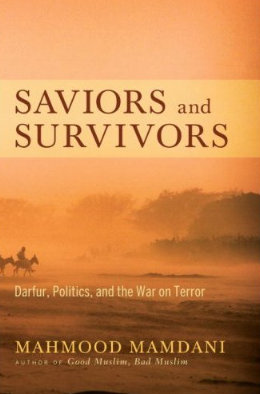
Mahmood Mamdani: “Western concern for Darfur = Neocolonialism”

300 000 people have been killed and 2.5 million been made refugees in the war in Darfur. In his new book, anthropologist Mahmood Mamdani describes the Save Darfur campaign as representing a refracted version of the moral logic of the “War on Terror” with the Arabs in both cases branded as evil, Alex de Waal writes in The Monthly Review.

Mamdani writes:

The Save Darfur lobby demands, above all else, justice, the right of the international community — really the big powers in the Security Council — to punish “failed” or “rogue” states, even if it be at the cost of more bloodshed and a diminished possibility of reconciliation. More than anything else, “the responsibility to protect” is a right to punish without being held accountable — a clarion call for the recolonization of “failed” states in Africa. In its present form, the call for justice is really a slogan that masks a big power agenda to recolonize Africa.

Mamdani criticizes Save Darfur as mobilizing “child soldiers,” by which he means naive American students, in a campaign that diminishes Africans as part of an argument to “save” them, G. Pascal Zachary notes in his review.

Zachary is one of several scholars who discuss Mamdanis book Saviors and Survivors. Darfur, Politics, and the War on Terror on their group blog Making Sense of Darfur.

Zachary is a huge fan of Mamdani but feels that “like almost everyone else who speaks on Darfur, Mamdani too has another agenda”:

Like all those he complains about who use Darfur to score points on matters of greater importance to them – repressive Islamic regimes, Christian tolerance, the value of military intervention, etc – Mamdani too subordinates Darfur to a broader set of stories he wants to tell about dysfunctional American power in the world, about misunderstood Muslims, about an Africa violated by Westerners from every point of the political spectrum. Mamdani may be right about all of these larger stories, but just he is wrong to exploit Darfur – as wrong as those he finds guilty of doing the same.

>> read the whole text “Mamdani and the Uses of Darfur”

>> Saviors and Survivors (Monthly Review 13.4.09)

>> What Does Darfur Have To Do With The “War On Terror”? Kevin Funk, Making Sense of Darfur, 19.4.09)

>> The Darfur the West Isn’t Recognizing as It Moralizes About the Region (New York Times, 30.3.09)

>> Mahmood Mamdani: You (and I) got Darfur Wrong (Radio Open Source 3.4.09)

In an interview with the Boston Globe, the anthropologist explains his interest for the Darfur case:

In a context where African tragedies seem never to be noticed, I wondered why Darfur was an obsession with the global media. The reason, I realized, was that Darfur had become a domestic issue here, thanks to the Save Darfur movement. So I thought it important to examine the movement’s history, organization, and message.

(…)

I’m struck by the contrast between the mobilization around Darfur and the lack of mobilization around Iraq. The explanation, I believe, lies in the fact that Save Darfur presented the conflict as a tragedy, stripped of politics and context. There were simply “African” victims and “Arab” perpetrators motivated by race-intoxicated hatred. Unlike Iraq, about which Americans felt guilty or impotent, Darfur presented an opportunity to feel good.

(…)

The language of human rights was once used primarily by the victims of repression. Now it has become the language of power and of interventionists who turn victims not into agents but into proxies. It has been subverted from a language that empowers victims to a language that serves the designs of an interventionist power on an international scale.

>> read the whole interview

I wrote about Mamdani and Darfur earlier, see Mahmood Mamdani: “Peace cannot be built on humanitarian intervention” and about earlier books Book review: Mahmood Mamdani: “Good Muslim, Bad Muslim”

300 000 people have been killed and 2.5 million been made refugees in the war in Darfur. In his new book, anthropologist Mahmood Mamdani describes the Save Darfur campaign as representing a refracted version of the moral logic of the…

Read more

Military Anthropology, HIV and the Engaged University: SfAA Podcasts online

SFAA FLYER

Their first set of conference podcasts in 2007 was a huge success. Now, Jen Cardew and her team published a large number of new recordings from the 2009 conference of the Society of Applied Anthropology.

It seems to have a been an interesting conference. There are podcasts about the following topics:

The Engaged University: What Does it Mean for Applied Anthropology?

Different Fields, Common Challenge: Lessons For and From Military Anthropology

Study of HIV and STIs in the Western Hemisphere, Part I

Studies Of HIV and STIs In The Western Hemisphere, Part II

Professional and Academic Collaboration: Strengthening the Preparation of New Professional Anthropologists

SFAA FLYER

Their first set of conference podcasts in 2007 was a huge success. Now, Jen Cardew and her team published a large number of new recordings from the 2009 conference of the Society of Applied Anthropology.

It seems to have a been…

Read more

The new blog by the American Anthropological Association

The American Anthropological Association (AAA) has launched a new blog at http://blog.aaanet.org/ It combines their previous Anthropology News, Public Affairs and Human Rights blogs. All archived content and comments were migrated to the new location. The blog looks much better now and it is easier to stay updated.

The AAA writes:

We have created this blog as a service to our members and the general public. It is a forum to discuss topics of debate in anthropology and a space for public commentary on association policies, publications and advocacy issues. We will post select items that we think are of interest to our members and that readers have voiced an interest in. We invite all anthropologists to use this domain to stimulate intellectual discussion, and would be delighted to host guest bloggers who are active in any of anthropology’s four fields.

>> visit the AAA blog

The American Anthropological Association (AAA) has launched a new blog at http://blog.aaanet.org/ It combines their previous Anthropology News, Public Affairs and Human Rights blogs. All archived content and comments were migrated to the new location. The blog looks much better…

Read more

Off to Damascus

Time for Easter Holidays! I’ll be mostly offline the following 8 days that I’ll spend in Syria. My first time there! More updates after the 14.4.09. Happy Holidays!

Time for Easter Holidays! I'll be mostly offline the following 8 days that I'll spend in Syria. My first time there! More updates after the 14.4.09. Happy Holidays!

Read more