search expand

Book Review: How Indissoluble is Hindu Marriage?

Divorce does not belong to Hindu tradition, anthropologist Livia Holden was told when she started her research in India 14 years ago. But is this true? Tereza Kuldova reviews for antropologi.info Holden’s new book Hindu Divorce. A Legal Anthropology.

Anthropologist Livia Holden has been on 16 months of fieldwork over the course of 12 years in a village in Madhya Pradesh, India. With the help of the case studies of several women she challenges popular belief and earlier anthropological studies.

Here is the review:

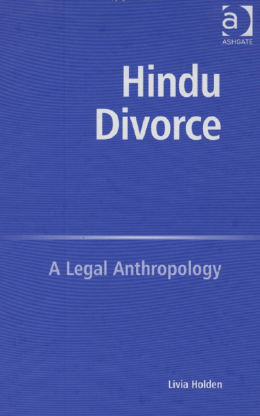
cover

Review: Holden, Livia. 2008. Hindu Divorce: A Legal Anthropology. Ashgate.

Tereza Kuldova

Livia Holden’s book Hindu Divorce presents an invaluable and to a certain degree also provocative re-examination of the praxis and legal status of Hindu divorce and remarriage, both in its past and present manifestations. Being an anthropologist, Livia Holden has the necessary first-hand experience with the actual practices of Hindu divorce and remarriage, at the same time as she connects these with the greater framework of the official law at the national level and even traces the implications of her findings transnationally.

Her examination of the divorce practices and remarriage is based on 16 months of fieldwork over the course of 12 years in a village in Madhya Pradesh, India. Over these years she had the opportunity to follow her informants, their stories and to develop deep relationships.

With the help of the case studies of several women (p. 69-124), which she has gathered over this period, she proves that contrary to the popular discourse in which Hindu marriage is considered indissoluble, and even contrary to the most legal and even anthropological studies, it is possible to find textual, historical and even contemporary evidence of customary provisions for divorce and remarriage.

The mainstream view of the Brahmans and other upper-caste Hindus, as it is codified in the Laws of Manu and other classical texts, which claims that marriage – solemnized according to the sacred rites prescribed by the ancient religious texts – is indissoluble, is contested on the basis of the customary law and practice.

It is also this view which served the British when developing the Anglo-Hindu personal law, as they gave priority to the religious texts and naturally also to the upper-caste views on law (p. 14). This codification led to even greater general consolidation of this idea, which is again what is reflected in most of the anthropological and law treatises.

In 1955 the Hindu Marriage Act was passed. This act guaranteed divorce for all Hindus and has saved customary practices of divorce. The emphasis on customary law and practices is important here, because, as Livia Holden points out, it would be a misconception to believe that most Hindu divorces take place through the juridical process in the civil courts, it is rather the customary law which prevails.

In addition “the inclusion of custom in the realm of the legal has the unique advantage of overcoming the fictional opposition between normative and non-normative behaviors, or between official and alternative normative orders that fix society within the limits of a privileged and totalizing cultural system” (p. 11). And it thus corresponds more to what her empirical data clearly show, i.e. that these customary provisions for divorce and remarriage function even among Brahmans and other high-caste Hindus, even though they are commonly perceived as practices of the lower castes.

She claims firmly that “dissolution of marriage did not only exist from ancient times; it was available to women and it was also widespread among the Hindu upper caste” (p. 5).

Being inspired by the feminist anthropology she also provides throughout her book an account of “how the mainstream Hindu discourse of gender imbalance shapes the legal discourse of law and how, in turn, the official legal discourse shapes Hindu society” (p. 19). Relating her empirical observations to the law discourse and theories on gender, she shows that customary law may actually provide more scope than the statutory personal law for the woman to negotiate successfully the conditions of her existence. She provides an analysis of the problem whether and if so how does the Hindu divorce and remarriage constitute a certain way out for women in the situations of matrimonial crisis.

In this context she presents several of her cases in which she also discusses such topics as arranged and child marriage, dowry, bigamy, domestic violence and interestingly also manipulations of custom and of official law. She further discusses the treatment of the Hindu divorce in the framework of national official law and its various relationships to the customary law and discusses the effects of the official law for the women.

She concludes that:

“in specific circumstances Hindu women can successfully negotiate the end of an unsuitable matrimonial tie and remarry to secure better lives for themselves and their children; but for an understanding of peculiar techniques, which are part of the women’s legal awareness, it is necessary to see beyond positive law, to where the non-state law can inform or even substitute for state-law a perspective of legal pluralism that is something more than plurality of law” (p.218).

This book is no doubt a great contribution both for anthropology and for the study of law in India. Connecting the different levels of analysis it provides a coherent picture of the state of affairs. The possible direction of future research in this area might lie in the focus on the Hindu divorce and remarriage in the urban areas, especially among middle classes.

As my own fieldwork experience suggests, divorce and remarriage among Hindus in villages, even among higher-caste Hindus was generally possible, precisely on the basis of the customary law as pointed out above. But in the urban areas on the other hand the higher-castes acted more conservatively and generally restricted women who left their husbands to remarry, and even women themselves felt that it would be inappropriate. Investigating these processes which go hand in hand with modernity and which to a certain degree can be considered as the products of modernity, might thus be a fruitful scenario fur further research.

But except for the undoubtedly remarkable contribution of rethinking of the Hindu divorce and remarriage in various areas, the book is also striking in its degree of self-reflexivity. The chapter 2 (p. 27-68) is devoted to the discussion of the theoretical and methodological insights and reflection over these. It is very instructive in its open discussion of the changing role of the anthropologist and her positioning in the field.

Livia Holden goes on to discuss such topics as what challenges doing research together with a husband brings and what possibilities it on the other hand also opens, or how she was perceived in the first period when she was childless and how the relationships changed and evolved when she came next time with a baby and how this changed situation opened up different arenas for her research. She reflects also on doing research in a village which was already previously studied by her professor J. L. Chambard and the negotiation of the relationships with the villagers on this subject. She reflects on her status as a woman who is concerned generally with mens matters, as she becomes a kind of honorary male, which allows her cross-gender behavior. She also discusses her ideas on authorship and the collaborative nature of her research.

Methodologically this book is also interesting as it combines different resources, even integrating the method of filming. The resulting ethnographic film from 2001 is called Runaway Wives and it was done in co-production with her husband Marius Holden who also wrote a chapter in this book (p. 60-8) that discusses and reflects the process of filming and the theoretical problems of visual anthropology.

This extensive self-reflection incorporated throughout the whole book makes it instructive and an interesting reading for every anthropology student and anthropologist. In addition the multidisciplinary approach to the research which draws from feminist and legal studies and social sciences will be of interest to any student or scholar of law, sociology and anthropology.

>> Information on the book by the publisher (Ashgate)

>> information on Tereza Kuldova (both anthropologist and artist)

SEE ALSO:

Thesis: How Indian women fight the stigma of divorce

Unmarried Women in Arab Countries: Status No Longer Dependent upon the Husband

China: Where women rule the world and don’t marry

On African Island: Only women are allowed to propose marriage
cover

Divorce does not belong to Hindu tradition, anthropologist Livia Holden was told when she started her research in India 14 years ago. But is this true? Tereza Kuldova reviews for antropologi.info Holden’s new book Hindu Divorce. A Legal Anthropology.

Anthropologist…
Read more

Why we need more disaster anthropology

cover

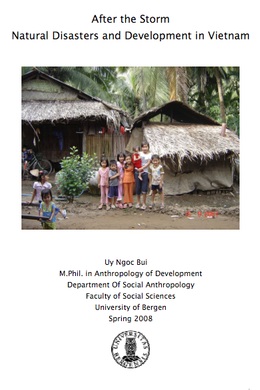
On the 5th of December 2006, typhoon Durian hit Bến Tre province in Southern Vietnam. Close to 100 people died, more than 800 moored fishing boats sank, thousands of buildings collapsed including schools and hospitals. In her master’s thesis, Uy Ngoc Bui looks at how this event changed peoples’ lives and explains why we need more disaster anthropology.

In this extremly well written thesis at the University of Bergen (Norway), Uy Ngoc Bui looks at the role of NGOs, the state and the people themselves’ in the period after the disaster. Although the government and the NGOs did a significant job in handling typhoon Durian the real heroes were the people themselves, who helped one another in a time of great need, she writes:

They showed great courage, endurance and solidarity by overcoming this challenge. As such, it is perhaps no surprise that my study concurs with the many previous studies which state that disaster management is very dependent on the participation of the community, and their strengths and efforts can determine the outcome of the disaster.

Therefore it is important to study peoples’ knowledge and coping mechanisms:

In disasters as floods and tsunamis, traditional knowledge acts as warning signs which can be read ahead of time, saving many lives. This type of information should be spread wherever it is useful, as Red Cross has done in Vietnam.
(…)
I believe that thorough research into traditional knowledge and local coping mechanisms should be emphasised as they are a type of accumulative knowledge which has been passed on throughout generations, adapted to their specific environment. This type of knowledge is valuable because it is not written down, and if is lost, it will be lost forever. Here anthropology has an important job to do.

There are lots of topics to study for anthropologists, for example the local-global linkages and the reconstruction work:

My experience is that more research should be done on the bridging of relief aid with long term reconstruction and development. Relief aid has become more efficient and standardised, which is positive, but this is only short term help for people who are in a vulnerable situation. Decreasing their vulnerability and strengthening their capacity to overcome disasters in the future should be the key foci of anthropologists and NGOs.

(…)

Anthropology provides a unique look at how the local situation relates to the global through the holistic approach. It is therefore important that anthropology uses this approach to better understand the complex local-global linkages in future research. Solid fieldwork on the ground level can show how the lives of the people involved are changed as a result of the disaster and the following intervention by foreign actors. The real effects of natural disasters, the ones that are felt intimately and which linger on long after the dust has settled, are best researched with anthropological methods which can take into account all the historical, economical, political and social factors that are involved in the making of a natural disaster.

One of the global forces are related to global warming:

Many blame the Western industrial ways for corrupting the planet’s eco-system, creating more and more havoc for each year. Research in disaster management therefore also includes research into finding more eco-friendly ways to live.

Uy Ngoc Bui has studied anthropology at the University in Bergen, Norway. As she’s “of Vietnamese origin” she felt that she “had an advantage in being half-immersed in the ‘culture’ already, which would make the transition somewhat smoother”. Furthermore, people were as interested in hearing about Norway and Norwegian culture as she was interested in them, she writes.

>> download the thesis “After the Storm: Natural Disasters and Development in Vietnam”

Today was by the way the second day of an interdisciplinary climate conference in Copenhagen. Among the researchers we find many anthropologists. Kirsten Hastrup is team leader of the research project Waterworlds at the anthropology department at the University of Copenhagen:

The ambition of the project is to study local, social responses to environmental disasters related to water, as spurred by the melting of ice in the Arctic and in other glacier areas, the rising of seas that flood islands and coastal communities, and the drying of lands accelerating desertification in large parts of Africa and elsewhere. The aim is to contribute to a renewed theory of social resilience that builds on the actualities of social life in distinct localities, and pays heed to human agency as the basis for people’s quest for certainty in exposed environments.

SEE ALSO:

When applied anthropology becomes aid – A disaster anthropologist’s thoughts

The Anthropology of Disaster – Anthropologists on Katrina

“Disasters do not just happen” – The Anthropology of Disaster (2)

Anthropology News October: How Anthropologists Can Respond to Disasters

Comparative studies of flood management in neoliberal, social-democratic states needed

New website: Understanding Katrina: Perspectives from the Social Sciences

BBC: Tsunami “folklore” saved islanders

How to survive in a desert? On Aboriginals’ knowledge of the groundwater system

Thailand: Local wisdom protects hometown from the onslaught of globalisation

cover

On the 5th of December 2006, typhoon Durian hit Bến Tre province in Southern Vietnam. Close to 100 people died, more than 800 moored fishing boats sank, thousands of buildings collapsed including schools and hospitals. In her master's thesis,…

Read more

Why anthropologists should become journalists

We need courses and programs in “Anthropology & Journalism” to help create the critical public intellectuals of the 21st century, Brian McKenna writes in Counterpunch. Such programs will help equip students with skills to popularize critical knowledge:

One thing is certain. We need a new wave of writers and journalists, unafraid to do the most radical thing imaginable: simply describe reality. Their ranks will largely come from freethinkers, dissenting academics and bored mainstream journalists who rediscover what got them interested in anthropology in the first place, telling the truth. Anthropologists have no choice. They must become media makers and journalists themselves.

Many anthropologists look skeptically at journalism. But whenever McKenna hears one of them saying “I never talk to journalists, they always get me wrong. I just can’t trust them”, his mind churns, “Then why don’t you become the journalist and write it yourself?”

Anthropologist have lots in common with journalists. They can make great journalists:

What makes a good journalist? In a telling Slate Magazine article, “Can Journalism School Be Saved?” editor Jack Shafer said that “I’d rather hire somebody who wrote a brilliant senior thesis on Chaucer than a J-school M.A. who’s mastered the art of computer-assisted reporting. If you can crack Chaucer, you’ve got a chance at decoding city hall.” (Zenger 2002)

Anthropologists can crack Chaucer and much more. Anthropologists can debate Foucault, survive in foreign lands with little more than the grit of our teeth and write insightful interpretations of the global/local intersections of capital. Anthropologists would make great journalists, albeit if they learned to write more quickly, urgently, succinctly and in a public voice.

(…)

Anthropologist James Lett is a former broadcaster and present-day anthropologist. In 1986 he wrote abut his dual life commenting that found it “remarkable that [the] similarities [between the two professions] are not more widely appreciated. As an anthropologist, I have been trained to observe, record, describe, and if possible, to explain human behavior, and that is the essence of what I do every day as a journalist.” (Lett 1986)

McKenna discusses in this article several papers on anthropology and journalism

>> read the article in Counterpunch

His texts reminds me of another texts I wanted to blog about earlier: “Anthro-Journalism” by Randolph Fillmore that is part of the site Communicating Anthropology (lots of advice for better writing). Sybil Amber has collected some links in her post Journalism in Anthropology. One of them leads to the blog Making Anthropology Public

(links updated 20.1.2016)

SEE ALSO:

The Future of Anthropology: “We ought to build our own mass media”

More and more anthropologists, but they’re absent from public debates – “Engaging Anthropology” (1)

“Discuss politics!” – How anthropologists in Indonesia engage with the public

Blogging and Public Anthropology: When free speech costs a career

We need courses and programs in "Anthropology & Journalism" to help create the critical public intellectuals of the 21st century, Brian McKenna writes in Counterpunch. Such programs will help equip students with skills to popularize critical knowledge:

One thing is…

Read more

Anthropologist Explores Wall Street Culture

40,000 AT&T workers lost their job. This sounds like terrible news. But the stock market applauded it, sending AT&T shares up. Why? Anthropologist Karen Ho was fascinated and confused by the different reactions and wrote her dissertation about it. In July, her book Liquidated: An Ethnography of Wall Street will come out.

Ho went on fieldwork as a business analyst to “learn the language of finance.” She interviewed hundreds of people, shadowed investment bankers at work and hang out with them at bars and industry conferences. “Today, amid Wall Street’s biggest crisis since the 1930s, her insights are fascinating for investors and regulators alike”, Kara McGuire writes in the Star Tribune.

McGuire interviews the anthropologist and asks questions like “How are investment bankers different from the rest of us?” That’s the way, I think, the members of finance or wall street culture should be treated. They seem to live in a totally different world than most of us, a world with their own logic. They seem to represent a totally different culture.

Karen Ho answers:

Investment bankers are structured toward the next bonus. They’re compensated on how many deals they can push through, not on the quality of the deals or long-term strategy. Investment bankers have tons of job insecurity; they are a total revolving door. But what’s interesting is that because of their fairly elite biographies and kind of privileged networks they move in, as well as their lavish compensation, the way they experience downsizing is very different from that of the average worker.

One of the things I argue in the book is that they cultivate a culture of liquidity, of continual restructuring and downsizing that they understand from their particular cultural point of view and privileged location as a productive challenge, as a building of character, precisely because their cushion is so thick. They can say, “Hey look, I have a really risky job, but that’s why I just got paid $1 million last year.” They’ll actually recommend this kind of churning for other workers who have a very different experience. This actually affects corporate America, how other industries are operating.

In her forthcoming book, she focuses on a cultural shift in finance. One of the main ideas of the book is to figure out how short-term shareholder value became the undisputed mission of most corporations from the 1980s onward:

Throughout the mid-20th century, Business Roundtable leaders would say: “Our mission is to negotiate the long-term interests of multiple stakeholders — consumers, employees, distributors, as well as the shareholder.” After 1980, it’s: “We don’t have to negotiate all these other interests; we just have to be concerned about the shareholder.”

The corporate takeover movement Wall Street led in the 1980s helped to culturally make that shift so CEOs now imbibe that Wall Street mantra. (…) Corporations get rewarded and investment bankers get rewarded for financial dealmaking that actually does not increase productive capability.

>> read the interview in Star Tribune

PS: Ah, saw too late that this story (of course!) already was mentioned in Savage Minds’ “Around The Web”

SEE ALSO:

Used anthropology to predict the financial crisis

Anthropologist: Investors need to understand the tribal nature of banking culture

How anthropologists should react to the financial crisis

40,000 AT&T workers lost their job. This sounds like terrible news. But the stock market applauded it, sending AT&T shares up. Why? Anthropologist Karen Ho was fascinated and confused by the different reactions and wrote her dissertation about it. In…

Read more

War in Iraq: Why are anthropologists so silent?

Many US-anthropologists protested against the Vietnam war in the 60s. Why have anthropologists been so reluctant to engage with the “immense tragedy” and “waste of resources by our governments” in the Iraq war, Antonius C.G.M. Robben and Marshall Sahlins ask in the current issue of Anthropology Today.

There has been much debate and protests regarding the embedding of anthropologists in Human Terrain Teams of the U.S.Army, but not about the consequences of the war for the people in Iraq. There is hardly any independent anthropological research going on in Iraq. Of the 1800 panels (11,000 papers) at the annual meetings of the American Anthropological Association (AAA) between 2006-2008, Robben writes, only one has dealt directly with the Iraq War:

We have been far too timid on the issue of the Iraq war. Rather than tackling the issue head-on, we have dealt with it on the back foot, as an issue of ethical concerns about our professional conduct in military and intelligence matters. What of the broader issues concerning Iraq under occupation and the plight of its peoples? Given the immense human and material cost of this war, why has this not been at the forefront of our professional focus?

Robben criticizes the AAA for not acting independently from the US government:

What is disconcerting is how the AAA appoints the members of the Commission on the Engagement of Anthropology with the US Security and Intelligence Communities on the basis of ‘balancing’ interests between individuals employed in intelligence-gathering capacity and independent anthropologists engaged in bona fide academic activity. Why should this commission include members from the security establishment at all?

Surely, if anthropology is to remain an independent academic discipline, it must insist on populating these important bodies with independent anthropologists free of any personal involvement in such matters. In this case, we can speak of imbalance, for two militarized anthropologists on this commission outweigh the one person representing the critics. It is disconcerting to see how panels at the AAA’s conferences also tend to have a culture of aiming for such ‘balance’.

During the Vietnam-war, anthropologists organized teach-ins, an innovation by famous anthropologist Marshall Sahlins. According to Anthropology Today,

the teach-in … unlike the strike, is a constructive process in which participants bring all their knowledge of a critical issue of public concern to the university, with the aim of generating publicity and action. The teach-in became a powerful instrument in this sense, helping to shift public opinion and eventually to change government policy on the Vietnam war.

In Anthropology Today, Sahlins quotes a footnote in a report by the a Senate Judiciary subcommittee on national security about the beginnings of the teach-ins:

The teach-in movement was born at the University of Michigan after heavy criticism of an original plan for a 1-day faculty ‘work moratorium’ to protest U.S. policies in Vietnam. The notion of a ‘strike,’ while sufficiently dramatic, was so controversial that it diverted attention away from the basic aim of the protest group. During a meeting on the night of March 17 they were batting around alternative ideas […] when Anthropologist Sahlins suddenly interrupted the discussion: ‘I’ve got it. They say we’re neglecting our responsibilities as teachers. Let’s show them how responsible we feel. Instead of teaching out, we’ll teach in – all night.’

Sahlins wonders:

Why is there not the same anti-war agitation today? The absence of a national military draft is often given as the major reason. (…) Among the other significant differences between then and now, consider only the striking fact that at present business courses constitute by far the most popular subject matter of the higher learning in America. Where the mobilization against the Vietnam War drew on a large cadre of already existing rebels without a cause, the Iraq war came upon us as a cause without the rebels. (That’s James Dean the movie, crossed with Lévi-Strauss the books.)

According to Antonius C.G.M. Robben there are lots of ways for anthropologists to take action:

We must find ways to engage issues concerning Iraq objectively and independently, without being railroaded into a partisan security agenda. Now that we have blogs and online communities, teach-ins and university protests are no longer the only instruments of opposition.

And even if fieldwork were impossible, we can surely weigh up and analyse the fragmentary information available and draw on a comparative anthropology of violence and social suffering to help make sense of current events in Iraq. Anthropologists such as Nadje Al-Ali, Keith Brown, Steven Caton, Matthew Gutmann, Allen Feldman and Catherine Lutz have done so.

The adversarial and partisan agendas of Minerva and the Human Terrain initiatives must not be the central focus of our professional engagement at our annual conferences, for they are recipes for creating security-speak elites with an interest in perpetuating war rather than finding solutions.

We must now strive to engage and disseminate our own independent anthropological studies of the military campaigns undertaken as part of the global ‘war on terror’. The teach-in remains a relevant option today, especially now that we have social networking sites such as Facebook to help.

Unfortunately, the articles are available for subscribers only.

SEE ALSO:

Bush, “war of terror” and the erosion of free academic speech: Challenges for anthropology

American Anthropologists Stand Up Against Torture and the Occupation of Iraq

Fieldwork reveals: Bush administration is lying about the “war on terror” in the Sahara

Cooperation between the Pentagon and anthropologists a fiasco?

The dangerous militarisation of anthropology

Many US-anthropologists protested against the Vietnam war in the 60s. Why have anthropologists been so reluctant to engage with the "immense tragedy" and "waste of resources by our governments" in the Iraq war, Antonius C.G.M. Robben and Marshall Sahlins ask…

Read more