search expand

Anthronow – new magazine will make anthropology accessible to lay readers

logo (via somatosphere) “Other disciplines have a magazine for the general public. Why can’t we?” Now, we have it. The first issue of Anthronow is out. The editors Katherine McCaffrey, Emily Martin, Ida Susser, and Susan Harding (they’re all from American universities) write:

Other disciplines have a magazine for the general public. Why can’t we? Why can’t we have a “popular anthropology” magazine that would fill the gap between conventional news coverage of current events and topics and the more specialized analysis of similar events and topics in professional journals? If our scholarship were written in clear and accessible language and embellished with photographs and other visual materials, wouldn’t there be public interest in the ways that anthropological theory and research can inform and affect contemporary public discourse and public policy debates?

Anthropology Now’s mission is to make anthropological knowledge accessible to lay readers, and to enrich knowledge and debate in the public sphere. The magazine aims to reclaim a voice for anthropology in public debate, not by simplifying complex problems, but by conveying anthropological knowledge in clear and compelling prose. Anthropology Now will build on a growing commitment among anthropolo- gists to make our research findings open and accessible to the world outside of the confines of the academy.

It seems that there is both a paper and a webversion of Anthronow. All articles of the first issue are online. I hope they will continue to provide open access to future issues as well.

I havent’ had time to look at the articles yet. Have they succeeded in making anthropology accessible for the world outside of the universities?

>> visit Anthronow

PS: There is another “popular anthropology” magazine, not in the U.S, but in Germany. It’s called Journal Ethnologie. Are there more? Oh yes, maybe American Ethnography?

UPDATE: Debate about Anthronow and its future over at Savage Minds

logo

(via somatosphere) "Other disciplines have a magazine for the general public. Why can’t we?" Now, we have it. The first issue of Anthronow is out. The editors Katherine McCaffrey, Emily Martin, Ida Susser, and Susan Harding (they're all…

Read more

Thesis: The limits of youth activism in Afghanistan

What possiblities have Afghan youth to rebuild their country and to work for a better future? Which constraints do they meet? Anthropologist Elisabet Eikås has been on fieldwork among young people in Kabul from October 2003 to June 2004. The result is the thesis ‘It is open, but not so open’ – gaining access to participation among Kabuli youths.

Young people are often seen as agents of change. But they don’t act independently of the wider society. Eikås’ study provides an ambivalent picture of the young peoples’ possiblities.

There are lots of young people in different organisations who work for a better future. Many of them want to replace the political model of the elder and ethnicity & affiliation with a model based on equality: “All generations or sects should be involved in politics, everybody, every group should be represented in politics”, informant Amin said.

But the young peoples’ activism is a continuous struggle with the structures of the society.

A big problem for many young people is the strong position of the family. As the government is not able to provide satisfactory social services and security, the extended family is still regarded as the safety-net. The strong reciprocity of obligations and rights within the family is limiting the time young people can spend on political activism.

Eikås regards personal autonomy from the family as the main entrance to change.

Being in their 20s, the young activits are expected to marry – something that would mean further responsibilities and less time for political activities. Many informants try therefore to delay the time of marriage. One of her informants decided to move away from his family.

The tradition of respect of the elders was often mentioned as one of the major obstacles for the youths to contribute to society, this being in the family, at university, at work or in other social arenas, she writes. Patriarchy is not only concerned with male domination over females, but also dominance by seniors (“elders”) over juniors.

She describes a meeting with some board members in a youth organisation, when suddenly the leader of the organisation enters the room.

All stand up to greet him. (…) He sits down behind his 3X2 meter teak desk where there is a picture of himself, a framed table sign with his name and an Afghan flag. One of the others pours him a cup of tea and serves him. (…)

The feedback of the members to the leader, their behaviour towards him, shows similarities with how the youths describe the elders, or how the teachers at university expect to be treated. In the interaction with the regular members, the behaviour by the members are characterised by loyalty and respect towards the leader. They are hesitant to state critical comments, they usually wait for him to invite them to speak, and some of them to a certain degree expect the leader to have more knowledge and provide the answers.
(…)
The hierarchy within the youth organisations suggests that these organisations are not able to change the model of the elder for that of equality within their own organisations, and as such they alternate but still reproduce the patriarchy, however through a young leader

The most promising place for an alternative form of politics to evolve is the university. Despite the prohibition of political activities on campus enforced by the Ministry of Higher Education, student groups are established, and seminars, also concerning participation by students, are held, she writes.

At the university, students with diverse backgrounds, both ethnically, regionally and regarding gender, meet:

The proximity of these students, the diverse forums they meet in, in class, in the canteen (although that is segregated according to gender) and outside the classroom, builds the foundation for diverse networks to mingle and also the possibility of bridging networks to evolve, where their common status as students can be the main source of their solidarity.

The fact that they were able to arrange a seminar, where representatives from different student groups were gathered, further substantiates the potential, through co-operation, of a change in the political culture towards a more universalistic culture where equality between the different students can be the guiding principle.
(…)
On the other hand, there is also evidence that bonded loyalties prevail, also among the students. (S)ome students see their possibility of participation best secured through a bonding network adhering to particularistic values, whether this be family, kin, an external patron, political group or ethnicity.

Many problems are related to the long periods of war in Afghanistan. War leads to the breakdown of trust, and networks are usually narrowed:

My data seem to support Putnam’s understanding of trust to be developed through face-to- face contact, in lack of institutional trust, exemplified through how relations to political activities or aspirations only were discussed with ‘people one knows’. As such, Kabul University can be a promising place for increased trust to develop.

As I interpret much of the data in this thesis, I believe the lack of trust in the Afghan society, is one of the main reasons why both bonding networks and also patron- client relations prevail. It takes time to build trust in a population which has been at war. The people in Afghanistan have just started this process.

>> download the thesis

SEE ALSO:

Researched the sexual revolution in Iran

Online: Thesis about Up-Country Tamil Students

Conflict Resolution and Anthropology: Why more scholarship on violence than on peace?

What possiblities have Afghan youth to rebuild their country and to work for a better future? Which constraints do they meet? Anthropologist Elisabet Eikås has been on fieldwork among young people in Kabul from October 2003 to June…

Read more

Used anthropology to predict the financial crisis

She spent a year in Tajikistan during her PhD, looking after goats. Two years ago, she predicted the current financial crisis. “I happen to think anthropology is a brilliant background for looking at finance,” anthropologist Gillian Tett, assistant editor at the Financial Times, says in an interview with The Guardian:

Firstly, you’re trained to look at how societies or cultures operate holistically, so you look at how all the bits move together. And most people in the City (financial district of London) don’t do that. They are so specialised, so busy, that they just look at their own little silos. And one of the reasons we got into the mess we are in is because they were all so busy looking at their own little bit that they totally failed to understand how it interacted with the rest of society.

But the other thing is, if you come from an anthropology background, you also try and put finance in a cultural context. Bankers like to imagine that money and the profit motive is as universal as gravity. They think it’s basically a given and they think it’s completely apersonal. And it’s not. What they do in finance is all about culture and interaction.
(…)
“(Anthropology is) a weird background to have. But it’s helped me in covering the financial crisis. Having seen the Japanese financial crisis, I’ve always known that banks can fall apart. We never imagined that the Soviet Union would break up. And then in Tajikistan there was a horrific civil war. So that whole experience taught me that extraordinarily unexpected things can happen.

Tett was Japan correspondent for the Financial Times during the country’s financial collapse, and wrote a book about it, “Saving the Sun”:

The behaviour and the psychological mood of the markets in late July was almost identical to what happened in the autumn of 1997 in Japan. I was busy cancelling holidays and things. But it came out of the blue for many people – investors, policymakers, bankers, our readers were suddenly completely at sea, at a loss to make sense of it. The financial system is so dysfunctional, so tribal, that people just don’t communicate with each other.

More non-economics should be interested in finance, she says:

People who come from a background of arts and humanities and social studies tend to think that money and the City is boring and somehow dirty. But if you don’t look at how money goes round the world you don’t actually understand the world at all. When you try and join up the dots about how money can be linked to politics, can be linked to culture, then it’s electrifying.

>> read the whole interview in The Guardian

>> Gillian Tett’s articles in the Financial Times

SEE ALSO:

Gillian Tett: Investors need to understand the tribal nature of banking culture

Anthropologist Gillian Tett finds insight into Japan’s bad-loan crisis

She spent a year in Tajikistan during her PhD, looking after goats. Two years ago, she predicted the current financial crisis. "I happen to think anthropology is a brilliant background for looking at finance," anthropologist Gillian Tett, assistant editor at…

Read more

Who has the right to vote? Anthropology News on US-election

If you need anthropological perspectives on the US-election Obama-McCain, you’ll find them in the new issue of Anthropology News. One of the articles is about a study on voting, politicial participation and citizenship among individuals with psychiatric disability.

Many Americans are excluded from voting. Anthropologist Sara M. Bergstresser is conducting the study, using a “community-based participatory research framework”. She writes:

The stigma of mental illness underlies taken-for-granted assumptions about some citizens’ ability to participate in the electoral process. Public discourse about disability in general, and psychiatric disability in particular, often retains historically- conditioned, biologized models of deviance and moral worth, questioning whether these individuals deserve to participate politically. Such assumptions share their origins with rhetoric that has accompanied many other social barriers to voting throughout the history of the US.
(…)
Taken-for-granted concerns about “capacity” to vote may well tell us more about societal levels of stigma than about individual neurological deficiency.
(…)
Just as health disparities have become an important focus of research in the United States, disability-linked disparities in social and political participation should also be brought to the attention of policymakers and researchers.

>> read the whole article (pdf)

PS: I realize I haven’t seen that the October Anthropology News was about the Global Food crisis!

If you need anthropological perspectives on the US-election Obama-McCain, you'll find them in the new issue of Anthropology News. One of the articles is about a study on voting, politicial participation and citizenship among individuals with psychiatric disability.

Many Americans…

Read more

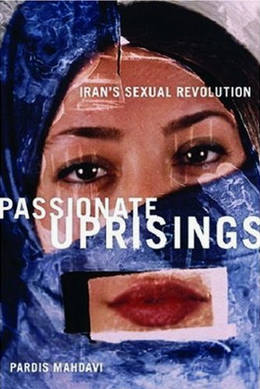
Researched the sexual revolution in Iran

cover

Girls wear makeup, go with their hair uncovered, drink, have boyfriends and premarital sex: For seven years, anthropologist Pardis Mahdavi has studied the sexual revolution in Iran, the Ventura Country Star reports.

Those actions could have brought harsh punishment and even jail time in the past. But now the sheer numbers of young people overwhelm the morality police, who must often turn a blind eye on offenders, she said during a lecture.

Many parents are onboard with the changes:

Before 2002, women could not wear open-toe shoes, and then suddenly women began to openly defy the law, and you saw many, many women wearing sandals and flip-flops without any recrimination. I think they wear red lipstick just to irritate authority.

Ian Chesley has reviewed her book “Passionate Uprisings: Iran’s Sexual Revolution”:

Several of Mahdavi’s research subjects reported that by the summer of 2007, their parents considered premarital dating normal and acceptable. And while a parent in the US might be mortified by having to bail out their child from jail after an arrest at a rowdy party, some of Mahdavi’s adults happily come to their children’s rescue and forego any punishment of their own.

Mahdavi also writes of several parties put on by parents for their children and friends, and the parents come out looking more unrestrained than the younger generation. This observation is probably the most startling in the entire book: the fact that the older generation has begun to consider social behaviors as a form of protest against governmental restrictions is a clear piece of evidence that behavioral fashions are spreading to new segments of the population, beyond the young, wealthy and secular.

He writes that “the most startling and groundbreaking aspect of Mahdavi’s book is her description of the activities of young Iranians behind their bedroom doors. Not only are the book’s subjects frank and honest about their own liberal attitudes to sex, they have even provided Mahdavi with direct access to a group-sex party.

>> read the review i Gozaar

Mahdavi, who is a trained medical anthropologist and Del Jones Award Winner, adds that the sexual revolution has its problematic aspects:

I started this project looking at things from a public health standpoint — what about sex education, HIV, sexually transmitted diseases? The public health aspect is alarming. There is much premarital sex, but no sex education in schools, and almost all sex is unprotected. A condom can’t be purchased without proof of marriage. The young are largely uninformed about the risks of sex.

>> read the whole story in the Ventura County Star

>> Daily Sundial: Iranian youth continue sexual revolution against government

UPDATES:

Laura Secor has written a long review in The Nation (15.12.08)

The book was reviewed in The Australian (22.11.08)

Violet Blue sees similarities to white American evangelical teens (31.10.08)

SEE ALSO:

Weblogs are sweeping the political and social landscape of Iran

Anthropologist explores heavy metal in Asia, South America and the Middle East

Lila Abu-Lughod: It’s time to give up the Western obsession with veiled Muslim women

Chronicles Women’s Social Movements in India

cover

Girls wear makeup, go with their hair uncovered, drink, have boyfriends and premarital sex: For seven years, anthropologist Pardis Mahdavi has studied the sexual revolution in Iran, the Ventura Country Star reports.

Those actions could have brought harsh punishment and even…

Read more