search expand

New anthropology group blog, forum

Somatosphere – Science medicine and anthropology is the title of a new medical anthropology blog by researchers at McGill University in Montreal, Canada.

It will be an interdisciplinary blog as Eugene Raikhel writes in his first post:

The core of this blog is medical anthropology – the majority of the authors are anthropologists who work on medical topics; however, we’re particularly interested in the borders between anthropology and a number of neighboring disciplines: namely, science and technology studies (STS), cultural psychiatry and bioethics.

In his second post, he reviews some medical anthropology related journals (special issues).

Raikhel is currently a postdoc at the Division of Social and Transcultural Psychiatry and the Department of Social Studies of Medicine – “fairly unique interdisciplinary units in which foster some very interesting research and discussions between anthropologists and psychiatrists, neuroscientists, sociologists and historians of science.”

His dissertation is an ethnographic study of addiction and the therapeutic market in contemporary Russia. He’s been on extensive fieldwork in addiction and psychiatric hospitals, clinics and rehabilitation centers in St. Petersburg (source).

>> visit Somatosphere – Science medicine and anthropology

I was also asked to announce a new social science forum www.socialtalks.net. It is run by Espen Malling, student of anthropology at the University of Aarhus, Denmark.

At the same I want to remind of recent activity (not much, though) in the antropologi.info forum. It is also a pin board that you can use to post announcements
http://www.antropologi.info/anthropology/forum/

Somatosphere - Science medicine and anthropology is the title of a new medical anthropology blog by researchers at McGill University in Montreal, Canada.

It will be an interdisciplinary blog as Eugene Raikhel writes in his first post:

The core…

Read more

Study: Drug smuggling as vehicle for female empowerment?

An increasing number of women are becoming involved in Mexico’s drug trade. Anthropologist Howard Campbell has conducted fieldwork among female smugglers on the U.S.-Mexico border, The Dallas Morning News reports.

Dallas Morning News refers to Campbells paper that was published in the Anthropological Quarterly Winter 2008 issue.

The anthropologist has resided and worked in the border region for 15 years. He writes that women’s involvement in drug trafficking has expanded dramatically. Yet there are few studies of female drug smugglers, the causes of female involvement in smuggling, and the impact of smuggling on women’s lives specifically:

Ethnographic research on drug issues tends to focus on drug use and abuse; anthropological studies of trafficking organizations, because of the dangers such work entails, are limited. The major studies, with some exceptions (Anderson 2005) have little information on women, treat them as secondary and subsidiary to men, or else focus on women’s mostly subordinate, victimized role in street-level crack-dealing in American cities

He portraits a variety of drug smugglers, among others Zulema who belongs to the “high-level female drug smugglers” who enjoy “a pleasurable lifestyle and relative autonomy from men.

He argues that women, like men, may obtain excitement, adventure and thrills from engaging in illegal activities such as drug smuggling. We should not assume, that women’ s sole motivation for engaging in crime is narrowly economic or subsistence oriented:

Zulema revels in the money, power and independence she reaped from cocaine and heroin smuggling . Although she was raised in an upper-middle-class Catholic household in a small north central Mexican town, as a teenager Zulema left the comforts of her bourgeois home and nun’ s school to live with a “wild aunt” in a poor barrio of Ciudad Juárez on the U.S.-Mexico border.

This aunt was – in Zulema’s words “a whore, a drunk, a crazy woman, and considered the black sheep of the family”.

The anthropologist writes:

Contrary to standard interpretations of women’ s motivation for entry into drug smuggling, Zulema was initially attracted to crime, including drug-selling, by the opportunity it presented for adventure and revolt against bourgeois lifestyles.

Consciously rebellious, Zulema discarded the discreet attire of her social class and donned a masculine chola outfit. (…) Zulema’s macho style and determination gained her acceptance in the then male-dominated drug world and allowed her to move upward.
(…)
Drug trafficking profits allowed her to achieve a freedom from male control that was available to few other women of her background. After “ El Mexicano’ s” death Zulema became the leader of her own heroin and cocaine smuggling ring in maj or Texas cities in the 1990s.
(…)
Zulema’ s life and that of other female drug lords, though not typical of average smugglers, sharply contradict cultural stereotypes about Mexican female passivity or that the only role for women in the drug life is that of “trophy wife.
(…)
Although Zulema’s case may seem extreme, there are other similar cases of powerful female drug lords, though they seldom appear in social science literature on drugs which emphasize women’s victimization.

All in all, he divides his informants in four different categories of smugglers. He summarizes:

High-level female drug smugglers may be attracted to the power and mystique of drug trafficking and may achieve a relative independence from male dominance.

Middle-level women in smuggling organizations obtain less freedom vis-à-vis men but may manipulate gender stereotypes to their advantage in the smuggling world.

Low-level mules also perform (or subvert) traditional gender roles as a smuggling strategy, but receive less economic benefit and less power, though in some cases some independence from male domestic control.

A fourth cate gory of women do not smuggle drugs but are negatively impacted by the male smugglers with whom they are associated.

I argue that drug smuggling frequently leads to female victimization, especial y at the lowest and middle levels of drug trafficking organizations. However, it is also, in the case of high-level and some low-level and middle-level smugglers, a vehicle for female empowerment

His paper is only available to subscribers.

>> Mexico’s drug war shows a virulent feminine side (Dallas Morning News

SEE ALSO:

Online: On the Margins – An Ethnography from the US-Mexican Border

Why borders don’t help – An engaged anthropology of the US-Mexican border
An increasing number of women are becoming involved in Mexico's drug trade. Anthropologist Howard Campbell has conducted fieldwork among female smugglers on the U.S.-Mexico border, The Dallas Morning News reports.

Dallas Morning News refers to Campbells paper that was…

Read more

The death of Buddhism in Japan?

Will Buddism die out in Japan? Across Japan, Buddhism faces a confluence of problems, the New York Times reports.

Interest in Buddhism is declining in urban areas. The religion’s rural strongholds are being depopulated. Successors to chief priests are lacking. Many temples in the countryside are expected to close.

Buddhism is also losing its grip on the funeral industry as more and more Japanese are turning to funeral homes or choosing not to hold funerals at all. Although the Japanese have long taken an “buffetlike approach to religion”, the New York Times writes, the Japanese have traditionally been inflexibly Buddhist when it comes to funerals (they ring out the old year at Buddhist temples and welcoming the new year, several hours later, at Shinto shrines. Weddings hew to Shinto rituals or, just as easily, to Christian ones.)

“Buddhism doesn’t meet people’s spiritual needs”, according to chief priest Ryoko Mori. “If Japanese Buddhism doesn’t act now, it will die out,” he says.

According to anthropologist Noriyuki Ueda, Japanese Buddhism had been sapped of its spiritual side in great part because it had compromised itself during World War II through its close ties with Japan’s military.

>> read the whole story in the New York Times

But Buddhist monks are trying to reach out to the public, see the story Buddhist monks now going clubbing

SEE ALSO:

“Racist” Buddhist monks hope for “ethnically clean” Tibet?

Book review: Ritual praxis in modern Japan

Maurice Bloch: Religion is a Figment of Human Imagination

“Visual Anthropology of Japan” and more new blogs

Will Buddism die out in Japan? Across Japan, Buddhism faces a confluence of problems, the New York Times reports.

Interest in Buddhism is declining in urban areas. The religion’s rural strongholds are being depopulated. Successors to chief priests are…

Read more

“A well-informed critique of wartime anthropology for the military”

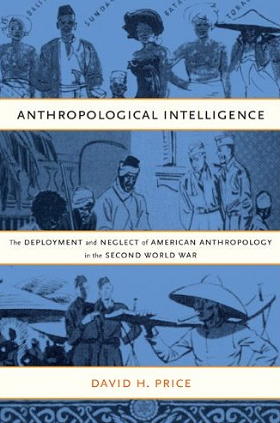
cover Approximately half of all anthropologists in the United States contributed their expertise to the World War II effort. In his new book Anthropological Intelligence: The Deployment and Neglect of American Anthropology in the Second World War, anthropologist David Price explores the wide range of roles they played through dozens of accounts profiling their work.

In a review in Anthropological Quarterly that today was published in Red Orbit, Roberto J Gonzalez writes:

Price’s work reveals that even in a “good war” like WWII, anthropologists often stood on ethically shaky ground when working for military and intelligence agencies, and some of them came to regret the long- term consequences of their participation.

In addition, the book reveals that the during the war, military officials had a tendency of “selectively ignoring and selectively commandeering social scientists’ recommendations” (p. 198). All too often, anthropologists had little impact on policy making and functioned as cogs in large bureaucracies with clearly established goals.

Anthropologists were involved in many doubtful projects. But only “few anthropologists had second thoughts about the ethics of applying anthropology to warfare” according to Price’s book.

The Office of War Information employed nearly a dozen anthropologists, who among other things designed propaganda custom made for Japanese audiences for the purpose of convincing them to surrender.

(…)

Still others were recruited into the Office of Strategic Services (established in 1942), a spy agency that was the precursor to the CIA. For example, Gregory Bateson carried out clandestine missions in South Asia; Carleton Coon used his anthropological knowledge to train assassins and kidnappers in North Africa

(…)

Among the most shocking sections is a description of “social engineers” such as Henry Field (p. 127). Field and several other anthropologists were deeply involved in the “M Project” initiated by President Roosevelt in 1942. The goal was to search the globe for regions where millions of wartime refugees could be resettled.

Declassified documents reveal that “library bound bureaucrats [were] designing contingency plans to move tens of millions of people thousands of miles away from their native lands. Field and his staff appear[ed] comfortable planning to move inventoried people about the globe like fungible commodities” (p. 126).

Even more disconcerting is that fact that “in almost every case, the peoples identified for relocation were victims of the aggression of others (e.g., the Roma, Jews, etc.), as if the reward of being victimized was being moved so that the aggressor could live in peace” (p. 127).

Price concludes that anthropologists’ efforts might have helped defeat the forces of fascism. But at the same time, they unleashed other forces that could potentially be used for harm.

Gonzales has written a quite enthusiastic review. Price’s book is an “extraordinarily powerful and well-informed critique of wartime anthropology for the military”, he writes.

When I’m not very comfortable with the review, it’s because of the connections between the two anthropologists. Gonzales and Price are among the founding members of the Network of Concerned Anthropologists and have written several texts together, i.e. When Anthropologists Become Counter-Insurgents

>> read the whole review

There is also a short review in The Olympian

David Price seems to be a fan of open access anthropology. He has put online lots of articles, including about World War I & II and Anthropology

SEE ALSO:

Cooperation between the Pentagon and anthropologists a fiasco?

More and more anthropologists are recruited to service military operations

The dangerous militarisation of anthropology

Anthropology and CIA: “We need more awareness of the political nature and uses of our work”

Protests against British research council: “Recruits anthropologists for spying on muslims”

American Anthropologists Stand Up Against Torture and the Occupation of Iraq

cover

Approximately half of all anthropologists in the United States contributed their expertise to the World War II effort. In his new book Anthropological Intelligence: The Deployment and Neglect of American Anthropology in the Second World War, anthropologist David Price explores…

Read more

Fieldwork reveals how slot machines are exploiting people

In November, a referendum on the legalizing of slot machines in Maryland will be held. In the Washington Post, anthropologist Natasha Dow Schüll tells us how slot machines are exploiting people.

Natasha Dow Schüll has been on fieldwork in Las Vegas among gamblers and the designers of the slot machines. Her book Machine Life: Control and Compulsion in Las Vegas will be published by Princeton University Press in early 2009.

Her research, she writes has been “focused on a dramatic turn that has taken place in recent decades from social forms of gambling played at tables to asocial forms played alone at video terminals”. The machines are designed to exploit aspects of human psychology:

Without the presence of social elements such as other players or a live dealer, they are able to exit the world and enter a state where everything fades away. (…) Players enter what’s known as the “machine zone,” where even winning stops mattering; in fact, it can be unwelcome because it interrupts the flow of play. Such players only stop when their credits are consumed.

She concludes:

What revenue slot machines do generate comes not from entertaining but exploiting people. Should the government, whose role is to protect its citizens, become a partner in this ethically dubious enterprise?

>> read the whole story in the Washington Post

To Salon.com she says that the industry has successfully defined the terms of gambling addiction: It’s telling that we speak about problem gamblers, but not problem machines, problem environments, or problem business practices.

The anthropologist has put three papers on her Las Vegas research online (pdf):

Digital Gaming: The Coincidence of Desire and Design

Machines, Medication, Modulation: Circuits of Dependency and Self-Care in Las Vegas

Oasis/Mirage: Fantasies of Nature in Las Vegas

In November, a referendum on the legalizing of slot machines in Maryland will be held. In the Washington Post, anthropologist Natasha Dow Schüll tells us how slot machines are exploiting people.

Natasha Dow Schüll has been on fieldwork in Las…

Read more