search expand

Ethnographic study: Social network sites are “virtual campfires”

cover

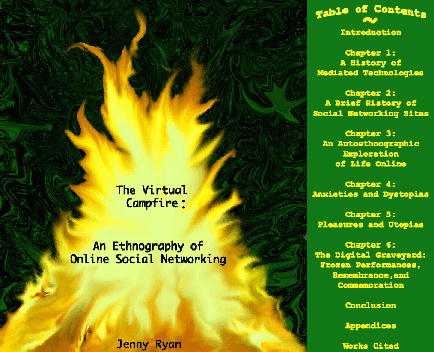
After five years participant observation, anthropologist Jenny Ryan has published her masters’ thesis about the social network sites Facebook, My Space and Tribe.net. She created a beautiful web version of her thesis at http://www.thevirtualcampfire.org/

In her thesis, she proposes that everyday involvement with these sites can be metaphorically represented as a “virtual campfire” that “bridges the gap between the place of the hearth and the space of the cosmos, potentially reversing what has been called “the disintegration of the public sphere” (Habermas 1962: 175).

She explains in her introduction:

Thousands of years ago, our early human ancestors gathered around campfires, creating communal hearths of warmth and light. There they might tell stories, converse about the day’s events, perhaps engage in shamanistic rituals involving plants, music and dance, or simply gaze silently at the flames in collective meditation.

Today, the fireplace in my family’s living room shares its centralizing power with the television, around which we gather with our laptops and cellphones by our sides. Our time spent together is increasingly mediated by new technologies, enabling new forms of storytelling, altering our processes of individual and collective identity formation, and extending the possibilities for creating and maintaining social relationships.

(…)

My central argument in this thesis is that online social networks can potentially serve as both places of the hearth and avenues to the cosmos. Over time, these sites function as personal records of one’s experiences and relationships. These archives are made up of a variety of forms akin to older modes of record keeping, such as address books, journals, diaries, photo albums, personal correspondences, and yearbooks.

Additionally, they serve as gateways to the greater milieu, enabling the circulation of information about the world and granting members the capacity to participate in various ways. For teenagers and marginalized groups, in particular, these sites can be safe spaces for exploring and experimenting with identity, as well as for connecting to new people and ideas.

Ryan plans to add interactive features to the website version of her thesis, maybe she’ll turn it into a wiki, she writes in her blog.

>> visit The Virtual Campfire

>> Jenny Ryan’s bog

SEE ALSO:

Cyberanthropology: “Second Life is their only chance to participate in religious rituals”

The Birth of a Cyberethnographer: The MU5 is to Blame

Interview with Michael Wesch: How collaborative technologies change scholarship

Why anthropologists blog: Blogs more interesting than journals?

Another way of doing fieldwork: Developing websites with your informants!

Ethnographic research on Friendster’s online communities

How internet changes the life among the First Nations in Canada

Ethnographic Study About Life Without Internet: Feelings of Loss and Frustration

The Internet Gift Culture

cover

After five years participant observation, anthropologist Jenny Ryan has published her masters' thesis about the social network sites Facebook, My Space and Tribe.net. She created a beautiful web version of her thesis at http://www.thevirtualcampfire.org/

In her thesis, she proposes that everyday…

Read more

Anthropology blogs more interesting than journals?

Have anthropology journals ignored students? Is this one of the reasons for the popularity of anthropology blogs? Anthropology journals are not well known among students, Owen Wiltshire writes in his class assignment Why do anthropologists blog? A mini ethnography, a story, and a field report:

A restrictive publishing environment gives little voice to students. Not only that, but anthropology journals have ignored students and perhaps in doing this they have missed out on generating a name for themselves. As more and more material becomes freely available online, it becomes a matter of knowing where to look – and my small survey of students revealed that journals are not well known.
(…)
My small survey revealed that students had a hard time identifying a prestigious journal in their field, and the survey from Savage Minds shows that graduate students make up a large percentage of the readership. In my exploration of blogs I found a number of graduate students writing them. So perhaps the limited distribution of academic publishing contributes to the desirability of the blogsphere.

Owen Wiltshire found much “interesting thought” in the blogosphere and wonders if journal publications would only serve for the purposes of gaining prestige: “Everything is being said in conversations elsewhere, but is ‘proved’ in journals”.

In his text, he discusses several reasons for why anthropologists blog – or do not blog. Among other things he talked to several anthropologists who wish there was more room for new ways of writing anthropology.

Several students don’t want to share their thoughts online because they fear of having ideas “stolen”:

Another anthropology professor discussed the way societies he had studied were hierarchical, depending on secrecy and not necessarily the democratic exchange of knowledge – but as my interviews revealed many students worry that ideas can be stolen, and this is perhaps another reason people might have to not blog. Anthropologists in this sense are a hierarchical organization too, and secrecy is indeed a reason many do not feel comfortable sharing or discussing their ideas.

Here is his prelimarlary summary:

Why do Anthropologists Blog?

  • Public engagement – feedback from beyond the discipline
  • Less formal – much broader range of style, more complex ways of manipulating knowledge
    (video, text, dynamic content)
  • Community, feedback. Enjoy discussing ideas with others.
  • Prestige – great place to get known, at least by other anthro bloggers
  • Younger generation growing up with online publishing – not worried about privacy as much
  • Perhaps an escape from work/professionalism when reflecting on anthropological ideas

Why Don’t Anthropologists Blog?

  • Fear that their work isn’t good enough
  • Do not want to have their name associated with it
  • Generally not part of internet culture – accessibility
  • Lack of time – anthropology is a professional topic – there aren’t many “amateur
    anthropologists” – although this is one thing many bloggers want to change
  • Fear of having ideas stolen – desire to “own” ideas.
  • Prefer traditional publishing mediums – books
  • Desire for more filtered knowledge
  • Desire to maintain privacy outside of work

Wiltshire explored this issue by participation in the blogosphere through his own blog, and reading and writing on numerous other anthropology blogs. He also discussed blogging, sharing information, and public engagement with a focus group of six students, and multiple interviews with students and one professor – all at Concordia University.

>> read the whole text on Wiltshire’s blog

>> Follow-up post: forced vs free writing: “Students ignore journals, just as much as journals ignore students”

Related issues are discussed by Erkan Saka in an e-seminar at the EASA Media Anthropology Network 19 May – 1 June 2008. “Blogging as a research tool for ethnographic fieldwork”.

SEE ALSO:

Plans to study anthropological online communities and Open Access movement

Interview with Michael Wesch: How collaborative technologies change scholarship

antropologi.info survey: Six anthropologists on Anthropology and Internet

Paper by Erkan Saka: Blogging as a Research Tool for Ethnographic Fieldwork

On fieldwork: “Blogging sharpens the attention”

Blogging and Public Anthropology: When free speech costs a career

Danah Boyd on Open Access: “Boycott locked-down journals”

Success in publishing defined by quality? Anthropology Matters on “The Politics of Publishing”

Have anthropology journals ignored students? Is this one of the reasons for the popularity of anthropology blogs? Anthropology journals are not well known among students, Owen Wiltshire writes in his class assignment Why do anthropologists blog? A mini ethnography,…

Read more

Lila Abu Lughod: “In Israel and Palestine we have an amazing opportunity”

cover

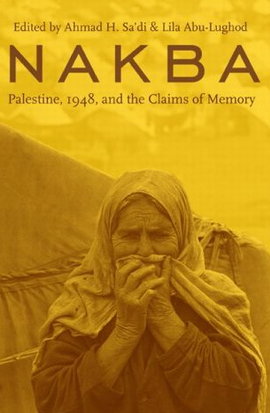
(via CultureMatters) While Israelis celebrate the 60th anniversary of their state’s founding, Palestinians around the world are mourning the “Nakba” – or “catastrophe” – that drove so many into exile. SPIEGEL ONLINE interviewed anthropologist Lila Abu-Lughod on the Nakba and today’s Palestine.

Together with Ahmad Sa’di, she published the book “Nakba: Palestine, 1948, and the Claims of Memory”. Abu-Lughod’s father was Palestinian.

“I don’t see the anniversary as a time of mourning but as an occasion for trying to get the world to listen to what really happened and to think about how this should shape our vision of a solution”, she says:

Palestinians and Israelis are tightly entangled. Any resolution must involve a recognition of the fact that Israel was founded on the expulsion of Palestinians. Then we can think and talk together about restitution, redress, compensation, or whatever it takes for a more just way forward. In Israel and Palestine we have an amazing opportunity — to think about changing history by considering a democratic state with a living future for everyone.

The number of those who actually lived through the Nakba decreases every year. The Nakba commemoration has spurred storytelling, the anthropologist says:

Dr. Rosemary Sayigh, who has been interviewing Palestinians about their experiences for decades, describes her work as a race against time. But Diana Allan, an anthropologist from Harvard who has been videotaping old men and women in the refugee camps all over Lebanon to create a Nakba Archive, would be the first to insist that though it is important to get these stories, it should not distract us from the contemporary problems Palestinians face, in Lebanon and elsewhere.

I have been following with interest, though, the way this particular Nakba commemoration has galvanized people and spurred storytelling: a good example is the series of “untold stories” on the Web site of the Institute for Middle East Understanding.

>> read the whole interview in SPIEGEL ONLINE

For information on her book on Nakba, see the Columbia University Press blog, The Institute for Middle East Understanding, This Week in Palestine and the review on H-Net.

SEE ALSO:

Lila Abu-Lughod: It’s time to give up the Western obsession with veiled Muslim women

New book by Lila Abu-Lughod: The Politics of Television in Egypt

Interview with Lila Abu-Lughod on women and Islam in the wake of the American war in Afghanistan (Asiasource)

Anthropologists on the Israel-Lebanon conflict

“Voices”: Anthropologist publishes e-book about Palestinian women

cover

(via CultureMatters) While Israelis celebrate the 60th anniversary of their state's founding, Palestinians around the world are mourning the "Nakba" - or "catastrophe" - that drove so many into exile. SPIEGEL ONLINE interviewed anthropologist Lila Abu-Lughod on the Nakba and…

Read more

"Dreamtime" no longer an acceptable term

cover

The West Australian and South Australian education departments have made lists of appropriate and inappropriate words to describe Aboriginal people and culture, The Australian reports.

Dreamtime is no longer an acceptable term to describe the collection of Aboriginal creation stories, and should be referred to as The Dreaming or The Dreamings.

– The structure of traditional Aboriginal society should not be described as primitive – but as complex and diverse

– The term native should be replaced by indigenous groups or language groups.

– Instead of saying myths and legends, teachers should say Dreaming stories, teaching from The Dreaming or creation stories.

– Aborigine should not be replaced by the term Aboriginal person.

Rituals should be called ceremonies

religion should be avoided in favour of spirituality

tribal should be shunned for traditional.

tribe should be replaced by Aboriginal people,

horde should be replaced by language groups

– instead of clan the term family groups should be used

The list of terms was developed with input from a wide variety of sources, including departmental staff, Aboriginal organisations and academics.

>> read the whole story in The Australian

>> Download “Aboriginal Education for all Learners in South Australia” including the section on sensitive terms and issues (pdf)

SEE ALSO:

Anthropologists condemn the use of terms of “stone age” and “primitive”

cover

The West Australian and South Australian education departments have made lists of appropriate and inappropriate words to describe Aboriginal people and culture, The Australian reports.

- Dreamtime is no longer an acceptable term to describe the collection of Aboriginal creation stories,…

Read more

The resurgence of African anthropology

cover

What is the state of anthropology at African universities? African anthropology is interdisciplinary and focuses on solving problems like poverty, diseases and violence, Paul Nchoji Nkwi writes in the book World Anthropologies (download the book):

The West invented anthropology to study the “Other” and it defined the canons. But in developing economies, where resources are scarce, science has to be either useful or be gone.

In his very interesting text that is available online (Word-document), he describes the recent developments of our discipline in Africa and calls for a better cooperation between anthropologists in Africa with anthropologists in other parts of the world:

The European and American traditions of the discipline are distinct and the discipline surely deserves an African twist as well. It is time for the social sciences, including anthropology, across Africa to regroup and to face the challenges that confront us as a continent and as part of the human family: Disease, hunger, HIV/AIDS, ethnic wars, poverty … We need to look for answers to these scourges. It will be salutary for Africans to bring their own particular perspectives to all the social sciences, including anthropology

It is the applied option that dominates anthropology in Africa. Applied anthropology as the focus of academic work rehabilitated the discipline that has been discredited in post-colonial Africa because of its history as the handmaiden of colonialism:

African anthropologists grew up in societies that were either colonized or recently decolonized. Westerners initially controlled the production of anthropological knowledge and the result was functionalist studies. These studies were explicitly ahistorical and often myopic about colonialism. After the colonial period, the new nations of Africa dismissed anthropology both as a cultivation of primitivism and as an apologetic for colonialism.

Throughout the 1960s and 1970s African and Africanist anthropologists found it difficult to practice their profession openly, Paul Nchoji Nkwi writes. Anthropology took cover within African Studies programs, or anthropology institutes disappeared into sociology departments.

Some African anthropologists like Kwesi Prah (papers), Godwin Nukunya, Harris Memel-Fotê and Théophile Obenga, remained in Africa, while others like Adam Kuper, John Comaroff and Brian du Toit, Archie Mafeje, and Maxwell Owusu, left their countries “in search of more conducive environments”.

But by the 1980s, there was more and more demand for anthropological knowledge – mainly regarding development projects. Many projects had failed due to their top-down approach. A perspective from below was needed – an anthropological perspective. Also, a shift from hospital-centered to people-centered health care gave medical anthropologists a window of opportunity.

In 1987, the Pan African Anthropological Association (PAAA) was established. This was another event in the late 1980s and early 1990s that helped integrate anthropology into the discourse of development in Africa.

Anthropology, Paul Nchoji Nkwi writes, had to rediscover itself as a discipline that could help to solve problems:

During the first PAAA conference in 1989, many participants argued that addressing important human issues, such as the need for health care, the spread of famine, rapid population growth, environmental degradation, discrimination and violence against women, poverty, and ethnic violence would enhance the discipline’s tarnished image.
(…)
Since 1989, the PAAA has organized twelve annual conferences and a series of training workshops for junior anthropologists. The association has also worked hard to bring the discipline closer to other social sciences. The future of anthropology depends, we feel, on how well the discipline integrates with the other social sciences. For anthropology to attract funds it must take on, and bring a unique perspective to, research problems that are common to other social sciences.
(…)
Over the years, African anthropologists have worked closely with environmental biologists, organic chemists, economists, demographers, health providers, and others. This experience showed that multi-disciplinary work is mutually enriching since each discipline draws on its unique insights to attain a common goal.

At the University of Yaoundé, there were 525 students majoring in anthropology in the 2002-2003 academic year, the same number of students took it as their minor. Paul Nchoji Nkwi witnessed an “increased involvement of the social sciences in health, agriculture, animal, environmental, and population research programs funded by the government”:

Targeting critical areas such as general health, reproductive health, population growth, the environment, and agricultural development led to the design of courses in medical anthropology, development anthropology, and environmental impact assessment. Today, the University of Yaoundé-I has one of the most active and dynamic departments of anthropology in Central Africa, attracting students from the entire region.

African anthropologists want opportunities to work and earn their way – in partnership with their colleagues all over the world, he stresses:

To bring this about requires a series of small but doable changes in the formal academic training programs, grant administration procedures, and grant requirements to promote better partnership arrangements.
(…)
Strengthening the ability of Africans to organize and develop their own professional associations is a way to address all of these issues at once. Truly professional associations will link Northern and African anthropologists in a single intellectual, publishing, and teaching endeavor on a more equal footing.

>> read the whole text “Anthropology in a Post-Colonial Africa – The Survival Debate” by Paul Nchoji Nkwi (Word-document)

SOME LINKS RELATED TO AFRICAN ANTHROPOLOGY:

Pan African Anthropological Association (PAAA) (no updates since 2005!)

African Anthropologist (Journal of the Pan African Anthropological Association)

Etho-Net Africa (the new website of this network is no longer available)

African e-Journals Project

Nordic Journal of African Studies

African Studies Quarterly

African Journal on Conflict Resolution

JENdA: A Journal of Culture and African Women Studies

Afrikanistik online

Africa Writes

SEE ALSO:

How can we create a more plural anthropological community?

Book and papers online: Working towards a global community of anthropologists

cover

What is the state of anthropology at African universities? African anthropology is interdisciplinary and focuses on solving problems like poverty, diseases and violence, Paul Nchoji Nkwi writes in the book World Anthropologies (download the book):

The West invented anthropology to…

Read more