
search expand

Wear red shirts on friday – Anthropologists on the protests in Burma?

burma-demonstration

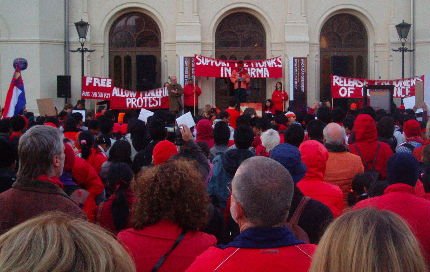
Wear red for Burma: Several thousand people at the demonstration in Oslo

“Wear a red t-shirt in solidarity this friday!” “Light candles in your windows on Friday night to honour the victims of the demostrations.” Pro-democracy protest marches in Burma have entered the tenth day. Burmese soldiers have detained about 200 Buddhist monks and fired shots as they attempt to disperse thousands of anti-government protesters in Rangoon.

Any comments by anthropologists on the situation in Burma? By now I’ve found two three four:

Monique Skidmore, medical anthropologist in The College of Arts & Social Sciences at the Australian National University (ANU) has been conducting research in Burma since 1994.

red shirt for burma

In the Australian online magazine Crikey she explains, that the the current protests stretch its roots stretch back to 1962 “when the Burmese armed forces, led by General Ne Win, usurped power from Burma’s democratically elected government of Prime Minister U Nu. General Ne Win ruled the country by fear, informers, propaganda and isolation. A civil war has waged since then, with estimates of the loss of life at up to 10,000 each year.”

Today’s street protests are furthermore “the culmination of a campaign for democracy being coordinated by the ’88 Student Generation, the activist movement in exile, the labor movement (embodied by Su Su Nway, now in hiding), monks, and the National League for Democracy.”

Coordination is difficult given that most mobile phones are illegal as well as use of the internet, she writes: “Burma’s first blog appeared last week showing the first day of the monk protest in Rangoon. It only took the military regime 24 hours to shut it down.”

>> Monique Skidmore: The Burmese people have had enough

Sometimes Burma is also called Myanmar. Myanmar is actually the official name, the BBC explains: The ruling military junta changed its name from Burma to Myanmar in 1989, a year after thousands were killed in the suppression of a popular uprising. Rangoon also became Yangon.

The name change is a form of censorship, says anthropologist and editor of Anthropology Today Gustaaf Houtman in the BBC article Should it be Burma or Myanmar?

Houtman has written a book that is available online (free) called Mental Culture in Burmese Crisis Politics. Aung San Suu Kyi and the National League for Democracy. It is also available on Google Books. Read also an interview with Houtman on The Culture of Burmese Politics.

update: In the New York Times story Karma Power: What Makes a Monk Mad anthropology professor Ingrid Jordt contributes with some orientalitic statements when she explains that the monks’ power comes from their role in bestowing legitimacy on the rulers:

“Legitimacy in Burma is not about regime performance, it’s not about human rights like the West. It is something that comes from the potency and karma bestowed by the monks. That’s why the sangha is so important to the government,” she said, referring to the Buddhist hierarchy and the spiritual status that its monks can convey. “They are actually the source of power.”

free burma

UPDATE: Anthropologist Gabriele Marranci tells a story that the mass media neglects to inform us: Muslims in Burma are persecuted, not only by the military, even by the ‘peaceful’ monks: >> Gabriele Marranci: The other, invisible suffering of Burma

FOR MORE INFORMATION ON THE SITUATION IN BURMA SEE:

BBC News Special Reports: Burma Protest

Wikipedia: 2007 Burmese anti-government protests

Global Voices: Burmese bloggers on Burma

BBC News also has a story about how Burma cyber-dissidents crack censorship and tell the world what is happening under the military junta’s veil of secrecy.

See also on Facebook Support the Monks’ protest in Burma and Red Shirt For Burma

For non facebook users more on the red shirt campaign see on these blogs at Livejournal, Dynamic Nonvilence, Sungame and in the Phuket Gazette: Red-shirt-Friday campaign sweeps Phuket and Norwegian trade union leader backs call to “wear red”

To those who think this might be a pointless or even stupid campaign I’ve found this comment in a facebook group:

Nobody thinks wearing a red shirt is gonna change the situation. Did you actually think so? Now THAT is really stupid.

Nobody really thought demonstrating against the Iraq war in Oslo, where I live, or any other place in the world would for that matter, would make Bush change his mind either. Point is, we still did it, it’s the biggest demonstration in Norwegian history.

What’s wrong with gathering the world? What’s wrong with trying to spread the word to everybody? What’s wrong with showing that you care, and that you are aware of the situation and have a statement, even though it doesn’t necessarily make a practical change? Negativity of that kind is what really is stupid.

UPDATE

Monks prosecute muslims? Free Burma International Bloggers’ Day 4.10.2007

burma-demonstration

Wear red for Burma: Several thousand people at the demonstration in Oslo

"Wear a red t-shirt in solidarity this friday!" "Light candles in your windows on Friday night to honour the victims of the demostrations." Pro-democracy protest marches in Burma…

Read more

Society for Ethnomusicology condemns use of music in torture

(via Savage Minds) Can a discussion about the use of music in torture shed new perspectives in our debates about the use of anthropological knowledge in torture, askes Kerim Friedman on Savage Minds. Jason Baird Jackson points in his comment to the Society for Ethnomusicology’s position statement on the use of music in torture:

The Society for Ethnomusicology condemns the use of torture in any form. An international scholarly society founded in 1955, the Society for Ethnomusicology (SEM) and its members are devoted to the research, study, and performance of music in all historical periods and cultural contexts. The SEM is committed to the ethical uses of music to further human understanding and to uphold the highest standards of human rights.

The Society is equally committed to drawing critical attention to the abuse of such standards through the unethical uses of music to harm individuals and the societies in which they live. The U.S. government and its military and diplomatic agencies has used music as an instrument of abuse since 2001, particularly through the implementation of programs of torture in both covert and overt detention centers as part of the war on terror.

The Society for Ethnomusicology

* calls for full disclosure of U.S. government-sanctioned and funded programs that design the means of delivering music as torture;
* condemns the use of music as an instrument of torture; and
* demands that the United States government and its agencies cease using music as an instrument of physical and psychological torture.

There’s also a link to the paper by by Suzanne Cusick: “Music as Torture, Music as Weapon”, published in Revista Transcultural de Música/Transcultural Music Review 10 (2006) that starts with these lines:

This paper is a first attempt to understand the military and cultural logics on which the contemporary use of music as a weapon in torture and war is based. After briefly tracing the development of acoustic weapons in the late 20th century, and their deployment at the second battle of Falluja in November, 2004, I summarize what can be known about the theory and practice of using music to torture detainees in Afghanistan, Iraq and Guantanamo. I contemplate some aspects of late 20th-century musical culture in the civilian US that resonate with the US security community’s conception of music as a weapon, and survey the way musical torture is discussed in the virtual world known as the blogosphere. Finally, I sketch some questions for further research and analysis.

>> Savage Minds: Rage against the machine and music in torture

>> The Society for Ethnomusicology’s position statement on the use of music in torture

>> Suzanne G. Cusick: Music as torture / Music as weapon

SEE ALSO:

American Anthropologists Stand Up Against Torture and the Occupation of Iraq

Anthropology and CIA: “We need more awareness of the political nature and uses of our work”

The dangerous militarisation of anthropology

(via Savage Minds) Can a discussion about the use of music in torture shed new perspectives in our debates about the use of anthropological knowledge in torture, askes Kerim Friedman on Savage Minds. Jason Baird Jackson points in his…

Read more

Anthropology and CIA: “We need more awareness of the political nature and uses of our work”

In the newest issue of Anthropology Today (to be published in October), David Price continues discussing how CIA and similar agencies “covertly set our research agendas and selectively harvest the resulting research” and writes that “sometimes we may need to follow Delmos Jones’ Vietnam War-era example of withholding materials from publication when there is a risk of abuse by military and intelligence agencies:

Given the abuse of power we have already witnessed and the uncertain future we face in relation to the security state that perpetrated this, how far should we permit our professional involvement to go in this matter? We need more awareness of the political nature and uses of our work. As long as we publish in the public arena, anyone can use our findings for ends we may not approve. But we also analyse and advocate on the basis of data we collect, and have a degree of control over our own interpretations. Though secrecy may limit our knowledge of how our research is deployed by the security state, we must continue to expose and publicize known instances of abuse or neglect of our work.

Price’s text “Buying a piece of anthropology. The CIA and our tortured past” is the second part of a two-part article examining how research on stress under Human Ecology Fund sponsorship found its way into the CIA’s Kubark interrogation manual. Abuse of detainees at Guantánamo Bay, in Afghanistan and Iraq, and in the CIA’s network of secret ‘rendition’ prisons involves tweaking techniques described in Kubark:

As I have argued here, new information has become available that shows how anthropological knowledge has been applied to devising coercive interrogation techniques in the past. Also, we now know that Tony Lagouranis, who joined Abu Ghraib as an interrogator after the torture scandal broke, has described how Patai’s The Arab mind was abused by military personnel attempting to help interrogators dehumanize Arab enemies (Lagouranis and Mikaelian 2007). We must take this backdrop to the involvement of our discipline into account if we are not to become complicit.

(…)

Those who lead calls for social scientists to design improved interrogation methods (see ISB, Gross 2007) claim to do so in order to move away from torture towards a more humane interrogation, but they fail to acknowledge the irony that those they hail as pioneers of scientific interrogation were key CIA MK-Ultra-funded scientists who unethically commissioned and mined research for this purpose (Shane 2007). As a discipline we cannot afford to condone torture; were we to allow our work to be used for such ends we should become ‘specialists without spirit, sensualists without hearts’ (Weber 1904: 182).

Among other things, Kubark discussed the importance of interrogators learning to read the body language of interrogation subjects. The HEF funded the research by anthropologist Edward Hall on this issue, David Price writes. Several pages of Kubark describe how to read subject’s body language with tips such as:

It is also helpful to watch the subject’s mouth, which is as a rule much more revealing than his eyes. Gestures and postures also tell a story. If a subject normally gesticulates broadly at times and is at other times physically relaxed but at some point sits stiffly motionless, his posture is likely to be the physical image of his mental tension. The interrogator should make a mental note of the topic that caused such a reaction. (CIA 1963b: 55)

In 1977, after public revelations of the CIA’s role in directing HEF research projects, Edward Hall discussed his unwitting receipt of CIA funds through the HEF to support his writing of The hidden dimension (Hall 1966):

Hall conceded that his studies of body language would have been useful for the CIA’s goals, ‘because the whole thing is designed to begin to teach people to understand, to read other people’s behavior. What little I know about the [CIA], I wouldn’t want to have much to do with it’ (Greenfield 1977: 11).10 But Hall’s work, like that of others, entered Human Ecology’s knowledge base, which was selectively drawn upon for Kubark.

However, it does not take CIA funding for anthropologists to produce research consumed by military and intelligence agencies, Price stresses:

During the 1993 American military actions in Somalia I read a news article mentioning an ethnographic map issued by the CIA to Army Rangers. Because of my interest in ethnographic mapping, I wrote to the CIA’s cartographic section requesting a copy of this map. A CIA staff member responded to my query, informing me that no such map was available to the public. This CIA employee also politely acknowledged that she was familiar with a book I had published while a graduate student that mapped the geographical location of about 3000 cultural groups (Price 1989).

Given the CIA’s historic role in undermining democratic movements around the world, I was disheartened that they were using my work, but I should not have been surprised. Obviously nothing we publish is safe from being (ab)used by others for purposes we may not intend.

For more texts by David Price on anthropology and CIA, se his homepage

SEE ALSO:

Oppose participation in counter-insurgency! Network of Concerned Anthropologists launched

The dangerous militarisation of anthropology

Laura McNamara: Cultural Dynamics in Interrogation: The FBI At Guantanamo (Savage Minds)

Protests against British research council: “Recruits anthropologists for spying on muslims”

More and more anthropologists are recruited to service military operations

“Tribal Iraq Society” – Anthropologists engaged for US war in Iraq

San Jose: American Anthropologists Stand Up Against Torture and the Occupation of Iraq and AAA Press Release: Anthropologists weigh in on Iraq, torture at annual meeting

In the newest issue of Anthropology Today (to be published in October), David Price continues discussing how CIA and similar agencies "covertly set our research agendas and selectively harvest the resulting research" and writes that "sometimes we may need to…

Read more

Oppose participation in counter-insurgency! Network of Concerned Anthropologists launched

(via Savage Minds) As a response to the growing militarisation of anthropology, a group of anthropologists (incl. David Price, Gustaaf Houtman and Kanhong Lin) has lauched the Network of Concerned Anthropologists: They encourage the development of an ethical anthropology and to oppose anthropologists’ participation in counter-insurgency.

In an email they ask us to sign a petition and spread the word.

The Department of Defense and allied agencies are mobilizing anthropologists for interventions in the Middle East and beyond. It is likely that larger, more permanent initiatives are in the works.

Over the last several weeks, we have created an ad hoc group, the Network of Concerned Anthropologists, with the objective of promoting an ethical anthropology. Working together, we have drafted a pledge of non-participation in counter-insurgency, which we have organized as a petition (see attachment). We invite you to become a part of this effort by taking the following steps:

1. Download and print the attached pledge (in .pdf format). Ask your colleagues to sign the pledge, and promptly send it to us via regular mail. Our address is Network of Concerned Anthropologists, c/o Dept. of Anthropology, George Mason University, 4400 University Drive, MS 3G5, Fairfax, VA 22030 (USA). If it is more convenient, email a .pdf copy of collected signatures and send it to us at concerned.anthropologists (AT) gmail.com.

2. Forward this message to your colleagues, and encourage them to sign.

3. Join our network by emailing us at concerned.anthropologists (AT) gmail.com. Be sure to include your name, title, and affiliation. We will add you to our email list.

4. Visit our web site at http://concerned.anthropologists.googlepages.com/home for more information and updates.

SEE ALSO:

The dangerous militarisation of anthropology

Protests against British research council: “Recruits anthropologists for spying on muslims”

More and more anthropologists are recruited to service military operations

“Tribal Iraq Society” – Anthropologists engaged for US war in Iraq

San Jose: American Anthropologists Stand Up Against Torture and the Occupation of Iraq and AAA Press Release: Anthropologists weigh in on Iraq, torture at annual meeting

“War on terror”: CIA sponsers anthropologists to gather sensitive information / see also debate on this on Savage Minds

Anthropology and Counterinsurgency: The Strange Story of Their Curious Relations

Bush, “war of terror” and the erosion of free academic speech: Challenges for anthropology

Military anthropologist starts blogging about his experiences

(via Savage Minds) As a response to the growing militarisation of anthropology, a group of anthropologists (incl. David Price, Gustaaf Houtman and Kanhong Lin) has lauched the Network of Concerned Anthropologists: They encourage the development of an ethical anthropology and…

Read more

Connecting Art and Anthropology

What happens when artists and anthropologists are asked to do something together rather than talk from the safety of their own practice? The result can be seen on the website Connecting Art & Anthropology: Transcripts of discussions, short reports, a video and even a sound notebook based on the workshop! Read also Anne Galloway’s comments on this website/workshop.

Last year we had a similar event in Oslo, see Cosmoculture: Preferably more art than books!. Thomas Hylland Eriksen said: “The most important thing the Palestinian intellectual Edward Said did was to establish a Jewish-Arabic youth orchestra. This was more important than writing 100 books.”

What happens when artists and anthropologists are asked to do something together rather than talk from the safety of their own practice? The result can be seen on the website Connecting Art & Anthropology: Transcripts of discussions, short reports, a…

Read more