
search expand

Why were they doing this work just to give it away for free? Thesis on Ubuntu Linux hackers

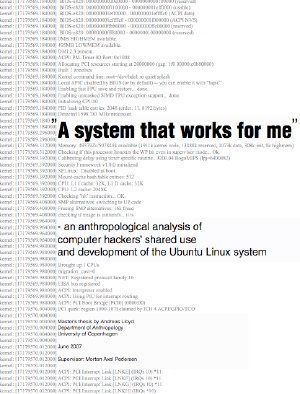
thesis-cover

It all started when anthropologist Andreas Lloyd (University of Copenhagen) was browsing on the Internet looking for a new laptop computer and ended up installing the free Windows alternative Linux. Two years later, he finished his master thesis “A system that works for me” – an anthropological analysis of computer hackers’ shared use and development of the Ubuntu Linux system.

The thesis is a study of the Internet Gift Economy. Linux is developped by computer geeks saround the world, collaborating over the Internet, building a computer operating system in their spare time, which can be downloaded, installed, used and modified completely for free. It is among the biggest and most complex engineering projects ever conceived and built:

Based on more than 2 years of daily use of the Ubuntu Linux system and 6 months of online and in-person fieldwork among the developers working to develop and maintain it, this thesis examines the individual and collaborative day-to-day practices of these developers as they relate to the computer operating system that is the result of their labour.
(…)
A group of Spanish computer scientists measured the size of a Linux system similar to Ubuntu, and found that it contained around 230 million lines of source code. When they translated this into the effort spent on writing this code using a standard software industry cost estimate model, they found that it would correspond to almost 60.000 man-years of work (Amor-Iglesias et. al. 2005). By comparison, it took an estimated 3.500 man-years to build the Empire State Building in New York, and 10.000 man-years to build the Panama Canal. This immense effort makes modern operating systems such as Ubuntu among the biggest and most complex engineering projects ever conceived and built.

So the anthropologist was curious to learn more about how the hackers collaborate to build such an intricate system, and to learn why they were doing all of this work just to give it away for free.

How do you do fieldwork among hackers around the world? He explains:

I joined the Ubuntu on-line community on the same terms as the Ubuntu hackers, contributing to and using the same system, sharing their experiences with the system, and meeting them in-person on the same terms as they do at the conferences at which they gather, experiencing the same social and technical means and limitations through which they develop the system.
(…)
In order to do participant observation in this on-line space, I began contributing to the system by writing the system help and documentation, rather than the system itself due to my lack of technical understanding. In this way, I could take part in shaping Ubuntu alongside other community members while slowly developing a feel for the everyday exchanges and work in the community.

His thesis is by the way neither dedicated to any girl friend nor his parents:

In the true digital spirit of this work, I dedicate this thesis to Rosinante, the laptop on which I first experienced the Ubuntu system, and which was my faithful companion during my fieldwork and the writing of this thesis, only to bow out a week before tsafe for so long.

>> download the thesis

(Links updated 11.1.17)

SEE ALSO:

The Internet Gift Culture

Open source movement is like things anthropologists have studied for a long time

Open Source Fieldwork! Show how you work!

Gift economies and open source software: Anthropological reflections

Why you always get a present you don’t want – Social Sciences and Gift-Giving

Mobile phone company Vodafone gets inspired by traditional Kula exchange system

Open Source Anthropology : Are anthropologists serious about sharing knowledge?

2006 – The Year of Open Access Anthropology?

thesis-cover

It all started when anthropologist Andreas Lloyd (University of Copenhagen) was browsing on the Internet looking for a new laptop computer and ended up installing the free Windows alternative Linux. Two years later, he finished his master thesis "A…

Read more

“Anthropology = Smarter Counterinsurgency”

Another article about military anthropologists: The Christian Science Monitor writes about anthropologist “Tracy” who helps the US Army in their war against Afghanistan. Tracy “can give only her first name” to the journalist:

Evidence of how far the US Army’s counterinsurgency strategy has evolved can be found in the work of a uniformed anthropologist toting a gun in the mountains of eastern Afghanistan. Part of a Human Terrain Team (HHT) – the first ever deployed – she speaks to hundreds of Afghan men and women to learn how they think and what they need.
(…)
Finding ways to challenge that fear – and learn what makes Afghans choose to support the government or its enemies – is the job of the HTT. The key ingredient is a “senior cultural analyst,” in this case, Tracy, the anthropologist in uniform.

She has interviewed hundreds of Afghan women and men, sometimes for hours on end, hearing how most are “so tired of war.” In nine months, Tracy has gained deep knowledge, she says, aimed at helping “fill the vacuum that the Taliban and other nefarious actors want to fill.”

Tracy tells Afghans that she wants to “enhance the military’s understanding of the culture so we don’t make mistakes like in Iraq.” But the bar is high, and this village with the medical clinic shows signs of militant influence, such as being “coached.”

Still, Tracy says that she sees real progress, “one Afghan at a time.” And the US military’s views are evolving accordingly, away from firepower to a smarter counterinsurgency.

“It may be one less trigger that has to be pulled here,” Tracy says of the result. “It’s how we gain ground, not tangible ground, but cognitive ground. Small things can have a big impact.

>> read the whole story in the Christian Science Monitor

SEE ALSO:

The dangerous militarisation of anthropology

“Tribal Iraq Society” – Anthropologists engaged for US war in Iraq

Military – social science roundtable: Anthropologists help mold counterinsurgency policy

Protests against British research council: “Recruits anthropologists for spying on muslims”

More and more anthropologists are recruited to service military operations

Military anthropologist starts blogging about his experiences

San Jose: American Anthropologists Stand Up Against Torture and the Occupation of Iraq and AAA Press Release: Anthropologists weigh in on Iraq, torture at annual meeting

“War on terror”: CIA sponsers anthropologists to gather sensitive information / see also debate on this on Savage Minds

Another article about military anthropologists: The Christian Science Monitor writes about anthropologist "Tracy" who helps the US Army in their war against Afghanistan. Tracy "can give only her first name" to the journalist:

Evidence of how far the US Army's…

Read more

Keith Hart and Thomas Hylland Eriksen: This is 21st century anthropology

(Links checked 8.9.2019) What holds humanity together? What are the hidden or unacknowledged features of mainstream society? These are the issues that 21st century anthropology should address, Thomas Hylland Eriksen writes in his paper The perilous identity politics of anthropology, Keynote lecture at the conference “21st century Anthropology” at the University of Oxford 28–29 June 2007.

“Obsessed with everything that divides humanity for a hundred years, anthropology could now be ready to return to the commonalities, that which holds humanity together”, the Norwegian anthropologist suggests.

And rather than studying down, we have to begin to study sideways and up. “The crowded field of minority studies”, he writes, “in no way matched by an equal interest in majority studies”:

A possible solution might consist in making a real effort to study the basic institutions of society – any society – essentially through ethnographic methods, in the same way as we should – again – begin to address the central intellectual questions of today, in the domains of development, democracy, rights, human nature and the environmental crisis. This is being done already, but in too modest a way to make an impact proper. (…) Anthropological studies of everyday life in a modern society, municipal politics, diplomacies, government corporations, schools, hospitals and even military academies exist, but most of them focus too much on culture and too little on the features of the social organisation, in its formal as well as informal aspects.
(…)
Anthropology should confidently locate its focus of enquiry to the centre of society, using ethnographic methods not so much to create wonderment and surprise, but to reveal hidden or unacknowledged features of mainstream society. In this way we would be able to generate knowledge which is not only truthful, but also relevant and – dare I say it – useful. (…) Just as our predecessors took on the central institutions in their small-scale societies, we should now do the same thing in large-scale societies.

>> read the whole paper “The perilous identity politics of anthropology” (Link updated)

Nearly at the same time, Keith Harth published his paper Toward a new human universal. Rethinking anthropology for the twenty-first century, a lecture he is going to hold at the Center for 21st century studies, University of Wisconsin-Milwaukee on the September 7th.

Keith Hart argues in a similar way. In his opinion, “the task of building a global civil society for the twenty-first century, even a world state, is an urgent one and anthropological visions should play their part in that”:

The solution to anthropology’s problems cannot be found in increased specialization, in the discovery of new areas of social life to colonize with the aid of old professional paradigms or in a return to literary scholarship disguised as a new dialogical form. It requires new patterns of social engagement extending beyond the universities to the widest reaches of world society.

This in turn requires us first, to acknowledge how people everywhere are pushing back the boundaries of the old society and second, to be open to universality, most versions of which have been driven underground by national capitalism and would be buried forever if the present corporate privatization of intellectual life is allowed to succeed.

(…)

So, given the precariousness of contemporary anthropology as an academic institution, the issue of its future needs to be couched in broader terms than those defined by the profession itself. (…) Rather I have sought inspiration in Kant’s philosophy and in the critique of unequal society that originates with Rousseau. ‘Anthropology’ would then mean whatever we need to know about humanity as a whole if we want to build a more equal world fit for everyone.

>> read the whole paper “Toward a new human universal. Rethinking anthropology for the twenty-first century” (link updated 19.7.12)

SEE ALSO:

More and more anthropologists, but they’re absent from public debates – “Engaging Anthropology” by Thomas Hylland Eriksen (1)

Interview: “Anthropology Is Badly Needed In Eastern Europe”

Working towards a global community of anthropologists

For an Anthropology of Cosmopolitanism

“Discuss politics!” – How anthropologists in Indonesia engage with the public

Get Out of the Library and Into the Streets – new book by David Graeber

“Anthropology needs to engage in an activist way”

The dangerous militarisation of anthropology

Protests at Yale: When Walmart’s management principles run an anthropology department

(Links checked 8.9.2019) What holds humanity together? What are the hidden or unacknowledged features of mainstream society? These are the issues that 21st century anthropology should address, Thomas Hylland Eriksen writes in his paper The perilous identity politics of anthropology,…

Read more

New website helps save Kenai Peoples language (Alaska)

Their language is nearly dead. Maybe a new website can revitalize Kahtnuht’ana Qenaga: The Kenai Peoples Language in Alaska? For more than two years, the two anthropologists Alan Boraas and Michael Christian have taken pictures, navigated through HTML and digitized old audio recordings of Native writer Peter Kalifornsky in order to present vocabulary, grammar, stories and place names in an interactive Web site that went live last month, the Peninsula Clarion reports.

“I hope people of all ages go to it and gain insights into both the language and the culture,” Boraas says. This project is the latest in the Kenaitze Indian Tribe‘s endeavor to revitalize their Native language. Finding people who actively speak the Dena’ina language is one of the most difficult parts of revitalizing it. The credit for much of the Dena’ina revitalization goes to James Kari, who spent 30 years working on a dictionary.

>> read the whole story in the Peninsula Clarion

>> visit the website Kahtnuht’ana Qenaga: The Kenai Peoples Language

SEE ALSO:

How to save Tibetan folk songs? Put them online!

Knowledge Fades As Africa Languages Die

Modern technology revives traditional languages

Saving native languages

Inuit language thrives in Greenland

Book review: Empires of the Word: A Language History of the World

Their language is nearly dead. Maybe a new website can revitalize Kahtnuht'ana Qenaga: The Kenai Peoples Language in Alaska? For more than two years, the two anthropologists Alan Boraas and Michael Christian have taken pictures, navigated through HTML and digitized…

Read more

John Postill on media anthropology and internet activism in Malaysia

Is Internet making any significant difference to the governance of an multiethnic middle-income suburb of Kuala Lumpur? Anthropologist John Postill has been on fieldwork there and sent me a working paper about his research Field theory and the political process black box: analysing Internet activism in a Kuala Lumpur suburb.

The suburb is renowned in Malaysian ICT policy circles for its rich diversity of ‘e-community’ initiatives – and it was the vibrant Internet scene that attracted Postill to the locality. In his paper he discusses several approaches within media anthropology:

In recent years Pierre Bourdieu’s field theory has received increased attention from sociologists, anthropologists, media scholars and others (Benson and Neveu 2005). (…) Yet instead of adopting Bourdieu’s field theory wholesale I concentrate on an area of field theory that is underdeveloped in Bourdieu but has an earlier history within political anthropology, namely the field-theoretical study of political processes such as social dramas undertaken by Victor Turner and other Manchester scholars.

>> read the whole paper

On his website, Postill has published lots of related papers.

SEE ALSO:

Now online: EASA-conference papers on media anthropology

How Media and Digital Technology Empower Indigenous Survival

Is Internet making any significant difference to the governance of an multiethnic middle-income suburb of Kuala Lumpur? Anthropologist John Postill has been on fieldwork there and sent me a working paper about his research Field theory and the political process…

Read more