search expand

Engaged research = Terrorism: Germany arrests social scientists

Germany arrested urban sociologist Andrej Holm because of his academic activities. He was accused of being member of a “terrorist association” called “militante gruppe” (militant group) who is suspected to be behind arson attacks against police and army vehicles.

Holm was arrested because his publications contain keywords and phrases, which are also used in the texts written by the Militante Gruppe (especially the term “gentrification”). The warrant also claims that Holm is intellectually capable of authoring the rather sophisticated texts of the militant groups, since he has a PhD in political science. This person is also said to be suspicious because »he works in a research institution and thus has access to libraries, which he can use inconspicuously for doing the research needed to produce the texts of the militant group«.

After lots of emails the protest against German authorities has become global. The American Sociology Association demands that the Federal Prosecutor immediately release Andrej Holm and the other imprisoned from jail at once:

We strongly reject the outrageous accusation that the academic research activities and the political engagement of Andrej Holm are to be viewed as complicity in an alleged “terrorist association”. No arrest warrant can be deduced from the academic research and political work of Andrej Holm. The Federal Prosecutor, through applying Article § 129a, is threatening the freedom of research and teaching as well as social-political engagement.«

Professor Jerome Krase from The City University of New York writes:

What is especially troubling to me as an Activist or Public Scholar is that Dr. Andrej Holm, Dr. Matthias B., Florian L., Oliver R. und Axel H. were investigated and arrested for the kind of activities that I and most other socially conscious social scientists routinely engage in.

Over the course of my career I have engaged in research and writing about Civil Rights for Nonwhite minorities, Affordable Housing, and most recently the rights of the newest immigrants in the United States and abroad.

If such work can so easily be presented as “potentially” (therefore actually) criminal then it must follow that critical academic activities of all sorts, including those that are only distantly related to political and social engagement can be horribly transformed, by the State, into crimes of subversion and terrorism.

I understand that we live in dangerous and difficult times but such menacing actions by those who are sworn to protect the rights of its citizens must be ever more cautious and reluctant to use its power to take those rights away and cast a chilling shadow across the scholarly community that historically has been a bastion against tyranny.

Academic Advisory Council, Attac Germany warns that “if this reasoning is accepted by society it will destroy the fundamentals of a critical public in a free society. If the reasoning is taken as evidence for the membership in a terrorist organization, critical science is put under general suspicion.”

The Open letter to the Generalbundesanwaltschaft (Federal Prosecutor) against the criminalization of critical academic research and political engagement has already been signed by many of the most known social scientists.

More information on the website http://einstellung.so36.net/en

SEE ALSO:

Richard Sennett and Saskia Sassen: The war on shapeless terror. There seems to be no rational basis for the arrest of a group of German sociologists, and the case highlights the fragility of our civil liberties (Comment is free, The Guardian, 20.8.07)

Pessimistic Views on Academic Freedom: A greater percentage of social scientists today feel that their academic freedom has been threatened than was the case during the McCarthy era (Inside Higher Education, 15.8.07 via Savage Minds)

RELATED EARLIER POSTS:

Bush, “war of terror” and the erosion of free academic speech: Challenges for anthropology

Blogging and Public Anthropology: When free speech costs a career

Fired from Yale, anarchist professor points to politics

USA: Censorship threatens fieldwork – A call for resistance

Engaged anthropologists beaten by the Mexican police

The dangerous militarisation of anthropology

Protests against British research council: “Recruits anthropologists for spying on muslims”

San Jose: American Anthropologists Stand Up Against Torture and the Occupation of Iraq

Get Out of the Library and Into the Streets – new book by David Graeber

Germany arrested urban sociologist Andrej Holm because of his academic activities. He was accused of being member of a "terrorist association" called "militante gruppe" (militant group) who is suspected to be behind arson attacks against police and army vehicles.…

Read more

Get Out of the Library and Into the Streets – new book by David Graeber

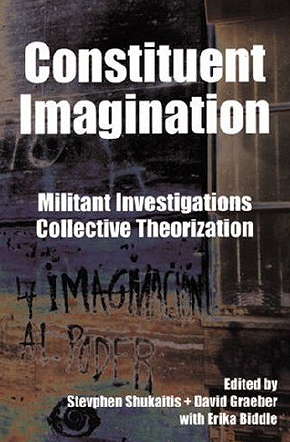
book cover

Popular anarchist anthropologist David Graeber is one of the editors of a new book on the relationship between academics and social action called Constituent Imagination: Militant Investigations, Collective Theorization:

According to libcom.org:

The book opens with the editors’ provocative history of the academy’s inherent limitations and possibilities. The essays that follow cover a broad range: embedded intellectuals in increasingly corporatized universities, research projects in which factory workers and academics work side by side, revolutionary ethnographies of the global justice movement, meditations on technology from the branches of a Scottish tree-sit. What links them all is a collective and expansive reimagining of engaged intellectual work in the service of social change. In a cultural climate in where right-wing watchdog groups seem to have radical academics on the run, this unapologetic anthology is a breath of fresh air.

As Matt Wasserman in The Indypendent claims, there are only few academics with ties to social movements – despite denouncements of “tenured radicals” by commentators on the right:

Plenty of academics write articles for obscure journals on transgression or “interrogate” race, gender and class, but almost none are found in the streets. This is the classic bargain of academia: you can think subversive thoughts as long as you don’t act upon them. Case in point: the firing of Constituent Imagination co-editor David Graeber from Yale University’s anthropology department.
(…)
The writers who contributed to Constituent Imagination want to tear down the barrier set up within the academy between theory and practice. In an occasionally jargon-ridden, often brilliant and generally provocative set of essays, they theorize and research about the globaljustice movement from within the movement.
(…)
The authors, rather than seeing their role as diagnosing the “objective” nature of the system and on this basis prescribing the correct strategy for social movements to follow, instead attempt to work out what it means to perform engaged intellectual work alongside, in service to and within social movements themselves.

>> read the whole review in The Indypendent

UPDATE: Parts of the book are available online at http://www.constituentimagination.net/

Graeber agrees in that there are “very few anarchist professors” but “a good number of grad students and a very large number of undergrads” according to an interview in The Ready Stock Book where he also explains what he thinks about anarchism. We also get to know that he is working on a history of the idea of debt and on a book developing an anarchist version of world-systems analysis with his friend Andrej Grubacic.

Graeber will by the way begin teaching at Goldsmiths College, University of London, in September 2007.

SEE ALSO:

David Graeber: There never was a West! Democracy as Interstitial Cosmopolitanism

Review of Graeber’s book: Fragments of an Anarchist Anthropology / download the whole book

Protests at Yale: When Walmart’s management principles run an anthropology department

“Discuss politics!” – How anthropologists in Indonesia engage with the public

More and more anthropologists, but they’re absent from public debates – “Engaging Anthropology” (1)

Too engaged anthropology? The Lumpenproletariat on the US-Mexican Border

Chronicles Women’s Social Movements in India

book cover

Popular anarchist anthropologist David Graeber is one of the editors of a new book on the relationship between academics and social action called Constituent Imagination: Militant Investigations, Collective Theorization:

According to libcom.org:

The book opens with the editors’ provocative history of the…

Read more

Now online: Third issue of “Ecological and Environmental Anthropology”

The third issue of Ecological and Environmental Anthropology, an open access peer-reviewed journal published by the University of Georgia is out and consists of four book reviews and two papers:

Keri Vacanti Brondo, Laura Woods:
Garifuna Land Rights and Ecotourism as Economic Development in Honduras’ Cayos Cochinos Marine Protected Area

David Driscoll, Afua Appiah-Yeboah, Philip Salib, Douglas J Rupert:
Merging Qualitative and Quantitative Data in Mixed Methods Research: How To and Why Not

As the editors write in their editorial (pdf):

The articles and book reviews in this issue underscore the crucial role that the field of anthropology can play in helping to identify the causes and the roots of environmental problems and global insecurities, and the impact of those insecurities on the human condition. Interdisciplinary perspectives offered by the growing fields of ecological and environmental anthropology and constructive social science can offer rich, practical insights into biodiversity conservation and natural resource management from a more people-centered perspective.

Ecological and environmental anthropology and similar fields dedicated to the study of human-environment relations can offer possible solutions to environmental problems by informing public policy of alternative knowledge systems and by drawing attention to the impacts of policy and macro-level processes on local lives, human health, and regional economies.

Their website has been upgraded recently and now offers RSS-feeds!

>> Overview over Vol 3, No 1 (2007) of Ecological and Environmental Anthropology

SEE ALSO:

Primatologists go cultural – New issue of Ecological and Environmental Anthropology

Pacific Ethnography – Anthropology research consultancy on Human and Environmental Interaction

Culture and Environment – New issue of Pro Ethnologica is online

The third issue of Ecological and Environmental Anthropology, an open access peer-reviewed journal published by the University of Georgia is out and consists of four book reviews and two papers:

Keri Vacanti Brondo, Laura Woods:
Garifuna Land Rights and Ecotourism as…

Read more

Bilingualism and multiculturalism: New issue of Durham Anthropology Journal

Volume 14 Issue 1 – Summer 2007 of the Durham Anthropology Journal is out. The Open Access journal is edited by postgraduate students at the Department of Anthropology of Durham University. The new issue consists of four articles:

Chris Allen: The death of multiculturalism: blaming and shaming British Muslims
The paper questions the sometimes tenuous relationship between ‘multiculturalism’ and notions of ‘Britishness’ as well as their effect and resonance contemporarily on perceptions and attitudes shown towards Muslims.

Mark Jamieson: Language and the Process of Socialisation Amongst Bilingual Children in a Nicaraguan Village
Social scientists have in recent years devoted a good deal of attention to the role of language in the lives of children. Few, however, have focused on the relationship between language and the logic by which categorical distinctions between children and adults are reproduced.

Michael Carrithers: Story Seeds and the Inchoate
The German word Vergangenheitsbewältigung, ‘overcoming the [Nazi] past’, became a key term to describe the extraordinary form of negative nationalism that took hold in German political culture by the 1980’s. Here the origins of the term, and its rhetorical character, are examined as a case in the study of rhetoric in culture.

Kristin Klingaman and Helen Ball: Anthropology of caesarean section birth and breastfeeding: Rationale for evolutionary medicine on the postnatal ward
Our research examines birth events, feeding strategies and the attitudes underlying them in order to better understand how modes of delivery and postnatal arrangements affect breastfeeding outcomes, maternal satisfaction and safety

>> Frontpage of Durham Anthropology Journal – Volume 14 Issue 1 – Summer 2007

Volume 14 Issue 1 - Summer 2007 of the Durham Anthropology Journal is out. The Open Access journal is edited by postgraduate students at the Department of Anthropology of Durham University. The new issue consists of four articles:

Chris Allen: The…

Read more

Selected quotes from "On Suicide Bombing" by Talal Asad

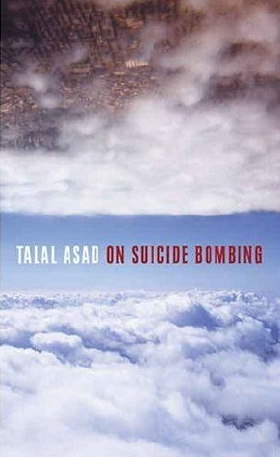
On Suicide Bombing - Cover

I’ve finished reading Talal Asad’s new book On Suicide Bombing. It belongs to the category of books I like most: It challenges common assumptions, makes us think (not so important if you agree with him all the time or not). By showing that the world is more complex, that you can look at the phenomenon from many angles, Asad does his job as anthropologist well.

In case of suicide bombing, one of his points is that suicide bombers might not be so something that special: Is there really a big difference between soldiers at war and suicide bombers? What actually is terrorism? What kind violence is labelled as “legitimate” and why? What role do common ideas about “civilized” and “uncivilized” people play in this discourse?

As Asad writes:

My argument is directed against thinking of terrorism simply as an illegal and immoral form of violence and advocates an examination of what the discourse of terror – and the perpetration of terror – does in the world of power.

Instead of a review (which I’m going to write in Norwegian), here some selected quotes.

I’ll start with the Epilogue

Western states (including Israel) have now massacred thousands of civilians and imprisioned large numbers without trial; they have abducted, tortured, and assasinated people they claim are militants and laid waste to entire countries. (…) In the long perspective of human history, massacres are not new. But there is something special about the fact that the West, having set up international law, then finds reasons why it cannot be followed in particular circumstances. I find this more disturbing than the sordid violence of individual terrorists.

It seems to me that there is no moral difference between the horror inflicted by state armies (especially if those armies belong to powerful states that are unaccountable to international law) and the horror inflicted by its insurgents. In the case of powerful states, the cruelty is not random but part of an attempt to discipline unruly populations. Today, cruelty is an indispensable technique for maintaining a particular kind of international order, an order in which the lives of some peoples are less valuable than the lives of others and therefore their deaths less disturbing.

The perception that human life has differential exchange value in the marketplace of death when it comes to “civilized” and “uncivilized” peoples is not only quite common in liberal democratic countries; it is necessary to a hierarchial global order. (…) All this is familiar stuff, and yet our media and our political potboilers remain obsessed with the ruthlessness of jihadists and the dangers of an unreformed Islam.

[teaserbreak]

Terrorism: The distinction between terrorists and armies at war

So, war is a legally sanctioned concept, and the hateful killing perpetrated by unlicenced militants is not. And yet soldiers are taught to hate the enemy they are required to kill; the fact of killing being legally sanctioned is an abstract irrelevance. In this regard, soldiers are no different from terrorists.

If the motive of military commanders is complex (they kill noncombatants but wouldn’t if they did’t have to), however, couldn’t the same be said of the terrorist whose killing of civilians is at once deliberate and yet coerced? He has reached the limit; he has no option left – or so he claims, when he argues that in order to try to prevent “the coercive transformation of (his people’s) way of life”, he must carry out immoral killings. If he kills enough civilians (so he reasons), perhaps those who are politically responsible will respod in the desired way.

So: it is not cruelty that matters in the distinction between terrorists and armies at war, still less the threat each poses to entire ways of life, but their civilizational status. What is really at stake is not a clash of civilizations (a conflict between two imcompatible sets of values but the fight of civilization against the uncivilized. In that fight, all civilized rules may be set aside.

War is (…) a collectively organized, legitimized, and moralized game of destruction that is played much more savagely by the civilized than the uncivilized.

Suicide Terrorism: How unique is suicide bombing?

So how unique is suicide bombing? If it is special – and I believe that in a sense it is – that is not because of the motives involved. (…) The uniqueness of suicidebombing (…) resides, one might say, not in its essence but in its circumstances.

Explanations of suicide fighters tend to focus on the origin of motivation. (…) That reason is often – not always – seen as being in some way pathological. Or as being alienated – that is, as not properly integrated into Western civilization.
(…)
Strenski’s redescription of motive in terms of the concept of sacrifice offers a religious model by means of which suicide bombing can be identified as “religious terrorism”. And that appellation defines the bomber as morally underdeveloped – and therefore premodern – when compared with peoples whose civilized status is partly indicated by their secular politics and their private religion and whose violence is therefore in principle disciplined, reasonable, and just.

In a recent unpublished article, May Jayyusi insists that suicide fighters must be understood in relation to new forms of political subjectivity that have been formed in the context of resistance to the particular powers that circumscribe them (46). (…) The stress here should be not on violece as such but on spontaneous action when legal political means are blocked.

Robert Pape, a political scientist, collects figures. He insists that statistics show suicide bombers must be understood as employing a strategy of war:

"I have spent a year compiling a database of every suicide bombing and attack around the globe from 1980 to 2001. (...) The data show that there is little connection between suicide terrorism and Islamic fundamentalism, or any religion for that matter. In fact, the leading instigator of suicide attacks is the Tamil Tigers in Sri Lanka, a Marxist-Leninist group whose members are from Hindu families but who are adamantly opposed to religion (they have committed 75 of 188 incidents).

Rather, what nearly all suicide terrorist campaigns have in common is a specific secular and strategic goal: to compel liberal democracies to withdraw military forces from territory that the terrorists consider to be their homeland. Religion is rarely the root cause, although it is often used as a tool by terrorist organizations in recruiting and in other efforts in service of the broader strategic objective."

(…)
Pape is right to suggest that these incidents must be set in the context of what are in effect miniwars of rebellion. But he does not mention something about the states attacked that I think is more important than their liberal democratic status: their powerful armies. The insurgents are faced with an adversary that posseses formidable military weaponry as well as methods of controlling civilian populations in occupied territory that are often very effective, and this superiority cannot be met directly

The right of liberal democratic states to defend themselves with nuclear weapons – and this seems to be accepted by the international community – is in effect an affirmation that suicidal war can be legitimate. This leads me to the thought that the suicide bomber belongs in an important sense to a modern Western tradition of armed conflict for the defense of a free political community: To save the nation (or to found its state) in confronting a dangerous enemy, it may be necessary to act without being bound by oridinary moral constraints.

Horror at Suicide Terrorism: Why do Westerners express horror at suicide terrorism?

In the Abrahamic religions, suicide is intimately connected with sin because God denies the individual the right to terminate his own earthly identity In the matter of his/her life, the individual creature has no sovereignty. (…) In antiquity, by contrast, suicide was neither a sin nor a crime, although it was typically the elites, to whom that freedom was a personal entitlement, whocould legitimately take their own lives. Political authorities could offer suicide to members of the elite as a legal option to being judically executed (Socrates is perhaps the most famous example)

Why do Westerners express horror at suicide terrorism – what is so special about it? (…) Warfare, of course, is an even greater violation of civilian “innocence”, but representations have sedimented in us so as to see that in principle war is legitimate even when civilians are killed that in principle death in war (however horrible) are necessary for the defense of our form of life. Here the language of “civilization” and “barbarism” comes readily to hand rather than the more superficial “clash of civilizations”

(…)

In the suicide bomber’s act, perhaps what horrifies is not just dying and killing (or killing by dying) but the violent appearance of something that is normally disregarded in secular modernity: the limitless pursuit of freedom, the illusion of an uncoerced interiority that can withstand the force of institutional disciplines. Liberalism, of course, disapproves of the violent exercise of freedom outside the frame of law. But the law itself is founded by and continuosly depends on coercive violence.

If modern law seeks to found or to defend a free political community with its own law, can one say that suicide terrorism (like a suicidal nuclear strike) belongs in this sense to liberalism? The question may, I think, be more significant than our comforting attempts at distinguishing the good conscience of just warriors from the evil acts of terrorists.

EARLIER POSTS ON TALALs BOOK

New York Times reviews Talal Asad’s “On Suicide Bombing”

Anthropological perspectives on suicide bombing

>> Talal Asad: Thinking About Just War (Huffington Post, updated link)

Anthropologist y Gabriele Marranci made related points in several posts on his blog, see New blog: Islam, Muslims, and an Anthropologist.

Somehow, concerning state violence, David Graeber’s views are useful here, see There never was a West! Democracy as Interstitial Cosmopolitanism

On Suicide Bombing - Cover

I've finished reading Talal Asad's new book On Suicide Bombing. It belongs to the category of books I like most: It challenges common assumptions, makes us think (not so important if you agree with him all the time or not).…

Read more