search expand

Military anthropologist starts blogging about his experiences

One of the anthropologists who is working for the military has started blogging about his experiences with the U.S. Army. His name is Marcus Griffin, professor at Christopher Newport University, Virginia (USA). He now works at Ft. Hood, Texas, for the time being participating in a simulation of activities that prepares Army personnel “to work effectively in Iraq” as he calls it.

In the beginning, Griffin wasn’t sure if he was allowed to blog, but now he knows that he is “free to blog” about his experiences “trying to apply anthropology to a very thorny problem facing the world and the United States in Iraq and Afghanistan in particular”. But as a quick look at his blog reveals, it seems that his job is doing some advertising for the US Army. as m Most anthropologists oppose this kind ofa collaboration with the military.

>> visit Marcus Griffin’s blog

SEE ALSO:

The dangerous militarisation of anthropology

“Tribal Iraq Society” – Anthropologists engaged for US war in Iraq

Military – social science roundtable: Anthropologists help mold counterinsurgency policy

San Jose: American Anthropologists Stand Up Against Torture and the Occupation of Iraq and AAA Press Release: Anthropologists weigh in on Iraq, torture at annual meeting

“War on terror”: CIA sponsers anthropologists to gather sensitive information / see also debate on this on Savage Minds

One of the anthropologists who is working for the military has started blogging about his experiences with the U.S. Army. His name is Marcus Griffin, professor at Christopher Newport University, Virginia (USA). He now works at Ft. Hood, Texas,…

Read more

Paternalistic anthropology

Quote from an article about tourism in Papua New Guinea (reads more like advertising, though):

Tourism is good for PNG,” asserts Dr Nancy Sullivan, a Madang-based anthropologist with an abiding affection for Papua New Guineans. “It brings much-needed funds to these remote communities, encourages them to maintain a traditional lifestyle and prevents the young men, in particular, from having to seek work in the cities where they are subject to many dangerous influences.”

Paternalistic anthropology?

Nancy Sullivan owns an anthropology consulting company based in Madang, Papua New Guinea:

Nancy Sullivan Ltd. provides Ecotourism Consulting, Leadership Training Consulting and Social Science Consulting. We also prepare Participatory Rural Appraisals (PRAs) and Rapid Rural Appraisals (RRAs) tailored to a client’s needs, including economic, social, legal and project-specific investigations.

>> visit Nancy Sullivan Ltd’s website (lots of articles, reports and pictures)

[links updated 11.6.2015)

SEE ALSO:

Culture Matters: A new paternalism for Aboriginal Australia

Anthropologists condemn the use of terms of “stone age” and “primitive”

“Good story about cannibals. Pity it’s not even close to the truth”

Fieldwork in Papua New Guinea: Who are the exotic others?

Quote from an article about tourism in Papua New Guinea (reads more like advertising, though):

Tourism is good for PNG," asserts Dr Nancy Sullivan, a Madang-based anthropologist with an abiding affection for Papua New Guineans. "It brings much-needed funds to…

Read more

Akbar Ahmed’s anthropological excursion into Islam

“One of the most famous anthropologists in the world” was he called by Alan MacFarlane. According to the BBC he is “probably the world’s best known scholar on contemporary Islam”. Akbar Ahmed‘s new book Journey Into Islam: The Crisis of Globalisation is out and according to a review in The Blade he has “painted a fascinating picture of contemporary Islamic world”:

He is a master of simplification. He can take snarled strands of culture, religion, and traditions and through the reason and logic of an anthropologist, Islamic scholar, and historian, is able to untangle the complex jigsaw puzzle and present it in an easy to comprehend narrative.

But maybe this ability to simplify also represents a weakness as he seems to generalize too much? Ahmed’s book was “Book of the week” in The Guardian. Reviewer Edward Mortimer writes:

To a surprising extent he (Akbar) accepts Huntington’s premise that Islam and the west are still distinct civilisations. Only once does he abandon this construct and refer to “a world civilisation”, in which “people are now too close to and dependent on each other to afford the luxury of ignoring and excluding others”. The rest of the time he treats western and Muslim cultures as discrete entities, which need to be brought closer together.

Two weeks ago he said according to The Guardian:

“It’s not just 9/11. It started in the 19th century when the first clashes between the west and Islam took place. We’re seeing the same patterns being played out today.”

The book is based on a “anthropological excursion”: Ahmed Akbar and two students visited eight Islamic countries — India, Pakistan, Syria, Jordan, Turkey, Qatar, Malaysia, and Indonesia — to talk to a cross section of people about their attitudes towards America, their fears and their concerns according to The Blade:

Most of the people in those countries feel alienated from the West and believe that the war on terrorism is in fact a war against Islam being waged under the rubric of globalization. (…) This fear is partly based on the 500-year colonial era. The colonists ruled Muslim lands with two objectives; to exploit natural resources of the occupied lands and to civilize them by converting them to Christianity. The current push for globalization is, to many, the re-colonization of the Islamic world, albeit with a difference. This time the seeds of exploitation are hidden in the Trojan horse of globalization.

>> review in The Blade

>> review in The Guardian

>> Alan MacFarlane interviews Akbar Ahmed

Akbar has also started to blog (a bit) and has a professional website with links to articles and interviews.

Akbar Ahmed appears regularily in the media, see for example:

West ‘must stop looking at Islam through the lens of terror’ (The Guardian, 28.6.07)

Akbar Ahmed’s Call for Compassion: How has globalization changed the world in terms of religious tolerance and stereotyping? (The Internationalist, 4.3.07)

Interview with Prof. Akbar Ahmed (ABC News Austraia, 19.9.01)

‘It Is Time for Muslims to Reciprocate’ (Newsweek, 28.9.06)

Globalist Interview: Akbar Ahmed: Islam Under Siege (The Globalist, 20.6.03)

Conflict with Iraq: Akbar Ahmed (BBC, 2003)

Akbar Ahmed studies differences but seeks unity (Princeton University, 7.11.00)

Articles on Islam by Professor Akbar S. Ahmad (Islam For Today)

SEE ALSO:

New blog: Islam, Muslims, and an Anthropologist

Anthropological perspectives on suicide bombing

Protests against British research council: “Recruits anthropologists for spying on muslims”

Doctoral thesis: Towards a transnational Islam

Muslims in Calcutta: Towards a middle-class & moderation

What does it mean to be Muslim in a secular society? Anthropologist thinks ahead

Islam: Embracing modernity while remaining true to their traditions and core beliefs

Book review: Mahmood Mamdani: “Good Muslim, Bad Muslim”

Islam in Europe: Mainstream society as the provider of conditions

Interview with Arjun Appadurai: “An increasing and irrational fear of the minorities”

"One of the most famous anthropologists in the world" was he called by Alan MacFarlane. According to the BBC he is "probably the world’s best known scholar on contemporary Islam". Akbar Ahmed's new book Journey Into Islam: The Crisis of…

Read more

Keith Hart is blogging

banner memory bank

Economic anthropologist Keith Hart has upgraded his website The Memory Bank. Now it looks more like a blog and produces a RSS-feed so it’s easier to follow. Apart from his blog posts, his book on the anthropology of money is online and many papers.

banner memory bank

Economic anthropologist Keith Hart has upgraded his website The Memory Bank. Now it looks more like a blog and produces a RSS-feed so it's easier to follow. Apart from his blog posts, his book on the anthropology of money is…

Read more

New Proposals – New Open Access Journal

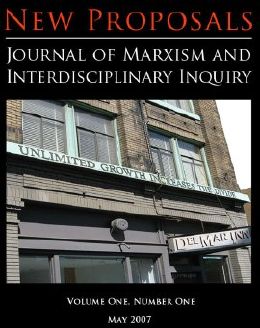
new proposals - cover Anthropologist Charles Menzies is the editor of a new open access journal called New Proposals: Journal of Marxism and Interdisciplinary Inquiry:

New Proposals is a journal of Marxism and interdisciplinary Inquiry that is dedicated to the radical transformation of the contemporary world order. We see our role as providing a platform for research, commentary, and debate of the highest scholarly quality that contributes to the struggle to create a more just and humane world, in which the systematic and continuous exploitation, oppression, and fratricidal struggles that characterize the contemporary sociopolitical order no longer exist.

The first issue was launched in May and focuses on marxist anthropology.

The journal has (of course) its own blog.

new proposals - cover

Anthropologist Charles Menzies is the editor of a new open access journal called New Proposals: Journal of Marxism and Interdisciplinary Inquiry:

New Proposals is a journal of Marxism and interdisciplinary Inquiry that is dedicated to the radical transformation of the contemporary…

Read more