
search expand

A First Look at Italian Anthropology

antrocom
There are not many anthropologists in Italy that have websites in English. But some have. And in Italy they is an Open Access anthropology journal Antrocom that will be translated into English in a few months. I was contacted by the Italian Antrocom Press Office and provided with some links – so here a first look at Italian anthropology.

Duccio Canestrini runs Homo Turisticus, a web site dealing with the anthropology of tourism.

From the self description:

(The website) provides an original viewpoint of the touristic “species” and of recreational land uses. Travel myths, holiday rythes and touristic encounters are my personal research field.

Over the last decades it seems that everybody has travelled to just about everywhere. But there’s also something risky in the side effects of global tourism. We can do better. A responsible tourism should protect natural resources, respect different cultures and improve everybody’s quality of life.

Although ecotourism and sustainability are new buzz words, and in such risk dying of a dose of media overkill, new representations and new manners in tourism are investigated and largely practiced. Tourism likes and needs innovation. New ideas often come from social sciences.

In English, some articles and videos are available.

Laura Ciaffi is medical anthropologist who focuses on HIV/AIDS. On her website we can read her Cameroon Diary and download three papers about aids and health in Africa.

Cristina Grassen has started blogging on the Anthropology of Innovation.

Alessandro Duranti is Professor of Anthropology at UCLA (Los Angeles). He has put online lots of articles and papers and video clips. He is mainly interested in linguistic and political anthropology.

I was also pointed at these two papers:

Alessandro Cavalli and Fabio Luca Cavazza (2001): Reflections on political culture and the “Italian national character” (published in Daedalus, Summer 2001)

Franco Pelliccioni (1980): “Anthropology in Italy” (published in Human Organization, Journal of the Society for Applied Anthropology)

Earlier today, I’ve written about another Italian anthropologist Gabriele Marranci who runs the blog Islam, Muslims, and an Anthropologist.

Finally, there is the Italian online anthropology community Anthropos with news, links, forum and lots more – currently only in Italian, though.

antrocom website

There lots of anthropology sites in other languages as well (f.ex. Spanish/Portuguese), maybe a topic for another post?

If know more websites, leave a comment!

SEE ALSO:

World Anthropologies: Working towards a global community of anthropologists

How can we create a more plural anthropological community?

Savage Minds: Is Anthropology Global?

antrocom

There are not many anthropologists in Italy that have websites in English. But some have. And in Italy they is an Open Access anthropology journal Antrocom that will be translated into English in a few months. I was contacted…
Read more

New blog: Islam, Muslims, and an Anthropologist

The Anthropology of Islam and Jihad Beyond Islam are the most recent books by Gabriele Marranci. In January this year he has started his own blog Islam, Muslims, and an Anthropologist. He is also writing for the excellent Middle East blog Tabsir.

Gabriele Marranci explains:

By nature, academic publications, even when attempting to reach the general public, are not very widely read outside the ivory tower of academia. (…)For this reason I also started, with Prof. Daniel Varisco, and regularly contribute to, Tabsir.

I believe that anthropologists, as Franz Boas and Margaret Mead have taught us, should engage and contribute to their time by facilitating debate.

In his recent post Collateral damage in the Wars on Terror: between Afghanistan and Glasgow, he comments on the public discourse and press coverage of the recent car bombings in Britain that were linked to al-Qaeda:

Yet are these attacks really al-Qaeda-sponsored? It is too early to say, but I have the impression that this series of attacks were the work of some ‘amateurs of terror’.

(…)

Prime Minister Gordon Brown misleads us when repeating ,

“It’s obvious that we have a group of people – not just in this country, but round the world – who’re prepared at any time to inflict what they want to be maximum damage on civilians, irrespective of the religion of these people who are killed or maimed are to be.”

It’s obvious, I would say, that this is not what those people want; this is, in this case, the inevitable ‘collateral damage’. This group of people kills because they want to achieve their idea of justice and good; they are fighting their battle against ‘evil’ to affirm ‘good’; they are ‘gifting’ us with a purifying fire which will be able to bring joy and prosperity in the future. They are gifting their victims with paradise, they are terrorising us for what they think is right, though costly to achieve. So they say.

Yet are we not terrorising, killing and maiming Afghan civilians to achieve what we think is the right cause? Have we not killed, possibly tortured, illegally detained (i.e. kidnapped), thousands of innocent people, or asked rogue Middle Eastern dictatorships to do so, to achieve what, paraphrasing Mr Brown, is in the interests of a perversion of our western democracy?

During these years of research with different Muslims, having different ideas and beliefs, I have reached the conclusion that we, the homely people of all colours, cultures, faiths and nationalities have found ourselves between not just one ‘War on Terror’ but two. And here is the issue: Terror fighting terror, the only result can be an endless chain of death.

>> visit Gabriele Marranci’s blog

SEE ALSO:

Anthropological perspectives on suicide bombing

Anthropologists on the Israel-Lebanon conflict

“Discuss politics!” – How anthropologists in Indonesia engage with the public

More and more anthropologists, but they’re absent from public debates – “Engaging Anthropology” (1)

The Anthropology of Islam and Jihad Beyond Islam are the most recent books by Gabriele Marranci. In January this year he has started his own blog Islam, Muslims, and an Anthropologist. He is also writing for the excellent Middle East…

Read more

Inuit language thrives in Greenland

In the 1960s and 1970s, elders in Greenland feared their language would be lost. Today, the vast majority of Greenlanders – 92 per cent – are fluent in their native tongue. Inuit language thrives in Greenland, Nunatsiaq News reports:

You can find a copy of Harry Potter, translated in Greenlandic, at the local library of Greenland’s capital. Also available are the translated works of William Shakespeare, Charles Dickens and Ernest Hemingway. Fifty Greenlandic publications are produced each year, says Carl Christian Olsen, head of Greenland’s language secretariat and chair of the languages commission.

(…)

On the streets of Nuuk, Greenlandic is often spoken by children, who all seem to carry cellphones. They send text messages to one another, in both abbreviated Danish and Greenlandic, shortening words like qujanaq, or thank you, to qujan.

(…)

Beyond books, Green­landic is practiced in a lively music scene, ranging from soulful Greenlandic folk tunes to jazz to gangsta rap

In Canadian Nunavut on the other hand, the situation is quite different and according to Nunatsiaq News, some in Nunavut fear that Inuktitut, and related dialects like Inuinaqtun, are dying. Inuit language has been treated differently in Greenland and Canada:

While Inuit in Nunavut were punished for speaking Inuktitut in residential schools, Greenland has a long history of teaching Green­landic in schools, since the early 20th century.

It’s also a consequence of having those missionaries decide that the language ought to be written with standard Roman orthography, rather than the more-difficult-to-reproduce syllabic system popularized by missionaries in Canada’s eastern Arctic.

Having money to translate and print such books helps, too. Olsen says he’s disappointed that Canada, a country of “enlightened people,” doesn’t give Inuktitut the same sort of language funding that French receives as an official language

>> read the whole story in Nunatsiaq News

Nunatsiaq News also writes about Qikiqtani Inuit Associ­ation (QIA) that wants the Government of Nunavut bring in new laws that would give the Inuit language the same status within Nunavut that the French language enjoys in Quebec, see QIA wants language laws dumped, re-written.

SEE ALSO:

Modern technology revives traditional languages

How filmmaking is reviving shamanism

How internet changes the life among the First Nations in Canada

In the 1960s and 1970s, elders in Greenland feared their language would be lost. Today, the vast majority of Greenlanders - 92 per cent - are fluent in their native tongue. Inuit language thrives in Greenland, Nunatsiaq News reports:

You can…

Read more

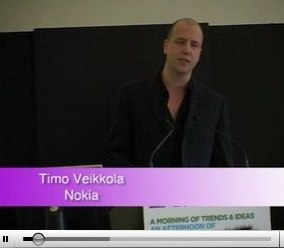
Timo Veikkola – The Anthropologist as Future Specialist

watch Veikkola's presentation Things are changing: See how an anthropologist is introduced in this story: “As many anthropologists these days he holds a strategic position inside a global corporation.” Juliana Xavier writes about Timo Veikkola – anthropologist at Nokia. His jobtitle: “Senior Future Specialist”:

As Senior Future Specialist at Nokia Design, he looks at society to comprehend how there are going to be shifts in behavior and culture that can inspire their design team. Timo is a future teller.

Veikkola was one of the speakers at an innovation conference in London (by PSFK). Juliana Xavier has been there and writes that this was the second time in less than an year that an anthropologist came to speak at a planning/marketing/advertising conference:

Last year, Bob Deutsch from Brain Sell (…) talked about treating people as people rather than as consumers. Timo talked about that as well, but also about that as a crucial part of his work at Nokia, or better saying: about how to envision the future through trends, observation and – an expression that I liked a lot – informed intuition

(…)

Timo’s trend team is composed of a diversity of people from Brazil to India, from Chile to China – everyone sitting in the same room. It is a way to cultivate the atmosphere in the office, an atmosphere of global and cultural diversity. A good observer of the present wants to be close to people, is keen to get involved and has to seek stimulation through real experience.

>> read the whole article by Juliana Xavier

Veikkola’s presentation is available online

>> Watch Timo Veikkola, Future Strategist at Nokia, on a Vision of our Future at the PSFK Conference London

SEE ALSO:

“The science of ethnography is an ideal tool to designing mobile phones”

Popular IT-anthropologists: Observe families until they go to bed

INTEL and Microsoft conference “a coming-out party” for ethnography

Ethnography, cross cultural understanding and product design

Anthropology Matters – New issue out on anthropology of science and technology

watch Veikkola's presentation

Things are changing: See how an anthropologist is introduced in this story: "As many anthropologists these days he holds a strategic position inside a global corporation." Juliana Xavier writes about Timo Veikkola - anthropologist at Nokia. His jobtitle: "Senior Future…

Read more

Good anthropological writing: “Nuclear Borderlands” and “Global Body Shopping”

Examples of good anthropological writing? In his constant search to find books he can hand to students and say: “Here is anthropology”, Christopher Kelty is two books richer in 2007: Global Body Shopping: An Indian Labor System in the Information Technology Industry by Xiang Biao’s and Nuclear Borderlands: The Manhattan Project in Post-Cold War New Mexico by Joseph Masco.

On Savage Minds he reviews both books.

Xiang’s book, he writes “could serve as an excellent starting point for a new generation of comparative ethnography of quasi-formal labor systems”. But what is body shopping? Laborers as a commodity in the new global labour market? A new form of slave trade? The anthropologist explains:

(…) a usually Indian intermediary firm hires a bunch of “qualified” Indian IT employees, deals with immigration and visa issues, and in turn sends them off to work for EU, Aus or US IT firms. Often the intermediary can be taking up to half (or more) of the employee’s wages, but they also take all the risk in terms of immigration and labor-market surpluses. It leads to lots of unemployed Indian IT workers (“benched”) milling about places like Central New Jersey and Southern Silicon Valley waiting for IT firms to take up the slack. There are all kinds of horrible results, but it has been central to making Indian labor so globally visible and accessible in the IT industry…

>> read the whole review on Savage Minds

>> read the introduction of the book

Whereas Xiang’s book was excellent for its simplicity, Masco’s book Nuclear Borderlands: The Manhattan Project in Post-Cold War New Mexico is excellent for its controlled complexity, he writes. It is “a frankly cosmological book; it is about how the bomb makes us who we are today”:

The naive anthropology student might approach New Mexico as a place with many different populations: anglo scientists, pueblo indians, neuvomexicanos, hippie anti-nuke activists — each with their own distinctive lifeworld and worldview. But Masco is having none of that: for him, the bomb is the bomb. It has determined nearly every aspect of our lives (and “our” means basically everyone on the planet) for 50 years… to say nothing of our futures. Thus, in the chapters that explore the lives and thoughts of these different groups, the same cosmological questions about the impact of Nuclear Weapons and the Cold War keep coming up—and keep providing ways to connect these seemingly diverse groups to each other: through the lab, through secrecy and hypersecurity measures, and through politics of race and sovereignty.

>> read the whole review on Savage Minds

>> read the introduction of the book

SEE ALSO:

The Secret of Good Ethnographies – Engaging Anthropology Part III

Examples of good anthropological writing? In his constant search to find books he can hand to students and say: "Here is anthropology", Christopher Kelty is two books richer in 2007: Global Body Shopping: An Indian Labor System in the…

Read more