search expand

Museum Anthropology Review: Blogging book reviews

Another example of experimenting with the internet: The journal Museum Anthropology (MUA) has started publishing its book reviews in a blog called Museum Anthropology Review:

Its purpose is the dissemination of reviews, essays, obituaries and other editorially-reviewed content complementing the work of Museum Anthropology. It reflects the research and outreach interests of the Council for Museum Anthropology and is offered as a resource enhancing all fields concerned with the study of material culture and with the place of museums and related institutions in social life.

Journal editor Jason Baird Jackson explains:

On a case by case basis, I am asking authors of reviews-in-hand if they would be willing to publish their review online. Publishing reviews in this way takes advantage of the following benefits of the online medium (among others): immediate rather than delayed publication, free access to anyone in the world with internet access, the ability to incorporate internet hyperlinks, the ability to publish color images along with the review, the ability (if desired by the author) to turn on the blog’s comment function for the review (thus allowing others to comment on the review or its subject matter), and the ability for an author to simply send an email link for the review to whomever they wish to share the review with.

Because reviews published thus are easily found by anyone doing internet searches, they may become a subject of discussion elsewhere on the web. They can also benefit from the power of the social networking dynamic of the web today, such as with folksonomy tagging. This strategy also provides more space for publication of peer-reviewed articles in the journal itself.

>> visit the Museum Anthropology Review

SEE ALSO:

More book reviews: Publishers are approaching bloggers

New: Anthropology Matters with book reviews

American Ethnologist: Book Reviews in Full-Text!

Lots of book reviews on The Canadian Review of Sociology and Anthropology’s site

Another example of experimenting with the internet: The journal Museum Anthropology (MUA) has started publishing its book reviews in a blog called Museum Anthropology Review:

Its purpose is the dissemination of reviews, essays, obituaries and other editorially-reviewed content complementing the…

Read more

Focus Anthropology – another online journal!

The journal has existed for a few years already but it seems to be one of the many hidden treasures on the web. It’s called Focus Anthro and is an peer-reviewed undergraduate anthropology journal at Kenyon College, Ohio.

Lots of interesting papers to explore, among others The Concept of Tribe in Sub-Saharan Africa by Meghan Schaeffer that refers to our discussion of the term tribe in a recent post (it was by googling the book that Alex Golub recommended that I’ve stumpled upon this journal)

>> visit Focus Anthropology

The journal has existed for a few years already but it seems to be one of the many hidden treasures on the web. It's called Focus Anthro and is an peer-reviewed undergraduate anthropology journal at Kenyon College, Ohio.

Lots of…

Read more

Anthropologists condemn the use of terms of "stone age" and "primitive"

Good news: British anthropologists take part in public debates. The ASA (Association of Social Anthropologists) issued a statement where they “condemn the use of terms like ‘stone age’ and ‘primitive’ to describe tribal and indigenous peoples alive today”.

We anthropology bloggers have often criticized the use of these terms.

The official condemnation comes in the wake of controversial comments made on the BBC (not online!) by Baroness Jenny Tonge, the Liberal Democrat peer, who called the Bushmen of the Kalahari Desert ‘stone age’ and ‘primitive.’

The ASA statement reads:

‘All anthropologists would agree that the negative use of the terms ‘primitive’ and ‘Stone Age’ to describe [tribal peoples] has serious implications for their welfare. Governments and other social groups. . . have long used these ideas as a pretext for depriving such peoples of land and other resources.’

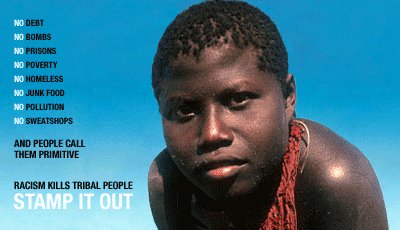
The ASA has become the latest supporter of Survival International’s campaign against racism in the media which challenges the use of terms like ‘stone age’, ‘primitive’ and ‘savage’ to describe tribal and indigenous peoples.

Survival International writes:

Terms like ‘stone age’ and ‘primitive’ have been used to describe tribal people since the colonial era, reinforcing the idea that they have not changed over time and that they are backward. This idea is both incorrect and very dangerous. It is incorrect because all societies adapt and change, and it is dangerous because it is often used to justify the persecution or forced ‘development’ of tribal peoples. The results are almost always catastrophic: poverty, alcoholism, prostitution, disease and death.

Other supporters of this campaign include prominent journalists such as John Simpson, John Pilger and George Monbiot.

According the Washington Times, the American Anthropological Association did not return calls for comment.

But why do they still use the term tribe in their campaign? Why not use society or community? Doesn’t the term tribe imply something similar as “primitive”?

As I’ve mentioned earlier, several African scholars argue that the idea of tribe promotes misleading stereotypes and that “anyone concerned with truth and accuracy should avoid the term “tribe” in characterizing African ethnic groups or cultures”.

In their paper Talking about “Tribe” Moving from Stereotypes to Analysis, they argue that:

  • Tribe has no coherent meaning.
  • Tribe promotes a myth of primitive African timelessness, obscuring history and change.
  • In the modern West, tribe often implies primitive savagery.
  • Images of timelessness and savagery hide the modern character of African ethnicity, including ethnic conflict.
  • Tribe reflects once widespread but outdated 19th century social theory
  • Tribe became a cornerstone idea for European colonial rule in Africa.

Black Britain sheds more light on the use of this term. Several scholars, among others sociologist and cultural historian Lez Henry say that Survival and the ASA should also examine their use of the terms ‘tribe’ and ‘tribal.’ Henry says, people in Africa who live simple agrarian lifestyles are often seen as ‘primitive.’ Such notions served as justification for the colonisation of countries designated as ‘third world’. For Ekwe Ekwe, the term ‘tribe’ conjures up images of being unsophisticated and away from technological advancement.

According to Survival, they are guided by the United Nations in their definition of the term ‘tribe.’:

“Survival uses the term ‘tribal’ peoples, partly because we need a way to describe the type of people that we are working with. The term ‘indigenous’ can be used as well and often is.”

Following publication of the Black Britain article, the ASA contacted Black Britain to clarify its position and said:

“The ASA does not support the use of the term ‘tribal’ to describe people…We share your concerns about the use of the word in perjorative ways in the same vein as primitive, etc.

“However, we do support the overall aim of the campaign which is to change perceptions and work against racism and outdated ideas of social evolution. Hence we wish to support Survival International’s aims even if the wording is difficult.”

>> read the whole article on Black Britain

SEE ALSO:

Our obsession with the notion of the primitive society

Primitive Racism: Reuters about “the world’s most primitive tribes”

“Stone Age Tribes”, tsunami and racist evolutionism

“Good story about cannibals. Pity it’s not even close to the truth”

Ancient People: We are All Modern Now – Debate on Savage Minds

Good news: British anthropologists take part in public debates. The ASA (Association of Social Anthropologists) issued a statement where they "condemn the use of terms like 'stone age' and 'primitive' to describe tribal and indigenous peoples alive today".

We anthropology…

Read more

Interview: “Anthropology Is Badly Needed In Eastern Europe”

vytis Social anthropology isn’t (yet) an established discipline in Eastern Europe. In an interview with me, Vytis Ciubrinskas explains why he thinks anthropology is badly needed.

Vytis Ciubrinskas is Head of the Center of Social Anthropology at Vytautas Magnus University in Lithuania and editor of the scientific journal “Lietuvos etnologija: socialines antropologijos ir etnologijos studijos” (“Lithuanian Ethnology: Studies of Social Anthropology and Ethnology”).

Last week, he was in Oslo and lectured at the research program Cultural Complexity in the new Norway (where I work) about identity in post-communist Lithuania.

If you visit Vytis Ciubrinskas’ website you’ll see that his Center of Social Anthropology is part of the sociology department. There’s no Department of Social Anthropology.

He explains:

– Anthropology is not established as a seperate discipline. It belongs to sociology at my university. In many East European countries, anthropology departments are either part of national ethnology, or sociology as in Poland or in the Balkans or together with sociology. This is really a bad situation.

It’s the same situation in the other Baltic countries?

– It’s the same or even worse. We already have a program in social anthropology and we have started teaching, but that’s not the case in Latvia or Estonia. In Poland, the Czech republic and Hungary, anthropology is still a very new thing.

Why?

– Because of the dominance of Volkskunde (“national ethnology” / “folklore studies”). National ethnologists are especially nationally supported: They are dealing with ethnic culture, the soul of the culture (“Volksseele, Volksgeist”). But also archaeology, history, liguistics.

– Another reason: This territory has been a closed society for almost half a century that never took account of global or foreign or cosmopolitan attitudes. Comparative perspectives were not allowed because we had “one system and one truth and one leader”. Always, “the world is wrong and we are right”.

– Anthropology is badly needed because of the prevalence of national ethnologies. These diciplines have their own established voices in the region. Their orientation is very different from that in anthropology departments in Western or Northern Europe whose professionals work in many spheres of public sectors.

– Spreading information about anthropology is very important, especially in Central and Eastern Europe where anthropology is almost unknown or is known as physical anthropology. It’s very important to question the use of self-focused ethnocultural approaches especially where issues of culture, heritage, identity, globalisation are concerned.

What do you mean by self-centered ethnocultural focus?

– Societies in Central and Eastern Europe are open now and live in a new Europe. But we still have with us the inheritance that comes from the approach of a captive mind where “local knowledge and way of life is the best”. Globalisation, multiculturalism, all kinds of new influences are taken as threats rather than challenges.

– Cultural policy bureaucrats listen to the local scholars who say: “Look, the end of the world is near. They are starting Halloween parties instead of continuing our old and deep moral tradition of All Saints and All Souls’ Day. You must pay respect to your ancestors, light a candle on the grave. This is a very important holiday, and suddenly Halloween comes with crazy parties. It’s totally unacceptable. What is to be done?”

– So if we take it seriously and signal like it’s the end of the world, it will be a very ethnocentric attitude.

– In my understanding we need real analyses of everyday life, of life-ways, of identity, of identity politics on multiculturalism and globalism and who can do that? I’m afraid not many local scholars do that because, especially in Humanities, they are very much focused on national heritage, tradition, culture, folklore. They need a comparative, a global perspective. And who can provide that? Sociologists? Psychologists? Politologists? I doubt it. Anthropologists are badly needed.

– We need comparative studies and an international team to come and do work in Lithuania. Interdisciplinary is good but international is even better.

– Lithuania is a fertile research field. Transitionalism is very interesting and important to study and is comparable to postcolonial studies which have identified significant problems in former colonial communities.

– Europe is not explored enough in anthropology. Oceania or Latin America are much better explored than Europe. European anthropology and anthropology at home should be taken more seriously than it is today.

What are the major challenges in anthropology? What should be researched?

– 1) Studies of postcolonialism and post-communism. Westernisation is a big issue in postcolonial and post-communist societies but it has not been explored enough: How does western aid and develoment work, what kind of impact does it have on local populations?

– An example is Ida Knudsen’s researches on EU hygiene standards – how they are accepted and dealt with. It’s somewhat like being at school again with the master prompting you. It’s a new standardisation of your culture. In post-communist countries modernity as such is known. It is not bringing modernity to pre-modern societies, it’s the bringing of standards which are received or accepted in diverse ways.

– Lithuania is a good example. We have the highest rates of suicide in Europe, maybe in the whole world. We have very high rates of dependency on alcohol, attitude of fatalism, racism, frustration and passivity. This could be blamed on problems of rapid change, uncertainty, but at the same time, I think it might have more to do with the introduction of a new standard, a new way of doing things.

– It’s about changing from communism to capitalism and having capitalism not just as an open market but as recipebook. This recipe book syndrome is important to study: How it is accepted? How it is implemented? How does it undermine the old ways? What are the the social consequences?

– 2) Of course anthropology should always be aware of and interested in local knowledge and identity: What is sameness and togetherness in a particular community?

– 3) Antiglobalism. I like very much Jonathan Friedman’s idea. He says that globalism is nothing new but what we have to be aware of is the kinds of changes that take place at home. People might be globals but they have stayed more or less the same. Antiglobalism amounts to new religious movements: ecovillages, new ways of consumption. That’s all new. Globalism in not new, but antiglobalism is, and it’s very inventive.

You’re the editor of “Lietuvos etnologija” (“Lithuanian Ethnology”). What do you think of open access to scholarship so that all articles are online for free for everybody?

– It’s very important I agree, and we’re now on the way to doing that. Very soon you’ll be able to read it. But you’ll need a good Lithuanian-English dictionary. Of course, we do have summaries of all the articles in English.

You can download two papers by Vytis Ciubrinskas:

Vytis Ciubrinskas: Revival Of Tradition For Reconstruction of Identity. Lithuanian Case (pdf)

Vytis Ciubrinskas: Transnational Lithuanian identity: imagined, constructed and contested in diaspora (pdf)

MORE ANTHROPOLOGICAL RESEARCH ABOUT LITHUANIA:

Kristina Sliavaite: When Global Becomes Local: Rave Culture in Lithuania

Kristina Sliavaite: From Pioneers to Target Group: Social Change, Ethnicity and Memory in a Lithuanian Nuclear Power Plant Community

Irmina Matonytë: Elites in Soviet and post-Soviet societies

SEE ALSO:

In Central-Europe and Poland: “I think that anthropology has never been as strong as it is now…”

Doing fieldwork in Eastern Europe – New issue of Anthropology Matters

Researches neo-paganism in an overwhelmingly Catholic society

New issue of Pro Ethnologica: The Russian Speaking Minorities in Estonia and Latvia

The power of dead bodies in Eastern Europe

Book review: East to West Migration: Russian Migrants in Western Europe

Book and papers online: Working towards a global community of anthropologists

vytis

Social anthropology isn't (yet) an established discipline in Eastern Europe. In an interview with me, Vytis Ciubrinskas explains why he thinks anthropology is badly needed.

Vytis Ciubrinskas is Head of the Center of Social Anthropology at Vytautas Magnus University in Lithuania…

Read more

International Polar Year opened – Anthropologists involved

More than 50,000 scientists from 63 nations turned their attention to the world’s poles when the International Polar Year officially opened on Monday: It unifies 228 research projects about the impact of global warming in the Arctic the Washington Post reports.

Anthropologists are also part of it. “Anthropologists are also planning to study the culture and politics of some the Arctic’s 4 million inhabitants” according to the newspaper.

More information can be found on the website of the Polar Year where the participants already have started blogging. The website provides lots of RSS feeds.

One of the projects about people in the Arctic is:

NOMAD: Reindeer herding from a reindeer perspective:

The central idea of NOMAD is the establishment of a mobile observation platform. This is facilitated by a nomadic tent camp that houses an interdisciplinary group of researchers. They follow the annual migration of semi-domesticated reindeer in Kola Peninsula, Northwest Russia. This is a novel effort, putting social and other scientists on the reindeer trek on a long-term basis. By positioning themselves in close contact with migrating reindeer herds the researchers observe the delicate ecology and conditions of renewable resource use in the subarctic.
(…)
The NOMAD Blog and Forum will start as soon as the first photographs and entries of the fieldwork diary will be sent over from the camp to the Max Planck Institute for Social Anthropology (Halle, Germany). We reckon this will happen in late April 2007.

On the website of the Indigenous People International Polar Year, we can see presentations from a workshop and videos. Among others, you can watch the whole Opening of the Indigenous Peoples International Polar Year, in Guovdageaidnu, Norway online – a three-day’s conference! Unfortunately there are no subtitles (presentations in both Norwegian, English, Saami).

Recent news coverage about the Polar Year

Greenland meltdown could change the world: If ice covering the island melts, rising sea levels could displace millions from Florida to Bangladesh (The Vancouver Sun, 28.2.07)

SEE ALSO:

A new word For June – or: When is the Arctic no longer the Arctic?

More than 50,000 scientists from 63 nations turned their attention to the world's poles when the International Polar Year officially opened on Monday: It unifies 228 research projects about the impact of global warming in the Arctic the Washington Post…

Read more