search expand

Thank You!

Antropologi.info was recently voted as one of the best anthropology blogs.

Jason Antrosio, editor of Living Anthropologically and Anthropology Report asked his readers to pick their three favorites among 120 anthropology blogs. I’m especially happy about the result as I haven’t told anybody about the survey and I don’t use facebook og twitter to “promote” this blog. And his list included also several popular blogs within physical / biological anthropology and archaeology.

So, thanks a lot to everybody who voted for antropologi.info!

It has been quite quiet recently here on antropologi.info. The main reason is that I’m still in Cairo, and this city etc has consumed most of my mental bandwith.

Now, my time in Cairo is about to finish, I will be back in Norway next week. There, I will have to spend most of my time on finding an affordable flat and getting back in my freelance business. Nevertheless, I’ll try to resume blogging and hopefully will be blogging more frequently than last year, including more shorter posts.

Antropologi.info was recently voted as one of the best anthropology blogs.

Jason Antrosio, editor of Living Anthropologically and Anthropology Report asked his readers to pick their three favorites among 120 anthropology blogs. I’m especially happy about the result as I…

Read more

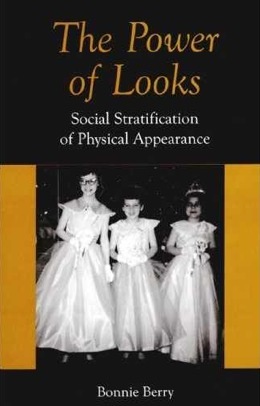
Lookism: Why we don’t want to be perceived as "ugly" or "different"

We are living in a visually biased society. Bonnie Berry has written a book about prejudice and racism based on looks. Antropologi.info contributor Tereza Kuldova has read the book. Here is her review.

Book review of The Power of Looks. Social Stratification of Physical Appearance by Bonnie Berry, Ashgate 2008

By Tereza Kuldova, PhD Fellow, Museum of Cultural History, University of Oslo

“When we consider the disparity in what we spend our money on, we find the depressing fact that, in the US, more money is spent on beauty than on education or social services. This fact shows the vacuousness of our society, but also may explain why we persist in the mainly pointless behaviors of buying beautifying products and services. If we are not educated, we may believe that physical appearance is more important than being learned, and we may rely on looks to accrue power instead of using our brains” (p.69).

The book The Power of Looks deals with one of those topics that impact all of us in our everyday lives every single day, one way or another. Namely our prejudices and conceptions of beauty and attractiveness and the ways in which we act on those and discriminate people based on their looks.

Bonnie Berry calls this phenomenon ‘lookism’, which is one of the many ‘isms’ we have to deal with in our world, such as racism, or colorism.

The book shows very clearly how the bias towards attractiveness and beauty creates profound social inequalities and determines our access to both social and economic power. It is not news that people who ‘look better’ have better chances to succeed, get jobs, pass oral exams and so forth. In the same way in which beautiful people are positively ‘discriminated’, those not beautiful enough are negatively discriminated.

This appearance bias, the beauty ideal created and supported and perpetuated by the media, advertising and cosmetic and pharmaceutical companies, creates a feeling in ourselves, a feeling of ‘not being good enough’, the result is anxiety (p. 57). We tend to constantly fix ourselves, be it through make up, clothes, plastic surgery, liposuction, teeth whitening (and more), in order to be perceived as ‘acceptable’ or ‘normal’, if not beautiful. Being perceived as ‘ugly’ or different often leads to social exclusion, isolation, economic, social and romantic discrimination as well as lack of access to social and economic power.

What distinguished The Power of Looks from other popular books on this topic, such as the Beauty Myth by Naomi Wolf or Beauty Junkies by Alex Kuczynski, is that it has a distinctively sociological take on the topic. This is a great advantage over the book Bonnie Berry published earlier, Beauty Bias, which was much more ‘popular’ and part of the same discursive realm as the books mentioned above. The Power of Looks has even two chapters on theory, method and possible approaches to the problem of social stratification based on our looks and to what she calls ‘social aesthetics’, from functionalism to symbolic interactionism. It is no doubt that this book can serve as a great introduction into the topic for students of sociology and anthropology.

For greater awareness about lookism

The most important aspect of this book in my view is however not its originality or its bravado of writing, but it is its message and the aim to build awareness about social stratification and discrimination based on looks. This is a message of acute importance in our world that is too often driven by media images of what is beauty and what it means to be beautiful, messages that fuel our continual sense of inadequacy and force us to recreate ourselves according to these images through consumption of products that often do very little to improve our looks. In the worst cases, these images, ideals and messages drive us under the scalpel where many have died. (See for instance this ABC news story Mother’s Death Highlights Dangers of Plastic Surgery).

The book is important in its focus on and analysis of these phenomena. And since it adopts a sociological approach, it not only builds our awareness about appearance bias and the way it shapes hierarchies and inequality, but it also gives us a conceptual apparatus to grasp these phenomena, to be able to conceptualize them, pinpoint them and talk about them. This is what I consider the greatest contribution of the book. And in line with the message of the book, I wish to draw your attention, in this review, to certain issues that the book raises and that I feel are interesting to think through and reflect about.

The topic of discrimination based on skin color is going through the whole book and it is interesting to think in this respect of the work of Nina Jablonski – Skin: A Natural History, which is a more evolutionary take on the topic of skin, yet definitely interesting – particularly the fact that from a biological perspective, white skin which is considered socially superior is in fact biologically inferior, in that it is easily prone to cancer and other environmentally caused damage. For more you can view a TED talk by Nina Jablonski here

Nina Jablonski breaks the illusion of skin color

Bonnie Berry also refers on many occasions throughout the book to facial and bodily disfigurement and what life can be like for those people in such a visually biased society. The awareness around this issue seems to be growing. Take for instance the popular show by a British fashion designer Wan Gok called Beauty and the Beast: The Ugly Face of Prejudice, which speaks directly to the topic of this book

For more on facial disfigurement see this video:

Skin lightening cream commercials – The intersection between racial ideology and capitalist consumer culture

The role of media and advertising in shaping our tastes, likes and dislikes has been already well documented. The interesting thing is how these commercials try to associate a whole universe of meanings with the products they are trying to sell us. The paramount example is the Indian Fair & Lovely commercial for the most popular Indian skin lightening cream. All of the company’s numerous advertisements follow the same logic which we will see in the example below. These commercials reflect and shape notions of beauty and therefore we should be aware of how they are constructed. Let us look at one of their commercials, as this might ‘flesh out’ the book for its future readers, since it tends to focus little too often on the structural and does not include many concrete examples.

Fair skin is in India often associated with higher status. Now watch how this is played out and reconfirmed in the commercial.

It begins with a father sitting and reading newspaper, then he asks for a tea with milk. His wife looks back at him with her sad big eyes and says that there is no milk, since there is no money. The father then goes on to complain: ‘I wish I had a son’ – meaning someone who would be able to provide for them. His daughter overhears the comment and starts crying, then the TV in her room features a Fair & Lovely facial cream commercial. At that moment she spots a newspaper job advertisement for an air hostess. She connects the two together (the same way as the audience is supposed to). After applying the cream, she is beautiful and fair, and therefore empowered. She gets the job and the surroundings suddenly turn glamorous, at the end she sits with her parents at what seems to be an airport coffee shop and her father with a happy face comments: ‘now we can get a tea, I guess’. The message is simple, beauty and fairness equals higher status, happiness and success. This nicely portrays the “the intersection between racial ideology and capitalist consumer culture” (p. 40).

Watch the commercial here:

The book itself points to many examples of prejudice and racism based on looks. An interesting one comes from Japan and the apparent racism against Koreans and Chinese prevalent in the popular Japanese comic books, such as manga. It is especially physical features that are being mocked in these comic books. (see for instance Asia Rivals’ Ugly Images Best Sellers in Japan or Racist Cartoons in Asia – An Example of Japanese Racism Against Koreans).

Looks, poverty and power

It is not a coincidence in this respect that, as Bonnie Berry points out:

“South Korea, incidentally, has had, as part of the new economy of Asia, the largest group of aesthetic surgeons practicing in Asia in the 1990s, primarily doing nose and eyelid alterations. (…) These westernizing surgeries, as undertaken by the middle-class Japanese, Vietnamese and Koreans, may be more about signs of achieving middle-class status than achieving and “American identity”, confirming once again that the desire to look a certain way is motivated by the pursuit of economic and social network power” (p. 41, emphasis mine).

This last sentence is possibly the most important here. If you do not look certain way, if you do not conform to the beauty ideals or at least try hard to approximate them, you are prevented from acquiring social and economic power. As Bonnie says:

“For those of us who are not naturally attractive, which is most of us, we must spend time, energy, and funds to make ourselves as acceptable as possible if we want to capture social and economic power” (p. 51)

It is instructive to see how the problems of obesity are correlated with poverty and lack of access to social power:

“The thin ideal is also maintained by social network mobility. Notably, thin women are more likely to marry in an upwardly mobile direction. Heavier women marry men of the same social class or lower” (p. 45).

Another important topic is the surgeries people surrender to in the name of beauty and improvement.

Bonnie notes:

“There have been a growing social acceptance of plastic surgery and growing numbers of people engaging in it. The stigma is gone. Many of us are unhappy with our appearance and we greatly exaggerate to ourselves what we consider to be defects, with this dissatisfaction very likely culturally and socially generated. We compare ourselves to mass media images of beauty; indeed we want to look exactly like them, as it turns out. If full lips are in fashion, we can have them. High cheekbones? Tan skin? Blond hair? Blue eyes? Full lips? No problem” (p. 57).

In her book, Bonnie mentions French artist Orlan who has throughout her career experimented with surgeries and her own body. It certainly does raise questions. That all I leave up to you after watching this video

French artist Orlan: 'Narcissism is important'

Succumb to lookism?

As a conclusion, I wish to ask you a question together with Bonnie:

“Should we feel pressure to change and succumb to this pressure? Of course not. But until or unless we are no longer judged and stratified by our appearance, only the bravest of us will not ‘fix up’” (p.63)

“If history is any judge, based on social reactions to other ‘isms’, lookism will remain a discriminating social attitude and behavior, even as it declines in social acceptability. There are signs that appearance bias is being at least discussed. There is greater social awareness. There are a few public policies leveled against lookism. And there are social movement organizations that are making small inroads into consciousness raising and legislation. It will take a long time. Most major social changes do” (p. 125).

Among the books that encourage critical thinking about contemporary world, this one is of those you might like to read.

>> Information about the book by the publisher (Ashgate)

>> download the introduction (pdf)

We are living in a visually biased society. Bonnie Berry has written a book about prejudice and racism based on looks. Antropologi.info contributor Tereza Kuldova has read the book. Here is her review.

Book review of The Power of Looks.…

Read more

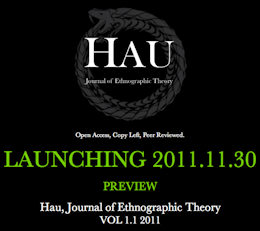
Here is the Preview of “Hau. Journal of Ethnographic Theory” – New Open Access Journal

It’s Open Access, Copy Left, and Peer Reviewed: Hau. Journal of Ethnographic Theory. Only ten days left, then the first issue will be available online. Yesterday, the preview (=table of contents) of the inaugural issue was posted at http://haujournal.org/

“By drawing out its potential to critically engage and challenge Western cosmological assumptions and conceptual determinations, HAU aims to provide an exciting new arena for evaluating ethnography as a daring enterprise for ‘worlding’ alien terms and forms of life, by exploiting their potential for rethinking humanity and alterity”, it is stated on the journal homepage.

Many well-known anthropologists (from the US and Western Europe only, unfortunately) are among the contributors of the first issue. Will HAU become one of the most important Open Access journals in English and promote Open Access publishing or will it end up as a “One Hit Wonder” as the maybe similar journal project After Culture did?

It's Open Access, Copy Left, and Peer Reviewed: Hau. Journal of Ethnographic Theory. Only ten days left, then the first issue will be available online. Yesterday, the preview (=table of contents) of the inaugural issue was posted at http://haujournal.org/…

Read more

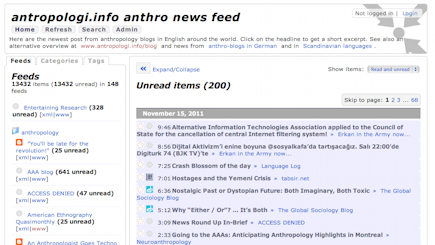
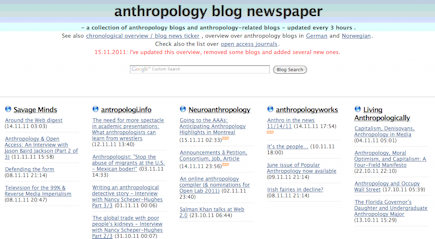
Updated overview over anthropology blogs and their newest posts

Nearly every hour an anthropologist somewhere on this planet publishes a blog post in English. The antropologi.info overviews over the newest blog posts in English are now updated with several new blogs. I’ve also removed some blogs that haven’t been updated for a while and tried to fix some bugs.

It’s not the edited overview with hand picked posts that Greg Downey at Neuroanthropology is looking for, though (and I hope will be realised somehow in the near future as well). I haven’t included all anthropology blogs, though, so there was some editing.

I’m sure I’ve missed some blogs, so please let me know if there are anthropology blogs that should be part of the overviews:

  • Overview over anthropology blogs and their latest posts: http://www.antropologi.info/blog/

  • Overview over the latest anthropology blog posts including blog search http://antropologi.info/feeds/anthropology/

Nearly every hour an anthropologist somewhere on this planet publishes a blog post in English. The antropologi.info overviews over the newest blog posts in English are now updated with several new blogs. I’ve also removed some blogs that haven’t been…

Read more

The need for more spectacle in academic presentations: What anthropologists can learn from wrestlers

Now, only a few days before the largest gathering of anthropologists in the world, it’s time to take up again the banner of the well-prepared, well-written, well-presented conference paper, writes Rex in his post Defending the form at Savage Minds .

In the following text, antropologi.info contributor Tereza Kuldova and Jan Martin Kvile explain why we need more spectacle in academic presentations:


Wrestling With Others for Self for Others: on the Need of Spectacle in Academic Presentations

Tereza Kuldova & Jan Martin Kvile

PhD Fellow in Social Anthropology at Museum of Cultural History, University of Oslo & The Ultimate Math Teacher, Holmen High School

Intro

Have you been recently at a conference? How many people could you count dozing off at the beginning, in the middle and at the end of the presentations? Or maybe, you too were dozing off, unable to even count your fellow colleagues who shared that miserable state of existence at an utterly boring presentation…

Or, maybe, you are one of those who really try to give people a chance and engage with their ideas, but you are on a verge of becoming disinterested in even the most spectacular and thought provoking subjects just because the presentations kill it? Or maybe you are the presenter who makes people doze off? In that case, you need to learn something from wrestlers.

Read on…

So here we are, at yet another anthropological conference. We, anthropologists, write about incredibly interesting, exciting things in the world, cultures, myths, religions, hierarchies, imaginations from all corners of the world. Yet, when you come to an anthropological conference, with some exceptions that merely confirm the rule, you will see a room full of people with almost disinterested expressions on their faces – these are possibly intended to signify the seriousness and depth (oh yeah, the anthropological obsession with ‘depth’) of their intellectual endeavor (however, it is enough to wait for the dinner and a little wine and, before you know it, you are listening to stories from the very same people’s bedrooms /possibly a way how to get ‘deeply’ familiar with each other/).

Better to get back to the conference room now. So they have a script and a plan. Each gets 20 minutes to present a paper. For some reason very few understand the simple concept of 20 minutes (yet all of them seem to be heavy users of watches) and for some even more miraculous reason most do really believe that presenting equals reading. Some basic arithmetic would make this clear immediately, if 2=2 and an apple is an apple, then presenting and reading can hardly be equal. These are namely two very different concepts.

Reading ≠ Presenting

Reading means comprehending and understanding the written word, deciphering its meaning and interpreting it while engaging with the text and its ideas. It is a relation between the reader and the text, a private and intimate relation too. Reading paper out loud disrupts this. It intends to invite the listener in, yet at the same time it never really succeeds, and by the very nature of this awkward relationship it cannot. Reading out loud does not invite the listener into a dialogue, the listener is not part of that exclusive bond between the reader and the text, and is rather ambivalently included and dis-included at the same time.

Presentation on the other hand stands for performance, act, demonstration, display, exposition, giving. Reading a paper out loud is hardly a performance (if it is, then it must be a really bad one), it is not a demonstration, not an exposition, not a show that invites participation.

And so we are sitting in the conference room, another speaker is being introduced. Interesting topic, the title sounds amazing. We sit back on our chairs and wake up a little. Then the word goes to the speaker himself.

First thing that he says, “eergh, I was rushing to the airport yesterday, was a bit delayed and had to catch the flight, so it happened I forgot my USB somewhere, still have not figured out where and with it the presentation, and it is not even in my laptop or on my email, so I am left without it, but I will really try to make up for that, I promise” (‘so you promise, eh’, we think to ourselves).

And he goes on (as if this was not already enough), “my paper is a little longer, so maybe I talk into the discussion time, but that is fine I guess, it is important” (we are beginning to sense frustration, which is the first stage of dozing off later on). So he sits down (‘oh no, not one of those again’, crosses our minds), and puts his paper right in front of his face and starts reading, as if reading for himself, no intonation, no enthusiasm.

We try really hard to follow with the fast flow of unintelligibly long sentences, five minutes into the reading we lose it, look out of the window and watch the birds outside, think of our lovers or our deadlines, suddenly our minds re-enter the room and we try to re-focus. Impossible, we lost it. This ‘reader’ does not know what highlights and repetition are, we are done and our imagination flies back to our lovers (or deadlines). Thirty minutes into the talk we start wondering, wasn’t he supposed to be finished by now, hell, what’s the time.

Around the 35th minute the speaker starts blabbering something about finishing off soon, we sharpen our ears, we get one sentence. We match it fast with the title of the paper, get the picture of what was probably going on and then we manage to formulate few relevant questions. Then one of us says, “thank you for the very exciting and stimulating lecture” (though the only thing that in reality really excited and stimulated us was probably the thought of our lovers) and add, “I have one little remark…”.

And so we go on with the theatre.

After the speaker is done the others start coming to him, “very good presentation, you have some nice points, see you at the dinner”. Do you want to know what they really think? “It sucked and I am definitely not going to read your paper, but I am going to pretend I will”.

Good reasons for that, the moment our speaker stepped in on the stage and wasted five minutes on diminishing himself giving us a story of lost USB, he was doomed to fail. The moment he started reading while hiding himself behind the paper, he confirmed that. The moment he went over his time, he showed he does not care for others. Yes, it is disrespectful. And yes, it shows your disinterest in discussion. Creating engaging dialogue should be the aim, yet, instead you fear, fear the questions. Grow up, the questions are there for you, through engaging with others’ reflections you will emerge as a transformed person! Stop fearing what others have to say! Embrace it instead.

‘Argument is war’ is one of the famous metaphors we live by (Lakoff and Johnson 2003). It is through dialogue and juxtaposition of different voices that meaning emerges (Bakhtin 2004). In knowledge, disruption is the goal! If dialogue ends, everything ends, as Bakhtin says. What is the ultimate spectacle of violent conflict, the ultimate metaphor of an argument? Wrestling! Yes, we should learn from wrestling and that too on more than one level!

Can We Academics Learn Something from Wrestling?

A wrestler is charismatic, has a stage presence, he is there to please the audience and that is how his success is determined. His performance is designed to create desired effects. He is a “a self-promotional device to draw the crowds and build reputation that would precede his entrance in the town” (Mazer 1998: 24) – not unlike an academic in this respect. Now don’t you want to be more like that? And less like the one who makes the audience doze off?

Did you know that young wrestlers have only twenty minutes in the program of the day to impress the audiences and create ‘heat’? Well, they happen to stick to the time. And most of them create considerable amounts of ‘heat’. Now next time you go out there, think about your audience first and about yourself as a wrestler! You want your audiences’ brains to heat up! You want them to focus their attention on you and what you have to say! Talk briefly but with impact, like a wrestler – Bang! Get your point across – Bang!

You have been researching for ages and you know your stuff, so how come you have to read it (that is just suspicious by the way)? Talk to your audiences, get them engaged in your ideas and thoughts, and create a dialogue instead of killing it. Maybe you are the enemy of yourself in this staged performance that we call ‘presenting a paper’.

Our whole endeavor in anthropology is like wrestling. We wrestle with others and their ideas, for ourselves and for others and when it comes to presenting we have to wrestle with ourselves for others, for the audience. Show the world the power of your ideas, be bold, talk loud and rehearse your stage performance, give us the spectacle! We want to remember what you say and we want to get interested in what it is you do. Get me interested and I read your work, those 20 minutes, those are a teaser, a commercial, an advertisement. So start writing down your punch lines (it is not a coincidence it is called a punch line, come alive wrestler!).

Now to the more profound importance of ‘wrestling’, Roland Barthes once said that “wrestling is a sum of spectacles, of which no single one is a function: each moment imposes the total knowledge of a passion which rises erect and alone, without ever extending to the crowning moment of a result” (Barthes 1993).

Maybe, we should like a wrestler turn our presentations into a sequence of little spectacles, open these up with a puzzle, engaging paradox or ambiguity. Maybe the inevitable ambiguity of the worlds we research and try to describe and thus the ambiguous nature of our findings should be understood as a productive force. The world is dirty and fuzzy; full of artificial categories we create to grasp this fuzziness and mess. Oh yes, and to top it, we create other categories intended to describe these ambiguous cases, such as hybridity and creolization.

We should get rid of those statements beginning with “I argue that” or “I conclude that” (note that wrestling is not about winning, it is about the process) and maybe we should instead open possibilities and let ambiguous voices speak. We are dealing with dialogical materials we are in dialogue with, how can the product be anything else than an invitation into that dialogue, a dialogue that is a part of the ongoing dialogue of humanity?

Maybe loose ends should never be really tied up, never really resolved for the sake of further dialogue and for the sake of knowledge, which itself is only a sort of metadialogue. Words are power and they can carve us versus them very easily, they objectify and transform what is fluid into something static. Categories thrive on pollution and love for purity. The more pollution the stronger the desire for purity (Douglas 2002).

But can it be that tidying all dirt is not such a good idea? Maybe we need to deal with garbage and dirt differently (Eriksen 2011). This struggle for perfect labels and neat categories is no more than an act of violence against life that is an unending and ambiguous dance of merger and division (Anton 2001). If that is so, the question is, could we think of hypocrisy and wrestling as a virtue?

Bibliography:

Anton, C. 2001. Selfhood and authenticity. State University of New York Press.

Bakhtin, M. M. 2004. The Dialogic Imagination. Austin: University of Texas Press.

Barthes, R. 1993. Mythologies. London: Vintage.

Douglas, M. 2002. Purity and danger: an analysis of concepts of pollution and taboo. Routledge.

Eriksen, T. H. 2011. Søppel: avfall i en verden av bivirkninger. Oslo: Aschehoug.

Lakoff, G. & Johnson, M. 2003. Metaphors we live by. Chicago: University of Chicago Press.

Mazer, S. 1998. Professional wrestling: sport and spectacle. University Press of Mississippi.

Sources of original images: unknown

SEE ALSO:

How To Present A Paper – or Can Anthropologists Talk?

Pecha Kucha – the future of presenting papers?

Academic presentations: “The cure is a strong chairman and a system of lights”

What’s the point of anthropology conferences?

Cicilie Fagerlid: Things to remember when presenting papers at conferences

Secret knowledge exchange at Europe’s largest anthropology conference

Now, only a few days before the largest gathering of anthropologists in the world, it’s time to take up again the banner of the well-prepared, well-written, well-presented conference paper, writes Rex in his post Defending the form at Savage Minds…

Read more