search expand

Get Out of the Library and Into the Streets – new book by David Graeber

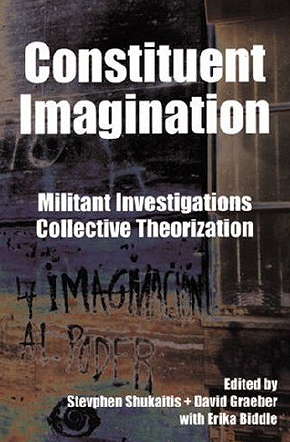
book cover

Popular anarchist anthropologist David Graeber is one of the editors of a new book on the relationship between academics and social action called Constituent Imagination: Militant Investigations, Collective Theorization:

According to libcom.org:

The book opens with the editors’ provocative history of the academy’s inherent limitations and possibilities. The essays that follow cover a broad range: embedded intellectuals in increasingly corporatized universities, research projects in which factory workers and academics work side by side, revolutionary ethnographies of the global justice movement, meditations on technology from the branches of a Scottish tree-sit. What links them all is a collective and expansive reimagining of engaged intellectual work in the service of social change. In a cultural climate in where right-wing watchdog groups seem to have radical academics on the run, this unapologetic anthology is a breath of fresh air.

As Matt Wasserman in The Indypendent claims, there are only few academics with ties to social movements – despite denouncements of “tenured radicals” by commentators on the right:

Plenty of academics write articles for obscure journals on transgression or “interrogate” race, gender and class, but almost none are found in the streets. This is the classic bargain of academia: you can think subversive thoughts as long as you don’t act upon them. Case in point: the firing of Constituent Imagination co-editor David Graeber from Yale University’s anthropology department.
(…)
The writers who contributed to Constituent Imagination want to tear down the barrier set up within the academy between theory and practice. In an occasionally jargon-ridden, often brilliant and generally provocative set of essays, they theorize and research about the globaljustice movement from within the movement.
(…)
The authors, rather than seeing their role as diagnosing the “objective” nature of the system and on this basis prescribing the correct strategy for social movements to follow, instead attempt to work out what it means to perform engaged intellectual work alongside, in service to and within social movements themselves.

>> read the whole review in The Indypendent

UPDATE: Parts of the book are available online at http://www.constituentimagination.net/

Graeber agrees in that there are “very few anarchist professors” but “a good number of grad students and a very large number of undergrads” according to an interview in The Ready Stock Book where he also explains what he thinks about anarchism. We also get to know that he is working on a history of the idea of debt and on a book developing an anarchist version of world-systems analysis with his friend Andrej Grubacic.

Graeber will by the way begin teaching at Goldsmiths College, University of London, in September 2007.

SEE ALSO:

David Graeber: There never was a West! Democracy as Interstitial Cosmopolitanism

Review of Graeber’s book: Fragments of an Anarchist Anthropology / download the whole book

Protests at Yale: When Walmart’s management principles run an anthropology department

“Discuss politics!” – How anthropologists in Indonesia engage with the public

More and more anthropologists, but they’re absent from public debates – “Engaging Anthropology” (1)

Too engaged anthropology? The Lumpenproletariat on the US-Mexican Border

Chronicles Women’s Social Movements in India

book cover

Popular anarchist anthropologist David Graeber is one of the editors of a new book on the relationship between academics and social action called Constituent Imagination: Militant Investigations, Collective Theorization:

According to libcom.org:

The book opens with the editors’ provocative history of the…

Read more

Selected quotes from "On Suicide Bombing" by Talal Asad

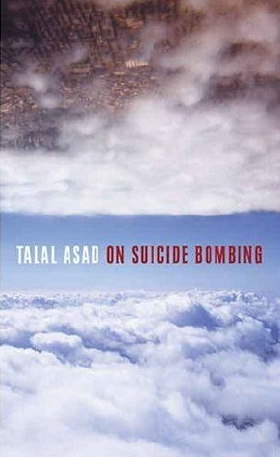
On Suicide Bombing - Cover

I’ve finished reading Talal Asad’s new book On Suicide Bombing. It belongs to the category of books I like most: It challenges common assumptions, makes us think (not so important if you agree with him all the time or not). By showing that the world is more complex, that you can look at the phenomenon from many angles, Asad does his job as anthropologist well.

In case of suicide bombing, one of his points is that suicide bombers might not be so something that special: Is there really a big difference between soldiers at war and suicide bombers? What actually is terrorism? What kind violence is labelled as “legitimate” and why? What role do common ideas about “civilized” and “uncivilized” people play in this discourse?

As Asad writes:

My argument is directed against thinking of terrorism simply as an illegal and immoral form of violence and advocates an examination of what the discourse of terror – and the perpetration of terror – does in the world of power.

Instead of a review (which I’m going to write in Norwegian), here some selected quotes.

I’ll start with the Epilogue

Western states (including Israel) have now massacred thousands of civilians and imprisioned large numbers without trial; they have abducted, tortured, and assasinated people they claim are militants and laid waste to entire countries. (…) In the long perspective of human history, massacres are not new. But there is something special about the fact that the West, having set up international law, then finds reasons why it cannot be followed in particular circumstances. I find this more disturbing than the sordid violence of individual terrorists.

It seems to me that there is no moral difference between the horror inflicted by state armies (especially if those armies belong to powerful states that are unaccountable to international law) and the horror inflicted by its insurgents. In the case of powerful states, the cruelty is not random but part of an attempt to discipline unruly populations. Today, cruelty is an indispensable technique for maintaining a particular kind of international order, an order in which the lives of some peoples are less valuable than the lives of others and therefore their deaths less disturbing.

The perception that human life has differential exchange value in the marketplace of death when it comes to “civilized” and “uncivilized” peoples is not only quite common in liberal democratic countries; it is necessary to a hierarchial global order. (…) All this is familiar stuff, and yet our media and our political potboilers remain obsessed with the ruthlessness of jihadists and the dangers of an unreformed Islam.

[teaserbreak]

Terrorism: The distinction between terrorists and armies at war

So, war is a legally sanctioned concept, and the hateful killing perpetrated by unlicenced militants is not. And yet soldiers are taught to hate the enemy they are required to kill; the fact of killing being legally sanctioned is an abstract irrelevance. In this regard, soldiers are no different from terrorists.

If the motive of military commanders is complex (they kill noncombatants but wouldn’t if they did’t have to), however, couldn’t the same be said of the terrorist whose killing of civilians is at once deliberate and yet coerced? He has reached the limit; he has no option left – or so he claims, when he argues that in order to try to prevent “the coercive transformation of (his people’s) way of life”, he must carry out immoral killings. If he kills enough civilians (so he reasons), perhaps those who are politically responsible will respod in the desired way.

So: it is not cruelty that matters in the distinction between terrorists and armies at war, still less the threat each poses to entire ways of life, but their civilizational status. What is really at stake is not a clash of civilizations (a conflict between two imcompatible sets of values but the fight of civilization against the uncivilized. In that fight, all civilized rules may be set aside.

War is (…) a collectively organized, legitimized, and moralized game of destruction that is played much more savagely by the civilized than the uncivilized.

Suicide Terrorism: How unique is suicide bombing?

So how unique is suicide bombing? If it is special – and I believe that in a sense it is – that is not because of the motives involved. (…) The uniqueness of suicidebombing (…) resides, one might say, not in its essence but in its circumstances.

Explanations of suicide fighters tend to focus on the origin of motivation. (…) That reason is often – not always – seen as being in some way pathological. Or as being alienated – that is, as not properly integrated into Western civilization.
(…)
Strenski’s redescription of motive in terms of the concept of sacrifice offers a religious model by means of which suicide bombing can be identified as “religious terrorism”. And that appellation defines the bomber as morally underdeveloped – and therefore premodern – when compared with peoples whose civilized status is partly indicated by their secular politics and their private religion and whose violence is therefore in principle disciplined, reasonable, and just.

In a recent unpublished article, May Jayyusi insists that suicide fighters must be understood in relation to new forms of political subjectivity that have been formed in the context of resistance to the particular powers that circumscribe them (46). (…) The stress here should be not on violece as such but on spontaneous action when legal political means are blocked.

Robert Pape, a political scientist, collects figures. He insists that statistics show suicide bombers must be understood as employing a strategy of war:

"I have spent a year compiling a database of every suicide bombing and attack around the globe from 1980 to 2001. (...) The data show that there is little connection between suicide terrorism and Islamic fundamentalism, or any religion for that matter. In fact, the leading instigator of suicide attacks is the Tamil Tigers in Sri Lanka, a Marxist-Leninist group whose members are from Hindu families but who are adamantly opposed to religion (they have committed 75 of 188 incidents).

Rather, what nearly all suicide terrorist campaigns have in common is a specific secular and strategic goal: to compel liberal democracies to withdraw military forces from territory that the terrorists consider to be their homeland. Religion is rarely the root cause, although it is often used as a tool by terrorist organizations in recruiting and in other efforts in service of the broader strategic objective."

(…)
Pape is right to suggest that these incidents must be set in the context of what are in effect miniwars of rebellion. But he does not mention something about the states attacked that I think is more important than their liberal democratic status: their powerful armies. The insurgents are faced with an adversary that posseses formidable military weaponry as well as methods of controlling civilian populations in occupied territory that are often very effective, and this superiority cannot be met directly

The right of liberal democratic states to defend themselves with nuclear weapons – and this seems to be accepted by the international community – is in effect an affirmation that suicidal war can be legitimate. This leads me to the thought that the suicide bomber belongs in an important sense to a modern Western tradition of armed conflict for the defense of a free political community: To save the nation (or to found its state) in confronting a dangerous enemy, it may be necessary to act without being bound by oridinary moral constraints.

Horror at Suicide Terrorism: Why do Westerners express horror at suicide terrorism?

In the Abrahamic religions, suicide is intimately connected with sin because God denies the individual the right to terminate his own earthly identity In the matter of his/her life, the individual creature has no sovereignty. (…) In antiquity, by contrast, suicide was neither a sin nor a crime, although it was typically the elites, to whom that freedom was a personal entitlement, whocould legitimately take their own lives. Political authorities could offer suicide to members of the elite as a legal option to being judically executed (Socrates is perhaps the most famous example)

Why do Westerners express horror at suicide terrorism – what is so special about it? (…) Warfare, of course, is an even greater violation of civilian “innocence”, but representations have sedimented in us so as to see that in principle war is legitimate even when civilians are killed that in principle death in war (however horrible) are necessary for the defense of our form of life. Here the language of “civilization” and “barbarism” comes readily to hand rather than the more superficial “clash of civilizations”

(…)

In the suicide bomber’s act, perhaps what horrifies is not just dying and killing (or killing by dying) but the violent appearance of something that is normally disregarded in secular modernity: the limitless pursuit of freedom, the illusion of an uncoerced interiority that can withstand the force of institutional disciplines. Liberalism, of course, disapproves of the violent exercise of freedom outside the frame of law. But the law itself is founded by and continuosly depends on coercive violence.

If modern law seeks to found or to defend a free political community with its own law, can one say that suicide terrorism (like a suicidal nuclear strike) belongs in this sense to liberalism? The question may, I think, be more significant than our comforting attempts at distinguishing the good conscience of just warriors from the evil acts of terrorists.

EARLIER POSTS ON TALALs BOOK

New York Times reviews Talal Asad’s “On Suicide Bombing”

Anthropological perspectives on suicide bombing

>> Talal Asad: Thinking About Just War (Huffington Post, updated link)

Anthropologist y Gabriele Marranci made related points in several posts on his blog, see New blog: Islam, Muslims, and an Anthropologist.

Somehow, concerning state violence, David Graeber’s views are useful here, see There never was a West! Democracy as Interstitial Cosmopolitanism
On Suicide Bombing - Cover

I've finished reading Talal Asad's new book On Suicide Bombing. It belongs to the category of books I like most: It challenges common assumptions, makes us think (not so important if you agree with him all the time or not).…

Read more

Extremism: “Authorities -and not Imams – can make the situation worse”

“Muslim religious leaders are not only working with local authorities but are helping to decrease radicalisation”, stresses anthropologist (and blogger) Gabriele Marranci. During an International Conference on Extremism in London, key authorities were criticized for not listening to Muslim Imams who reach out to offer help. They were criticized for paint the Muslim community as un-cooperative at the same time according The Voice.

Marranci said:

“During my research, I found no evidence to suggest that the Muslim chaplains are behaving or preaching in a way that facilitates radicalisation. On the contrary, my findings suggest that they are extremely important in preventing dangerous forms of extremism. However, the distrust that they face, both internally and externally, is jeopardising their important function.”

Marranci researched on islam in prisions: How does being behind bars impact on Muslim identity and their experience of Islam? He interviews over 170 current and former Muslim prisoners in Scotland, Wales and England and lived with the families of former prisoners. His study Living Islam in prison: faith, ideology and fear showed that sometimes it is actions by the authorities-and not Imams- which can make a situation worse. Current efforts by the authorities to curb radicalism within UK prisons are having the opposite effect according to the anthropologist.

His study said, the Voice writes, Muslim prisoners are subjected to stricter security surveillance than other inmates. Marranci claimed that security policies within prisons – including restricting praying in a communal space or reading the Qur’an during work breaks – are exacerbating, rather than suppressing the radicalisation process.

>> read the whole story in The Voice

In a recent entry in his blog he gives us more details about his studies and concludes:

The terrorist threat, as well as the general representation of an ‘Us’ versus ‘Them’ Armageddon battle, is polarising, in a very dangerous way, prison life. On one side are the Muslim prisoners, with a minority of radicals but a majority of ordinary Muslims pushed towards the aforementioned because of the discrimination they suffer. On the other side are the non-Muslim staff and prisoners whom understandably develop resentment towards the terrorists, but which too easily becomes resentment towards the ordinary Muslim prisoners.

These circumstances maximise the possibility of attacks against Muslim prisoners, and consequently provide a fertile soil for successful radicalisation of Muslim prisoners.

Yet I have the impression that the Prison Service and the Government see ‘extremism’ as merely the product of ‘indoctrination’. Yet, as my research suggests, ‘extremism’ within prison should be tackled by rejecting over focused Muslim-centric security policies in order to develop an encompassing strategy against intolerance. (…) I have highlighted many times to the Prison Service that extremism and radicalism are not just Muslim issues. Within the prisons there are visible increases in right-wing ideologies and a high level of unnoticed intolerance.

The ‘War on Terror’, he stresses, is disintegrating the British Values: “Today we are ready to deport people towards their torture and death thanks to shameful political agreements with tyrants who shun our democratic values.”

>> read the whole post “Mr Barot’s disfigured face can radicalise Muslim prisoners more than his voice”

Marranci is currently transforming his research into a book provisionally titled “Faith, ideology and fear: Muslim identities within and beyond prisons”. It will be published by Continuum Books in summer 2008. You can download a speech about his researchheld at the House of Lords.

SEE ALSO:

New blog: Islam, Muslims, and an Anthropologist

Protests against British research council: “Recruits anthropologists for spying on muslims”

Doctoral thesis: Towards a transnational Islam

"Muslim religious leaders are not only working with local authorities but are helping to decrease radicalisation", stresses anthropologist (and blogger) Gabriele Marranci. During an International Conference on Extremism in London, key authorities were criticized for not listening to Muslim Imams…

Read more

New York Times reviews Talal Asad’s “On Suicide Bombing”

Some weeks ago I wrote a few lines about the book On Suicide Bombing by anthropologist Talal Asad. Among other things, he questions our notions about legitimate violence.

On Sunday, the book was reviewed in the New York Times:

Asad (…) takes aim less at the Bush administration than at the rest of us, and at what he sees as our unspoken complicity in “some kinds of cruelty as opposed to others.” He hopes, he writes, to “disturb the reader sufficiently” by showing the hypocrisy of rules that permit murderous conduct by states but deny it to nonstate actors. And he is angered by scholars, theorists and journalists who don’t speak Arabic and have never set foot in the Middle East, yet sound off about why suicide bombers do what they do. He is understandably aghast that the American public has expressed so little shock over the bloodshed inflicted in its name.

And by the end of the book, his rage has overtaken him. The Bush administration’s actions in the Middle East have left him so disgusted that he declares simply, “It seems to me that there is no moral difference between the horror inflicted by state armies (especially if those armies belong to powerful states that are unaccountable to international law) and the horror inflicted by insurgents.”

It is hard to answer Asad’s argument without drifting into the distinctions he attempts to demolish. For instance, he cites the political philosopher Michael Walzer’s definition of the “peculiar evil of terrorism,” which, according to Walzer, is “not only the killing of innocent people but also the intrusion of fear into everyday life, the violation of private purposes, the insecurity of public spaces, the endless coerciveness of precaution.” Asad then asks why the United States’ war in Iraq and the Israeli cluster bombs in Lebanon do not earn the same condemnation as bombs wielded by terrorists. But if you continue to believe (as I do) that there is a moral difference between setting out to destroy as many civilians as possible and killing civilians unintentionally and reluctantly in pursuit of a military objective, you will indeed find “On Suicide Bombing” disturbing, if not always in the way he intends.

Nonetheless, Asad’s book is valuable because the legal distinctions he is challenging are especially vulnerable now.

The review is part of the article Our War on Terror.

As Savage Minds already has noted, Columbia University Press has published a mp3-interview with Talal Asad. For more information on the book and Talal Asad see my earlier entry Anthropological perspectives on suicide bombing

More information will follow. I’m currently reading this book.

Some weeks ago I wrote a few lines about the book On Suicide Bombing by anthropologist Talal Asad. Among other things, he questions our notions about legitimate violence.

On Sunday, the book was reviewed in the New York Times:

Asad (...) takes…

Read more

Airport lamps light only option for studious Guinea kids

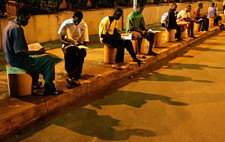
When the sun has set in Guinea, one of the world’s poorest nations, and the floodlights come on at Gbessia International Airport, the parking lot begins to fill with children. It is among the only places where they can count on finding the lights on. The long stretch of pavement has the feel of a hushed library, according to ap-writer Rukmini Callimachi in an fascinating article in USA Today:

Groups of elementary and high school students begin heading to the airport at dusk, hoping to reserve a coveted spot under the oval light cast by one of a dozen lampposts in the parking lot. Some come from over an hour’s walk away.

“I used to study by candlelight at home but that hurt my eyes. So I prefer to come here. We’re used to it,” says 18-year-old Mohamed Sharif, who sat under the fluorescent beam memorizing notes on the terrain of Mongolia for the geography portion of his college entrance test.

Eighteen-year-old Ousman Conde admits that sitting on the concrete piling is not comfortable, but says passing his upcoming exam could open doors. “It hurts,” he says, looking up from his notes on Karl Marx for the politics portion of the test. “But we prefer this hurt to the hurt of not doing well in our exams.”

Only about a fifth of Guinea’s 10 million people have access to electricity and even those that do experience frequent power cuts. With few families able to afford generators, students long ago discovered the airport.

The lack of electricity is “a geological scandal,” says Michael McGovern, a political anthropologist at Yale University, quoting a phrase first used by a colonial administrator to describe Guinea’s untapped natural wealth. Guinea has rivers which if properly harnessed could electrify the region, McGovern says. It has gold, diamonds, iron and half the world’s reserves of bauxite, the raw material used to make aluminum.

>> read the whole story in USA Today

“Although Guinea’s mineral wealth makes it potentially one of Africa’s richest countries, its people are among the poorest in West Africa” >> more information on Guinea in the BBC country guide

Michael (Mike) McGovern is / was the West Africa project director for the International Crisis Group. He has appeared quite often in the media on Guinea related issue as a google search reveals

When the sun has set in Guinea, one of the world's poorest nations, and the floodlights come on at Gbessia International Airport, the parking lot begins to fill with children. It is among the only places where they can count…

Read more