search expand

Paperless underclass exposes dark side of Europe


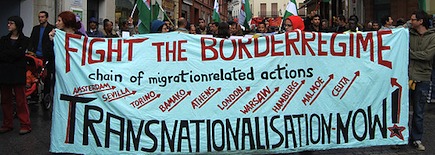
Demonstration in Sevilla. Photo: No Border Network, flickr

(Draft) “All human beings are born free and equal in dignity and rights.” These noble words in the Universal Declaration of Human Rights might be true in some distant part on this planet, but certainly not in Europe.

Here, peoples’ rights are dependent on their nationality. While I, with my German EU passport may travel and live nearly everywhere I want, people from countries like Egypt, Syria or Pakistan cannot. Europe has put much effort in building different kind of walls to prevent certain categories of people from entering. While wealthier peoples’ migration is celebrated, poorer peoples’ migration is criminalized. Anthropologist Owen Sichone calls this policy “Global apartheid”.

Two weeks ago, eight Norwegian police men arrested 25 year old Maria Amelie, an award winning book author, blogger and former anthropology student, born in North Ossetia. She had just finished her lecture at the Nansen Academy – the Norwegian Humanistic Academy about being paperless, undocumented, “illegal” migrant. This happened just three months after she had published her bok “Ulovlig norsk” (Illegally Norwegian), and one month after she was named “Norwegian of the Year” by Norway’s only cosmopolitan-minded magazine, Ny Tid.

Maria Amelie (her real name is Madina Salamova) is one of those 18 000 illegalized migrants in Norway who live here without any rights at all. No access to healthcare, education or work. They cannot open an bank account, they don’t get an ID-number, they actually don’t exist officially. Even helping them is forbidden.

Here is a video from Russia Today about Maria Amelie and a demonstration i Oslo for better rights for undocumented migrants. See related news story

Yesterday, despite lots of demonstrations and media attention, she was thrown out of Norway, where she has lived since she was 16, and deported to Russia. For Prime Minister Jens Stoltenberg and his red-green government, it was important to make clear that they don’t tolerate people like her. The Norwegian government is responsible for the deportation of hundreds of individuals and families – usually in the middle of the night without any prior notice. Media in Norway has done a good job in highlighting the plight of these people who all have a unique story to tell.

Read more:

Norway Expels Migrant Celebrity (Moscow Times, 25.1.2011)

Human rights court slams EU asylum policy as inhumane (Deutsche Wele, 21.1.2011)

‘No One Is Illegal’ Campaign aims to protect Norway’s ‘paperless’ refugees (Women News Network 8.12.2010)

SEE ALSO:

The “illegal” anthropologist: Shahram Khosravi’s Auto-Ethnography of Borders

“Human smugglers fight global apartheid”

“Anthropologists Should Participate in the Current Immigration Debate”

No more conferences in Arizona: Anthropologists condemn Immigration Law

How to challenge Us-and-Them thinking? Interview with Thomas Hylland Eriksen

Why borders don’t help – An engaged anthropology of the US-Mexican border

David Graeber: There never was a West! Democracy as Interstitial Cosmopolitanism

For an Anthropology of Cosmopolitanism

Interview with Sámi musician Mari Boine: Dreams about a world without borders

For free migration: Open the borders!

Demonstration in Sevilla. Photo: No Border Network, flickr

(Draft) "All human beings are born free and equal in dignity and rights." These noble words in the Universal Declaration of Human Rights might be true in some distant part on this planet,…

Read more

“Human smugglers fight global apartheid”


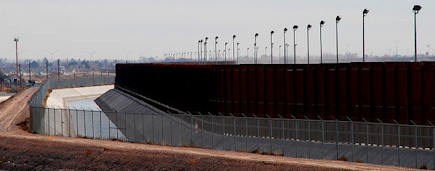
High-tech border between USA and Mexico. Photo: Paul Garland, flickr

The limitation of people’s freedom of movement based on their nationality (“global apartheid”) is maybe one of the biggest human rights issues nowadays.

One month ago I wrote about Shahram Khosravi’s auto-ethnography of illegalised border crossing.

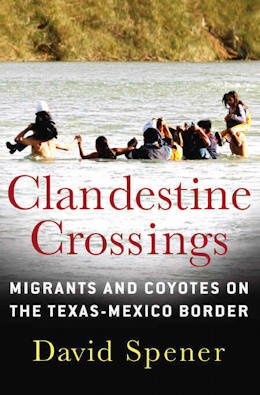
The Democracy In America blog at the Economist draws attention to a related book: Migrants and Coyotes on the Texas-Mexico Border by David Spener. The anthropologist spent eight years doing field work on both sides of the border.

Armed with latest technology, the U.S. does everything to prevent people from the South to enter its territory. Because border crossing is difficult, 90% of all illegalised migrants crossing into the United States through Mexico hired a smuggler (also called “coyote”). Human smuggling has become a $6.6-billion industry in Mexico.

The press presents human smuggling as a sinister organized-crime phenomenon. Spener argues that it is better understood “as the resistance of working-class Mexicans to an economic model and set of immigration policies in North America that increasingly resemble an apartheid system.

Publishing a book is not always the best strategy to spread knowledge. Therefore it is a good idea to set up companion websites as Spener has done. Here we find border crossing stories, articles and papers as well as images, maps and sounds.

As the Democracy in America blog reminds us: Even reaching the border is hard. Each year some 20,000 migrants are kidnapped for ransom in Mexico. Victims are made to give the phone numbers of relatives, who must pay upwards of $3,000 or more to get them released.

Migrants from Central and South America are particularly easy targets:

Illegal in Mexico, they must evade checkpoints throughout the country and risk deportation if they report a crime. Women and girls—about a fifth of the migrants making their way through Mexico—face additional dangers. Six out of ten are reckoned to suffer sexual abuse during their migration, according to Amnesty International, a human-rights watchdog.

For a global perspective, see the overview by the BBC: Walls Around The World

SEE ALSO:

The “illegal” anthropologist: Shahram Khosravi’s Auto-Ethnography of Borders

More Global Apartheid?

For free migration: Open the borders!Why borders don’t help – An engaged anthropology of the US-Mexican border

Online: On the Margins – An Ethnography from the US-Mexican Border

Interview with Sámi musician Mari Boine: Dreams about a world without borders

High-tech border between USA and Mexico. Photo: Paul Garland, flickr

The limitation of people’s freedom of movement based on their nationality (“global apartheid”) is maybe one of the biggest human rights issues nowadays.

One month ago I wrote about Shahram Khosravi’s…

Read more

Thesis: That’s why they go to war

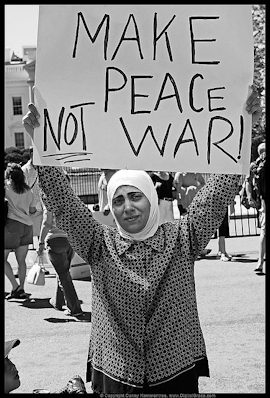
Make Peace. Photo: Danny Hammontree, flickr

What if they gave a war and nobody came?” is a popular slogan from the antiwar-movement. But nowadays, when USA with their allies go to war in Iraq and Afghanistan, people do come. Lots of people enlist in the military, even voluntarily, especially in the U.S. Why?

Anthropologist Sarah Salameh answers this question in her master’s thesis Courtesy Of The Red, White And Blue. A Midwest American Perspective on Troops, War and Nation.

She’s been on a six months’ fieldwork in a small town in the upper Midwest, a rather conservative and patriotic area that struggles with deindustrialization, low wages and unemployment. Salameh – an opponent of the U.S wars in Afghanistan and Iraq – describes the six months “as the most interesting and mind blowing time of my life.”

And it is indeed an interesting and well written thesis about “one of the most understudied groups”: white middle-class Americans.

She introduces us to a diverse group of military people:

The many settings the reader is introduced to includes an Army recruiting office, a public elementary school, Memorial Day celebrations, the motorcycle group the Patriot Guard Riders‟ missions, and the celebration of a National Guard unit returning home from Iraq. One gets to know people ranging from Army recruiters to the girls they helped enlisting at the age of 17, the concerned mother of a soldier, and a bunch of rather unconcerned 5th graders performing their patriotic duty decorating their town‟s cemetery with Star Spangled Banners.

One of her findings is the critical distance many soldiers have towards the government.

While in uniform, the anthropologist writes, soldiers are not allowed to speak negatively about the President. But in reality, as Robert, one of the soldiers, told her “The troops fight for the people, the American people, not the government. Neither the troops nor the people like the government.”

The official reason for waging a war is not always relevant for the soldiers. Looking at peoples‟ motives for joining the military, Salameh writes, “underlines the irrelevance of government and politics”.

Not one person she’s talked to (around 100) claimed to have joined the military because he or she thinks that this or that exact war is especially just or necessary as it is explained by politicians.

Robert is one of them. He did not believe the official explanation of the Iraq war (weapons of mass destructions). At times, Robert claimed the Iraq war is a quest for oil.

But he doesn’t care:

I am going for other reasons than oil. When I was in Iraq, I built schools, and handed out backpacks and paper to school children. I fixed dams so the people could have electricity. I spent two years totally committed to doing stuff like that.
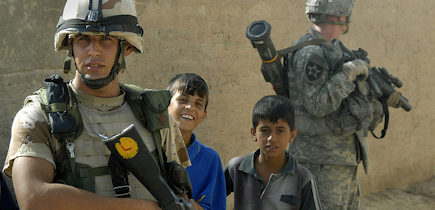

U.S. Army Soldiers in Iraq. Photo: Scott Taylor, U.S.Army, flickr

The research subjects explained and mostly legitimized the US military presence and their own participation, with a reference to themselves as Americans.

Robert places American politicians outside these “American people. He places himself, as a service member, on the side of and fighting for, the American people, not the government.

The anthropologist explains:

People and troops, the government and the people make up two societies that act according to two different value systems; the politicians according to a rather crooked one, initiating wars on unjust premises and ignoring the will of the American people; the American people according to what might perhaps be termed a more American one, expressed in Robert‟s account as focused on a wish to keep his own family and other Americans safe and free, and help Iraqis towards a better life.

Help Iraqis towards a better life? That’s in the eyes of the soldiers their responsibility as Americans. The USA is in their view a positive example for other countries, an example to follow. It seems to me they are on a kind of religious mission.

This religious dimension is interesting. Salameh discusses American nationalism as “civil religion”:

Much of the (…) USA and its military, can be understood within the context of civil religion, wherein the nation is the focus of belief, and its endeavours overseas is the spreading (missionary function) of the values inherent in the „national belief‟.

One of the dogmas of this “civil religion” is the idea that God has a special concern for America, putting Americans in the role of the chosen people, and America in the role of the promised land:

This is connected to the story of the American foundation, taking the form of myth, where today‟s American‟s ancestors came to this promised land and made a covenant with it, still binding today‟s Americans. The covenant has two aspects: to maintain the concept of promised land, basically to keep the USA free, as underlined by for example Robert, as well as to „export by example‟ the American version of freedom.

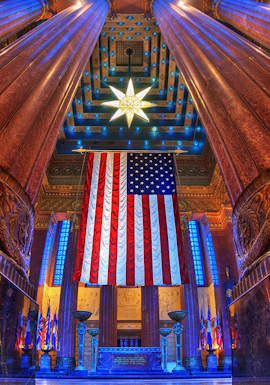
Indianapolis War Memorial Shrine Room.
Photo: Carl Van Rooy, flickr

She also describes the flag as totem, and blood sacrifice as an American group taboo.

At Memorial Day sacrifice was a central theme. “What soldiers in the Army do is to give up their life for others‟ freedom”, an army recruiter explained.

Tony‟s 5th graders stood up, faced the flag on the left side of the blackboard, put their right hand on the left side of their chest and said the Pledge simultaneously with the principal‟s voice. Everybody knew the Pledge by heart and said it out loud: I pledge allegiance to the flag of the United States of America and to the republic for which it stands: one nation under God, indivisible, with liberty and justice for all.

But do people in Iraq and Afghanistan really want their help? What about the widespread opposition towards the US wars?

This question is not very relevant for the research subjects. Even if the the people the USA tries to help reject the help, the USA‟s efforts are legitimate.

“It is as if the people on the receiving side of, what by the Americans is presented as „help‟, are not in a position to judge whether what the US presence offers is good or bad”, Salameh comments.

This remembers of what Edward Said describes as orientalism.

People in the Orient have frequently been portrayed as more passionate, more violent and barbaric, as well as culturally determined. This „savaging‟ of the Orientals has justified European and American imperialism throughout history, often presented as a civilizing project.
(…)
And in the very same act as „the West‟ thus diagnoses other countries as less developed, „the West‟ also categorizes them as passive (they are weak, ill), thus allowing for a paternal role.

For the research subjects, there are “good others” and “bad others” in Iraq and Afghanistan:

There is the „good Other‟ who takes the form of some sort of deprived, but possible, allied and member of the „free world‟; in the accounts above termed „innocents‟, „civilians‟, „the people‟ (of Afghanistan and Iraq), or simply „Afghanis‟ and „Iraqis‟. Opposed to this, exists a „bad Other‟ that cannot possibly be helped, thus only fought. This bad Other carries many different names, among them „terrorists‟, „insurgents‟, „extremists‟, „radicals‟, and to a varying degree also the Iraqi and Afghani „leaders‟ and „government‟ are included.

Although nationalism is important, she stresses that she does not claim it is the only, or the most central factor. There are many individual factors (escaping from smalltown life etc). Economic incentives are often central when people decide to join the military in the first place, and “a thesis could have been written on economy as incentive alone””.

Sarah Salameh is currently turning the thesis into a book where she will include on all those other factors as well.

The whole thesis is available online. (LINK UPDATED 4.4.2020)

SEE ALSO:

Thesis: That’s why there is peace

Secret rituals: Folklorist studied the military as an occupational folk group

Embedded anthropology? Anthropologist studies Canadian soldiers in the field

War in Iraq: Why are anthropologists so silent?

Military anthropologist starts blogging about his experiences

More and more anthropologists are recruited to service military operations

Make Peace. Photo: Danny Hammontree, flickr "What if they gave a war and nobody came?" is a popular slogan from the antiwar-movement. But nowadays, when USA with their allies go to war in Iraq and Afghanistan, people do…

Read more

The return of colonial anthropology?

“A dysfunctional ethnic and tribal brawl has been the norm in Afghanistan for centuries. Afghanistan is a mess. ” Who said that? A frustrated U.S. military officer? No, a professor of anthropology, Robert L. Moore.

In his article Tribes, Corruption Ail Afghanistan in The Ledger he shares his concerns about the difficulties for “us” (=the U.S. military) to “push this contentious country into the 21st century” and turn it into a “normal, stable country” that will be “governable in the way that most nations are”.

His main point: Afghanistan is an ethnic and religious mess:

Afghanistan is a mess. It is populated by a multitude of ethnic groups, the dominant ones being Pashtun, Tajik, Hazara and Turkic. Many of these groups are further subdivided into traditional tribes whose members regard loyalty to their tribe or clan as more vital than loyalty to any nation or government. Alongside these tribal and ethnic divisions are religious differences that separate Shi’a from Sunni Muslims. The upshot of all this is that Afghanistan is not governable in the way that most nations are.

“In this harsh landscape”, he continues, “our efforts to “stabilize” Afghanistan cannot bring about rapid dramatic change”:

There are areas of Afghanistan, mainly non-Pashtun regions, where the Taliban are deeply distrusted and in these areas our troops might be welcomed. But would our fighting on behalf of, say, Tajiks (who, by the way, are ethnic cousins of Iran’s Persians) help solve Afghanistan’s long-standing problem of ethnic conflict? It is more likely to simply add another dimension to the dysfunctional ethnic and tribal brawl that has been the norm in Afghanistan for centuries.

Ethnic mess – apartheid as ideal? U.S-military=”us”. “Anthropology= serve those in power” – Sounds like 19th century colonial anthropology!

Over at Zero Anthropology, Maximilian Forte gives an overview over European press coverage of U.S. Army’s Human Terrain System and its embedding of civilian social scientists in Afghanistan and Iraq.

SEE ALSO:

Sheds light on the collaboration between science and colonial administration in Naga ethnography

Army-Anthropologists call Afghans “Savages”?

“No wonder that anthropology is banished from universities in the ‘decolonized’ world”

The dangerous militarisation of anthropology

The Five Major Challenges for Anthropology

“A dysfunctional ethnic and tribal brawl has been the norm in Afghanistan for centuries. Afghanistan is a mess. ” Who said that? A frustrated U.S. military officer? No, a professor of anthropology, Robert L. Moore.

In his article Tribes, Corruption Ail…

Read more

No more conferences in Arizona: Anthropologists condemn Immigration Law

Even (seemingly?) rather conservative organisations are able to act and protest: In an official resolution, passed on Saturday, The American Anthropological Association has condemned the new immigration law in Arizona.

The association will refuse to hold scholarly conferences in Arizona until the law is ”either repealed or struck down as constitutionally invalid”, as we read in the AAA blog:

“The AAA has a long and rich history of supporting policies that prohibit discrimination based on race, ethnicity, national origin, religion or sexual orientation,” AAA Executive Board Member (and resolution author) Debra Martin said in a statement issued today. “Recent actions by the Arizona officials and law enforcement are not only discriminatory; they are also predatory and unconstitutional.”

The AAA describes the so-called Arizona Senate Bill (SB) 1070 as ”the broadest and most strict law on immigration enacted in generations”. The organisation sees the law as a movement to target and harass Arizona’s large population of Hispanic immigrants.

>> read more on the AAA blog

In December, the AAA condemned the coup in Honduras. And in 2006, the AAA stood up against torture and the occupation of Iraq

Last week, Indigenous and American Indian Studies scholars called for an economic boycott of Arizona.

See also the post at Savage Minds: Whiteness as Ethnicity in Arizona’s New Racial Order

Arizona immigration law sparks controversy

SEE ALSO:

Demonstrations against tougher immigration policy = birth of a new civil rights movement?

“Anthropologists Should Participate in the Current Immigration Debate”

Interview with Arjun Appadurai: “An increasing and irrational fear of the minorities”

Why borders don’t help – An engaged anthropology of the US-Mexican border

More Global Apartheid? New French immigration law

“Discuss politics!” – How anthropologists in Indonesia engage with the public

Even (seemingly?) rather conservative organisations are able to act and protest: In an official resolution, passed on Saturday, The American Anthropological Association has condemned the new immigration law in Arizona.

The association will refuse to hold scholarly conferences in Arizona…

Read more