search expand

Fieldwork among homeless heroin and crack users – new book by Philippe Bourgois

cover

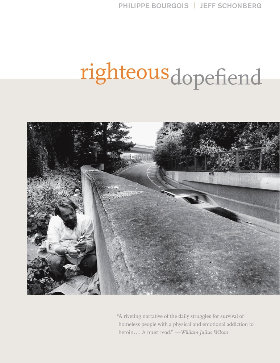
In Search of Respect. Selling Crack in El Barrio” is one of my favorite ethnographies. Now, Philippe Bourgois, is out with a new book. In “Righteous Dopefiend“, he looks at the clients of the dealers, the University paper Penn Current reports.

The paper published a interesting interview with him that also touches the popular topic “anthropology at home”. Bourgois conducted his fieldwork among homeless heroin and crack users a mere six blocks away from his San Francisco home. He spent lots of time with them, and even slept outside in homeless encampments to gain a true sense of what life is like for the addicts.

What happened? People in the neighborhood began to think that the anthropologist must be one of the addicts as well:

During the intense years, when I’d be hanging out on the corner, people in the neighborhood just took for granted that I was either a drug addict or someone about to fall into drug addiction.

I remember being embarrassed in front of my son’s friends, because my son at this time was about seven years old when I started the project, and so all of his friends lived in the neighborhood and would say, ‘I saw your father hanging out on the corner where all the drug addicts are.’ I was worried about my son’s friends’ parents, because they were seeing me.

But although the addicts lived so close to the neighborhood, they were invisible. It was “mind-boggling”, he says, that he literally had to walk not more than six meters through a little thicket in order to enter a totally separate universe:

You can hear all these people, I mean, literally, hundreds of people at rush hour, walking to the bus stop, and you’re in this separate universe, and the two don’t touch. You can spend several hours in this separate universe listening to people go by and they don’t look through the bushes and notice these people. You almost feel falsely protected in this cocoon. 
People don’t want to see it, either, and the point of my book is to make it visible.

Bourgois connects the daily life in the thicket with larger structures in the society:

(W)hat is terrifying is seeing – and this is in a sense what the book is about – how structural forces beyond our control, historical forces, shifts in the economy, shifts in the political organization of public policy, come crashing down on vulnerable sectors of the population and basically shove them around in very unpleasant ways.

These are the people who weren’t able to recover from the downsizing of the industrial sector in the United States. A bunch of other types of industries arose in place of that, but those people who aren’t able to make that adjustment, those people who don’t have the education to shift from being a factory worker to being an information technology processor, are people who fall into indigent poverty.

The guys that we studied – their parents were the people who lost their jobs working on the docks of San Francisco, working in the steel mills, working in the warehouses that were serving the active factory sector of San Francisco as a port industrial city. 
These are forces that are much larger than the will of any individual or the moral ability of any individual to act in a way that’s going to make them a productive member of society. The book is trying to show those dynamics and when you dig deeper you then see these other patterns, that whites are affected by this very differently than African Americans.

Over half of his informants have passed away during the study and in the two years since the end of the actual field work.

>> read the interview in the Penn Current

>> download the first chapter of the book

On his website, he has published lots of papers!

UPDATE Long article about the book in The Chronicle Review: An Anthropologist Bridges Two Worlds. See also the comment by Eugene Raikhel at Somatosphere

SEE ALSO:

The most compelling ethnographies

Is the anthropologist a spy? New Anthropology Matters about fieldwork identities

Study: Drug smuggling as vehicle for female empowerment?

cover

"In Search of Respect. Selling Crack in El Barrio" is one of my favorite ethnographies. Now, Philippe Bourgois, is out with a new book. In “Righteous Dopefiend", he looks at the clients of the dealers, the University paper Penn Current…
Read more

Mahmood Mamdani: “Western concern for Darfur = Neocolonialism”

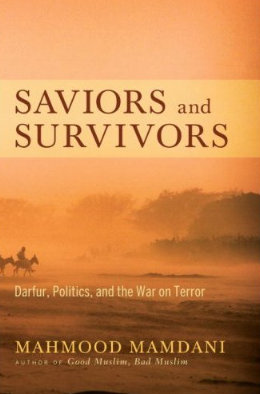
300 000 people have been killed and 2.5 million been made refugees in the war in Darfur. In his new book, anthropologist Mahmood Mamdani describes the Save Darfur campaign as representing a refracted version of the moral logic of the “War on Terror” with the Arabs in both cases branded as evil, Alex de Waal writes in The Monthly Review.

Mamdani writes:

The Save Darfur lobby demands, above all else, justice, the right of the international community — really the big powers in the Security Council — to punish “failed” or “rogue” states, even if it be at the cost of more bloodshed and a diminished possibility of reconciliation. More than anything else, “the responsibility to protect” is a right to punish without being held accountable — a clarion call for the recolonization of “failed” states in Africa. In its present form, the call for justice is really a slogan that masks a big power agenda to recolonize Africa.

Mamdani criticizes Save Darfur as mobilizing “child soldiers,” by which he means naive American students, in a campaign that diminishes Africans as part of an argument to “save” them, G. Pascal Zachary notes in his review.

Zachary is one of several scholars who discuss Mamdanis book Saviors and Survivors. Darfur, Politics, and the War on Terror on their group blog Making Sense of Darfur.

Zachary is a huge fan of Mamdani but feels that “like almost everyone else who speaks on Darfur, Mamdani too has another agenda”:

Like all those he complains about who use Darfur to score points on matters of greater importance to them – repressive Islamic regimes, Christian tolerance, the value of military intervention, etc – Mamdani too subordinates Darfur to a broader set of stories he wants to tell about dysfunctional American power in the world, about misunderstood Muslims, about an Africa violated by Westerners from every point of the political spectrum. Mamdani may be right about all of these larger stories, but just he is wrong to exploit Darfur – as wrong as those he finds guilty of doing the same.

>> read the whole text “Mamdani and the Uses of Darfur”

>> Saviors and Survivors (Monthly Review 13.4.09)

>> What Does Darfur Have To Do With The “War On Terror”? Kevin Funk, Making Sense of Darfur, 19.4.09)

>> The Darfur the West Isn’t Recognizing as It Moralizes About the Region (New York Times, 30.3.09)

>> Mahmood Mamdani: You (and I) got Darfur Wrong (Radio Open Source 3.4.09)

In an interview with the Boston Globe, the anthropologist explains his interest for the Darfur case:

In a context where African tragedies seem never to be noticed, I wondered why Darfur was an obsession with the global media. The reason, I realized, was that Darfur had become a domestic issue here, thanks to the Save Darfur movement. So I thought it important to examine the movement’s history, organization, and message.

(…)

I’m struck by the contrast between the mobilization around Darfur and the lack of mobilization around Iraq. The explanation, I believe, lies in the fact that Save Darfur presented the conflict as a tragedy, stripped of politics and context. There were simply “African” victims and “Arab” perpetrators motivated by race-intoxicated hatred. Unlike Iraq, about which Americans felt guilty or impotent, Darfur presented an opportunity to feel good.

(…)

The language of human rights was once used primarily by the victims of repression. Now it has become the language of power and of interventionists who turn victims not into agents but into proxies. It has been subverted from a language that empowers victims to a language that serves the designs of an interventionist power on an international scale.

>> read the whole interview

I wrote about Mamdani and Darfur earlier, see Mahmood Mamdani: “Peace cannot be built on humanitarian intervention” and about earlier books Book review: Mahmood Mamdani: “Good Muslim, Bad Muslim”

300 000 people have been killed and 2.5 million been made refugees in the war in Darfur. In his new book, anthropologist Mahmood Mamdani describes the Save Darfur campaign as representing a refracted version of the moral logic of the…

Read more

University Cancels Alternative G20 Summit – Academics Occupy University of East London

Academic freedom and freedom of speech is more and more under threat in the “Western world”: First, the University of East London (UEL) suspended anthropology professor Chris Knight, now they cancel the Alternative summit that should take place at the University campus, the Guardian reports.

A petition was launched to keep the university open. According the Alternative Summit website, academics and students have started to occupy the university:

Despite management efforts to shut down the Alternative London Summit on Wednesday 1st April organisers and speakers are committed to making sure the event goes ahead at the University of East London as planned.
(…)
Organisers are appealing to the public to join academics, union representatives and students in the occupation of the university in order to ensure that prominent political, scientific, academic and activist speakers who have remained committed to the event will be free and able to speak as planned.

It is vital at this pivotal moment in British and world history that we, the people have a public platform to understand and act on alternative ideas and strategies for our political, environmental and economic future.

According to Bernadette Buckley, from the politics department of Goldsmiths, the shut down of the UEL is “an astonishingly grim reflection on the state of academic freedom today.”

“The university is turned into a wasteland in the very moment when the university should instead be up to the task of hosting critical debate and be a hub of creative energies. This is not just about UEL, but about reclaiming universities and education in these times of crisis”, a member of the Chris Knight Reinstatement Solidarity Group on Facebook said.

“I guess the summit organizers are now openly admitting what they’re really afraid: and it isn’t molotov cocktails. It’s ideas”, the first signatory wrote.

A spokesperson for the university explained “that the potential scale of the event and associated risks had become unmanageable, and we would be unable to accommodate safely an event of this nature.”

>> Alternative G20 summit cancelled – University of East London shuts down for duration of G20 talks and cancels alternative summit (Guardian, 31.3.09)

>> Opposition grows as UEL shuts down for G20 (Wharf 31.3.09)

>> Alternative London Summit Press Release

>> Petition To the Corporate Management Team (CMT) of the University of East London

>> Analysis by Maximilian Forte at Open Anthropology

SEE ALSO:

“Intolerant Universities”: Anthropology professor Chris Knight suspended over G20-activism

Financial crisis: Anthropologists lead mass demonstration against G20 summit

How anthropologists should react to the financial crisis

Academic freedom and freedom of speech is more and more under threat in the "Western world": First, the University of East London (UEL) suspended anthropology professor Chris Knight, now they cancel the Alternative summit that should take place at the…

Read more

“Intolerant Universities”: Anthropology professor Chris Knight suspended over G20-activism

(UPDATE: Alternative Summit cancelled, university occupied) Shortly after The Sunday Telegraph wrote that anthropologist Chris Knight is one of the organizers of a mass demonstration against the G20 summit in London, he was suspended from his job at the University of East London, several British newspapers report.

According to the BBC and The Times he was suspended because of the comments he made in an interview for BBC radio.

Chris Knight, (or Mr. Mayhem according to the Evening Standard) said:

“We are going to be hanging a lot of people like Fred the Shred [Sir Fred Goodwin] from lampposts on April Fool’s Day and I can only say let’s hope they are just effigies.

“To be honest, if he winds us up any more I’m afraid there will be real bankers hanging from lampposts and let’s hope that that doesn’t actually have to happen.

“They [bankers] should realise the amount of fury and hatred there is for them and act quickly, because quite honestly if it isn’t humour it is going to be anger.

“I am trying to keep it humorous and let the anger come up in a creative and hopefully productive and peaceful way.

“If the other people don’t join in the fun – I’m talking about the bankers and those rather pompous ministers – and come over and surrender their power obviously it’s going to get us even more wound up and things could get nasty. Let’s hope it doesn’t.”

>> G20 protest professor suspended (BBC, 26.3.08)

>> Anarchist professor Chris Knight suspended after G20 ‘threat’ (The Times, 26.3.08)

>> Protest website G 20 Meltdown

>> The Guardian G20-overview and updates

Professor Chris Knight’s suspension for voicing anti-G20 sentiments is a sign of how intolerant universities have become, writes Rupa Huq in The Guradian.

The incident is “symptomatic of how university management culture has changed”:

The introduction of fees over the past decade has meant universities adopting more business-like ways, serving paying customers rather than Young Ones-style indolent students.
(…)
To some extent, as the polytechnics became universities, the universities underwent a degree of polytechnic-isation too: new and different types of courses appeared ¬– programmes with vocational outcomes and “transferable skills” in place of critical thinking. Exams were shunned in favour of continuous assessment, reflecting the changing needs for skills-based provision to produce good workers to service the economy

At least two Facebook groups have been formed already: Reinstate Professor Chris Knight and Chris Knight Reinstatement Solidarity Group (via Max Forte on twitter)

One of the group members posted a comment by Chris Knight:

“Management at UEL are telling the press the Alternative Summit (http://www.altg20.org.uk) may not happen. Meanwhile, they are actively sabotaging the Summit by crashing the only e-mail we have been using to organize it and by countermanding all requests to the UEL print-shop to produce vital publicity material. Not to mention barring me from getting into my own room on campus which until now has been the organizing centre.

They have done nothing to convince me that they will be respecting Earth Hour from 20.30 this evening. Maybe some of us should get down there around 19.30 tonight? We could then use UEL campus to enforce Earth Hour, secure the Summit venue and uphold the rule of law. I will certainly be down there.”

Comments from group members:

wherever you work you have a point of view about what is going on in the world…how dare jobs be threatened just because of your views…..
they can never stop what we think!!!!!!!

—-

I do support the reinstatement of Professor Knight as it looks like his university have thoroughly overreacted, but I think the anger at the city, specifically, is misplaced. Bankers have behaved as they were encouraged to within the logic of capitalism – it’s not a case of if they’d been a bit less greedy we could have had some version of “good” or “compassionate” capitalism; the entire system is the problem, not a figurehead bunch of bankers.

“Think theyve been trying to find an excuse to suspend him, personally though the move to suspend him over what was said is a stupid move; it shows nothing but UEL being an institution where individuality and political opinion is barred.”

UPDATE: Maximilian Forte at Open Anthropology comments:

Perhaps the most “threatening” thing Dr. Knight has said is to caution the police not to use violence. He is making a perfectly legitimate point, that has been made many times over the centuries, even from the seats of monarchic power and the Vatican: closing off avenues for peaceful protest and dissent will justify, legitimate, and even mandate more violent action for necessary and urgent change.

More anthropologists in action in London at the Alternative London Summit 2009 – here an excerpt from the anthropology section (!):

– David Graeber will be analyzing the banking crisis from a 5,000-year historical perspective.

– Jerome Lewis will adopt a hunter-gatherer perspective on the crisis, explaining how life is possible without hierarchy, money or notions of inevitable scarcity.

– Neil Bennun will be drawing on South African Bushman mythology to illustrate how “Another world is possible”.

SEE ALSO:

Financial crisis: Anthropologists lead mass demonstration against G20 summit (my post 5 days ago)

Blogging and Public Anthropology: When free speech costs a career

Bush, “war of terror” and the erosion of free academic speech: Challenges for anthropology

Engaged anthropologists beaten by the Mexican police

USA: Censorship threatens fieldwork – A call for resistance

Neoliberal applied anthropology: Who owns the research — the anthropologist or the sponsor?

(UPDATE: Alternative Summit cancelled, university occupied) Shortly after The Sunday Telegraph wrote that anthropologist Chris Knight is one of the organizers of a mass demonstration against the G20 summit in London, he was suspended from his job at the University…

Read more

Financial crisis: Anthropologists lead mass demonstration against G20 summit

(Update: Chris Knight suspended over G20-activism) The G20 summit in London next month may be marked by one of the biggest demonstrations since a million people marched against war in Iraq in 2003. According to The Sunday Telegraph, the demonstrations are being organised by anthropologists Camilla Power and Chris Knight.

Under the slogan “Storm the Banks”, the two members of The Radical Anthropology Group are urging the public to vent its anger on the financiers and bank executives many blame for the global economic crisis. They think it is necessary to question or even overthrow capitalism – a taboo topic for the ruling elites.

Very interesting: The Telegraph writes that the two anthropologists work at the University of East London, which is based close to the headquarters of some of the world’s biggest banks. The University is “proud of its links with the City of London and multinational companies based in London”.

The paper quotes the university’ website who “boasts“:

“We are committed to do all we can to ensure that our expertise is made available to benefit business and society. Utilising the wealth of expertise, research capabilities and facilities at UEL our solutions help companies to become more profitable, more competitive and more sustainable.”

(Or take a look at the frontpage of the university and study the language: Is this a university or a oil company or even a bank??)

Anyway, Camilla Power thinks her role in organising the protests does not conflict with her position at UEL and says:

“What our university management thinks is good for students and academics does not always accord with what students and academics think is good for them.”

But maybe they don’t disagree at all? A spokeswoman for UEL said (diplomatically?):

“The University of east London includes a range of academic disciplines and individual academics who advocate a range of viewpoints. We are proud of our diversity, which fosters a spirit of critical inquiry, and we support freedom of debate. We are also proud of our active partnerships with business.”

As often the case when people take to the streets, the media are mostly interested in writing about violence and “the worst public disorder for a decade“. . Up to 3,000 police officers will be on the streets. Armed undercover officers will mingle in the crowds while police snipers will be stationed on rooftops.

>> read the whole story in The Sunday Telegraph

>> Protest website G20 Meltdown

SEE ALSO:

How anthropologists should react to the financial crisis

Anthropologist Explores Wall Street Culture

After the Tsunami: Maybe we’re not all just walking replicas of Homo Economicus

The Internet Gift Culture

“Anthropology needs to engage in an activist way”

(Update: Chris Knight suspended over G20-activism) The G20 summit in London next month may be marked by one of the biggest demonstrations since a million people marched against war in Iraq in 2003. According to The Sunday Telegraph, the demonstrations…

Read more