search expand

Journal of European Ethnology is going (a little bit) Open Access

cover

Is Open Access the new buzz-word? Do we see some change in the world of anthropology journals? Angels Trias i Valls recently announced the birth of a new open access journal, Anthropology Reviews: Dissent and Cultural Politics.

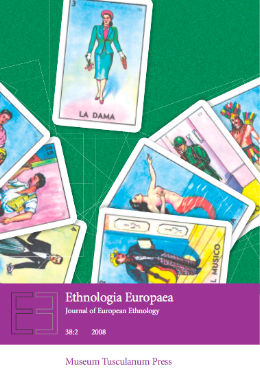
And last week, I received an email by Thomas Mogensen, the editor of Ethnologia Europaea. Journal of European Ethnology. He promoted his journal among other things by informing that they support open access publishing. Back issues (older than three volumes) are open access.

And he wrote:

As part of our policy in support of open access publishing, we also would like to offer you a free copy of one of the articles from the latest issue (vol. 38:2). You can access and distribute the article free of charge by using this link: http://www.mtp.dk/pdf/Is_East_Going_West-Or_is_the_West_Moving_East

If we take a look at the previously published volumes, we’ll find out that only back issues from 2004 and newer are freely available. Marketing Manager Niels Stern explains that they only had funds to digitize volumes published since 2001 (they were digitized in 2004). “But of course we would like to go further back”, he writes in an email to me. Being a non-profit publisher, they are still looking for funding initiatives that could aid in this respect.

At the same time, one of the larger commercial publishers is involved in a scandal. Elsevier has been lobbying against the open access movement for a long time on the grounds that open access journals can’t be trusted. Now they confirm that they have put out six fake journals. They look like peer reviewed but were sponsored by unnamed pharmaceutical companies. >> more info at Open Access News

Is East Going West – Or Is The West Moving East is the title of the open access article in the most recent issue og the Journal of European Ethnology.

For her doctoral thesis on (East) German identity-formation in today’s unified Germany, Sofi Gerber has conducted biographic interviews with persons who were born and grew up in the GDR and who now live in unified Germany.

She writes:

The most striking thing in the interviewees’ picture of the Eastern parts of Germany is their general de- scription of a society falling into decay. Contradictory to the hopes invested in the program Aufbau Ost (Re-Build the East), which has invested enormous amounts in the New Federal Republics’ infrastructure and buildings, the interviewees seem, rather, to describe an Abbau Ost (Dismantling the East). My interviewees’ narrations include an othering of big parts of Eastern Germany, as a place in which it is impossible or undesirable to live.

But the East–West boundary is not only reified, but also transcended by the interviewees:

This is articulated both implicitly, in that the interviewees stress other identifications, and explicitly, in that the dichotomisation is described as irrelevant or outdated. (…)
The identification with a region or a town can be described as superior to the East–West identification (…).
Most of the interviewees now living in Berlin identify themselves with the city, mostly because of what they describe as its openness, rawness and charm. Berlin is then not only a geographical place, but also a way of living, which is contrasted with the narrow-minded life in the countryside or the superficial life in other cities.
As described earlier, both of these contrasts can be associated with the East and the West respectively, but the special aura of Berlin can also be described as something extraordinary, transcending this dichotomisation. Even when the interviewees identify themselves with one district, this identification is often described as independent of the former border.

>> visit Ethnologia Europaea. Journal of European Ethnology

SEE ALSO:

New overview over open access anthropology journals

Open Access Anthropology in Africa – an introduction

Open access to all doctoral dissertations at Temple University

Why Open Access?

cover

Is Open Access the new buzz-word? Do we see some change in the world of anthropology journals? Angels Trias i Valls recently announced the birth of a new open access journal, Anthropology Reviews: Dissent and Cultural Politics.

And last week, I…

Read more

Anthropology, islam and homosexuality

Anthropology student Lykke Bjørnøy sent me an article on homosexuality and islam that she wrote as part of her studies at the University of Cairo. She tries to understand why homosexuality often is demonized. Not only in Islam, but also in Christianity (and other religions I suppose), homosexuality is a touchy subject.

It is (as always) work in progress and Lykke Bjørnøy is interested in getting feedback and comments:

Are homosexuals impure according to Sunni Islam?

Written by Lykke V. Bjørnøy

Last year I lived in the noisy metropolitan city of Cairo. Living there as a western, blond girl, my thoughts about discrimination and womens’ rights was flourishing in my head. I have never been so visible in my life and I wondered: Are there other groups that are invisible, but feel even more visible than I did? I looked different than all the others. However, I didn’t feel different.

Almost every religion has an opinion about homosexuals, or at least a view on sodomy. In Christianity sodomy is considered as “a sin against nature” and it’s the same in Judaism where it’s written in Leviticus: “[A man] shall not lie with another man as with a woman” Leviticus 18:22), both Christians and Jews are referring to this particular verse when the issue about homosexuality is questioned.

Islam doesn’t have the same clear restrictions on this subject, like other religions, but there are several hadiths and views on the topic. Islam contains much more written and boundary filled sexuality than Christianity. The Qur’an for instance is filled with restrictions according to sex, how it’s done, who it’s ought to perform and what time it should be done. One of the reasons for this can be the prophet Muhammad behavior, he was a sexual man in a contrast to Jesus. For the Prophet to cope with all the difficulties that could appear concerning sexual actions and the interaction with all his wives, he made restrictions and rules that would help the participants to deal with the conflicts that could emerge.

However, rules that are related to the control and restrictions against sodomy and sex in general is not just special for Islam, but all the religions, there is a set of laws in most holy texts, especially about the outsiders and the un-traditional actions that can take place in a society. The religion creates boundaries for the participants hence; it’s a way to deal with elements that need restriction or are considered unusual. Homosexuals have a different position and status than the mainstream in a society, and sometimes they are not even acknowledged. The president of Iran, Ahmadinejad, said on Fox News that they didn’t have a problem with homosexuals because they didn’t exist. Even though Ahmadinejad is seen as a Shi’a, his point still stands, his impression of homosexuality is just another act of sodomy which is not prohibited.

In order to understand the reasons why homosexuals often are considered as heathens, and why they are frequently demonized, it is therefore necessary to examine the basis of the condemnation. Demonization is often related to sickness and disturbances and these themes will be discussed further as we go along.

Homosexuality as a sickness
If you ask any religious scholar about homosexuals you get many different answers. One of the issues that are frequently discussed is the linkage between homosexuality as a disease. And if it is a sickness is it curable? There are scientists who do research on this matter right now; the internet is loaded with organizations and pages that discuss this issue (www.narth.com). So why do some people have the cravings to solve the “un-normalities” in the society and why is it so frowned upon?

What is it about the homosexuals that are so obviously wrong that needs to be solved? One argument that has been questioned is the fact that homosexuals have no function in the society and in the world in general, hence there has to be something wrong with them. The lion eats the zebra, the zebra eats grass; the circle of life. With homosexuals the circle of life is not being fulfilled.

Mary Douglas argues in her book “Purity and danger” that every human has a certain feeling of order. That objects or people are seen as impure if they don’t fit in a specific system. If homosexuals don’t fit in circle of life, they cannot reproduce, for this reason they are seen as impure according to Douglas. Several imams states that “if everyone was a homosexual, the world would go under”, which is true in the long term, because there would be no reproduction. Or as I see it a perfect solution to solve the global problem of constant increasing world population.

Levi-Strauss’ argument about impurity builds around the imam’s statement. For him, impurity is often linked to progress and logic. He proves this by looking at why incest is prohibited in most societies. He claims that one of the reasons that incest is prohibited is because it only reproduces defected human beings, which in the long term would lead to the extinction of human kind. If homosexuality is seen as impure because of their lack of reproducing skills, then why would God created them?

Most religious scholars reject the fact that it’s biological, by that I mean that homosexuality is something one is born with or can inherit. This is often stated because God doesn’t differentiate between people, we are all children of Adam according to the Sunni tradition. The hollowness in our stomachs, the lack of control, these are all factors that make us all similar (Katz, 2002:177.) In spite the fact that we all are made from the same foundation, Adam lost his purity in the Garden of Eden because apparently – no man is perfect. Since humans are not faultless there are stories in the Qur’an and in the Bible about what happens to people that don’t behave themselves, commit sins or disobey God.

The most famous one is the story about “The People of Lot” that exist both in the Quran and in the Bible. “The people of Lot” commits sins, like sodomy. The word homosexuality is of course not mentioned in the Qur’an or the Bible because it’s a modern expression. We can’t find an expression that is even comparable with the English term that was first used in the early 19th century, but the closest we get to homosexuality in is the act of sodomy (Qur’an:302).

The People of Lot got punished by God for their behavior and their towns were “turned upside down, and rained on them stones of backed clay, in a well arranged manner one after another” (Quran: 82) Apparently, these cities were in Palestine which today is the Dead Sea. This is the only punishment mentioned towards sodomy, however it’s pretty brutal. There are discussions about how sodomy ought to be punished today in some countries especially the Arab world, some scholars say that they should be stoned to death and get the same treatment as those who commit adultery, on the other hand this interpretation of the Qur’an has been created after the time of the Prophet Mohammed and has its origins from the hadiths and not the Holy script itself.

In the legal sources there has been differentiated between a grand and a petty sodomy. The grand sodomy is the action that takes place between two men and requires death of both participants (Wright & Rawson 1997:116) according to legal sources. A petty sodomy is anal sex between a man and a woman, although sexual intercourse with the opposite sex is” legal” this action is also forbidden by the Sunni tradition (Ibid). Since the Qur’an doesn’t differentiate between peoples’ feelings for the same sex and the actions of sodomy, means that the acts of sexual intercourse is the factor that makes sodomy impure and forbidden, not the homosexuals themselves.

As I mentioned in the introduction, sexuality has been an important part of literature and has played a much bigger part in Islam rather than it has in Christian societies. The grand example of this sort of literature is “One Thousand and One Nights” that were written in the early 1900’s and is filled with stories which all have elements of sexual actions, including sodomy. The simplicity of the sexual actions that were taken place in these stories say that sexual actions were not frowned upon, but rather appreciated. Why sodomy has the status of being “The Sin” contains an arsenal of meanings. The sexual act of sodomy is seen as animalistic, and naturally the sexual image of dog sex may have it’s similarities to sodomy, since the modern term of anal sex is called “doggy-style” is not taken out of the blue.

Islam has its restrictions and guidelines toward sexual actions and distinguishes between minor and major ahdaths. One example of a major ahdath can be regular sexual intercourse. Reinhart argues in is article “Impurity no Danger” that there is no danger in being in an impure state as an answer to Douglas’ article. He argues that there is a lack of control that makes something impure, not that an object is out of place. Reinhart says that Douglas’s argument don’t stand because semen, tears and mothers milk is not seen as impure objects in Islam. So it’s the action of ejaculation that is seen as a lack of control and therefore gains the same status a laughter break-out during prayer.

On the other hand another anthropologist named Julie Marcus agrees with Douglas and says that the fluid of sexual liquid across the body boundaries is seen as crucial (Marcus 1992:78). In other words the only solution to prevent oneself from getting in a position of impurity, is control. Therefore, if one compares adultery with sodomy as comparable sizes the only way the actor cannot become impure, is restriction. And in fact if you resist your desires you get paid in heaven according to the Qur’an (Qur’an:200).

The social sexual hierarchy in Islam
One of the foundations in Islam are that women and men are ought to be treated equally since they are both made from the same soul (Qur’an:7.189). Men and women are different biologically and Islam has rules on how the sexes cooperate with their biologically differences towards Islam. There are restrictions on menstruation, childbirth, sexual actions etc. and these are all considered major ahdath so they require major ablution before entering a mosque or pray.

Marcus argues in is article “Islam, Gender and hierarchy” that there do exist a basic social hierarchy in Islam. She says that women are naturally under men in the social hierarchy. She claims that since women menstruate and give birth they are considered below men in the social hierarchy. The lack of control concerning menstruation places women in an impure position regularly, without the possibility to change her status. She continues in her article “hierarchy is achieved at the point at which women are constructed as uncontrolled (…)”(Marcus 1992: 88.). By this statement she says implicit that men have a way to control their impurity, hence achieve then the higher rank in the hierarchy.

I will take Marcus’ theory a little bit further and make the comparison with homosexuals. Where do they fit in Marcus’s theory? If we state Marcus theory as a fact, man to man sex doesn’t fit into the system. If the regular dichotomy doesn’t hold its normal position, the factor is then according to Douglas’s theory impure, because it’s a matter out of place, in other words it’s un-placeable. If the natural order in the sexual hierarchy is not maintained and when the inferior is changed with the superior we end up with two sizes that are exactly the same.

This theory still stands if one just discusses sodomy which could happen between the same sex and the opposite sex. It is honorable to be the penetrator and it’s a disgrace to be the one’s being penetrated (Wright & Rowson 1997:199). The ones who is the penetrator has the power and the ones receiving are the inferior and when the action is between two men the action itself creates a hierarchy not the actors themselves.

Conclusion
The concept of same-sex sexual interactions has a tendency to disgust religious scholars and an attempt of legalizing homosexuals’ rights is seen as another “Western influence”. One of the reasons why religious scholars don’t acknowledge homosexuals is that it is not written implicit in the Qur’an how to handle them, just the actions of sodomy. Homosexuality is “The Sin” in Islam; the causes are that the well-known and “normal” social hierarchy that is presented in the holy scripts and in nature as we know it, is being tampered with.

A meddled system always creates chaos, and at the same time destructs the natural order as well as creating impurity. Since the impurity is characterized by actions that are located in social hierarchies, the status of a homosexual is not seen as impure.

The fact that there are two masculine human beings having sexual intercourse Marcus’ hierarchy is not being fulfilled, where there ought to be one superior and one being the inferior. When the sexual hierarchy is in chaos, who is then there to help us get the system back on track, when religion is the one factor, according to Durkheim that creates a system in chaos. Since the sexual actions between two men create an unbalance, will there ever be a system that accepts the interactions between homosexuals?

Bibliography
Douglas, Mary “Purity and Danger” 1966
Marcus, Julie, “A world of difference. Islam and gender hierarchy in Turkey”, Sydney 1992
Katz, Marion Holmes, “Body of Text: The Emergence of the Sunni Law of Ritual Purity”
Ithaca, New York, U.S.A.: State Univ of New York Pr 2002,
Reinhart, Kevin “Impurity / No Danger” University of Chicago;1990
Wright, W Jr. & Everett K. Rowsen “Homoeroticism in Classical Arabic Litterature” Colombia University Press: 1997
Dr. Muhammad Taqi-ud-Din Al-Hilali & Dr. Muhammad Muhsin Khan “Al-Quran” Islamic University, al-Medinah al-Munawwarah

SEE ALSO:

Native American Tribe Allows Gay Marriage

A subculture of hefty, hirsute gay men is attracting the attention of academics

An anthropologist on sex, love and AIDS in a university campus in South Africa

Researched the sexual revolution in Iran

Anthropology student Lykke Bjørnøy sent me an article on homosexuality and islam that she wrote as part of her studies at the University of Cairo. She tries to understand why homosexuality often is demonized. Not only in Islam, but also…

Read more

New overview over open access anthropology journals

Today we celebrate the first Open Access Anthropology Day. For this occasion, I’ve made a new overview over open access journals in our field (anthropology, area studies and related stuff).

The overview is not complete, still under construction and needs some more system. But anyway, I was surprised over how many open access journals there are. I made many new discoveries. I’ll write more about them in later posts when I’ll have more time. Enjoy the new overview here: http://www.antropologi.info/links/Main/Journals

The overview is based on the Directory of Open Access Journals, the overview by EVIFA and earlier discoveries.

If you want me to add more journals, please leave a comment!

Also, take a look at Sara’s post Happy Open Access Anthropology Day where she sums up all the contributions to this day.

Today we celebrate the first Open Access Anthropology Day. For this occasion, I've made a new overview over open access journals in our field (anthropology, area studies and related stuff).

The overview is not complete, still under construction and needs…

Read more

Imponderabilia – new international anthropology student journal

screenshot

Wow! A new anthropology journal! Made by students worldwide. Imponderabilia is it called, and it is “the product of our love of, and frustration with, anthropology”:

The journal tries to overcome, erode, undermine and blur the boundaries between institutions and disciplines, between theory and practice and between undergraduates and postgraduates. We envision a space where students can share their research and exchange their views, criticisms and reflections on anthropology through articles, interviews, photography and other creative methods.

Imponderabilia draws on the thoughts and insights of students from universities across the world; it represents a genuine dialogue between authors, editors and peer reviewers many of whom have been in contact during the process of planning, writing, and rewriting. Authorship therefore transcends university degrees and field sites and we hope the journal can develop into a platform for the sharing of our common, yet unique experiences of studying and ‘doing’ anthropology.

The first issue (spring 2009) consists of several dozens articles – there are interviews about visual and activist anthropology, text about activists and police at a Climate Camp, the significance of gossip, learning and teaching anthropology, and much more including poetry.

And the journal, based in Cambridge University (UK), exists both in a pdf version (even print?) and an “extended online version” – open access for all of us.

Imponderabilia, by the way means “a series of phenomena of great importance which cannot possibly be recorded by questioning or computing documents, but have to be observed in their full actuality” ( Malinowski 1922)

>> visit Imponderabilia (updated Link with copy from Internet Archive, journal closed down)

On their website I found two other student journals I haven’t mentioned before (local ones though): Abantu (University of Cape Town, South Africa) and Problematics (Stanford University, USA)

screenshot

Wow! A new anthropology journal! Made by students worldwide. Imponderabilia is it called, and it is "the product of our love of, and frustration with, anthropology":
The journal tries to overcome, erode, undermine and blur the boundaries between institutions and disciplines,…

Read more

Why we need more disaster anthropology

cover

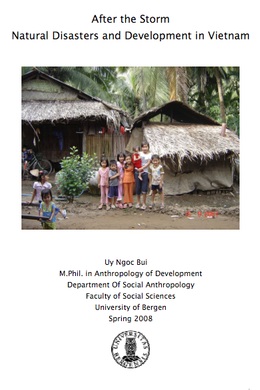
On the 5th of December 2006, typhoon Durian hit Bến Tre province in Southern Vietnam. Close to 100 people died, more than 800 moored fishing boats sank, thousands of buildings collapsed including schools and hospitals. In her master’s thesis, Uy Ngoc Bui looks at how this event changed peoples’ lives and explains why we need more disaster anthropology.

In this extremly well written thesis at the University of Bergen (Norway), Uy Ngoc Bui looks at the role of NGOs, the state and the people themselves’ in the period after the disaster. Although the government and the NGOs did a significant job in handling typhoon Durian the real heroes were the people themselves, who helped one another in a time of great need, she writes:

They showed great courage, endurance and solidarity by overcoming this challenge. As such, it is perhaps no surprise that my study concurs with the many previous studies which state that disaster management is very dependent on the participation of the community, and their strengths and efforts can determine the outcome of the disaster.

Therefore it is important to study peoples’ knowledge and coping mechanisms:

In disasters as floods and tsunamis, traditional knowledge acts as warning signs which can be read ahead of time, saving many lives. This type of information should be spread wherever it is useful, as Red Cross has done in Vietnam.
(…)
I believe that thorough research into traditional knowledge and local coping mechanisms should be emphasised as they are a type of accumulative knowledge which has been passed on throughout generations, adapted to their specific environment. This type of knowledge is valuable because it is not written down, and if is lost, it will be lost forever. Here anthropology has an important job to do.

There are lots of topics to study for anthropologists, for example the local-global linkages and the reconstruction work:

My experience is that more research should be done on the bridging of relief aid with long term reconstruction and development. Relief aid has become more efficient and standardised, which is positive, but this is only short term help for people who are in a vulnerable situation. Decreasing their vulnerability and strengthening their capacity to overcome disasters in the future should be the key foci of anthropologists and NGOs.

(…)

Anthropology provides a unique look at how the local situation relates to the global through the holistic approach. It is therefore important that anthropology uses this approach to better understand the complex local-global linkages in future research. Solid fieldwork on the ground level can show how the lives of the people involved are changed as a result of the disaster and the following intervention by foreign actors. The real effects of natural disasters, the ones that are felt intimately and which linger on long after the dust has settled, are best researched with anthropological methods which can take into account all the historical, economical, political and social factors that are involved in the making of a natural disaster.

One of the global forces are related to global warming:

Many blame the Western industrial ways for corrupting the planet’s eco-system, creating more and more havoc for each year. Research in disaster management therefore also includes research into finding more eco-friendly ways to live.

Uy Ngoc Bui has studied anthropology at the University in Bergen, Norway. As she’s “of Vietnamese origin” she felt that she “had an advantage in being half-immersed in the ‘culture’ already, which would make the transition somewhat smoother”. Furthermore, people were as interested in hearing about Norway and Norwegian culture as she was interested in them, she writes.

>> download the thesis “After the Storm: Natural Disasters and Development in Vietnam”

Today was by the way the second day of an interdisciplinary climate conference in Copenhagen. Among the researchers we find many anthropologists. Kirsten Hastrup is team leader of the research project Waterworlds at the anthropology department at the University of Copenhagen:

The ambition of the project is to study local, social responses to environmental disasters related to water, as spurred by the melting of ice in the Arctic and in other glacier areas, the rising of seas that flood islands and coastal communities, and the drying of lands accelerating desertification in large parts of Africa and elsewhere. The aim is to contribute to a renewed theory of social resilience that builds on the actualities of social life in distinct localities, and pays heed to human agency as the basis for people’s quest for certainty in exposed environments.

SEE ALSO:

When applied anthropology becomes aid – A disaster anthropologist’s thoughts

The Anthropology of Disaster – Anthropologists on Katrina

“Disasters do not just happen” – The Anthropology of Disaster (2)

Anthropology News October: How Anthropologists Can Respond to Disasters

Comparative studies of flood management in neoliberal, social-democratic states needed

New website: Understanding Katrina: Perspectives from the Social Sciences

BBC: Tsunami “folklore” saved islanders

How to survive in a desert? On Aboriginals’ knowledge of the groundwater system

Thailand: Local wisdom protects hometown from the onslaught of globalisation

cover

On the 5th of December 2006, typhoon Durian hit Bến Tre province in Southern Vietnam. Close to 100 people died, more than 800 moored fishing boats sank, thousands of buildings collapsed including schools and hospitals. In her master's thesis,…

Read more