
search expand

“Take care of the different national traditions of anthropology”

In attempts to globalize anthropology, it is a good thing to translate into Chinese textbooks such as William Haviland’s Anthropology, but it is also desirable to hold on to what is distinctive in local disciplinary history, Chris Hann suggests in Anthropology Today (December 2007).

“It would be a shame if the evolved expertise concerning local minorities were to be undermined in the aftermath of this exposure to global debates”, he writes and calls for a “reconciliation of anthropologies” and more interdisciplinarity.

Although anthropologists discuss similar topics at large conferences in Europe and the US, there do exist many different national traditions within anthropology.

In many countries (for example in Germany) there is a distinction between the study of “ones own culture” (Volkskunde – national ethnology) and those who study variation on a global level (Völkerkunde – cultural anthropology). And in Eastern Europe, social anthropology hardly does exist – the focus is mainly national ethnography. In China (as in many other places) anthropology at home is widely understood to refer primarily to the study of indigenous minorities.

While it might be obvious that national ethnology has much to learn from social anthropology (broader perspective), the same is true the other way round: Social anthropology als needs the more maginalized traditions of national ethnology or even folklore, Hann argues:

According to a caricature that still seems widespread, while the West refined anthropology into a rigorous comparative social science, and later into hermeneutic deconstruction on a global scale, the East produced only descriptive collectors of local butterflies. If there was ever some truth in such stereotypes, they hardly hold today, at any rate to judge from the work on Eastern Europe that comes my way.

Many ethnographers and folklorists nowadays range far outside their traditional territory and draw on the same bodies of theory as their Western counterparts in socio-cultural anthropology. Meanwhile, few of the latter nowadays aspire to rigorous comparison in the manner of a positivistic social science, and many engage very seriously with the historical record. In short, there is a lot of diversity in both camps and also a significant degree of convergence between them.

But to the extent that the national ethnographers retain some intellectual roots in the study of the traditions and customs of their country, it seems to me that this element could potentially enrich teaching and research in ‘general anthropology’, complementing the interests of those colleagues who develop other regional interests and who work in fields not covered at all in the national canon.

Such a combination of local and cosmopolitan interests, a confluence of the Volkskunde and Völkerkunde streams, could lead to a more balanced discipline, one which is neither the celebration of one’s own people nor the exoticization of ‘the Other’. It is a question of ‘overcoming the definitional straitjacket… which wedged anthropology between nationalism and primitivism’, to quote the recent words of João de Pina-Cabral (2006: 665).

This divison of labour has historic origins and is particularly striking in Germany:

In Germany, where I have been living and working for the last decade, one contrast is particularly striking. Here the distinction distinction between those who studied ‘primitives’ in the colonies and those who studied the Volk at home was institutionalized in the 19th century, and it persists to the present day. Völkerkunde (nowadays more commonly termed Ethnologie) was a discipline whose record of achievement compares well with that of comparative social anthropology in Britain and France in the generations preceding the Nazi catastrophe (Gingrich 2005).

Volkskunde, the home variant, was even more seriously compromised under National Socialism. However, under names such as ‘European ethnology’ or ‘empirical cultural studies’, it has survived. It is to these departments that the student wishing to carry out a project in Germany or elsewhere in Europe is expected to turn. The established departments of Völkerkunde for the most part view such projects as an unwelcome contamination of their discipline, even if the theories and research methods proposed are one and the same.

Thus, while Mediterranean specialists could make a substantial impact on social anthropology in Britain in the second half of the last century, they have been largely excluded from Völkerkunde. Studies of new immigrant communities at home have been similarly slow to gain acceptance in the German discipline.

In Central and Eastern Europe the anthropology that became institutionalized (in absence of oversea colonies) was primarily the Volkskunde variant. But with the collapse of the Soviet bloc and better opportunities to read Western literature and to move westwards for their degrees, the younger generation has generally been attracted to Anglophone anthropology. But on the other hand, the tradition of national ethnography is still strong as it is easier to get funding: “Few politicians would risk sacrificing departments and institutes that were so closely identified with the identity of the nation”, Hann writes.

Nevertheless, these boundaries are increasingly being transgressed. Not only in Europe, but also in China, ethnologists and anthropologists arrange conferences together. The International Union of Anthropological and Ethnological Sciences (IUAES), will hold its 16th congress in Kunming, China, under the title ‘Humanity, Development, and Cultural Diversity’.

But why stop here, Hann asks and calls for more interdisciplinarity:

After all, given all the contingencies which have shaped contemporary academic boundaries, why make the presence or absence of terms such as ‘ethno’, ‘anthro’ or ‘folk’ the litmus test? Should anthropology not be just as open to sociology, to political economy, and to cultural studies? The claims of archaeology and the biological sciences are especially strong, not because there was a common agenda in Frazer’s time but in the light of contemporary interdisciplinary interests in evolution which we should not be ignoring.
(…)
Reconciliation of the strands on which I have focused here would help to overcome the paradoxical parochialism of the post-Frazerian discipline in Britain. It would also be a modest prelude to major theoretical refurbishment, vital if we are to engage more effectively with the other disciplines that have encroached on space that should be ours.

The whole article in Anthropology Today is only accessible for subscribers. For more information the state of anthropology in Eastern Europe, see my interview with Vytis Ciubrinskas: “Anthropology Is Badly Needed In Eastern Europe”

SEE ALSO:

How can we create a more plural anthropological community?

Book and papers online: Working towards a global community of anthropologists (World anthropologies)

Keith Hart and Thomas Hylland Eriksen: This is 21st century anthropology

The Five Major Challenges for Anthropology

In attempts to globalize anthropology, it is a good thing to translate into Chinese textbooks such as William Haviland’s Anthropology, but it is also desirable to hold on to what is distinctive in local disciplinary history, Chris Hann suggests in…

Read more

An anthropologist on sex, love and AIDS in a university campus in South Africa

“It has sometimes been difficult persuading the girls to do interviews about love and sex with a white, foreign male researcher”, anthropologist Bjarke Oxlund says in an interview with OhMyNews. Oxlund traveled to South Africa in 2006 and 2007 to conduct research among students at the University of Limpopo.

South Africa has the highest number of people living with AIDS in the world, and therefore issues of gender equality and sexuality have been according to Oxlund propelled to the forefront of South African politics. Many have pointed to men as the driving force and explained this with reference to male dominance and female vulnerability. But is this correct?

The anthropologist shared some of his insights at a recent presentation in Pretoria:

  • Combined female and male agency (rather than male agency and female passivity)
  • Reciprocity of love and sex and the material and the immaterial (rather than ’transactional’ sex or prostitution)
  • Particularity of the concept of personhood in a resource poor setting rather than a particular (South) African sexuality

He said that we need to move away from the concept of transactional sex (or prostitution). His research showed that it’s wrong to juxtapose transactional sex / prositution with a normative notion of pure love which is supposed to be free from socio-economic interests or lust and desire:

(I)n many students’ lives it is the other way around – values of romance and finance are deeply intertwined. Young people navigate a social terrain of love, sex and materialism where exchanges are used to signal who you are. These exchanges take centre stage in processes of becoming, which can be summarised as the attempt to be the person you want to be and being recognised as such by others.

There are very few studies on love in Africa and lots of them are somehow problematic. For example, public health studies tend to look at sex in Africa as instrumental and loveless and anthropology always interpreted relationships as a mechanical exchange of women between kinship groups.

>> download the presentation

In another paper he writes:

I would like to argue that there are important social meanings of relationship dynamics that some of the more public health oriented studies have not grasped, and that in research and program interventions issues of female agency have been downplayed when it comes to love, sex and relationships.

He also notes that, overall, little attention has been given to notions of love or affection in academia, “while in the social reality of Limpopo informants spend huge proportions of their time living out and discussing love and how it relates to sex and relationships” (well, not only there, we could add…).

>> download the paper by Bjarke Oxlund: Of cheese-boys, course-pushers, ministers and the right ones: Sex, love and relationships in a South African university campus (pdf)

There is one more paper by him: Bjarke Oxlund: Masculinities in student politics: Gendered discourses of struggle and liberation at University of Limpopo, South Africa (Microsoft Word Document)

SEE ALSO:

Sexual anthropologist explains how technology changes dating, love and relationships

Anthropologist Priscilla Reining Broke Ground on AIDS

Male circumcision prevents AIDS?

“There’s no AIDS here because men and women are equal”

AIDS:”Traditional healers are an untapped resource of great potential”

The emerging research field of medical ethnomusicology: How music fights AIDS

Cultural values and the spreading of AIDS in Africa

AIDS and Anthropology – Papers by the AIDS and Anthropology Working Group

Taking as many lovers she pleases: Where women rule the world and don’t marry

"It has sometimes been difficult persuading the girls to do interviews about love and sex with a white, foreign male researcher", anthropologist Bjarke Oxlund says in an interview with OhMyNews. Oxlund traveled to South Africa in 2006 and 2007 to…

Read more

essays.se: Open access to Swedish university papers

Swedish universities have launched a new website www.essays.se which gives access to several thousands University papers:

Every year tens of thousands of Swedish university students spend many million hours researching and writing their final theses. The end result – all the essays – is a knowledge resource of great weight. However, up until quite recently, it was common that the finished essays where stored away in the darkest corners of the university libraries, where no-one would ever find them.

This problem led way to the Swedish website Uppsatser.se. The website was launched in 2004, with the goal to become a knowledge platform that could bridge the knowledge-gap between university students, schools and companies in Sweden.

Essays.se – the english language version of Uppsatser.se, was launched in november 2007. It is meant for all of people who do not speak Swedish, but still want to take part of the research carried out by Swedish students.

Essays.se and Uppsatser.se co-operate with the LIBRIS-department at the National Library of Sweden.

A search for anthropology gives 23 matches.

Additionally, there is the portal http://www.diva-portal.org/ that lets you find theses, dissertations and other publications in full-text from a number of mainly Swedish universities.

For Norwegian archives, see:DUO (University of Oslo)MUNIN (University of Tromsø)BORA (University of Bergen) and Theses from Norwegian University of Science and Technology (Trondheim)

SEE ALSO:

2006 – The Year of Open Access Anthropology?

Swedish universities have launched a new website www.essays.se which gives access to several thousands University papers:

Every year tens of thousands of Swedish university students spend many million hours researching and writing their final theses. The end result - all the…

Read more

First issue of open access journal “After Culture” is online

The first issue of “After Culture – Emergent Anthropologies” that was planned for release in September 2006 has finally been published, Savage Minds reports.

The journal is edited by anthropologist Matthew Wolf-Meyer . In his editorial he explains that After Culture is intended as international, open access, and run primarily by graduate students. One of the central issues for the journal is: How are we to explain the worlds we interact with and perceive when “culture” as an explanatory concept, as a causal force, had been debunked?

In the first issue we find among others an interview with George Marcus:

In the interview, Marcus reviews the common pitfalls of students’ first projects and offers his thoughts towards new framings of research design that can evolve out of “research imaginaries.” These new framings expose the tensions between the opportunities and pressures of collaboration in the field and older, simpler technologies of individual knowing. They also open the door to searching for critical data, challenging well-worn fieldwork tropes, and preparing for the reception of one’s work.

>> After Culture Volume 1

SEE ALSO:

Anpere – New Open Access Anthropology Journal

New Proposals – New Open Access Journal

New journal: “Radical Anthropology” with David Graeber

Omertaa – Open access journal for Applied Anthropology

2006 – The Year of Open Access Anthropology?

American Anthropological Association opposes Open Access to Journal Articles

The first issue of "After Culture - Emergent Anthropologies" that was planned for release in September 2006 has finally been published, Savage Minds reports.

The journal is edited by anthropologist Matthew Wolf-Meyer . In his editorial he explains that After Culture…

Read more

New journal: “Radical Anthropology” with David Graeber

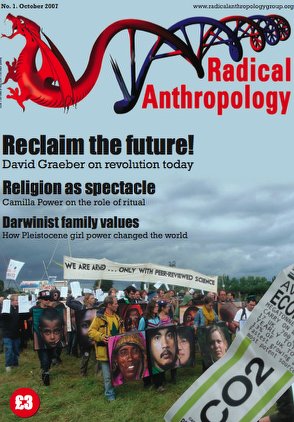
David Graeber is one of the authors in a new journal called Radical Anthropology. The journal is available for free. You can download it as pdf-file. The journal follows Graebers vision of anthropology as an “intellectual forum for all sorts of planetary conversations” that makes “common cause with social activism for the sake of human freedom”.

The first issue consists of two essays

David Graeber: Revolution in reverse
The idea of radical change today seems unrealistic.Why?

Camilla Power: Religion as spectacle
Richard Dawkins may think it’s just a delusion, but religion had amore interesting evolutionary role than that.

The journal is edited by The Radical Anthropology Group that was founded back in 1984. Many members are active in indigenous rights movements and combine academic research with activist involvement in environmentalist, anticapitalist and other campaigns.

>> download the first issue of “Radical Anthropology

>> previous publications by The Radical Anthropology Group (lots of papers!)

David Graeber is one of the authors in a new journal called Radical Anthropology. The journal is available for free. You can download it as pdf-file. The journal follows Graebers vision of anthropology as an “intellectual forum for all…

Read more