
search expand

Dissertation: Survival in the Rainforest

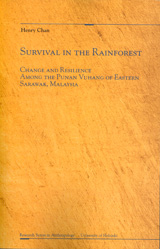
chan cover Are hunter-gatherer communities able to rely completely on the rainforest environment for their food, without any dependence on food traded from farming societies? How has their life changed as a result of settling down? How has the community responded to the drastic changes that have come with logging?

Anthropologist Henry Chan (University of Helsinki) answers these questions in his dissertation “Survival in the Rainforest. Change and Resilience among the Punan Vuhang of Eastern Sarawak, Malaysia” that has been published a few days ago.

For nearly all of their known history, the Punan Vuhang have lived as hunter-gatherers, writes the anthropologist. In 1968, however, they adopted cultivation. His research among the Punan Vuhang began in 1993 and continued through 1995, with a more brief follow-up period in November 2002. Chan is the first Sarawakian awarded the Asian Public Intellectual (API) Fellowship of the Nippon Foundation.

Based on memories of informants, and, where relevant, from participation-observation of present-day hunting-gathering activities, Chan has reconstructed their past economy, history and social organization.

He supports the argument that hunters-gatherers could survive without relying on farming societies for food. For several decades anthropologists and human ecologists have been divided in “The Hunter-Gatherer Dependency Debate”:

Ethnographic studies from the early 1960s of hunter-gatherers emphasized the economic and social advantages of hunting and gathering. This was a complete reversal of an earlier notion that hunter-gatherers are marginalized people on the perpetual verge of starvation, constantly pursuing food, and failing to develop forms of social organization associated with supposedly more advantageous means of production. (…) Lee and Marshall (1961) were the main proponents of a model that maintained that the environment sufficiently provides for the needs of hunter-gatherers.

(…)

Subsequent studies later challenged this model, leading to a series of debates that persisted into the 1990s. These debates pitted against each other two schools of thought commonly known as the “traditionalists” or “isolationists,” and the “revisionists” or “integrationists.” In contrast to traditionalists’ view of the ease in obtaining food, the revisionists documented the difficulty of some hunter-gatherer societies in obtaining carbohydrates. Further, the revisionists maintained that the perception of hunter-gatherers as isolated is erroneous and is an external view imposed on them by anthropologists. (…)

Most revisionists accept the world systems political model, first formulated by Immanuel Wallerstein (1974, 1979), as applicable to the analysis of past and present hunter-gatherers. They argue that the devotion of ethnographic attention to hunting and gathering is itself spurious, and that researchers should instead study how people relate to the forces of capitalism and colonialism.

His data, Chan writes, show that the rainforest is capable of sustaining a hunter-gatherer population:

The case of the Punan Vuhang lends some support to Sahlins’ “original affluence” theory that suggests hunting and gathering people are able to easily satisfy their needs and wants because they have few needs. In fact, of the things they need the most, food, the Punan Vuhang show little concern if no one succeeds in obtaining food for any particular day. They know that someone will get something the next day and share it with everyone else. So long as every hunter explores a field further away and is diligent, there are lots of little things to be found.

In addition to mastering the means by which a wide range of food could be obtained, coping with food scarcity also involved gaining an in-depth knowledge of the environment and its resources according to Chan:

Hunter-gatherers systematically combed the forest and kept in their memory the locations of sago groves, fruit trees and places that attract animals such as salt-licks and wallowing ponds. Armed with this knowledge, hunters brought their specially-bred dogs to hunt wild boars or used blowpipes to shoot tree-dwelling animals and birds. (…) Should an individual hunter fail to obtain game, he did not have to worry about going hungry, for the Punan Vuhang organized themselves so that successful hunters and gatherers shared their food with others.

But this prior situation of food sufficiency, from the past through 2001, was shattered as the Punan Vuhang entered the 21st Century:

In 2001, logging intruded into the remote rainforest and since then has drastically impacted the Punan Vuhang, both physically and socially, as it has left an altered, empty landscape littered with fallen branches and muddy soil. The Punan Vuhang feel frustrated and angered with this wanton destruction of their forest. They spend much time hunting in distant forests, but often return empty handed. Instead of sharing, successful hunters sell meat to loggers whose demand is insatiable.

Many Punan Vuhang men frantically search for scarce aloewood to sell before it is destroyed by logging. Consequently, they neglect their farms and they have to buy rice and sago starch from the logging camp’s grocery shop. Hence, with deforestation, it seems that they have now become truly dependent on outsiders for food. (…) Unable to bear such helplessness, many Punan Vuhang have resorted to alcohol and frequently become drunk.

>> download the thesis

UPDATE: See the comment by Eric Davis related to the Khmer: Hunting and Gathering Discussions

SEE ALSO:

“But We Are Still Native People” – Tad McIlwraith’s dissertation is online

Challenges popular notions on indigenous peoples: Alex Golubs dissertation on mining and indigenous people

How to survive in a desert? On Aboriginals’ knowledge of the groundwater system

chan cover

Are hunter-gatherer communities able to rely completely on the rainforest environment for their food, without any dependence on food traded from farming societies? How has their life changed as a result of settling down? How has the community responded…
Read more

Six reasons for bad academic writing

Sociologist Lars Laird Eriksen has written an interesting blog post about why academic texts often are so badly written. When academics try to write, it often becomes so full of jargon and it’s a turture for the reader. So why is this so?

Here’s his list:

1st reason for difficult language: Trying to sneak yourself to academic status.

2nd reason for difficult language: Not knowing exactly what you’re saying and hiding behind grand words.

3rd reason for difficult language: Being on a learning curve – still searching for the right words and images to convey your thoughts clearly. (The nice version of the 2nd reason…)

4th reason for difficult language: Common sense language is not specific enough.

5th reason for difficult language: Common sense language is too politicized.

6th reason for difficult language: Common sense language is what is being analysed.

Number 3 is the interesting one in his opinion:

It conveys to me that when an idea is better understood, it can be expressed more simply. This also explains why cutting-edge research often is difficult to read: No-one has thought these thoughts before, so we are still on the learning curve of making them easier to think and say.

Which reminds me: Sometimes a text is difficult to understand, even if it is written in plain language – it could be because it is saying something new and different, something requires the mind to change direction for a while and think differently.

His blog is bilingual (Norwegian / English). He also contributes to the blog Sosionautene (Norwegian only)

SEE ALSO:

Thomas Hylland Eriksen (Savage Minds): What is good anthropological writing?

How To Present A Paper – or Can Anthropologists Talk? A wishlist

The Secret of Good Ethnographies – Engaging Anthropology Part III

Why is anthropological writing so boring? New issue of Anthropology Matters

Sociologist Lars Laird Eriksen has written an interesting blog post about why academic texts often are so badly written. When academics try to write, it often becomes so full of jargon and it's a turture for the reader. So…

Read more

More and more anthropologists are recruited to service military operations

The connections between anthropologists, military counterinsurgency experts and intelligence agencies are multiplying and deepening. It is well known that anthropologists work for the military. But government agencies may be only the tip of the iceberg. Contractors to the military are probably employing many more anthropologists as the privatization of the military grows apace, Roberto J. González writes in Anthropology Today June 2007 (to be published in a couple of weeks).

I quote his “small sample of military contractors currently recruiting anthropologists to service military operations”:

1. BAE Systems is advertising a ‘field anthropologist’ position for deployment to Iraq and Afghanistan for what appears to be counterinsurgency support work. The job is ‘designed to dramatically improve the collection, interpretation, understanding, operational application, and sharing of local cultural knowledge… [it] facilitates the collection, analysis, archiving and application of cultural information relevant to the unit commander’s operational decision-making process.’

2. Hicks & Associates (a subsidiary of the multinational Science Applications International Corporation) is advertising a ‘research assistant’ position for a project that ‘investigates the evolution of subnational identities within and across states, and the implication of culture on attitudinal perspectives of other groups… [in] Tunisia and other North African nations… the position requires a background in anthropology… Arabic language skills are a plus.’

3. L-3 Communications is advertising a position for ‘cultural expert – Middle East’. Duties include ‘technical intelligence data gathering and analysis skills and abilities to manage, develop, implement, and administer intelligence analysis programs and policies for customer applications’. Candidate ‘MUST be fluent in Arabic, Pashtu, or Persian-Farsi… MUST have knowledge of prevalent Sunni and Shia tribes in the Middle East… US Citizens applying must hold PhD in History or Anthropology’.

4. Military Professional Resources Incorporated (MPRI) is advertising a ‘COIN operations specialist’ position in order to ‘provide Brigade Combat Team or Regiment, battalion and company-level leaders of Coalition units and brigade and battalion-level leaders of Transition Teams (MiTT/NPTT/BTT) and the Iraqi Security Forces (Iraqi Army and Iraqi National Police) with a fundamental understanding of COIN principles, lessons learned and TTPs required to execute full-spectrum operations in the Iraqi Theater of Operations… a Master’s Degree in Military Science, Psychology, Cultural Anthropology’ is preferred and military experience is a requirement.

5. Booz Allen Hamilton is advertising a position for a ‘war on terrorism analyst’ who will conduct ‘research into adversary and target country elements of power, including political, military, economic, social, infrastructure, and information (PMESII) systems to assist military planners… conduct evaluations of terrorist adversary and target country response to effects based activities… [and] work with joint military planners and the inter-agency community to determine planning options to achieve War on Terrorism efforts and objectives’. Qualifications include a BA or BS degree, with ‘knowledge of political science, economics, social anthropology, infrastructure, or information operations preferred’.

6. The Mitre Corporation is advertising a ‘sr. artificial intelligence engineer’ position ‘to play a role in applying modeling and simulation as an experimental approach to social and behavioral science problems of national significance… [and] to apply social sciences to critical national security issues.’ Desirable applicants will have a ‘PhD in a social science discipline (e.g. anthropology, sociology, sociolinguistics, medical anthropology, cultural geography, comparative social and cognitive psychology, cultural communication studies, science/technology studies, international labor/industrial relations, industrial/organizational psychology, comparative political science, public administration.)’

UPDATE:

Protests against British research council: “Recruits anthropologists for spying on muslims”

Summary of another article in Anthropology Today June 2007: >> The dangerous militarisation of anthropology

SEE ALSO:

“Tribal Iraq Society” – Anthropologists engaged for US war in Iraq

Anthropologist Mahmood Mamdani: “Peace cannot be built on humanitarian intervention”

Embedded anthropology? Anthropologist studies Canadian soldiers in the field

Fieldwork reveals: Bush administration is lying about the “war on terror” in the Sahara

San Jose: American Anthropologists Stand Up Against Torture and the Occupation of Iraq and AAA Press Release: Anthropologists weigh in on Iraq, torture at annual meeting

“War on terror”: CIA sponsers anthropologists to gather sensitive information / see also debate on this on Savage Minds

Anthropology and Counterinsurgency: The Strange Story of Their Curious Relations

Bush, “war of terror” and the erosion of free academic speech: Challenges for anthropology

USA: Censorship threatens fieldwork – A call for resistance

Two Books Explore the Sins of Anthropologists Past and Present

The connections between anthropologists, military counterinsurgency experts and intelligence agencies are multiplying and deepening. It is well known that anthropologists work for the military. But government agencies may be only the tip of the iceberg. Contractors to the military are…

Read more

“But We Are Still Native People” – Tad McIlwraith’s dissertation is online

Our fellow anthro-blogger Tad McIlwraith has successfully defended his dissertation “But We Are Still Native People’: Talking about Hunting and History in a Northern Athapaskan Village” that now can be downloaded from his website (The graduates in his year are the first who are able to request open access publication)

His dissertation is a study of hunting in the northern Athapaskan village of Iskut, British Columbia, Canada. Iskut hunting is a source of pride for Iskut people. Yet, hunting is sometimes stigmatized by outsiders with interests in the lands and natural resources of northern British Columbia. For some outside observers, he writes, modernization and acculturation are one-way processes. Traditions are better left in the past. At times, he found out, Iskut talk about hunting conveys those sentiments too. At other times, Iskut people strongly reject the stigma of labels like ‘impoverished’ or ‘nomadic’ that resonate in the words that have been written about Iskut people.

Tad McIlwraith indicates that the ethnographic inquiry into an Iskut culture was a profitable way to identify the importance of hunting to Iskut people and, thus, to offset the racism and stereotypes that are frequently associated with native lives.

He also argues that ethnoecological research and the Ethnography of Speaking both contribute useful methodological alternatives to Traditional Use Studies particularly when the documentation and interpretation of the varied expressions of hunting in Iskut Village is of concern.

>> download the dissertation

>> visit his blog

Our fellow anthro-blogger Tad McIlwraith has successfully defended his dissertation "But We Are Still Native People’: Talking about Hunting and History in a Northern Athapaskan Village" that now can be downloaded from his website (The graduates in his year are…

Read more

Thesis: How does EU influence the life of farmers in Finland?

farmers

Why see uncertainty as a hindering aspect of human experience, instead of an enabling one? In her thesis Good Lives, Hidden Miseries: An Ethnography of Uncertainty in a Finnish Village, anthropologist Susanne Ådahl from the University of Helsinki argues that there can be something called “good suffering”, a suffering which creates positive meaning and creative action:

There is a reason why people continue doing things, working, producing on the land, maintaining sociality and community although a lot of it goes against all economic logic. For farmers it is not only a matter of being engaged in practical action, but that the action has a quality of “meaningfulness” to it.

Her thesis is an ethnographic study, in the field of medical anthropology, of village life among farmers in south west Finland, based on 12 months of field work conducted 2002-2003 in a coastal village.

Ådahl asked people about their life histories, the meaning of the home, work, social solidarity and social interaction, notions of illness and well-being. She was primarily interested in finding out how people experience social change and what they do to deal with it. And by working with farmers she “came to understand the central symbols of farming life and the impetus that keeps these people going although outside forces are reducing their living space, both symbolically and literally”.

When she started her fieldwork Finland had been a member of the European Union for seven years, and farmers felt the EU had substantially impacted on their working conditions, she writes:

Perhaps one of the greatest losses they are experiencing is that of their autonomy, the freedom to decide over life which seems to be equivalent to a loss of honour, and an honourable way of dealing with the dependence on structures beyond their control. It is also a potential loss of the home. There was complaint of other pressures in life such as work related stress, the fast pace of life and strained inter-personal relationships. Informants expressed worry over the ingestion of artificial foods and other harmful substances in the environment.

Felt uncertainty in their lives is brought about by increasing social isolation, feelings of depression, anxiety, guilt and distress. A concrete sign of the structural changes that are taking place in society is the emptying of villages.

(…)

The introduction of on-farm inspections and with it the issue of doubt and distrust that is inherent in this practice is perhaps one of the hardest blows to farmers’ pride. They feel that a bureaucratic entity has penetrated into the sanctity of the home, transgressing boundaries of intimacy. Many also equate the present subsidy system with social welfare, living off a system, losing your independence. This has resulted in a loss of motivation to produce, because the reward for being a good farmer, one that strives to maximise his or her yields, is gone.

(…)

They feel that decision makers and representatives of the EU cannot understand, nor recognise the significance of local level knowledge, based in the reality of farming in Finland as well as the geographically specific areas of the country that “good farming practice” is based on.

In the midst of constraints and the demands to mould oneself to the social order there are also minimal forms of resistance, like writing “No EU” in bricks of contrasting colours on the roof of one’s barn. Or being active in a producers’ organisation, in municipal or party politics so as to influence the outcome of political decisions that impact on one’s life:

One of the most obvious forms of resistance is related to the “cancer talk” that people engage in. It is used as a political commentary of the state of affairs, of people’s fear of something foreign controlling their lives. It is a form of blaming society for making their living environment dangerous to dwell in and their food contaminated, and yet they keep on living in this environment.

So why can suffering be good and meaningful? The anthropologist explains:

For farmers it is natural to think that the importance of producing food makes their suffering meaningful, valuable and honourable. This positive, meaningful suffering produces wholesome food that feeds the nation and maintains our independence in terms of food security.
(…)
It is through working and being active in associations and other social activities that farmers can fulfil the central values of the farming life, those of continuity regardless of how economically unprofitable it has become to engage in farming especially for small holders. Farmers make the ambiguity of their lived realities understandable by referring to these core values that spring from the local context.
(…)
I believe that the central role of agency in the lived experience of human subjects emerges precisely because it is set against the backdrop of suffering, of the idea that those things which are at stake in one’s life are threatened.

>> download the thesis

Her reserach was part of the research project Ethnographies of Illness Experience in Contemporary Finnish Contexts that has published three medical anthropology papers online.

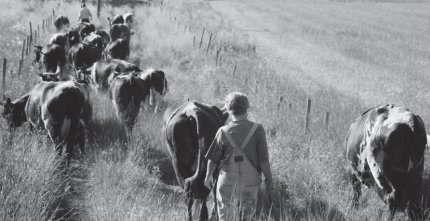
The picture was taken from her thesis.

SEE ALSO:

Local Foods – New issue of Open Access journal “Anthropology of Food”

Crop Diversity Continues Thanks to Modern, Traditional Practices

Thailand: Local wisdom protects hometown from the onslaught of globalisation

farmers

Why see uncertainty as a hindering aspect of human experience, instead of an enabling one? In her thesis Good Lives, Hidden Miseries: An Ethnography of Uncertainty in a Finnish Village, anthropologist Susanne Ådahl from the University of Helsinki argues that…

Read more