search expand

New fieldwork blog: Struggling with antipathy for the field and “anthropology-fed-up-ness”

Norwegian anthropologist Jon Henrik Ziegler Remme has started blogging. He is currently on fieldwork in the Philippines among the Pentecostal Christians in Ifugao.

In his first two posts of his blog Jon Henrik in Ifugao, he describes parts of the fieldwork process that are familiar for most anthropologists but that rarely make it into papers or monograps: “anthropology-fed-up-ness” and antipathy for the field.

“Back in Ifugao, the first thing that struck me was that I was already tired of being here”, he writes in his first post Chasing Ifugao Christians with a lack of motivation….

“One of the main impressions I had of my previous fieldwork was that this type of research is very inefficient. (…) Today I had such an experience again”, he writes in his second post When the time is right…

>> visit Jon Henrik Ziegler Remme’s blog

For information on his first research project, see the project website.

SEE ALSO:

On fieldwork: “Blogging sharpens the attention”

Paper by Erkan Saka: Blogging as a Research Tool for Ethnographic Fieldwork

antropologi.info survey: Six anthropologists on Anthropology and Internet

Anthropology blogs

Norwegian anthropologist Jon Henrik Ziegler Remme has started blogging. He is currently on fieldwork in the Philippines among the Pentecostal Christians in Ifugao.

In his first two posts of his blog Jon Henrik in Ifugao, he describes parts of…

Read more

Anthropologist examines influence of robots in Japan

At home, robots are about to replace the role of the grandmother and in the industrial sector, robots are more popular than foreign laborers according to anthropologist Jennifer Robertson. Robertson is researching on the effects of robots on Japanese society.

At a seminar, Robertson spoke on the decreasing human birthrate and increasing humanoid robot population in Japan, the university newspaper The Daily Texan informs.

In the industrial sector, Japan prefers robots over foreign laborers “because machines do not enhance racial tensions by evoking wartime memories, as foreigners do”, Robertson said (!)

But the country is according to the anthropologist more concerned with utilizing robots to help increase native births:

Because children require care at home, they can keep women from holding jobs. But in today’s society, many women need or want to hold professional positions. As mothers join the workforce, robots take over their household duties, thus increasing the workforce and the birthrate. (…) Robertson showed photos of cartoon-like machines with exaggerated features and colorful bodies. These were the robots such as Wakamaru, PaPeRo and Ri-man that babysit, tutor children and care for the elderly.
(…)
These robots transmit images to cell phones, thus allowing mothers to keep an eye on their children while away from the home. (…) Japanese children are obedient to their robotic caretakers, and the machines have replaced the role of the mother or grandmother in the home.

>> read the whole story in The Daily Texan

“Robots are expected to be in the 21st century what automobiles were in the 20th century,” Jenny Robertson said in an earlier article in The Michigan Daily. For more information on robots in Japan, see also two BBC-stories Japan’s rise of the robots and Japanese scientists have unveiled the most human-looking robot yet – a “female” android

SEE ALSO:

Why cellular life in Japan is so different – Interview with anthropologist Mizuko Ito

Pop goes Japanese culture: Japan’s most visible export isn’t economic, but cultural

The cultural nationalism of citizenship in Japan and other places

At home, robots are about to replace the role of the grandmother and in the industrial sector, robots are more popular than foreign laborers according to anthropologist Jennifer Robertson. Robertson is researching on the effects of robots on Japanese society.…

Read more

Monks prosecute muslims? Free Burma International Bloggers’ Day

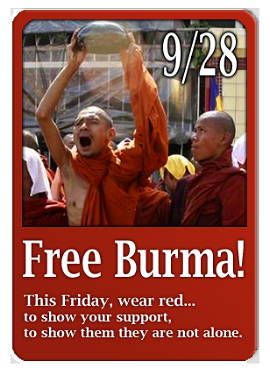
free-burma banner

Burma’s protesters may have been silenced, but we must continue to support them, writes Brendan Barber in The Guardian. But maybe we should not focus too much upon the courage of the monks. Muslims in Burma are persecuted, not only by the military, even by the ‘peaceful’ monks according anthropologist Gabriele Marranci:

free burma

From an anthropological viewpoint, the revolt in Burma is particularly interesting for an anthropologist specialised in Muslim societies and communities. There are two elements that attract my attention. First of all, how this revolt is represented by the western mass media and secondly, the near total lack of reference to the drama that the Muslim minority, the so called Rohingya Muslims, have experienced in the last three decades. There are some hard stereotypes which affect how the mass media represent religions, and consequently, how ordinary people understand religions.

Muslims in Burma are a persecuted minority – a story that the mass media neglects to inform us, he writes. The omission, when compared, is according to the anthropologist “not very dissimilar from the western attitude towards other Muslim minority and refugee tragedies”.

He explains:

The Rohingya Muslims live mainly in the North of the Rakhine State and represent, officially, 4% of the entire Burmese population, but represent 50% of the population of Rakhine state (previously known as Arkana) itself. (…) In 1784, a Burmese king, Bodawpaya, annexed Arkana to his domain. This provoked a long guerrilla war with the Muslims, which saw, according to historians, more than 200,000 Arkanese killed. Many of the local Muslim population, at that time, were reduced to slavery and forced to build Buddhist monasteries. (..)

Muslims in Burma are not considered to be citizens. They have no rights and often suffer discrimination and indiscriminate killings. Many of them, in particular after 1962, had to flee the country and still today live in refugee camps in Bangladesh, which actually do not welcome them. Although Muslims have taken active part in the 1988 revolt, and paid the consequences more than the Buddhist population, the majority of monks and Buddhists in Burma have anti-Muslim sentiments, in particular based on the fear of possible intermarriages.

Pamphlets glorifying race purity and Buddhism and actually reinforcing anti-Muslim sentiments have been distributed since 2001 (i.e. Myo Pyauk Hmar Soe Kyauk Hla Tai or The Fear of Losing One’s Race). These inflammatory publications, preaching against the Muslim minority, as well as rumors spread about Muslims raping children in the streets, provoked a series of monk-led riots against Muslim families and the destruction of mosques. Muslims were killed and mosques destroyed, and again the Rohingya Muslims had to flee to Bangladesh.

(…)

Everybody hopes that the Buddhist monks can succeed in mobilising the population in a sort of Intifada. Some Muslims, I know, are repeating their Inshallahs in the not so distant Rohingya refugee camps in Bangladesh. They hope that the end of the military junta means the end of their oppression.

Nonetheless, a question remains, after such strong monk-led anti-Muslim campaigns which were also reinforced by the welcomed ‘Bushit’ rhetoric of ‘war on terror’: would the new, certainly Buddhist, regime accept the history and the existence, as Burmese citizens, of Rohingya Muslims? Or, would the new regime, like their predecessor generals the Muslims as an easy scapegoat?

>> read the whole article on Gabriel Marraci’s blog

A few days after his blog post, mainstream media has started writing about the discrimination of muslims and minorities in Burma – but without reference to the monks, see the CNN-story Myanmar’s ethnic minorities suffer a ‘hidden war’

UPDATE: See also Martijn de Koning: Muslims in Burma (Closer, Anthropology of Muslims in the Netherlands)

UPDATE According to South Asia Analysis Group, the Burmese muslims in Rakhin “have strongly come out in support of the uprising against the military junta spearheaded by the Buddhist monks, students and others”. On 26 September 2007, the Rohingyas and Rakhaings had jointly participated in the demonstration staged by the Buddhist monks forming human chains in Akyab chanting the slogan: “We are a family and we are travellers in the same boat, we Burmese citizens need to be united without regard to religion, class or race.”

Supporters of Burmese protestors from around the world are planning a global day of protests on 6 October according to the Democratic Voice of Burma.

MORE INFORMATION:

Wear red shirts on friday – Anthropologists on the protests in Burma?

George Monbiot: Let’s put pressure on the companies responsible. Western interests in Burma contribute to the oppression of its people

Guardian Special Report: Burma

BBC News Special Reports: Burma Protest

Wikipedia: 2007 Burmese anti-government protests

Global Voices: Burmese bloggers on Burma

Democratic Voice of Burma

free-burma banner

Burma's protesters may have been silenced, but we must continue to support them, writes Brendan Barber in The Guardian. But maybe we should not focus too much upon the courage of the monks. Muslims in Burma are persecuted, not only…

Read more

Wear red shirts on friday – Anthropologists on the protests in Burma?

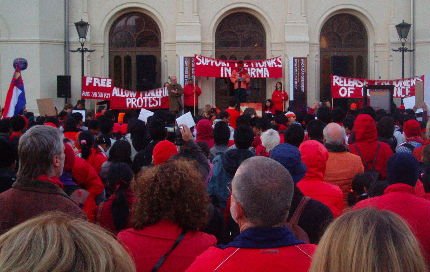
burma-demonstration

Wear red for Burma: Several thousand people at the demonstration in Oslo

“Wear a red t-shirt in solidarity this friday!” “Light candles in your windows on Friday night to honour the victims of the demostrations.” Pro-democracy protest marches in Burma have entered the tenth day. Burmese soldiers have detained about 200 Buddhist monks and fired shots as they attempt to disperse thousands of anti-government protesters in Rangoon.

Any comments by anthropologists on the situation in Burma? By now I’ve found two three four:

Monique Skidmore, medical anthropologist in The College of Arts & Social Sciences at the Australian National University (ANU) has been conducting research in Burma since 1994.

red shirt for burma

In the Australian online magazine Crikey she explains, that the the current protests stretch its roots stretch back to 1962 “when the Burmese armed forces, led by General Ne Win, usurped power from Burma’s democratically elected government of Prime Minister U Nu. General Ne Win ruled the country by fear, informers, propaganda and isolation. A civil war has waged since then, with estimates of the loss of life at up to 10,000 each year.”

Today’s street protests are furthermore “the culmination of a campaign for democracy being coordinated by the ’88 Student Generation, the activist movement in exile, the labor movement (embodied by Su Su Nway, now in hiding), monks, and the National League for Democracy.”

Coordination is difficult given that most mobile phones are illegal as well as use of the internet, she writes: “Burma’s first blog appeared last week showing the first day of the monk protest in Rangoon. It only took the military regime 24 hours to shut it down.”

>> Monique Skidmore: The Burmese people have had enough

Sometimes Burma is also called Myanmar. Myanmar is actually the official name, the BBC explains: The ruling military junta changed its name from Burma to Myanmar in 1989, a year after thousands were killed in the suppression of a popular uprising. Rangoon also became Yangon.

The name change is a form of censorship, says anthropologist and editor of Anthropology Today Gustaaf Houtman in the BBC article Should it be Burma or Myanmar?

Houtman has written a book that is available online (free) called Mental Culture in Burmese Crisis Politics. Aung San Suu Kyi and the National League for Democracy. It is also available on Google Books. Read also an interview with Houtman on The Culture of Burmese Politics.

update: In the New York Times story Karma Power: What Makes a Monk Mad anthropology professor Ingrid Jordt contributes with some orientalitic statements when she explains that the monks’ power comes from their role in bestowing legitimacy on the rulers:

“Legitimacy in Burma is not about regime performance, it’s not about human rights like the West. It is something that comes from the potency and karma bestowed by the monks. That’s why the sangha is so important to the government,” she said, referring to the Buddhist hierarchy and the spiritual status that its monks can convey. “They are actually the source of power.”

free burma

UPDATE: Anthropologist Gabriele Marranci tells a story that the mass media neglects to inform us: Muslims in Burma are persecuted, not only by the military, even by the ‘peaceful’ monks: >> Gabriele Marranci: The other, invisible suffering of Burma

FOR MORE INFORMATION ON THE SITUATION IN BURMA SEE:

BBC News Special Reports: Burma Protest

Wikipedia: 2007 Burmese anti-government protests

Global Voices: Burmese bloggers on Burma

BBC News also has a story about how Burma cyber-dissidents crack censorship and tell the world what is happening under the military junta’s veil of secrecy.

See also on Facebook Support the Monks’ protest in Burma and Red Shirt For Burma

For non facebook users more on the red shirt campaign see on these blogs at Livejournal, Dynamic Nonvilence, Sungame and in the Phuket Gazette: Red-shirt-Friday campaign sweeps Phuket and Norwegian trade union leader backs call to “wear red”

To those who think this might be a pointless or even stupid campaign I’ve found this comment in a facebook group:

Nobody thinks wearing a red shirt is gonna change the situation. Did you actually think so? Now THAT is really stupid.

Nobody really thought demonstrating against the Iraq war in Oslo, where I live, or any other place in the world would for that matter, would make Bush change his mind either. Point is, we still did it, it’s the biggest demonstration in Norwegian history.

What’s wrong with gathering the world? What’s wrong with trying to spread the word to everybody? What’s wrong with showing that you care, and that you are aware of the situation and have a statement, even though it doesn’t necessarily make a practical change? Negativity of that kind is what really is stupid.

UPDATE

Monks prosecute muslims? Free Burma International Bloggers’ Day 4.10.2007

burma-demonstration

Wear red for Burma: Several thousand people at the demonstration in Oslo

"Wear a red t-shirt in solidarity this friday!" "Light candles in your windows on Friday night to honour the victims of the demostrations." Pro-democracy protest marches in Burma…

Read more

“Anthropology = Smarter Counterinsurgency”

Another article about military anthropologists: The Christian Science Monitor writes about anthropologist “Tracy” who helps the US Army in their war against Afghanistan. Tracy “can give only her first name” to the journalist:

Evidence of how far the US Army’s counterinsurgency strategy has evolved can be found in the work of a uniformed anthropologist toting a gun in the mountains of eastern Afghanistan. Part of a Human Terrain Team (HHT) – the first ever deployed – she speaks to hundreds of Afghan men and women to learn how they think and what they need.
(…)
Finding ways to challenge that fear – and learn what makes Afghans choose to support the government or its enemies – is the job of the HTT. The key ingredient is a “senior cultural analyst,” in this case, Tracy, the anthropologist in uniform.

She has interviewed hundreds of Afghan women and men, sometimes for hours on end, hearing how most are “so tired of war.” In nine months, Tracy has gained deep knowledge, she says, aimed at helping “fill the vacuum that the Taliban and other nefarious actors want to fill.”

Tracy tells Afghans that she wants to “enhance the military’s understanding of the culture so we don’t make mistakes like in Iraq.” But the bar is high, and this village with the medical clinic shows signs of militant influence, such as being “coached.”

Still, Tracy says that she sees real progress, “one Afghan at a time.” And the US military’s views are evolving accordingly, away from firepower to a smarter counterinsurgency.

“It may be one less trigger that has to be pulled here,” Tracy says of the result. “It’s how we gain ground, not tangible ground, but cognitive ground. Small things can have a big impact.

>> read the whole story in the Christian Science Monitor

SEE ALSO:

The dangerous militarisation of anthropology

“Tribal Iraq Society” – Anthropologists engaged for US war in Iraq

Military – social science roundtable: Anthropologists help mold counterinsurgency policy

Protests against British research council: “Recruits anthropologists for spying on muslims”

More and more anthropologists are recruited to service military operations

Military anthropologist starts blogging about his experiences

San Jose: American Anthropologists Stand Up Against Torture and the Occupation of Iraq and AAA Press Release: Anthropologists weigh in on Iraq, torture at annual meeting

“War on terror”: CIA sponsers anthropologists to gather sensitive information / see also debate on this on Savage Minds

Another article about military anthropologists: The Christian Science Monitor writes about anthropologist "Tracy" who helps the US Army in their war against Afghanistan. Tracy "can give only her first name" to the journalist:

Evidence of how far the US Army's…

Read more