
search expand

The Journals of Knud Rasmussen: The impact of Christianity among the Inuit

rasmussen-film

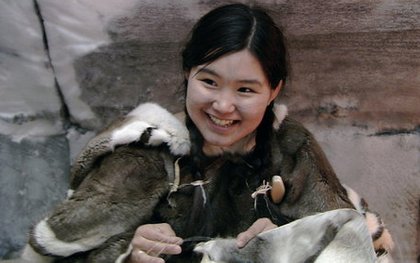
(LINKS UPDATED 30.9.2020) A new film by Inuit film maker Zacharias Kunuk (53) explores how missionaries force-fed Christianity to the Inuit in the 1920s. It’s called The Journals of Knud Rasmussen. Before its official world premier at the Toronto International Film Festival, a preview was held for Kunuks home community Igloolik, a cultural hub of the Arctic, 2,800 kilometres north of Toronto. Gayle MacDonald from The Globe and Mail has been there and reports:

The frigid temperature (30 C below) does not faze these people, who came in droves — some by prop plane from as far away as Qaanaaq, Greenland; and Nunavut’s capital, Iqaluit — to watch Kunuk’s latest cinematic creation. (…) “One of my friends left the seal hunt early so that he could get here before the show starts,” Kunuk, himself an avid hunter, adds proudly.
(…)
The shy filmmaker explains that his new film, shot in the relatively balmy months of April and May last year, is the story of explorer Knud Rasmussen, who travelled through this area in the 1920s, chronicling the conversion to Christianity of the great shaman Avva (played by local resident Pakak Innukshuk) and his willful daughter Apak (Leah Angutimarik).

The local Inuits appreciated that he took on taboo topics:

Some say they liked Atanarjuat, based on an Inuit legend, better. Others attest to being equally touched by this film, about the last great Inuit shaman, Avva. But all say they were glad Kunuk took on a taboo topic: shamanism, which the early missionaries dubbed devil worship, and which still sits uneasily with some of the town’s most religious Anglican, Roman Catholic and evangelical residents.

Kunuk’s production company, Igloolik Isuma Productions is according to the article one of the few success stories, periodically employing hundreds of local people as actors and film crew while injecting several million dollars into the economy. The people, by and large, are poor. Suicide (especially among those under 20), alcoholism, drug use and spousal abuse are rampant.

>> read the whole story in The Globe and Mail (replaced by copy)

Journals of Knud Rasmussen - trailer - IFFR 2007

SEE ALSO:

Isuma preps to film Igloolik’s history. Kunuk’s new film documents the arrival of Knud Rasmussen, Christianity (Nunatsiaq News, 10.9.04)

Study examines how Inuit coped with contact

Eskimo Folk-Tales collected by Knud Rasmussen

Inuit play makes fun of anthropologists

rasmussen-film

(LINKS UPDATED 30.9.2020) A new film by Inuit film maker Zacharias Kunuk (53) explores how missionaries force-fed Christianity to the Inuit in the 1920s. It's called The Journals of Knud Rasmussen. Before its official world premier at the Toronto International…

Read more

How to survive in a desert? On Aboriginals’ knowledge of the groundwater system

Indigenous Australians dug underground water reservoirs that helped them live on one of the world’s driest continents for tens of thousands of years, new research by hydrogeologist Brad Moggridge shows, according to ABC News. The study indicates Aboriginal people had extensive knowledge of the groundwater system. European settlers owed their subsequent knowledge of groundwater to the indigenous Australians, and even much of Australia’s modern road system is based on water sources identified by the original inhabitants.

Moggridge based his work on oral histories, Dreamtime stories, rock art, artefacts and ceremonial body painting as well as written accounts by white missionaries, surveyors, settlers, anthropologists and explorers.

>> read the whole story at ABC: Aboriginal people built water tunnels

In the article, there’s an interestring link to the research network Desert Knowledge that is “linking Indigenous and local knowledge with science and education to improve desert livelihoods”. (Link updated 3.9.2022)

SEE ALSO:

“Aboriginal knowledge is science”

Approaches to Indigenous Knowledge – conference papers in fulltext

Indigenous Australians dug underground water reservoirs that helped them live on one of the world's driest continents for tens of thousands of years, new research by hydrogeologist Brad Moggridge shows, according to ABC News. The study indicates Aboriginal people…

Read more

Explores how indigenous peoples interprete Christianity

Carolyn Schwarz spent 17 months in the most remote part of northern Australia to conduct field work for her dissertation on how Christianity and Western religious systems either came together or conflicted with one another. “There hadn’t been much work on introduced religious practices in aboriginal Australia”, she says to the journal Advance at the University of Conneticut:

In Western society, “religion is treated as being something separate,” she says, “But in aboriginal societies, religious beliefs are not as separated – politics and religion are one and the same. Religion is a way of life. It carries over into mundane activities, such as exchanging food, negotiating for money and receiving access to vehicles.”

>> read the whole story in Advance

Carolyn Schwarz spent 17 months in the most remote part of northern Australia to conduct field work for her dissertation on how Christianity and Western religious systems either came together or conflicted with one another. "There hadn’t been much work…

Read more

Available for download: Alex Golubs dissertation on mining and indigenous people

In his dissertation (published on his blog yesterday), anthropologist Alex Golub challenges popular notions on indigenous peoples, mining and globalisation. He has done research in a region that has gone through major transformations and fulfills every stereotype going “from the stone age to the jet age”. Now, the third largest gold mine in the world resides in the once remote valley. Golubs dissertation is about the relationship between the Porgera gold mine and the Ipili-speaking people on whose land the mine is located.

His findings are very interesting and challenge stereotypes among both the general public, political activists and anthropologists. For example, indigenous people are not always “victims of economic globalisation”:

While many would expect the intersection of a world-class gold mine and a relatively naïve indigenous people to result in a ‘fatal impact’ (Moorehead 1966), in fact the Ipili have been very successful at
extracting concessions from the mine and government.
(…)

[P]reconceptions of the Ipili as ecologically noble savages (Buege 1996) trampled on and degraded by global capitalism do not capture the complexity of Porgera’s politics.

(…)

[The Ipili] have actually became “one of the most active and successful fourth world people in the world today in terms of pressing claims against the state and transnational capitalism.

Another interesting point: Golub thinks that Papua New Guineans are much further along the road to understanding how “globalization” works than most anthropologists and that anthropologists have more to learn from them than they from us:

Where we see a dizzying flow of transnational entities and fractal, hybrid postmodern geographies, they see ‘Harry.’ Could it be we have something to learn from them rather than the other way around? ‘Landowners’ ability to sniff out the small knot of people behind stories of globalization is an incisive analytic move from which anthropologists who study “globalization” could learn.

Alex Golub goes an writing that studying globalization would require a very particular kind of academic discipline:

A discipline which delivers a richly detailed account of the lifeways of a small network of people as it is actually lived. A discipline attentive to the stories these people tell of themselves without uncritically accepting them as true. A discipline willing to recognize its entanglement in their lives without lapsing into either epistemological paralysis or the easy lie of a comfortable objectivity. In a world where our discipline is beset with doubts about its relevance, ethics, and epistemology, it may be that an anthropology which seeks to make itself feasible may have more to learn from Papua New Guineans than the other way around.

>> download the dissertation “Making the Ipili feasible: Imagining local and global actors at the Porgera Gold Mine, Enga Province, Papua New Guinea” (pdf, 1,5MB )

PS: I have just started reading the 436 pages

SEE ALSO:
Fieldwork in Papua New Guinea: Who are the exotic others?

In his dissertation (published on his blog yesterday), anthropologist Alex Golub challenges popular notions on indigenous peoples, mining and globalisation. He has done research in a region that has gone through major transformations and fulfills every stereotype going "from the…

Read more

Approaches to Indigenous Knowledge – conference papers in fulltext

For some reason, information on what is going on on anthropology conferences is difficult to obtain. Accidentally, I stumbled upon the website on a conference by the Association of Social Anthropologists on Approaches to Indigenous Knowledge that was held six years ago. Strangely enough, all papers are published in full text.

From the introduction:

Anthropology’s enduring interest in people’s knowledge systems has recently attracted the attention of development policymakers and practitioners. ‘Indigenous knowledge’ has emerged with the focus on popular participation and planning-from-below. It has opened up opportunities for anthropology to engage practically as never before. How might it further contribute to, and learn from this current burgeoning of interest, which has taken it somewhat by surprise?

>> overview over all papers

SEE ALSO:

“Aboriginal knowledge is science”

Who owns native culture?

For some reason, information on what is going on on anthropology conferences is difficult to obtain. Accidentally, I stumbled upon the website on a conference by the Association of Social Anthropologists on Approaches to Indigenous Knowledge that was held…

Read more