
search expand

“Encouraging to see a Muslim anthropologist studying American society”

Days and weeks before the launch of the new book by anthropologist Akbar Ahmed called Journey into America: the Challenge of Islam, it was already reviewed in major Pakistani newspapers. “Usually it is Western anthropologists who study Muslim societies. It is encouraging to see a Muslim scholar returning the compliment by studying American society”, Maleeha Lodhi writes in The News.

Accompanied by several researchers, Akbar Ahmed travelled for a year to over 75 cities across the U.S., meeting a diverse array of people and visiting more than a hundred mosques.

After (too?) much research on muslim issues and media focus, it seems that eveything has been said. But his book does not seem to be one of those numerous studies on “the integration of immigrant women”. His book is also an ethnography of today’s America.

In an article in the Guardian, the anthropologist writes that he “realised that it was impossible to study Islam in America without studying America itself and its identity.”

This “reinterpretation of the competing influences that have shaped American identity” is, writes, Maleeha Lodhi, “fascinating”:

Americans, Ahmed says, need to make a choice between the concept of the country fashioned by its Founding Fathers – universal, pluralist and tolerant – , or the post-9/11 vision “which is aggressive, self-centred and suspicious of, if not hostile to, “the other”:

He traces the first and dominant primordial identity to the original white settlers of the 17th century. Fashioned by white Anglo-Saxon Protestant (WASP) settlers, this vision of a society based on justice and a rule-bound charter was however exclusionary, meant only for Christians, not Native Americans or those who were forcibly brought from Africa.

From that period also emerges a secondary identity from the pluralist tradition. This foreshadows the vision of the country’s Founding Fathers based on equality between and respect for all citizens, democracy, religious freedom, and rejection of slavery.

Dr Ahmed identifies a third identity with origins in the 17th century. This is the predatory identity which unleashed an aggressive impulse that saw Native Americans as heathens who had to be eliminated. It also justified slavery. This established the notion of zero tolerance: that any threat to society had to be permanently decimated by the full use of force. Compassion was seen as weakness and compromise as defeat.

This identity, Dr Ahmed argues persuasively, asserted itself in the post-9/11 period when America under Bush embarked on two wars and a path that saw it compromising its own laws and ideals and justifying torture and Guantanamo in the name of protecting the nation. The invasion of Iraq, the Patriot Act and secret detention centres were all actions consistent with the old predatory identity.

The book also includes a “thought-provoking comparison” between two founding fathers Thomas Jefferson and Mohammed Ali Jinnah, writes Rafia Zakaria in The Dawn. “Sadly it seems both Americans and Pakistanis are only too willing to eviscerate the commitments these two founding fathers made towards tolerance and religious pluralism.”

The anthropologist is according to Maleeha Lodhi “just as forthright in identifying the weaknesses and problems in the Muslim diaspora”. He distinguishes between three traditions: mystic (Sufism, emphasises universal humanism), modernist (balance modernity with religion) and literalist (Salafis, adhere strictly to tradition) and concludes that “modernist Muslims have provided neither leadership nor a critical mass to change the community, while mistakenly dismissing literalists as being of no consequence.”

In order to “recreate the community’s self-image and extricate it from persistent identification with 9/11 and terrorism”, Muslim American leaders need to look to the African American community. he recommends.

According to the reviewers (somehow I have the impression they’re a bit too positive…), this is a well-written book, and Daily Times reviewer Mahjabeen Islam even things it will be the “talk of the town“.

For more information see the book blog at http://journeyintoamerica.wordpress.com/ and the first chapter (pdf) as well as Ahmed’s posts at Huffington Post

Anthropologist Maximilian Forte continues his analysis of the “predatory” elements of American culture in his recent posts on Zero Anthropology, among others Team USA at the 2010 FIFA World Cup: Motivation Unthinkable without the Military and Militainment: U.S. Military Propaganda in the News Media, Hollywood, and Video Games

SEE ALSO:

Akbar Ahmed’s anthropological excursion into Islam

How can anthropology help us understand Swat and Taliban? Gustaaf Houtman interviews Akbar Ahmed

Interview with Arjun Appadurai: “An increasing and irrational fear of the minorities”

“Arabs and Muslims should be wary of anthropologists”

“The insecure American needs help by anthropologists” – AAA-meeting part II

Days and weeks before the launch of the new book by anthropologist Akbar Ahmed called Journey into America: the Challenge of Islam, it was already reviewed in major Pakistani newspapers. "Usually it is Western anthropologists who study Muslim societies. It…

Read more

No more conferences in Arizona: Anthropologists condemn Immigration Law

Even (seemingly?) rather conservative organisations are able to act and protest: In an official resolution, passed on Saturday, The American Anthropological Association has condemned the new immigration law in Arizona.

The association will refuse to hold scholarly conferences in Arizona until the law is ”either repealed or struck down as constitutionally invalid”, as we read in the AAA blog:

“The AAA has a long and rich history of supporting policies that prohibit discrimination based on race, ethnicity, national origin, religion or sexual orientation,” AAA Executive Board Member (and resolution author) Debra Martin said in a statement issued today. “Recent actions by the Arizona officials and law enforcement are not only discriminatory; they are also predatory and unconstitutional.”

The AAA describes the so-called Arizona Senate Bill (SB) 1070 as ”the broadest and most strict law on immigration enacted in generations”. The organisation sees the law as a movement to target and harass Arizona’s large population of Hispanic immigrants.

>> read more on the AAA blog

In December, the AAA condemned the coup in Honduras. And in 2006, the AAA stood up against torture and the occupation of Iraq

Last week, Indigenous and American Indian Studies scholars called for an economic boycott of Arizona.

See also the post at Savage Minds: Whiteness as Ethnicity in Arizona’s New Racial Order

Arizona immigration law sparks controversy

SEE ALSO:

Demonstrations against tougher immigration policy = birth of a new civil rights movement?

“Anthropologists Should Participate in the Current Immigration Debate”

Interview with Arjun Appadurai: “An increasing and irrational fear of the minorities”

Why borders don’t help – An engaged anthropology of the US-Mexican border

More Global Apartheid? New French immigration law

“Discuss politics!” – How anthropologists in Indonesia engage with the public

Even (seemingly?) rather conservative organisations are able to act and protest: In an official resolution, passed on Saturday, The American Anthropological Association has condemned the new immigration law in Arizona.

The association will refuse to hold scholarly conferences in Arizona…

Read more

Protests against Human Zoo i Houston: Africans on display together with chimpanzees?

Five years ago people from all over the world protested against the “African Village” in the zoo in Augsburg, Germany. Now, a new campaign is being planned against “The African Forest“, a $50 million project in the Houston Zoo, where “African culture” is on display together with chimpanzees and giraffes.

The 6.5-acre exhibit is designed “to give patrons the illusion they are strolling through an open landscape populated with chimpanzees, giraffes and other equatorial animals”. “Through presentations and artifacts, human cultures of the equatorial forests will be included in the exhibit” , landscape architect Jim Brighton told the Houston Chronicle. “Houses fashioned from tree leaves — a form of temporary housing — will be constructed for children’s activities.”.

“This is indeed like the African village in Augsburg – except this is a project that costs tens of millions of dollars and will be permanent – and some of the same anthropologists who protested that human zoo are onboard to protest this one such as Nina Glick Schiller and Data Dea”, explains Shannon Joyce Prince, Dartmouth Lombard Fellow and citizen of Houston, in an email to me.

The Zoo is according to Prince “only showing aspects of Africa that fit Western stereotypes of cultural anachronism and primitivism. It “falls neatly into the contemptible tradition of its human zoo predecessors, replicating a non-white village, a place where non-white humans live, in a zoo among the habitats where animals live”.

“The African Forest is about exhibiting and teaching inaccurate Western conceptions of African indigenous cultures in a place designed to exhibit and teach about animals. The African Forest is also about making and keeping African indigenous peoples conservation refugees. The African Forest and the practices it promotes are neither about respecting Africans nor protecting animals. They’re about claiming authority over African land, wildlife, and human lives”, Shannon Joyce Prince writes in a paper.

In the Zoo’s view, Africans are in conflict with wildlife, she writes. Therefore, African Forest plans to promote ecotourism as a way to “help” Africans and African wildlife. But the consequences of such conservation activities are often devasting specifically for central Africans and pygmies. For in Africa it’s common for conservationists to create refuges to conserve wildlife by simply kicking Africans out. The Zoo is funded by corporations like Exxon, Chevron, Shell that have are involved in this business:

Basically, among the corporations that fund the Houston Zoo are some of the most human and wildlife rights abusing corporations in existence. These same businesses try to clean up their images by creating wildlife refuges – but they create those refuges by forcing indigenous people off their land. Then the Zoo, which receives funding from those corporations, claims that the indigenous people who are getting kicked off their land are the ones who harm wildlife and promotes conservation and conservation refuges.

>> Shannon Joyce Prince: Human Zoos, Conservation Refugees, and the Houston Zoo’s The African Forest (pdf, short versjon)

>> Human Zoos, Conservation Refugees, and the Houston Zoo’s The African Forest (long version)

Shannon Joyce Prince sent a letter to the Houston Zoo several weeks ago which has not received a response.

She asks for “opposing The African Forest, human zoos, and the creation/perpetuation of the conservation refugee crisis in one or more of the following ways”:

1. Tell the Houston Zoo you are against The African Forest human zoo and the creation of conservation refugees as well as the continuation of the conservation refugee crisis by contacting the Houston Zoo here: http://houstonzoo.com/contact/. Tell the Houston Zoo that you will boycott zoos that host human zoos and/or make/keep Africans conservation refugees. Please mention your affiliations. Be sure to send a copy of your message to nohumanzoo (AT) yahoo.com so that we have a record of your letter in case the Zoo doesn‚t respond and to prevent the Zoo from deciding to claim that no one is protesting.

2. Send your name and affiliation to nohumanzoo (AT) yahoo.com if you want to be put on a petition stating, „We, the undersigned, do not support The African Forest human zoo, the creation of conservation refugees, or the continuation of the conservation refugee crisis.”

3. Raise awareness about The African Forest through your blog and encourage others to write the Zoo and sign the petition.

Please be aware that, naturally, the letter you send or your signature on the petition may be made public.

“The racialization processes facilitated by the Augsburg zoo and other zoos are not benign because they can lay the ground work for discrimination, barriers to social mobility, persecution, and repression”, anthropologists Nina Glick Schiller, Data Dea and Markus Höhne wrote in their report African African Culture and the Zoo in the 21st Century: The “African Village” in the Augsburg Zoo and Its Wider Implications (pdf)

Such “ethnological exhibitions” or “Völkerschauen” have a long history, linked to colonialism. For more than half a century – from the beginning of the 1870s to the end of the 1930s – the exposition of so-called exotic peoples in zoological gardens** and international expositions attracted a huge public.

UPDATE: Interesting debate and round-up at ZooChat: Cultural Zoo Exhibits = Racist? » Houston Zoo

SEE ALSO:

African village in the Zoo: Protest against racist exhibition

In Detroit and London: More African Villages in the Zoo

Thesis: Conservation for Whom? Telling Good Lies in the Development of Central Kalahari

In Norwegian TV: Indian tribe paid to go naked to appear more primitive

Is this anthropology? African pygmies observe Britains in TV-show

Geldof’s Live8 and Western myths about Africa

Five years ago people from all over the world protested against the "African Village" in the zoo in Augsburg, Germany. Now, a new campaign is being planned against "The African Forest", a $50 million project in the…

Read more

Anthropologist uncovers how global elites undermine democracy

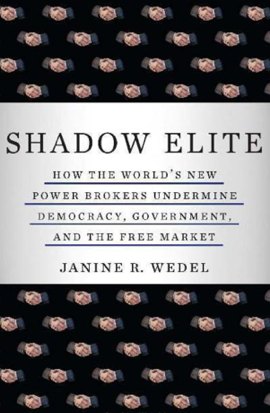
Janine Wedel has done something that far too few anthropolologists do: She studied powerful people. Those who rule the world.

In her book “Shadow Elite“, she shows how a new system of power and influence has taken hold globally, one that undermines democracy, government, and the free market.

Why went America to war against Iraq? More and more “government work” is performed by “shadow elites”: consulting firms, companies, nongovernmental organizations, think tanks etc, rather small circles of powerful people (she calls them “flexians”) who use their interlocking relationships to control public policy without public input. “Flexians” work often for private interests, academia and government at the same time.

The flexians form “Flex nets”. They cannot be reduced to lobbyists or interest groups. They are according to a review in the Financial Times defined by four features:

1) personalizing bureaucracy, or using personal connections and loyalties to realize goals;
2) privatizing information while branding conviction, or branding the information available only to insiders in this game;
3) juggling roles and representations, or changing spots frequently, wearing the pelt of military leader one day, analyst the next, and concerned citizen the next;
4) relaxing rules at the interstices of official and private institutions, or adjusting accountability and rules that apply to one or more of their pelts from the safety of a seemingly non-aligned position.

One of those flexians is the retired US general Barry McCaffrey, who has been simultaneously a commentator for the media, a consultant to the defence industry and professor. According to a 2008 exposé in the New York Times, he was one of several former military men who helped to shape public opinion on the Iraq war, while simultaneously having undisclosed ties to the Pentagon.

Wedel’s book has received quite a lot of media attention since it was released earlier this year. It was book of the month at Huffington Post (where she has started writing a weekly column) and was also reviewed in mainstream media. She was interviewed both by BBC, Russia Today, MSNBC and Al Jazeera.

Riz Khan - Shadow Elite - 15 dec 09 - Pt 1

Riz Khan - Shadow Elite - 15 dec 09 - Pt 2

It would be interesting to know how she studied the “shadow elites”. Has she been on fieldwork? I haven’t read all her texts. But in her newest article in Huffington Post, she explains how she came to understand the game: through her experience studying the mechanisms of power and influence in post-Cold War eastern Europe for about 30 years:

(E)xamining eastern Europe up close–through its transformations away from communism over the last quarter century–has been excellent preparation for making sense of how a small group of power brokers helped engineer the invasion of Iraq, and more broadly, how a new system of power and influence has taken hold globally, one that, as I write in my book Shadow Elite, undermines democracy, government, and the free market.

In communist Poland, the necessity of getting around the state-controlled system created a society whose lifeblood–just beneath the surface–was vital information, circulated only among friends and trusted colleagues, information that was not publicly available. Under-the-radar dealings that often played on the margins of legality – this was the norm, not the exception.
(…)
I began to recognize a familiar (to me) architecture of power and influence. I started to follow the networks and overlapping connections in government, foundations, think tanks, and business of a tiny set of neoconservatives – just a dozen or so players I call the “Neocon core”.
(…)
The playbook of the Neocon core seemed to come straight from that of the top players of transitional eastern Europe. In both cases, players who already knew each other set up a host of organizations–organizations that seemed more like an extended family franchise than think tank, populated by the same set of individuals. (…) And despite a new administration in Washington, not to mention the damage done to their credibility since the Iraq invasion, the Neocon core lives on, because networks like it are self-propelling, multipurpose, and enduring.

And she adds that as a social anthropologist, her “focus is not on whether the U.S. should have invaded Iraq, but rather how that decision was made, who made it, and what mechanisms of power and influence were used to make it”.

Exactly!

And in Anthropology News february 2010 (pdf) she explains why we need an “ethnographic focus” on power:

I have concluded that an ethnographic focus is indispensable to sorting out power and influence amid transforming federal governance in the United States, not only under change-of-system conditions such as those found in transitional eastern Europe.

The ethnographic sensibility that enabled scholars of communist and post-communist societies to deal with the complexity, ambiguity and messiness of political and policy processes is ideally suited to examine the interactions between public policy and private interests and the mixing of state, nongovernmental, and business forms that are increasingly preva- lent in the United States and around the world.

By focusing on players and their networks as drivers of governing and policy decisions, these ethnographers have laid the groundwork for badly needed critiques of social science categories such as “state” versus “private,” “top-down versus bottom-up,” and “centralized” versus “decentralized.” They have provided a basis for reexamining conventional models that guide so much thinking about politics, policy and power, and yet obfuscate, rather than illuminate, the real system of power and influence.

Her work is a good example of public anthropology. Her website is really impressive. There you find a great amount of her publications, both newspaper articles and papers (even back to pre-internet and pre-computer times), a collection of book reviews, TV and radio interviews, interviews related to Shadow elites etc

It is popular to lament about the lack of public anthropology, but anthropologists have been highly visible in matters regarding global financial and power issues, see earlier posts Anthropologist Explores Wall Street Culture, Financial crisis: Anthropologists lead mass demonstration against G20 summit and Used anthropology to predict the financial crisis.

Studies on elites are still not as common as studies on marginalized people, though. This is not only true for anthropology. I have to think of a series of great programs at BBC Thinking aloud about white collar crime – a rather neglected topic among sociologists and criminologists as well.

Janine Wedel has done something that far too few anthropolologists do: She studied powerful people. Those who rule the world.

In her book "Shadow Elite", she shows how a new system of power and influence has taken hold globally, one…

Read more

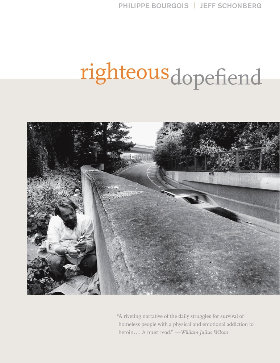
Fieldwork among homeless heroin and crack users – new book by Philippe Bourgois

cover

In Search of Respect. Selling Crack in El Barrio” is one of my favorite ethnographies. Now, Philippe Bourgois, is out with a new book. In “Righteous Dopefiend“, he looks at the clients of the dealers, the University paper Penn Current reports.

The paper published a interesting interview with him that also touches the popular topic “anthropology at home”. Bourgois conducted his fieldwork among homeless heroin and crack users a mere six blocks away from his San Francisco home. He spent lots of time with them, and even slept outside in homeless encampments to gain a true sense of what life is like for the addicts.

What happened? People in the neighborhood began to think that the anthropologist must be one of the addicts as well:

During the intense years, when I’d be hanging out on the corner, people in the neighborhood just took for granted that I was either a drug addict or someone about to fall into drug addiction.

I remember being embarrassed in front of my son’s friends, because my son at this time was about seven years old when I started the project, and so all of his friends lived in the neighborhood and would say, ‘I saw your father hanging out on the corner where all the drug addicts are.’ I was worried about my son’s friends’ parents, because they were seeing me.

But although the addicts lived so close to the neighborhood, they were invisible. It was “mind-boggling”, he says, that he literally had to walk not more than six meters through a little thicket in order to enter a totally separate universe:

You can hear all these people, I mean, literally, hundreds of people at rush hour, walking to the bus stop, and you’re in this separate universe, and the two don’t touch. You can spend several hours in this separate universe listening to people go by and they don’t look through the bushes and notice these people. You almost feel falsely protected in this cocoon. 
People don’t want to see it, either, and the point of my book is to make it visible.

Bourgois connects the daily life in the thicket with larger structures in the society:

(W)hat is terrifying is seeing – and this is in a sense what the book is about – how structural forces beyond our control, historical forces, shifts in the economy, shifts in the political organization of public policy, come crashing down on vulnerable sectors of the population and basically shove them around in very unpleasant ways.

These are the people who weren’t able to recover from the downsizing of the industrial sector in the United States. A bunch of other types of industries arose in place of that, but those people who aren’t able to make that adjustment, those people who don’t have the education to shift from being a factory worker to being an information technology processor, are people who fall into indigent poverty.

The guys that we studied – their parents were the people who lost their jobs working on the docks of San Francisco, working in the steel mills, working in the warehouses that were serving the active factory sector of San Francisco as a port industrial city. 
These are forces that are much larger than the will of any individual or the moral ability of any individual to act in a way that’s going to make them a productive member of society. The book is trying to show those dynamics and when you dig deeper you then see these other patterns, that whites are affected by this very differently than African Americans.

Over half of his informants have passed away during the study and in the two years since the end of the actual field work.

>> read the interview in the Penn Current

>> download the first chapter of the book

On his website, he has published lots of papers!

UPDATE Long article about the book in The Chronicle Review: An Anthropologist Bridges Two Worlds. See also the comment by Eugene Raikhel at Somatosphere

SEE ALSO:

The most compelling ethnographies

Is the anthropologist a spy? New Anthropology Matters about fieldwork identities

Study: Drug smuggling as vehicle for female empowerment?

cover

"In Search of Respect. Selling Crack in El Barrio" is one of my favorite ethnographies. Now, Philippe Bourgois, is out with a new book. In “Righteous Dopefiend", he looks at the clients of the dealers, the University paper Penn Current…

Read more