search expand

Anthropologist calls for a greater appreciation of child labor

(LINKS UPDATED 7.3.2023) There are many campaigns against child labour. But anthropologist Thomas Offit also views child labour as a chance for children to improve and take control of their lives. In an interview with The Lariat Online (Baylor University) he criticizes ethnocentric views of childhood.

“When we in the West view child labor, we view them as victims of exploitation instead of having some control over their lives,” Offit said. Many children are victims of child labor. But these children are also active agents in making their own and family’s lives better by working.

Offit has researched on child street labor, including in Guatemala City working with Mayan Indians in the textile trade. Child street labor is also the basis for his new book coming out within the year.

Guatemala doesn’t have a social welfare system and the economic opportunity is limited. In his view, a greater appreciation of child labor and the “greater economic forces that bring children to work on the streets in the first place”, is important. Our lives and theirs are closely related.

>> read the whole story in The Lariat Online

Similar views on child labor can be found in an article by Olga Nieuwenhuys in the Annual Review of Anthropology 1996 called The Paradox of Child Labor and Anthropology. In her view, one should rather focus on the economic conditions that create child labor. In her review, she is also criticizing notions of childhood that may make sense in rich countries, but not in poor ones:

Illuminating the complexity of the work patterns of children in developing countries, recent anthropological research has begun to demonstrate the need to critically examine the relation between the condemnation of child labor on the one hand and children’s everyday work practice on the other.

The emerging paradox is that the moral condemnation of child labor assumes that children’s place in modern society must perforce be one of dependency and passivity. This denial of their capacity to legitimately act upon their environment by undertaking valuable work makes children altogether dependent upon entitlements guaranteed by the state. Yet we must question the state’s role—as the evidence on growing child poverty caused by cuts in social spending has illuminated—in carrying out its mission.

(…)

As a global solution to eliminate child labor, development experts are now proposing a standard based on the sanctity of the nuclear family on the one hand and the school on the other as the only legitimate spaces for growing up. If this becomes a universal standard, there is a danger of negating the worth of often precious mechanisms for survival, and penalizing or even criminalizing the ways the poor bring up their children. This criminalization is made more malevolent as modern economies increasingly display their unwillingness to protect poor children from the adverse effects of neoliberal trade policies.

(…)

The price of maintaining this order (of childhood institutions like school) is high, because it requires, among other commitments, money to support the institutions at the basis of the childhood ideal, such as free education, cheap housing, free health care, sport and recreation facilities, family welfare and support services, etc. Developing economies will unlikely be able to generate in the near future the social surplus that the maintenance of these institutions requires. As the neoliberal critique of the welfare state gains popularity, wealthy economies also become reluctant to continue shouldering childhood institutions.

Rethinking the paradoxical relation between neoliberal and global childhood ideology is one of the most promising areas for research, she writes:

Research should especially seek to uncover how the need of poor children to realize self-esteem through paid work impinges upon the moral condemnation of child labor as one of the fundamental principles of modernity. (…) The ways children devise to create and negotiate the value of their work and how they invade structures of constraint based on seniority are other promising areas of future anthropological research.

This type of research is even more relevant in that it may not only enrich our knowledge of children’s agency but may prove seminal in understanding the process by which work acquires its meaning and is transformed into value.

Current child labor policies reinforce acccording to Olga Nieuwenhuys paradoxically children’s vulnerability to exploitation:

Irrespective of what children do and what they think of what they do, modern society sets children apart ideologically as a category of people excluded from the production of value. The dissociation of childhood from the performance of valued work is considered a yardstick of modernity, and a high incidence of child labor is considered a sign of underdevelopment. The problem with defining children’s roles in this way, however, is that it denies their agency in the creation and negotiation of value.

The whole paper is not accessible for people outside the academe (university account needed).

Available for everybody: The report by Norwegian anthropologist Tone Sommerfelt: Domestic Child Labour in Morocco. An analysis of the parties involved in relationships to “Petites Bonnes” (pdf). “Petites bonnes” (small maids) are young girls (here defined as under the age of 15 years) who perform various household tasks, and who live with their employers.

SEE ALSO:

“We want children to be their own ethnographers”

Ethnographic study: Why the education system fails white working-class children

(LINKS UPDATED 7.3.2023) There are many campaigns against child labour. But anthropologist Thomas Offit also views child labour as a chance for children to improve and take control of their lives. In an interview with The Lariat Online (Baylor University)…


Read more

“No wonder that anthropology is banished from universities in the ‘decolonized’ world” (updated)

The debates about the militarisation of anthropology have recently made the front page of the New York Times and several other newspapers (f.ex. The Boston Globe) and blogs discussed the story.

Are more and more (American) anthropologists willing to collaborate with the military? If so, anthropology’s role as an instrument of empire can come back into sharper focus as an inherent problem of a Western way of knowing the world”, writes Maximilian Forte:

Yet, we have to admit that imperialism is a significant feature of a “discipline” that was made possible by colonial expansion and where once again anthropologists can find profit from imperialist missions in places such as Afghanistan and Iraq.

When this is added to the chorus of voices in anthropology that would like to diminish indigeneity, that disputes the very concept “indigenous,” that refers to the struggles of the colonized for rights in terms of “seeking special rights,” and that lords over indigenous physical remains as if other people’s bodies (specifically colonized bodies) were the natural property of anthropology – then it is no wonder that this “discipline” (the martial severity of this terminology is indicative and fortuituous in this case) continues to be banished from most universities in the “decolonized” world.

>> read the whole blog post: Anthropology’s Dirty Little Colonial Streak?:

Roger N. Lancaster writes about his experiences during his anthropological research in Mexico:

Invariably, one of the first questions I was asked when I tried to begin an interview was, “Are you here to spy on us?”

Even after full disclosure of my university employment, publications and current research design, I found myself blocked out of some potentially useful interviews. Headlines like “Army Enlists Anthropology in War Zones” (front page, Oct. 5) will make future research all the more difficult.

The identification of anthropology with military operations, intelligence gathering and “armed social work” augurs ill for the future of a discipline that studies populations distrustful of power — many of which have had unhappy past experiences with American invasion, occupation or support for corrupt dictatorships.

>> read the whole “Letter to the editor” in the New York Times

Daniel Martin Varisco does not want to take sides. Nevertheless he stresses that anthropologists’ primary task is not to teach anthropology or cultural awareness. The military interest in ethnography is invariably about gathering “intelligence”, he writes. “This is not about knocking on doors, but finding suspects.” “And the issue here”, he continuies, “is not about serving in the army, or judging those who do, but whether or not anthropologists can conduct research that could be used to the detriment of the people being studied.”

In his opinion, these questions are worth discussing further:

• Would an anthropologist want to be in a position where there might be a major conflict between his or her own conscience as a researcher and the military chain of command?
• Would it be possible to establish trust and rapport, so essential for ethnographic research, when clothed in fatigues and followed by a military escort?
• How much time would a researcher have in order to collect information and who would actually own the rights to that data?
• How many anthropologists have the required language and dialect skills to work in Afghanistan or Iraq?
• If asked by the military, would an anthropologist go under cover to get information?
• And, for the long term, how long will it be in the future before anyone trusts anthropologists in either “war on terror” theater?

>> read the whole article: Anthropo covertus: A Disputed Species

Of course, many anthropologists may refuse to collaborate with the military / CIA for political reasons (for some critics the CIA is a terror organisation and opposition to the US-led war is legitimate), but even these ethical and technical research questions might be a good enough reason to simply not to do any military related work.

UPDATE 2: Eric Michael Johnson who runs the blog The Primate Diaries criticises anthropologists who state that “anthropology can help the war effort”. In his opinion, this is “uncritical enthusiasm”. It shouldn’t be forgotten, he writes, that anthropology has long had a connection with militaristic expansion. >> read his article Anthropology Goes to War. Anthropologists in the war effort from “savages” to “terrorists”

His article consists of three parts. Especially interesting part 3: Anthropology and counterinsurgency in Thailand. The USA misused anthropology to undermine communist influence. Most anthropologists, he writes joined this counterinsurgency project out of both professional interest and a desire to help the Thai villagers.

In a detailed account of one counterinsurgency effort, migrating Hmong villagers were viewed to be “potential” insurgents and were forced to resettle to less fertile farmlands. The Hmong “were forced to steal food rather than starve,” which then developed into a “full-scale rebellion” once the Thai Border Patrol Police “responded.” The Thai government “deployed troops and helicopters and finally resorted to heavy bombing and napalm” to battle these “communists.”

>> read the whole article

>> Joseph G. Jorgensen and Eric R. Wolf: Anthropology on the Warpath in Thailand

UPDATE 1: On NPR: Montgomery McFate and Roberto Gonzales discuss the controversial idea of “academic embeds” at war >> listen to the radio program

SEE EARLIER POSTS:

Anthropology and CIA: “We need more awareness of the political nature and uses of our work”

Oppose participation in counter-insurgency! Network of Concerned Anthropologists launched

The dangerous militarisation of anthropology

Protests against British research council: “Recruits anthropologists for spying on muslims”

More and more anthropologists are recruited to service military operations

San Jose: American Anthropologists Stand Up Against Torture and the Occupation of Iraq and AAA Press Release: Anthropologists weigh in on Iraq, torture at annual meeting

The debates about the militarisation of anthropology have recently made the front page of the New York Times and several other newspapers (f.ex. The Boston Globe) and blogs discussed the story.

Are more and more (American) anthropologists willing to…

Read more

Monks prosecute muslims? Free Burma International Bloggers’ Day

free-burma banner

Burma’s protesters may have been silenced, but we must continue to support them, writes Brendan Barber in The Guardian. But maybe we should not focus too much upon the courage of the monks. Muslims in Burma are persecuted, not only by the military, even by the ‘peaceful’ monks according anthropologist Gabriele Marranci:

free burma

From an anthropological viewpoint, the revolt in Burma is particularly interesting for an anthropologist specialised in Muslim societies and communities. There are two elements that attract my attention. First of all, how this revolt is represented by the western mass media and secondly, the near total lack of reference to the drama that the Muslim minority, the so called Rohingya Muslims, have experienced in the last three decades. There are some hard stereotypes which affect how the mass media represent religions, and consequently, how ordinary people understand religions.

Muslims in Burma are a persecuted minority – a story that the mass media neglects to inform us, he writes. The omission, when compared, is according to the anthropologist “not very dissimilar from the western attitude towards other Muslim minority and refugee tragedies”.

He explains:

The Rohingya Muslims live mainly in the North of the Rakhine State and represent, officially, 4% of the entire Burmese population, but represent 50% of the population of Rakhine state (previously known as Arkana) itself. (…) In 1784, a Burmese king, Bodawpaya, annexed Arkana to his domain. This provoked a long guerrilla war with the Muslims, which saw, according to historians, more than 200,000 Arkanese killed. Many of the local Muslim population, at that time, were reduced to slavery and forced to build Buddhist monasteries. (..)

Muslims in Burma are not considered to be citizens. They have no rights and often suffer discrimination and indiscriminate killings. Many of them, in particular after 1962, had to flee the country and still today live in refugee camps in Bangladesh, which actually do not welcome them. Although Muslims have taken active part in the 1988 revolt, and paid the consequences more than the Buddhist population, the majority of monks and Buddhists in Burma have anti-Muslim sentiments, in particular based on the fear of possible intermarriages.

Pamphlets glorifying race purity and Buddhism and actually reinforcing anti-Muslim sentiments have been distributed since 2001 (i.e. Myo Pyauk Hmar Soe Kyauk Hla Tai or The Fear of Losing One’s Race). These inflammatory publications, preaching against the Muslim minority, as well as rumors spread about Muslims raping children in the streets, provoked a series of monk-led riots against Muslim families and the destruction of mosques. Muslims were killed and mosques destroyed, and again the Rohingya Muslims had to flee to Bangladesh.

(…)

Everybody hopes that the Buddhist monks can succeed in mobilising the population in a sort of Intifada. Some Muslims, I know, are repeating their Inshallahs in the not so distant Rohingya refugee camps in Bangladesh. They hope that the end of the military junta means the end of their oppression.

Nonetheless, a question remains, after such strong monk-led anti-Muslim campaigns which were also reinforced by the welcomed ‘Bushit’ rhetoric of ‘war on terror’: would the new, certainly Buddhist, regime accept the history and the existence, as Burmese citizens, of Rohingya Muslims? Or, would the new regime, like their predecessor generals the Muslims as an easy scapegoat?

>> read the whole article on Gabriel Marraci’s blog

A few days after his blog post, mainstream media has started writing about the discrimination of muslims and minorities in Burma – but without reference to the monks, see the CNN-story Myanmar’s ethnic minorities suffer a ‘hidden war’

UPDATE: See also Martijn de Koning: Muslims in Burma (Closer, Anthropology of Muslims in the Netherlands)

UPDATE According to South Asia Analysis Group, the Burmese muslims in Rakhin “have strongly come out in support of the uprising against the military junta spearheaded by the Buddhist monks, students and others”. On 26 September 2007, the Rohingyas and Rakhaings had jointly participated in the demonstration staged by the Buddhist monks forming human chains in Akyab chanting the slogan: “We are a family and we are travellers in the same boat, we Burmese citizens need to be united without regard to religion, class or race.”

Supporters of Burmese protestors from around the world are planning a global day of protests on 6 October according to the Democratic Voice of Burma.

MORE INFORMATION:

Wear red shirts on friday – Anthropologists on the protests in Burma?

George Monbiot: Let’s put pressure on the companies responsible. Western interests in Burma contribute to the oppression of its people

Guardian Special Report: Burma

BBC News Special Reports: Burma Protest

Wikipedia: 2007 Burmese anti-government protests

Global Voices: Burmese bloggers on Burma

Democratic Voice of Burma

free-burma banner

Burma's protesters may have been silenced, but we must continue to support them, writes Brendan Barber in The Guardian. But maybe we should not focus too much upon the courage of the monks. Muslims in Burma are persecuted, not only…

Read more

Conflict Resolution and Anthropology: Why more scholarship on violence than on peace?

Is it because the academe rewards critique rather than advocacy? Conflict resolution studies, Mark Davidheiser and Inga E Treitler write in Anthropology News September, are “not widely acknowledged within our discipline” and are “rarely published in mainstream anthropological journals”.

Is it because these studies are often written to be intelligible to a broad audience, they wonder:

Addressing an interdisciplinary readership makes it impractical to philosophize on the finer points of specialized topics like agency and employ the latest anthropological jargon. A prominent case in point is the bestselling Getting to Yes, coauthored by anthropologist William Ury. Getting To Yes did not foreground anthropological themes, and while it has been read by many public health practitioners and management professionals, it has received scant attention within anthropology.

One may justifiably wonder why anthropology has not engaged conflict resolution in a more sustained manner. As Leslie Sponsel and Thomas Gregor emphasize in The Anthropology of Peace and Nonviolence, there has been much more scholarship on violence than on peace. The fact that their book has long been out of print only underlines their point.

>> read the whole article “Conflict Resolution and Anthropology: An Analytic Introduction and a Call for Interdisciplinary Engagement” (link updated)

In his historical overview of anthropology and Conflict Resolution, Kevin Avruch writes that most of anthropologists’s early involvement was dedicated to the problem of getting the field to take the idea of culture seriously. They faced two main hurdles. First, the political scientists and international relations folk took power to be the only “variable” that counted. Second, the psychologists assumed that given the biogenetic unity of the human brain, we must all think and reason in the same way, and so, say, decision-making (as in negotiation) must look the same everywhere.

>> read the whole article: A Historical Overview of Anthropology and Conflict Resolution (link updated)

Günther Schlee stresses that an important finding of anthropological research is related to causes of conflicts:

Ethnicity is not the cause of so-called ethnic conflicts. The corresponding thesis about religion is that religion is not the cause of religious conflicts. We continue to talk about ethnic or religious conflicts, because there is much about such conflicts that is indeed ethnic or religious—just not their causes. Frequently, ethnic or religious polarization only starts to emerge in the course of a conflict, and that is certainly the wrong time to be looking for a cause.

>> read the whole article “The Halle Approach to Integration and Conflict” (link updated)

As Mark Davidheiser and Inga E Treitler writes, there are anthropologists who argue that conflict resolution can be seen as an ideology that subverts access to “justice”. One of them is Laura Nader.

In her article in Anthropology News, she writes:

Conflict, adversarialness, dissent, confrontativeness are tools used in asymmetrical situations to right a real or perceived wrong—the collision of force with opposing force. In the absence of such opposing force there is acquiescence, subordination, passivity, apathy—features associated with Brave New World or 1984 societies.
(…)
Looking back on our study of consumer justice makes me realize that conflict, confrontativeness, adversarial law would have produced much more benefit for our society than the harmony and reconciliation industry, in terms of improved products, citizen participation (rather than apathy), and an investment in our judicial system appropriate to a country that espouses democratic rule.
(…)
The search for justice is both fundamental and universal in human culture and society. Thus, as long as there is power asymmetry one can expect conflict.

>> read the whole text “What’s Good About Conflict?” (link updated)

Leslie E. Sponsel is one of several anthropologists who contribute to the website Peaceful Societies. Alternatives to Violence and War

SEE ALSO:

Applied anthropology – A wedding ceremony in support of peace in West Timor

Book review: An Anthropological Challenge to Assumptions about War and Violence

Mahmood Mamdani: “Peace cannot be built on humanitarian intervention”

Challenges of Providing Anthropological Expertise: On the conflict in Sudan

Anthropologists on the Israel-Lebanon conflict

Anthropology in a Time of Crisis. A Note from Nepal

Cameroon: “Ethnic conflicts are social conflicts”

Do anthropologists have anything relevant to say about human rights?

Is it because the academe rewards critique rather than advocacy? Conflict resolution studies, Mark Davidheiser and Inga E Treitler write in Anthropology News September, are "not widely acknowledged within our discipline" and are "rarely published in mainstream anthropological journals".

Is…

Read more

Wear red shirts on friday – Anthropologists on the protests in Burma?

burma-demonstration

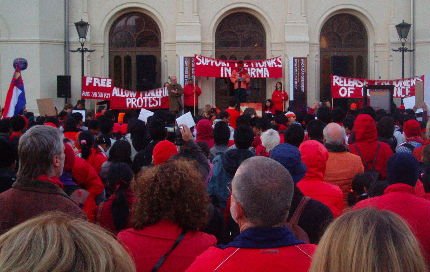
Wear red for Burma: Several thousand people at the demonstration in Oslo

“Wear a red t-shirt in solidarity this friday!” “Light candles in your windows on Friday night to honour the victims of the demostrations.” Pro-democracy protest marches in Burma have entered the tenth day. Burmese soldiers have detained about 200 Buddhist monks and fired shots as they attempt to disperse thousands of anti-government protesters in Rangoon.

Any comments by anthropologists on the situation in Burma? By now I’ve found two three four:

Monique Skidmore, medical anthropologist in The College of Arts & Social Sciences at the Australian National University (ANU) has been conducting research in Burma since 1994.

red shirt for burma

In the Australian online magazine Crikey she explains, that the the current protests stretch its roots stretch back to 1962 “when the Burmese armed forces, led by General Ne Win, usurped power from Burma’s democratically elected government of Prime Minister U Nu. General Ne Win ruled the country by fear, informers, propaganda and isolation. A civil war has waged since then, with estimates of the loss of life at up to 10,000 each year.”

Today’s street protests are furthermore “the culmination of a campaign for democracy being coordinated by the ’88 Student Generation, the activist movement in exile, the labor movement (embodied by Su Su Nway, now in hiding), monks, and the National League for Democracy.”

Coordination is difficult given that most mobile phones are illegal as well as use of the internet, she writes: “Burma’s first blog appeared last week showing the first day of the monk protest in Rangoon. It only took the military regime 24 hours to shut it down.”

>> Monique Skidmore: The Burmese people have had enough

Sometimes Burma is also called Myanmar. Myanmar is actually the official name, the BBC explains: The ruling military junta changed its name from Burma to Myanmar in 1989, a year after thousands were killed in the suppression of a popular uprising. Rangoon also became Yangon.

The name change is a form of censorship, says anthropologist and editor of Anthropology Today Gustaaf Houtman in the BBC article Should it be Burma or Myanmar?

Houtman has written a book that is available online (free) called Mental Culture in Burmese Crisis Politics. Aung San Suu Kyi and the National League for Democracy. It is also available on Google Books. Read also an interview with Houtman on The Culture of Burmese Politics.

update: In the New York Times story Karma Power: What Makes a Monk Mad anthropology professor Ingrid Jordt contributes with some orientalitic statements when she explains that the monks’ power comes from their role in bestowing legitimacy on the rulers:

“Legitimacy in Burma is not about regime performance, it’s not about human rights like the West. It is something that comes from the potency and karma bestowed by the monks. That’s why the sangha is so important to the government,” she said, referring to the Buddhist hierarchy and the spiritual status that its monks can convey. “They are actually the source of power.”

free burma

UPDATE: Anthropologist Gabriele Marranci tells a story that the mass media neglects to inform us: Muslims in Burma are persecuted, not only by the military, even by the ‘peaceful’ monks: >> Gabriele Marranci: The other, invisible suffering of Burma

FOR MORE INFORMATION ON THE SITUATION IN BURMA SEE:

BBC News Special Reports: Burma Protest

Wikipedia: 2007 Burmese anti-government protests

Global Voices: Burmese bloggers on Burma

BBC News also has a story about how Burma cyber-dissidents crack censorship and tell the world what is happening under the military junta’s veil of secrecy.

See also on Facebook Support the Monks’ protest in Burma and Red Shirt For Burma

For non facebook users more on the red shirt campaign see on these blogs at Livejournal, Dynamic Nonvilence, Sungame and in the Phuket Gazette: Red-shirt-Friday campaign sweeps Phuket and Norwegian trade union leader backs call to “wear red”

To those who think this might be a pointless or even stupid campaign I’ve found this comment in a facebook group:

Nobody thinks wearing a red shirt is gonna change the situation. Did you actually think so? Now THAT is really stupid.

Nobody really thought demonstrating against the Iraq war in Oslo, where I live, or any other place in the world would for that matter, would make Bush change his mind either. Point is, we still did it, it’s the biggest demonstration in Norwegian history.

What’s wrong with gathering the world? What’s wrong with trying to spread the word to everybody? What’s wrong with showing that you care, and that you are aware of the situation and have a statement, even though it doesn’t necessarily make a practical change? Negativity of that kind is what really is stupid.

UPDATE

Monks prosecute muslims? Free Burma International Bloggers’ Day 4.10.2007

burma-demonstration

Wear red for Burma: Several thousand people at the demonstration in Oslo

"Wear a red t-shirt in solidarity this friday!" "Light candles in your windows on Friday night to honour the victims of the demostrations." Pro-democracy protest marches in Burma…

Read more