search expand

Anthropologists: “It’s time to kill the Osama bin Laden myths”

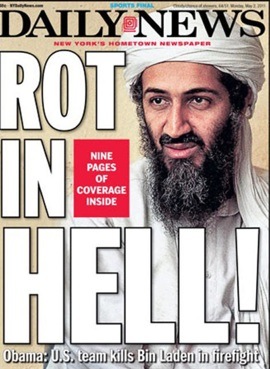
(draft, post in progress) It’s not the first time that Osama Bin Laden has died. Nevertheless, the Western political leaders, even European leaders who were supposed to oppose death penalty, are celebrating the killing of Bin Laden (incl. CIA torture), and the frontpages of American newspapers are shouting in Wild West style “ROT IN HELL”, as Daniel Martin Varisco documents on the blog tabsir.

Varisco is one of several anthropologists who have already started commenting this issue.

William O. Beeman, chair of the department of anthropology, University of Minnesota and past president of the Middle East Section of the American Anthropological Association, explains in an article the myths surrounding Osama bin Laden.

One of the myths is bin Laden’s supposed importance. “Osama bin Laden at the end was far from the looming powerful figure he was made out to be”, he writes:

bin Laden was promoted by the Bush administration as the mastermind of a gigantic apocalyptic global organization under his control. (…). This was a gigantic exaggeration that was largely accepted by the American public without question.

In fact, bin Laden was an incredibly useful symbolic bogeyman. His mere existence justified the United States’ presence in Afghanistan, as well as billions of dollars spent supporting the Pakistan military regime without complaint from the American public.

.

Furthermore, bin Laden was seen as promulgating the United States as al-Qaeda’s principal target. That’s not so true either.

“The mythic ideology of Islamic confrontation with the West, inherent in the bin Laden myth, should die with him”, he writes:

Americans, rather than celebrating a triumph over Islam, should instead be looking forward to a new era of cooperation with the progressive peoples throughout the region, who, with bin Laden’s death, have now begun to have the false accusation of Islamic extremism lifted from their shoulders.

W. Porter Bourie, a PhD student of cultural anthropology at the University of Colorado at Boulder, comments on his blog Dynamic Relations:

Celebrating his death only redefines the Us-Them divide and misdirects our gaze from the conditions that have led to the state of the world. His death won’t cause more violence, but the West’s continued political economic imperialism will. (…) Celebration blinds us to empathy and deludes us into thinking that the world is easily knowable.

Anthropologist Jason Antrosio, presents on the blog Living Anthropologically insights from anthropology and its “voice for tolerance”, contrasting it to the us-versus-them mentalities of the American “war on terror”. It would have been much a more powerful and enduring victory to see bin Laden tried in a court of law, he argues. “Let’s celebrate by investing in jobs, an inclusive healthcare system, schools, and paying our teachers”, he concludes.

The History News Network has published an interview with anthropologist and Afghanistan expert Thomas Barfield on Bin Laden’s death. Barfield seems to identify with the official American rhetoric, and when he says “We”, he means the U.S. administration.

Hamid Mir was the last journalist to interview Osama after 9/11. In his article The Osama bin Laden I knew, published today in the Pakistani newspaper The News, he concludes:

Physical elimination of Osama bin Laden is big news for the Americans but many outside America want elimination of the policies that produce bin Ladens. America came into Afghanistan in search of Osama bin Laden. No doubt that he was responsible for the killing of many innocent people but Americans cannot justify the killing of innocent people through drone attacks just because Osama killed some innocent Americans.

Both Osama bin Laden and Americans violated the sovereignty of Pakistan. It must be stopped now. Osama is dead. If America does not leave Afghanistan after the death of Osama bin Laden, then this war will not end soon and the world will remain an unsafe place.

Check also Wikipedia for the CIA-Osama bin Laden controversy

UPDATES:

Interesting analysis by Matt Thompson at Savage Minds: “One of the most revealing bits of trivia has been that Bin Laden was assigned the code name “Geronimo” by the operation tasked with capturing and killing him”, he writes:

This raises the question, what does a nineteenth century Apache leader have to do with twenty first century Saudi millionaire? Perhaps nothing when viewed from an academic standpoint, it seems more like a non sequitur. But when read as expression of an underlying ideology, one that has legitimated American military action for centuries, the answer is: quite a lot, actually.

Yes, and then we’re back we I’ve started this post, actually, in the Wild West! (Check also Osama, Geronimo, and the scalp of our enemy by Aaron Bady at zunguzungo)

SEE ALSO:

How can anthropology help us understand Swat and Taliban?

Extremism: “Authorities -and not Imams – can make the situation worse”

Selected quotes from “On Suicide Bombing” by Talal Asad

Anthropologist: Al-Qaeda uses dreams to justify violence

Fieldwork reveals: Bush administration is lying about the “war on terror” in the Sahara

Anthropology and CIA: “We need more awareness of the political nature and uses of our work”

War in Iraq: Why are anthropologists so silent?

Thesis: That’s why they go to war

(draft, post in progress) It's not the first time that Osama Bin Laden has died. Nevertheless, the Western political leaders, even European leaders who were supposed to oppose death penalty, are celebrating the killing of Bin Laden (incl. CIA torture),…
Read more

Global apartheid: Are you expat or immigrant? (updated)

What comes into your mind, when you’re reading the following lines?

“We tend to gather in certain locales (cities, sometimes specific neighbourhoods); we frequent particular businesses – some of the services being unique to our community; we have dedicated media, strong social networks and political tendencies; we even have certain etiquette, social rules and beliefs we would likely agree on (a topic for another day), all the result of shared experiences distinct to our clique.”

Sounds like one of those popular descriptions of “immigrants living in a parallel society”? Wrong, anthropologist Sarah Steegar writes about a group of people called “expats”.

Why doesn’t she call them migrants? Well, it’s a question of class and “race”: The people she writes about aren’t from Somalia or Iraq. They’re white people and wealthy. By using a different term, a distance to “the other” is established.

So, it’s not surprising to see that no Somali people are interviewed on the website about Expats in Norway.

In Wikipedia we get this revealing definition:

In its broadest sense, an expatriate is any person living in a different country from where he or she is a citizen. In common usage, the term is often used in the context of professionals sent abroad by their companies, as opposed to locally hired staff (who can also be foreigners).

The differentiation found in common usage usually comes down to socio-economic factors, so skilled professionals working in another country are described as expatriates, whereas a manual labourer who has moved to another country to earn more money might be labelled an ‘immigrant’. There is no set definition and usage does vary depending on context and individual preferences and prejudices.

I always found the usage of the word expat interesting. Personally, I never use it, and call everybody for migrants regardless their class or “race”. Inspired by Steegar’s text I googled around and found that the usage of the terms expat and migrant is contested.

On Wikipedia’s talk page long there’s a long debate about the meaningfulness of this distinction.

Aaron Hotfelder points to a long interview in the journal Reason. There, Kerry Howley writes:

“If you picked up, moved to Paris, and landed a job, what would you call yourself? Chances are, if you’re an American, you’d soon find yourself part of a colorful community of ‘expats.’ If, while there, you hired an Algerian nanny– a woman who had picked up, moved abroad, and landed a job– how would you refer to him or her? Expat probably isn’t the first word that springs to mind. Yet almost no one refers to herself as a ‘migrant worker.'”

Yes, that’s because, as Laura María Agustín says in the interview with Howley, ” ‘migrants’ travel because they are poor and desperate, ‘expatriates’ travel because they are curious, self-actualizing cosmopolites.”

Or as Andrew Kureth writes:

Westerners don’t like referring to themselves as immigrants because the word “immigrant” has such nasty connotations. (…) An immigrant is an unwanted job-stealer, while an expat is a foreigner who could be leaving any day now. An immigrant is on a desperate search for a better life. An expat is on an adventure. (…) Our usage of these words reveals a certain double standard. Whether you’re an expat or an immigrant depends not on your residency plans, but on the relative wealth of your native country.

I might add, the usage of this term suits very well to the rhetoric of the political elite in the West who is building and enforcing Fortress Europe, as part of the larger project of Global Apartheid

UPDATE 1: (via richmondbrige) Great commentary in the Guardian by sociologist Peter Matanle, British migrant in Japan, published today. He feels uncomfortable when British people overseas, or the Guardian, use the term “expat” with reference to Britons abroad, then use words such as “immigrant” when describing people from other countries who are in the UK:

So, my proposal is for the Guardian to amend its style guide to discourage the use of the word “expat” in its pages. The word is too redolent of the days of empire and sipping gin and tonic in the shade while the locals toil beyond the fence. It is too easily used as a cultural marker to distinguish people from one another, making it easy for some Britons to feel both superior to and separated from the local people in their host cultures. I suggest that words such as resident, visitor, settler, immigrant and tourist be used instead in order to equalise the way we describe ourselves with the ways in which we describe others. It is only fair and just to do so.

UPDATE 2: Brendan Rigby has written an excellent post: Are you a Greek or a Barbarian?

UPDATE 3: Great post by Julie Sheridan, “native Scot” in Spain: Double acts & double standards. She asks: What makes me an expat but my neighbour an immigrant? She also draws attention to the etymology of “expat” (excluded, absent from one’s “fatherland”) and ends her post with these sentences:

No idea how long I’ll be here, but while I am, I want to feel settled, and ideally integrated. And try to remember that being here is an experience, rather than an identity.

SEE ALSO:

Paperless underclass exposes dark side of Europe

“Human smugglers fight global apartheid”

The “illegal” anthropologist: Shahram Khosravi’s Auto-Ethnography of Borders

Racism: The Five Major Challenges for Anthropology

How to challenge Us-and-Them thinking? Interview with Thomas Hylland Eriksen

What comes into your mind, when you're reading the following lines?

"We tend to gather in certain locales (cities, sometimes specific neighbourhoods); we frequent particular businesses - some of the services being unique to our community; we have dedicated media, strong…

Read more

Anthropologists and stereotypes about Libya and Japan


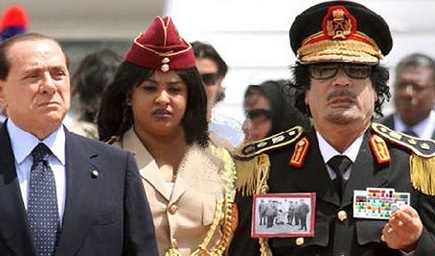
Two friends, same culture: Berlusconi and Gaddafi. Photo: Derek Visser, flickr

(draft) Have you tried googling “Japan” “earthquake” and “no looting”? Or “Libya” and “tribes”? It’s no big surprise to see stereotypical representations of other people in the news, but the ongoing historical developments in Libya and Japan might provide especially interesting examples.

Libya is for many journalists and experts a “tribal” country.

“Many Americans pride themselves on God and country. In Libya, it’s God, tribe, then country”, explains CNN and quotes anthropologist Philip Carl Salzman who says “Libyans have a strong loyalty to tribe. A tribe provides welfare in times of need,” he said. “They have a collective responsibility.”

In the article In Libya the revolution will be tribalized (The Globe and Mail), Khalil Ali Al-Musmari, a retired professor of anthropology and sociology, said the foreign media have often crudely misrepresented the nature of “tribal power” in the country, by talking about tribal leaders as though they still commanded the same obedience they did in ancient times. Educated Libyans in coastal cities, he says, make their own political decisions and do not feel obligated to follow their tribal elders. Talk of tribal divisions in the country is dangerous.

Check also The Egyptian revolution Orientalist essay contest

Japan is for journalists and experts a calm and spirutal country. Most meanstream papers around the world run stories like “Why is there no looting in Japan in earthquake aftermath?”


A lack of looting in Japan?

“The layer of human turmoil – looting and scuffles for food or services – that often comes in the wake of disaster seems noticeably absent in Japan”, claims CNN and several experts give culturalist explanations. Among them Merry White, an anthropology professor at Boston University who studies Japanese culture. “Violence, and taking what belongs to others, are simply not culturally approved or supported”, she says.

A great deal of culturalism can be found in the article Japan Earthquake Feature: Japanese stoicism part of the culture in the National Post.

The paper writes about “the extraordinary sense of calm on the Japanese archipelago amid conditions which in perhaps any other place would have led to chaos”.

“The Japanese culture encourages a heightened sense of individual responsibility, but also a very powerful sense of solidarity, and that is a very powerful combination”, says sociologist Frank Furedi.

“In Japanese culture, there’s a sort of nobility in suffering with a stiff upper lip, in mustering the spiritual, psychological resources internally,” explains anthropologist John Nelson.

“Quake response showcases Japan’s resilient spirit” is the title of Associated Press story:

Theories abound as to what makes the Japanese so resilient and willing to cooperate. Some cite the centuries-old need to work together to grow rice on a crowded archipelago prone to natural disasters. Others point to the hierarchical nature of human relations and a keen fear of shaming oneself before others.

“It strikes me as a Buddhist attitude,” Glenda Roberts, an anthropology professor at Tokyo’s Waseda University, said. “Westerners might tend to see it as passivity, but it’s not that. It takes a lot of strength to stay calm in the face of terror.”

There are even stories about the lack of a Japanese word for looting, as the bloggers at Language Log have observed. “As usual, the attempt to diagnose and explain culture cheaply in lexical terms is empirically as well as conceptually weak”, Mark Liberman comments. Further down in the comment field, Chris Kern deconstructs the notion of the non-looting Japanese:

Looking at Japanese news articles on the disasters is the easiest way to disprove this. There’s one article that discusses the American news media’s wonder over the lack of looting with the following headline:
「なぜ略奪ないの?」=被災地の秩序、驚きと称賛-米
“ryakudatsu” is used as the translation of “looting” there.

But there are other articles that talk about looting that actually has been occurring in Japan in the wake of the disasters, and they use “ryakudatsu” and “goudatsu”

But there has been looting, and these stories don’t seem to be translated into English or reported on English language news sites as the BBC explains.

What are the consequences of this kind of reporting?

These news stories that contrast peaceful Japan with violent Haiti have often triggered racist discourses in the comment fields.

Comments like this here were made quite often:

Japan is one of the least “diverse” countries in the world. This gives them solidarity and sense of nationhood that “multicultural” societies don’t have, it allows them to pull together for the common good in times of adversity. Contrast that with “multicultural” New Orleans response to a natural disaster. It seems like unity is a strength and “diversity” is a weakness.

Johann Hari challenges these stereotypes in her comment The myth of the panicking disaster victim. The evidence gathered over centuries of disasters, natural and man-made, is overwhelming, she writes:

The vast majority of people, when a disaster hits, behave in the aftermath as altruists. They organise spontaneously to save their fellow human beings, to share what they have, and to show kindness. They reveal themselves to be better people than they ever expected.

But what about the violence in New Orleans after Hurricane Katrina?

Remember the gangs “marauding” through New Orleans, raping and even cannibalising people in the Super-Dome after Hurricane Katrina? It turns out they didn’t exist. Years of journalistic investigations showed them to be racist rumours with no factual basis. Yes, there was some “looting” – which consisted of starving people breaking into closed and abandoned shops for food. Of course human beings can behave atrociously – but the aftermath of a disaster seems to be the time when it is least likely.

“The cultural explanation for looting just doesn’t cut it, and at its worst it shows signs of racism”, David A. Love explains in his piece From Haiti to Japan: Is looting economic or cultural?:

As an African-American who lived with a Japanese family as a high school exchange student, majored in Japanese studies in college, and later rode the Tokyo subway every day to work in a Japanese corporation, I have some thoughts. I say it is economic, but it isn’t quite that simple, because other circumstances are at play.

SEE ALSO:

Haiti Earthquake: Worldwide solidarity, a common humanity? (updated)

How racist is American anthropology?

Emphasis on ‘culture’ in psychology fuels stereotypes, scholar says

“Stone Age Tribes”, tsunami and racist evolutionism

In Norwegian TV: Indian tribe paid to go naked to appear more primitive

The Culture Struggle: How cultures are instruments of social power

Thesis: That’s why there is peace

When applied anthropology becomes aid – A disaster anthropologist’s thoughts

Two friends, same culture: Berlusconi and Gaddafi. Photo: Derek Visser, flickr

(draft) Have you tried googling "Japan" "earthquake" and "no looting"? Or "Libya" and "tribes"? It's no big surprise to see stereotypical representations of other people in the news, but the…

Read more

“A wonderful development” – Anthropologists on the Egypt Uprising (updated 6.2.)


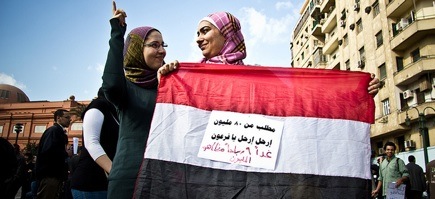
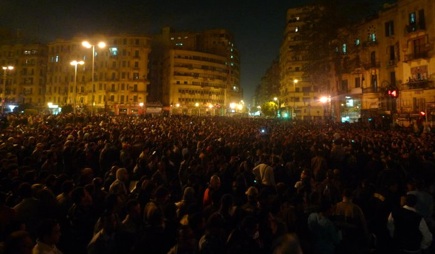
More than one million Egyptians protesting for democracy. Photo: Al Jazeera, flickr

(last updated 6.2.2011, 21:30 – updates in bold – check also new post: Saba Mahmood: Democracy is not enough – Anthropologists on the Arab revolution part II 22.2.2011 ) “The government would come down hard on even the smallest protest, and everyone would be arrested. Now, it’s as if the people are saying,  ‘We’re not going to be afraid anymore.’ “I am very, very happy for the Egyptian people. I really am. It’s a wonderful development for the Egyptian people.”

That’s how anthropologist Carolyn Fluehr-Lobban comments the recent protests in Egypt. She has spent six years since 1970 living and conducting research in the Sudan, Egypt and Tunisia and is currently teaching “Arab-Islamic Culture and the West”.

In contrast to Carolyn Fluehr-Lobban, Norwegian anthropologist Unni Wikan is worried.

In an Op-Ed in yesterday’s Aftenposten, Wikan defended Mubarak and attacked the protesters.

She claims that “Mubarak is not a despot” and that he is “considered a very honorable man”. In her opinion, Mubarak “did well / prove worthy of the situation in not giving in to the peoples’ voices on the streets”. People – especially the poor she has studied for decades – don’t care for democracy. They want stability! Without Mubarak, the “criminal mob on the streets” would lead the country into chaos, she writes. Even today, when more than a million people protested in Cairo and other cities in Egypt, she insisted that Mubarak has the peoples’ support.

Of course, her article “traveled”, among others to the Lebanese-American professor of political science As’ad AbuKhalil at at California State University, who posted a Google translation of her article and comments: “I suspect that you will both laugh and cry while reading this piece of rubbish”.

UPDATE: Comment by anthropologist David H. Price in Counterpunch: “We can expect Wikan’s incredible claims to be paraded out by Fox News and CNN as part of a distortion campaign to support Mubarak’s efforts to cling to power, all in the name of balance.”

As you might have noticed, Wikan is argueing along similar lines as the Western political elite who is about to lose an important ally in the Middle East. For them, “stability” is more important than people power, as Maximilian Forte and his co-bloggers at Zero Anthropology explain in several blog posts, among others The Fall of the American Wall: Tunisia, Egypt, and Beyond and Encircling Empire: Report #11, Focus on Egypt, Encircling Empire: Report #12, FOCUS ON EGYPT: Revolution and Counter-Revolution and The Song of the Nonaligned Nile (by Eliza Jane Darling).

Spoof on US State Departments Position on Egypt

Forte quotes Hillary Clinton who said that ”our assessment is that the Egyptian Government is stable and is looking for ways to respond to the legitimate needs and interests of the Egyptian people.”

“Let’s be really clear about what is happening in Tunisia, Egypt, perhaps soon Israel/Palestine, and now Lebanon and Yemen”, he states. “A wall of U.S. supported dictatorships and clients is collapsing.”

UPDATE: How should the West react? “The discussion in the West should focus on the factor we are responsible for and we can influence – the role our governments have played in suppressing the Egyptian people, writes Johann Hari in Huffington Post. “Your taxes have been used to arm, fund and fuel this dictatorship.”

See also Ryan Anderson’s post at Ethnografix Power, realpolitik, and freedom: Egypt and US Ideals about Freedom.

Meanwhile, over 150 academics have signed an Open letter to President Barack Obama, calling on Obama to support Egypt’s democratic movement. (You see the irony here of course… Western leaders fearing for a democratic Middle East. “The hypocrisy of western liberals is breathtaking: they publicly supported democracy, and now, when the people revolt against the tyrants on behalf of secular freedom and justice, not on behalf of religion, they are all deeply concerned”, writes Slavoj Žižek in the Guardian).

UPDATE: The American Anthropological Association signed a statement of support for Egypt. But it’s mostly about the “losses to cultural heritage” and doesn’t say anything about Mubarak.

UPDATE: Maximilian Forte ay Zero Anthropology criticizes the AAA statement. Archaeologist Rosemary Joyce addresses the issue “valuing things over people” in a very interesting post. She also questions protection of Egyptian antiquities out of concern for their status as “global cultural heritage”.


Anti-Mubarak protesters at Tahrir Square in Cairo 30.1.2011. Photo: darkroom productions, flickr

The keys to understanding what has driven millions of citizens to the streets are the tragic circumstances surrounding the deaths of two young men, writes anthropologist Linda Herrera in her text Two Faces of the Revolution at the blog Closer.

She tells the story of Mohammed Bouazizi in Tunesia who “overwhelmed by the burden of fines, debts, the humiliation of being serially harassed and beaten by police officers, and the indifference of government authorities”, set himself on fire” and the Egyptian Khaled Said who was brutally murdered by Police.

She stresses that “contrary to a number of commentators in news outlets in North America and parts of Europe the two revolutions overtaking North Africa are not motivated by Islamism.” “These are inclusive freedom movements for civic, political, and economic rights” as this video below shows as well and is described in Robert Fisk’s report in the Independent: Secular and devout. Rich and poor. They marched together with one goal

UPDATE: In the Western hype about Islamists the Muslim Brotherhood, who denounced violence a long time ago has been demonized for too long”, says anthropologist Petra Kuppinger. “While militant Islamist groups exist, they are increasingly marginal. The Brotherhood is certainly not one of them.”

“It is a revolution without a leader”, says Adrienne Pine from the Department of Anthropology at the American University in Washington in the interview below. But that does not mean chaos. She’s blogging at http://quotha.net/

Historian Mark LeVine has conducted a great interview with the Egyptian journalist and blogger Hossam el-Hamalawy.

He gives us the bigger picture, conntects the local with the global:

Revolutions don’t happen out of the blue. It’s not because of Tunisia yesterday that we have one in Egypt mechanically the next day. You can’t isolate these protests from the last four years of labour strikes in Egypt, or from international events such as the al-Aqsa intifada and the US invasion of Iraq.

UPDATE: Anthropologist Karl Lorenz from Shippensburg University agrees. He’s not surprised about the protests. He believes that it is too late for reforms from Mubarak, because the people have wanted it for 30 years and it has not been done.

Anthropologist Daniel Martin Varisco wrote two comments All Eyes on Egypt and Yemen is not Tunisia or Egypt. Another anthropologist, William O. Beeman, explains why an Islamic Government in Egypt Might Not Be So Terrible.

UPDATE: Anthropologist Farha Ghannam writes about the rich symbolism of the Tahrir Square: “In a society sharply divided by class and gender, the square has been a place where all feel comfortable – young and elderly, rich and poor, men and women, Muslim and Christian.”

Sociologist Sherifa Zuhur shares her thoughts about the recent protests and how it is received in the West.

Anthropologist Jon Anderson questions the importance of social media – a topic that was also discussed at Savage Minds: Thinking about the importance of communications “revolutions”.

The Truth Behind The Egyptian Revolution 2011. Protesters Singing. World MUST MUST Watch!

When looking for scientific publications, I made the same experience as Barbara Miller at anthopologyworks. Most articles deal with the (very distant) past. Miller concludes:

Clearly, you will have a better chance of finding out about early cat domestication, prehistoric ships, vessel residue analysis and even infant weaning during Roman times than you will have of learning about the social dimensions of today’s street protests.
(…)
I used the single search term “Egypt,” and I chose the publication dates of 2000-2010. Nearly 400 articles popped up. In scanning through them, I found that only 10 percent were related to contemporary social life. The other 90 percent of the references are dominated by archaeology with a sprinkling of biological anthropology as well as some non-anthro sources.

The sociology/anthropology repository of the American University of Cairo hosts several relevant publications.

Mats Ivarsson from the University in Lund (Sweden) has written a paper that sounds interesting: Impact of authoritarian pressure on the political blogosphere in Egypt. He “proposes the hypothesis that an authoritarian state actually will strengthen the quality of the information disseminated in the blogosphere” (pdf)

Then I stumpled upon the thesis Youth and internet in Egyptian party politics : balancing authoritarianism with agency in a condition of negative peace by Tone-Rita Henriksen from the University of Tromsø, Norway (pdf).

"Bravest girl in Egypt" translated into English

This is just a small selection of texts about the ongoing revolution in Egypt and around.

Maybe the best and most comprehensive round-up with links to tons of articles (and less chaotic than this one here) can be found at the blog Closer, compiled by anthropologist Martijn de Koning: Closing the week 5 – Featuring the Tunisia & Egypt Uprising

The Middle East blog tabsir.net has a round up What the Arab papers say

For more round-ups see posts by anthro-blogger Erkan Saka who has been active as usual, se among others Registering a revolution. Hail to the brave people of Egypt. A roundup and – media anthropologist John Postill’s bookmarks – mainly about the role of media in the Tunesia and Egypt uprisings.

My favorite news souces are Al-Jazeera (especially their live stream) and – as usual – Global Voices.

There, Gina Cardenas highlights women’s role in her post Egypt: Protesting Women Celebrated Online, a topic that has not been given enough media attention.

Very interesting also Egypt: A Voice in the Blackout, Thanks to Google and Twitter, showcasing the power of Egyptian peoples’ transnational ties and new technology.

I close this post with Global Voices video collection Egypt: Solidarity Pours in from Around the World

Riz Khan - Tariq Ramadan and Slavoj Zizek on the future of Egyptian politics

“Stupid multiculturalism, no clash of civilisations: When we’re fighting tyrants we’re universalists and building global solidarity. I’m proud of the Egyptians! They understand democracy better than we in the West (Zizek) – “This is the time to support Egypt” (Ramadan)

Check also new post 22.2.2011: Saba Mahmood: Democracy is not enough – Anthropologists on the Arab revolution part II

More than one million Egyptians protesting for democracy. Photo: Al Jazeera, flickr

(last updated 6.2.2011, 21:30 - updates in bold - check also new post: Saba Mahmood: Democracy is not enough - Anthropologists on the Arab revolution part II 22.2.2011 )…

Read more

Paperless underclass exposes dark side of Europe


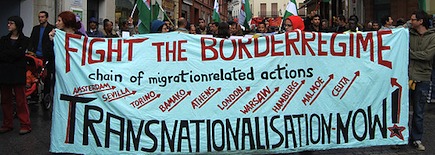
Demonstration in Sevilla. Photo: No Border Network, flickr

(Draft) “All human beings are born free and equal in dignity and rights.” These noble words in the Universal Declaration of Human Rights might be true in some distant part on this planet, but certainly not in Europe.

Here, peoples’ rights are dependent on their nationality. While I, with my German EU passport may travel and live nearly everywhere I want, people from countries like Egypt, Syria or Pakistan cannot. Europe has put much effort in building different kind of walls to prevent certain categories of people from entering. While wealthier peoples’ migration is celebrated, poorer peoples’ migration is criminalized. Anthropologist Owen Sichone calls this policy “Global apartheid”.

Two weeks ago, eight Norwegian police men arrested 25 year old Maria Amelie, an award winning book author, blogger and former anthropology student, born in North Ossetia. She had just finished her lecture at the Nansen Academy – the Norwegian Humanistic Academy about being paperless, undocumented, “illegal” migrant. This happened just three months after she had published her bok “Ulovlig norsk” (Illegally Norwegian), and one month after she was named “Norwegian of the Year” by Norway’s only cosmopolitan-minded magazine, Ny Tid.

Maria Amelie (her real name is Madina Salamova) is one of those 18 000 illegalized migrants in Norway who live here without any rights at all. No access to healthcare, education or work. They cannot open an bank account, they don’t get an ID-number, they actually don’t exist officially. Even helping them is forbidden.

Here is a video from Russia Today about Maria Amelie and a demonstration i Oslo for better rights for undocumented migrants. See related news story

Yesterday, despite lots of demonstrations and media attention, she was thrown out of Norway, where she has lived since she was 16, and deported to Russia. For Prime Minister Jens Stoltenberg and his red-green government, it was important to make clear that they don’t tolerate people like her. The Norwegian government is responsible for the deportation of hundreds of individuals and families – usually in the middle of the night without any prior notice. Media in Norway has done a good job in highlighting the plight of these people who all have a unique story to tell.

Read more:

Norway Expels Migrant Celebrity (Moscow Times, 25.1.2011)

Human rights court slams EU asylum policy as inhumane (Deutsche Wele, 21.1.2011)

‘No One Is Illegal’ Campaign aims to protect Norway’s ‘paperless’ refugees (Women News Network 8.12.2010)

SEE ALSO:

The “illegal” anthropologist: Shahram Khosravi’s Auto-Ethnography of Borders

“Human smugglers fight global apartheid”

“Anthropologists Should Participate in the Current Immigration Debate”

No more conferences in Arizona: Anthropologists condemn Immigration Law

How to challenge Us-and-Them thinking? Interview with Thomas Hylland Eriksen

Why borders don’t help – An engaged anthropology of the US-Mexican border

David Graeber: There never was a West! Democracy as Interstitial Cosmopolitanism

For an Anthropology of Cosmopolitanism

Interview with Sámi musician Mari Boine: Dreams about a world without borders

For free migration: Open the borders!

Demonstration in Sevilla. Photo: No Border Network, flickr

(Draft) "All human beings are born free and equal in dignity and rights." These noble words in the Universal Declaration of Human Rights might be true in some distant part on this planet,…

Read more