search expand

Conference Podcasting: Anthropologists thrilled to have their speeches recorded

Are we on the way to “Open Access Conferences”? As already announced, several sessions at the conference of the Society for Applied Anthropology (SfAA) will be published as podcasts. Jen Cardew who has taken the initiative to this project reports that all presenters (except for one) were very happy to have their speeches to be recorded:

Presenters were; Paul Farmer, Phillipe Bourgois, Merrill Singer, Linda Whiteford, Carolyn Nordstrom, Barbara Rylko-Bauer, Didier Fassin, and Jame Quesada, all of whom were excellent speakers with excellent things to say. The room was packed and I believe there was 300+ people at any given time. These are the rockstars of anthropology. All of the presenters were thrilled to have their speeches recorded for the podcasting project and they even had me announce the project to the group. The fact that all of these presenters were excited about the opportunity to be recorded made the project worth it to me in itself. It actually was quite an honor :)
(…)
It was very reassuring to see that the anthropologists were open to new technology, as we are not known as a “techy” or “progressive with new technology” field :)

There are also some students doing informal interviews and some minimal coverage of the conference, which will be published on the web, she writes. Their goal was to seek out how anthropologists are using technology.

Read more on her blog

>> SfAA Day 2

>> SfAA Day 1

SEE ALSO:

Podcasting: Anthropologists no longer a primitive tribe?

The Future of Anthropology: “We ought to build our own mass media”

AAA Annual Meeting: Are blogs a better news source than corporate media?

Anthropology and the World: What has happened at the EASA conference?

This is conference blogging!

Are we on the way to "Open Access Conferences"? As already announced, several sessions at the conference of the Society for Applied Anthropology (SfAA) will be published as podcasts. Jen Cardew who has taken the initiative to this project…

Read more

Interview: “Anthropology Is Badly Needed In Eastern Europe”

vytis Social anthropology isn’t (yet) an established discipline in Eastern Europe. In an interview with me, Vytis Ciubrinskas explains why he thinks anthropology is badly needed.

Vytis Ciubrinskas is Head of the Center of Social Anthropology at Vytautas Magnus University in Lithuania and editor of the scientific journal “Lietuvos etnologija: socialines antropologijos ir etnologijos studijos” (“Lithuanian Ethnology: Studies of Social Anthropology and Ethnology”).

Last week, he was in Oslo and lectured at the research program Cultural Complexity in the new Norway (where I work) about identity in post-communist Lithuania.

If you visit Vytis Ciubrinskas’ website you’ll see that his Center of Social Anthropology is part of the sociology department. There’s no Department of Social Anthropology.

He explains:

– Anthropology is not established as a seperate discipline. It belongs to sociology at my university. In many East European countries, anthropology departments are either part of national ethnology, or sociology as in Poland or in the Balkans or together with sociology. This is really a bad situation.

It’s the same situation in the other Baltic countries?

– It’s the same or even worse. We already have a program in social anthropology and we have started teaching, but that’s not the case in Latvia or Estonia. In Poland, the Czech republic and Hungary, anthropology is still a very new thing.

Why?

– Because of the dominance of Volkskunde (“national ethnology” / “folklore studies”). National ethnologists are especially nationally supported: They are dealing with ethnic culture, the soul of the culture (“Volksseele, Volksgeist”). But also archaeology, history, liguistics.

– Another reason: This territory has been a closed society for almost half a century that never took account of global or foreign or cosmopolitan attitudes. Comparative perspectives were not allowed because we had “one system and one truth and one leader”. Always, “the world is wrong and we are right”.

– Anthropology is badly needed because of the prevalence of national ethnologies. These diciplines have their own established voices in the region. Their orientation is very different from that in anthropology departments in Western or Northern Europe whose professionals work in many spheres of public sectors.

– Spreading information about anthropology is very important, especially in Central and Eastern Europe where anthropology is almost unknown or is known as physical anthropology. It’s very important to question the use of self-focused ethnocultural approaches especially where issues of culture, heritage, identity, globalisation are concerned.

What do you mean by self-centered ethnocultural focus?

– Societies in Central and Eastern Europe are open now and live in a new Europe. But we still have with us the inheritance that comes from the approach of a captive mind where “local knowledge and way of life is the best”. Globalisation, multiculturalism, all kinds of new influences are taken as threats rather than challenges.

– Cultural policy bureaucrats listen to the local scholars who say: “Look, the end of the world is near. They are starting Halloween parties instead of continuing our old and deep moral tradition of All Saints and All Souls’ Day. You must pay respect to your ancestors, light a candle on the grave. This is a very important holiday, and suddenly Halloween comes with crazy parties. It’s totally unacceptable. What is to be done?”

– So if we take it seriously and signal like it’s the end of the world, it will be a very ethnocentric attitude.

– In my understanding we need real analyses of everyday life, of life-ways, of identity, of identity politics on multiculturalism and globalism and who can do that? I’m afraid not many local scholars do that because, especially in Humanities, they are very much focused on national heritage, tradition, culture, folklore. They need a comparative, a global perspective. And who can provide that? Sociologists? Psychologists? Politologists? I doubt it. Anthropologists are badly needed.

– We need comparative studies and an international team to come and do work in Lithuania. Interdisciplinary is good but international is even better.

– Lithuania is a fertile research field. Transitionalism is very interesting and important to study and is comparable to postcolonial studies which have identified significant problems in former colonial communities.

– Europe is not explored enough in anthropology. Oceania or Latin America are much better explored than Europe. European anthropology and anthropology at home should be taken more seriously than it is today.

What are the major challenges in anthropology? What should be researched?

– 1) Studies of postcolonialism and post-communism. Westernisation is a big issue in postcolonial and post-communist societies but it has not been explored enough: How does western aid and develoment work, what kind of impact does it have on local populations?

– An example is Ida Knudsen’s researches on EU hygiene standards – how they are accepted and dealt with. It’s somewhat like being at school again with the master prompting you. It’s a new standardisation of your culture. In post-communist countries modernity as such is known. It is not bringing modernity to pre-modern societies, it’s the bringing of standards which are received or accepted in diverse ways.

– Lithuania is a good example. We have the highest rates of suicide in Europe, maybe in the whole world. We have very high rates of dependency on alcohol, attitude of fatalism, racism, frustration and passivity. This could be blamed on problems of rapid change, uncertainty, but at the same time, I think it might have more to do with the introduction of a new standard, a new way of doing things.

– It’s about changing from communism to capitalism and having capitalism not just as an open market but as recipebook. This recipe book syndrome is important to study: How it is accepted? How it is implemented? How does it undermine the old ways? What are the the social consequences?

– 2) Of course anthropology should always be aware of and interested in local knowledge and identity: What is sameness and togetherness in a particular community?

– 3) Antiglobalism. I like very much Jonathan Friedman’s idea. He says that globalism is nothing new but what we have to be aware of is the kinds of changes that take place at home. People might be globals but they have stayed more or less the same. Antiglobalism amounts to new religious movements: ecovillages, new ways of consumption. That’s all new. Globalism in not new, but antiglobalism is, and it’s very inventive.

You’re the editor of “Lietuvos etnologija” (“Lithuanian Ethnology”). What do you think of open access to scholarship so that all articles are online for free for everybody?

– It’s very important I agree, and we’re now on the way to doing that. Very soon you’ll be able to read it. But you’ll need a good Lithuanian-English dictionary. Of course, we do have summaries of all the articles in English.

You can download two papers by Vytis Ciubrinskas:

Vytis Ciubrinskas: Revival Of Tradition For Reconstruction of Identity. Lithuanian Case (pdf)

Vytis Ciubrinskas: Transnational Lithuanian identity: imagined, constructed and contested in diaspora (pdf)

MORE ANTHROPOLOGICAL RESEARCH ABOUT LITHUANIA:

Kristina Sliavaite: When Global Becomes Local: Rave Culture in Lithuania

Kristina Sliavaite: From Pioneers to Target Group: Social Change, Ethnicity and Memory in a Lithuanian Nuclear Power Plant Community

Irmina Matonytë: Elites in Soviet and post-Soviet societies

SEE ALSO:

In Central-Europe and Poland: “I think that anthropology has never been as strong as it is now…”

Doing fieldwork in Eastern Europe – New issue of Anthropology Matters

Researches neo-paganism in an overwhelmingly Catholic society

New issue of Pro Ethnologica: The Russian Speaking Minorities in Estonia and Latvia

The power of dead bodies in Eastern Europe

Book review: East to West Migration: Russian Migrants in Western Europe

Book and papers online: Working towards a global community of anthropologists

vytis

Social anthropology isn't (yet) an established discipline in Eastern Europe. In an interview with me, Vytis Ciubrinskas explains why he thinks anthropology is badly needed.

Vytis Ciubrinskas is Head of the Center of Social Anthropology at Vytautas Magnus University in Lithuania…

Read more

In India: Many anthropology departments are shutting down

Anthropology in India is losing relevance. Many anthropology departments are shutting down, especially in Western India. “Gifted anthropologists” are also shifting to other professions. At the Second Indian Anthropological Congress, KK Basa, director of the anthropology museum Indira Gandhi Rashtriya Manav Sangrahalaya, said anthropological theory needed to keep pace with rapid globalisation.

“Anthropology as a discipline developed in the colonial period is fast losing relevance. It needs to adapt to the transition taking place today,” said Basa according to Express India.

Reading this I wonder what kind of anthropology is practiced in India?

SEE ALSO:

“Anthropology needs to engage in an activist way”

“Discuss politics!” – How anthropologists in Indonesia engage with the public

More and more anthropologists, but they’re absent from public debates – “Engaging Anthropology” by Thomas Hylland Eriksen (1)

Why anthropology fails to arouse interest among the public – Engaging Anthropology (2)

Riots in France and silent anthropologists

Chronicles Women’s Social Movements in India

The Rediff Interview/Nandini Chattopadhyay: Music and Protest

Why American shopping culture is rejected in India

Anthropology in India is losing relevance. Many anthropology departments are shutting down, especially in Western India. "Gifted anthropologists" are also shifting to other professions. At the Second Indian Anthropological Congress, KK Basa, director of the anthropology museum Indira Gandhi…

Read more

Book and papers online: Working towards a global community of anthropologists

How many Siberian anthropologists do you know? What are Chinese anthropologists engaged in? The discipline of anthropology is quite ethnocentric. It is dominated by research institutes in the U.S and Britain. Only a small elite interacts on a global level. It’s time to globalize anthropology! To connect anthropologists from all over the world, to make anthropology more multivocal, richer and diverse. We need to create World Anthropologies.

That’s the endeavor of the World Anthropologies Network.

One year ago, Gustavo Lins Ribeiro and Arturo Escobar published the book World Anthropologies. Disciplinary Transformations within Systems of Power. Now, you can read the whole book online, including more recent papers.

Among others, you can read Reshaping Anthropology: A View from Japan (by Shinji Yamashita), Anthropology in a Post-Colonial Africa: the Survival Debate (by Paul Nchoji Nkwi) or World Anthropologies. Cosmopolitics for a New Global Scenario in Anthropology (by Gustavo Lins Ribeiro) and many more.

“We intend this volume as a contribution to the making of a new transnational community of anthropologists”, Gustavo Lins Ribeiro and Arturo Escobar write in their introduction. “Anthropologies everywhere will benefit from the scholarship already existing in globally fragmented spaces”:

We see a tremendous transformative potential in embracing this project. Whether conceived in terms of diversifying anthropological practices while maintaining a unified sense of the field or adumbrating a ‘post-anthropological era’ in which the idea of a single or universal anthropology is put into question, we believe there are great gains to be made by opening up to new possibilities of dialogue and exchange among world anthropologies.
(…)
Eurocentrism can only be transcended if we approach the modern colonial world system from the exteriority, i.e. from the colonial difference (modernity’s hidden face). The result of this operation is diversality or the possibility of epistemic diversity as a universal project.

>> continue reading the introduction

>> overview over all papers of the World Anthropologies Network

The network already has quite a lot of members from all continents – except from Africa (typical somehow!)

In Anthropology News October Gustavo Lins Ribeiro wrote about the lacking globalisation of anthropology, see my summary How can we create a more plural anthropological community?

(Thanks to the journal Ethnologic at the University of Munich for the link. The World Anthropologies website has been down for several month, but now it’s up and running again)

SEE ALSO:

Ironies regarding “Establishing Dialogue among International Anthropological Communities”

Open Source Anthropology : Are anthropologists serious about sharing knowledge?

For an Anthropology of Cosmopolitanism

The Future of Anthropology: “We ought to build our own mass media”

More and more anthropologists, but they’re absent from public debates – “Engaging Anthropology” (1)

The Five Major Challenges for Anthropology

How many Siberian anthropologists do you know? What are Chinese anthropologists engaged in? The discipline of anthropology is quite ethnocentric. It is dominated by research institutes in the U.S and Britain. Only a small elite interacts on a global level.…

Read more

Fieldblogging from Nicaragua

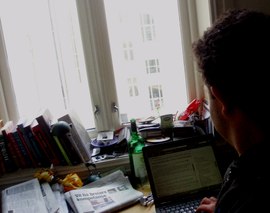
desk It’s a privilege to be an anthropologist on fieldwork. Reading Cicilie’s field blog from Paris and now also Antropyton’s field blog from Nicaragua makes me wonder: Why am I still sitting on my messy desk (picture) in Oslo?

A few weeks ago, Antropyton has arrived in Nicaragua, and has now started blogging about her experiences including her mixed feelings before she left Norway:

I was terrified by where we were supposed to live, by not understanding Nicaraguan Spanish (especially my hosts!), by not having a will to get to know them, by the scorching heat and by all my ideas dying in the shadow of volcanoes! I wasn’t on cloud nine at that time. Frankly speaking, excitement that was accompanying me for so long, disappeared as if by magic.

But then in Latin-America, everything changed:

Once I landed in San Jose in Costa Rica, I did realize that reading anthropology is something totally different than DOING anthropology.
(…)
I knew at once that this was going to be hard. But I was excited. Still, I had the will to conquer the world and carry out what I had planned the last few months. The world was new and beautiful and waiting for me.
(…)
It’s much better now, as one could suppose. I’ve started classes and tamed the city. Usually I don’t need much time to adapt myself to new environments. Albert Camus has a point in one of his essays (…) Like me, after a night in a hotel, the next morning he goes out on the street and click! you feel at home.

>> read the whole entry “Bienvenido”

Her most recent entry is about Nicaraguan conference culture:

The event was inaugurated with a national anthem, something that gave a dignity to the event. And the opening words seemed to go on endlessly. Every member of the organizing committee was welcomed and mentioned by name, academic title, organisations and institutions one belongs to and a post one has.

(…)

Every presentations was followed by a discussion that almost always ended with talk about politics, the new government and changes in policy that are essential to improve the health condition for the people. (…)What I observed was that presentations from Sweden (the conference was organized in cooperation with Lund University) were more “society friendly”. I mean that they presented not only results from their research, but also suggestions for how to apply this knowledge into society.

>> read the whole post ” III Conference on Multidisciplinary Environmental Research, Managua”

Also take a look at her pictures of volcano Cerro Negro and her new hometown Leon.

UPDATE (14.2.07): What happened? In her newest post she asks us Do we need/have to like our informants?

SEE ALSO:

New blog: Blogging anthropological fieldwork in Brazil

Open Source Fieldwork! Show how you work!

Paper by Erkan Saka: Blogging as a Research Tool for Ethnographic Fieldwork

Fieldwork in Papua New Guinea: Who are the exotic others?

On fieldwork: “Blogging sharpens the attention”

Fieldwork as cab-driver: “An amazing other world”

desk

It's a privilege to be an anthropologist on fieldwork. Reading Cicilie's field blog from Paris and now also Antropyton's field blog from Nicaragua makes me wonder: Why am I still sitting on my messy desk (picture) in Oslo?

A few weeks…

Read more